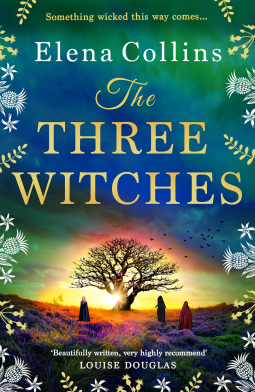
The Three Witches by Elena Collins

I’ve read other novels inspired by Shakespeare’s Macbeth, but this is the first one that has focused specifically on the characters of the three witches. Although Shakespeare’s witches aren’t thought to have been based on any individual people (he took the idea from Holinshed’s Chronicles which refers to the ‘Weird Sisters’ or ‘nymphs or fairies’), Elena Collins imagines them here as three young women growing up in 11th century Scotland. They are the daughters of Sidheag, a wise woman or healer, and their names are Isobel, Ysenda and Merraid.

In modern day Bristol, Ruthie Reed is attending an audition for a new documentary about Macbeth and the historical Mac Bethad mac Findláech, King of Alba (Scotland), on whom the play is based. Acting is all Ruthie has ever wanted to do, but her career seems to be going nowhere and she’s desperate for a decent role. When she’s offered the part of one of the three witches in the documentary, she hopes this is the opportunity she’s been waiting for and will lead to bigger things. On arriving at Forres in the north of Scotland, however, things don’t go quite according to plan. The cast and crew are plagued with bad luck and disaster – and then Ruthie herself starts to catch glimpses of a mysterious young woman who seems to provide a link between past and present.

Ruthie’s story alternates with the story of Isobel and her sisters, left alone in the world after their mother’s death. Isobel, the youngest, has inherited her skills with herbs and potions, as well as her ability to see the future in the flames of the fire, but in a world where women who are different are viewed with suspicion, these talents could be a curse rather than a blessing. When Isobel falls in love with Lulach, Mac Bethad’s stepson, she believes she has found the security she needs, but Lulach’s mother, Gruoch, has other ideas…

As with most dual time period novels, there was one narrative that I enjoyed more than the other, and in this case it was the historical one. I liked the way the focus was on the fictional characters of Isobel, Ysenda and Merraid and their daily lives in the village rather than on the real historical figures such as Mac Bethad and Gruoch, who appear only occasionally. It was easy to see where Isobel’s story was heading, particularly as we get a hint of it in the prologue, but that didn’t make it any less impactful. Although widespread witch trials and burnings peaked in Scotland in the 16th and 17th centuries, women were obviously being accused of witchcraft much earlier than that, so it’s not impossible that the historical Macbeth could have met women like Isobel and her two sisters – and this is something Ruthie and her friends in the modern day narrative begin to research, believing that the witches (both in the play and in history) deserve to be given more attention after centuries of being interpreted through the lens of misogyny.

I liked Ruthie and enjoyed following the filming of the documentary, but it did feel that her storyline was there mainly to add more context to the historical one and I didn’t become quite as invested in her chapters as I did in Isobel’s. The supernatural element of the book is well done – although it’s not a time travel or timeslip novel, there are moments where past and present seem to merge – but I wasn’t convinced that everyone else would have been so ready to believe Ruthie when she told them what she’d been experiencing! There’s also a romance for Ruthie which seemed to happen very suddenly and not with the person I’d expected it would be with.

Overall, I found this an interesting, engaging read. It’s the first I’ve read by Elena Collins, so I’m looking forward to reading some of her other books.

Thanks to Boldwood Books for providing a copy of this book for review via NetGalley.

Fair Rosaline by Natasha Solomons

Is Rosaline, whom thou didst love so dear,
So soon forsaken? young men’s love then lies
Not truly in their hearts, but in their eyes.

If you’ve read or seen Shakespeare’s Romeo and Juliet, you’ll remember Rosaline as the girl Romeo was infatuated with before meeting and falling in love with Juliet. We never actually meet Rosaline in the text of the play but her role is still important because she is the reason why Romeo attends the Capulet ball where he sees Juliet for the first time. In Natasha Solomons’ new novel, she gives Rosaline a voice of her own and tells the story of her relationship with Romeo Montague.

Rather than a simple retelling of Romeo and Juliet, Fair Rosaline is what the publisher has described as a ‘subversive, powerful untelling’. It wasn’t really what I had been expecting and I was quite surprised by the way Solomons chose to approach this novel.

First of all, as Shakespeare provides us with almost no information on Rosaline’s appearance and personality, Solomons has taken inspiration from some of his other characters with a similar name – Rosalind in As You Like It and Rosaline in Love’s Labour’s Lost – so that the woman we meet at the beginning of Fair Rosaline is a fully formed character. We join her just after the death of her mother, Emelia Capulet, when her father informs her that she is going to be sent to a nunnery. The horrified Rosaline suspects that he just wants to avoid having to pay a dowry if she marries, but he insists that it was actually her mother’s dying wish.

Granted a twelve day reprieve before being sent to join the nuns, Rosaline is determined to make the most of her last days of freedom. When she meets Romeo Montague and falls in love, she begins to hope that there’s still a chance of a happier future – until she makes a shocking discovery about him and breaks off their relationship. However, it seems that Romeo has turned his attentions to her younger, more vulnerable cousin Juliet. Can Rosaline save Juliet or will she be unable to prevent things from ending in tragedy?

I’ve always loved Romeo and Juliet – it contains some of the most beautiful language in all of Shakespeare’s work – and I’ve never questioned its position as one of the greatest tragic love stories of all time. Fair Rosaline, though, looks at the play through a completely different lens. Here, Romeo is not a romantic hero but a villain, a sexual predator who targets young girls and discards them when he loses interest in them. Solomons uses Juliet’s extreme youth (thirteen in the play) and the fact that Romeo’s exact age is not given, to suggest that he is an older man than we usually assume and to give their relationship a much darker tone than in the play. I think how much you’ll enjoy this book will depend on how much you can accept this new version of Romeo. Personally, I prefer characters in retellings to at least bear some resemblance to the originals and this Romeo didn’t, which was a big problem for me.

I’ve loved some of Natasha Solomons’ previous novels, particularly House of Gold and The Novel in the Viola, so I’m sorry I didn’t enjoy this one more. There were plenty of things I liked, such as the portrayal of Tybalt, who is also quite different from Shakespeare’s depiction – he is still the proud, impetuous and hot-tempered character we know, but seeing him through the eyes of his cousin Rosaline makes him much more sympathetic. I also found the setting interesting; as Solomons explains in her author’s note, there’s no evidence that Shakespeare ever visited Italy so she tried to capture the same feel, writing about Italy as though she had never been there and blending 14th century Verona with the Elizabethan England that would have been familiar to Shakespeare. I just wish she could have found a way to create a story for Rosaline and explore the difficulties facing medieval women without completely destroying Romeo’s character in the process.

Have you read any good retellings of Romeo and Juliet? O, Juliet by Robin Maxwell is another that left me slightly disappointed, so I would be interested in any other recommendations.

Thanks to Manilla Press for providing a copy of this book for review via NetGalley.

This is book 10/20 of my 20 Books of Summer 2023

This is book 32/50 for the 2023 Historical Fiction Reading Challenge.

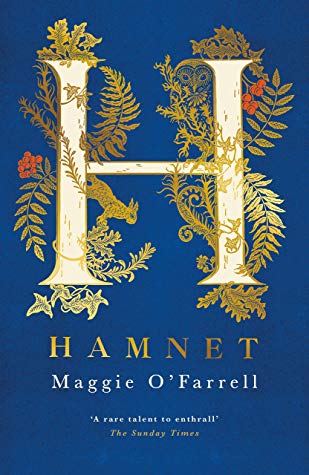
Hamnet by Maggie O’Farrell

Maggie O’Farrell is an author I’ve heard a lot about over the years from other bloggers without ever feeling tempted to read myself, but the subject of her latest novel (the death of William Shakespeare’s son, Hamnet, at the age of eleven), appealed to me and I thought I would give it a try.

Despite the title, the focus of the novel is really Shakespeare’s wife, whom O’Farrell calls Agnes; she is more often known as Anne Hathaway, but Agnes is apparently the name by which her father referred to her in his will. Agnes, as she is depicted here, is an unconventional woman who flies a kestrel, has a knowledge of herbs and healing – and, some say, possesses the powers of second sight. Her husband, in contrast, is less well defined as a character. He is never even given a name; he is always ‘the husband’, ‘the father’ or, sometimes, ‘the Latin tutor’.

The novel begins with Hamnet alone in the empty workshop of his grandfather, a glovemaker, desperately searching for an adult who can help him; his sister Judith is unwell and he doesn’t know what to do. His father is in London and Agnes is away tending her beehives. It is some time later when Agnes returns home and hears the news of Judith’s illness and she will always wonder whether things might have played out differently if she had arrived earlier:

Every life has its kernel, its hub, its epicentre, from which everything flows out, to which everything returns. This moment is the absent mother’s: the boy, the empty house, the deserted yard, the unheard cry…It will lie at her very core, for the rest of her life.

Judith has a disease which appears to be the bubonic plague but we know from the historical records that it is Hamnet who will die. Knowing this in advance doesn’t spoil the story at all because we don’t know exactly when it’s going to happen or under what circumstances or exactly what impact Hamnet’s death is going to have on the people around him; these are things to be decided by the author and explored over the course of the novel. And although many people will be drawn to this book by the Shakespeare connection, I would describe it more as a book about grief and loss. O’Farrell’s portrayals of a grieving mother, a grieving father and grieving siblings – and the differences in the way each of these people handles their grief – are beautifully and poignantly written.

We are also taken back to an earlier time, before Hamnet was even born, when a Latin tutor arrives at the home of a sheep farmer to teach his young sons and becomes captivated with the boys’ half-sister. The tutor, despite not being named, is clearly Shakespeare, and the young woman, of course, is his future wife Agnes. The narrative moves backwards and forwards in time throughout the novel, alternating between the early days of Agnes and Shakespeare’s relationship and the story of Hamnet’s death, which takes place in the summer of 1596.

Although, as I’ve said, the writing is beautiful, the book is written in the third person present tense and that’s something I often dislike. It doesn’t necessarily stop me from enjoying a book (I don’t seem to have a problem with it in Hilary Mantel’s Thomas Cromwell books, for example) but in general I find it distancing and distracting and that was the case here. Another thing I found jarring was O’Farrell’s decision to avoid using Shakespeare’s name. I can understand that the reason for doing so must have been to keep the focus on Agnes and the children and to prevent it from becoming just another novel about Shakespeare, but she goes to such lengths to find alternative ways to describe him that I felt it actually drew attention to him rather than the other way around. This, and the decision to use the name Agnes instead of the more familiar Anne, makes me wonder whether the links to Shakespeare were really necessary at all; I think the story might have worked just as well with entirely fictional characters.

Finally, I want to mention one of the most memorable sections of the book: a detailed and imaginative description of how the plague which takes Hamnet’s life makes its journey from a glassmaker’s workshop in Venice to the faraway Warwickshire town of Stratford-upon-Avon. An aspect of the novel that turned out to be particularly timely and relevant, although O’Farrell couldn’t have known it while she was writing it!

If you enjoy reading historical fiction with a Shakespeare connection, here is a list of other books I’ve read either about or inspired by Shakespeare.

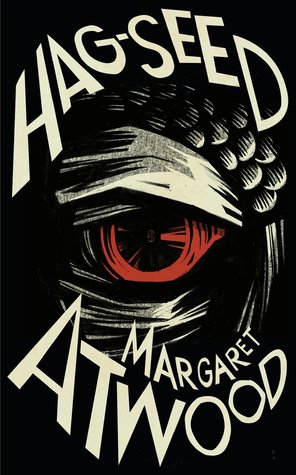
Hag-Seed by Margaret Atwood

This month I’ve been taking part in Nonfiction November, but it’s also Margaret Atwood Reading Month hosted by Naomi at Consumed by Ink and Marcie at BuriedInPrint. I was planning to read one of her longer books – The Blind Assassin or possibly Cat’s Eye, but I found myself running out of time towards the end of the month, so I decided on the much shorter Hag-Seed instead. This book is part of the Hogarth Shakespeare series of retellings of Shakespeare’s plays by modern authors.

Felix Phillips had a successful career as Artistic Director of the Makeshiweg Theatre Festival until his assistant, Tony, betrayed him and took his job. Forced to abandon his plans to stage a contemporary version of The Tempest – a play close to his heart, having recently lost his three-year-old daughter Miranda (who shared her name with Shakespeare’s heroine) – Felix drops out of public life and begins to plot his revenge. Under the name of Mr Duke, he applies for a position at Fletcher Correctional, helping to improve the literacy of the prisoners. Here he will have his chance to direct The Tempest after all, while making his enemies pay for what they have done.

The Tempest is a play that I know quite well, although I wish I’d found time to re-read it before starting Hag-Seed. I’m tempted to do that now, but I think reading them in the opposite order would have been more helpful! I enjoyed watching the prisoners as they study the play for the first time and try to interpret it in their own unique way (could Ariel have been an alien rather than a fairy? Would Shakepeare’s songs be improved by rewriting them as rap?) Personally, when it comes to adaptations of books and plays, I don’t usually like to see things being modernised or given ‘contemporary twists’, but even so it was good to see the Fletcher Correctional Players having so much fun and being so inventive.

Felix plays Prospero, the magician and rightful Duke of Milan, in the prisoners’ production, but he also fills the role of Prospero in the framing narrative. The prison represents the magical island to which Prospero is exiled, while Tony is clearly the equivalent of Prospero’s usurping brother, Antonio. Events in Felix’s life mirror events from The Tempest, coincidentally at the beginning, but then intentionally as he begins to orchestrate his plan for revenge. And of course, even as Felix controls and manipulates the other characters, we know that he is also a character and a prisoner, caught between the pages of Margaret Atwood’s novel, controlled and manipulated by Atwood herself.

Having some familiarity with the play does make it easier to understand and unravel the many layers of Hag-Seed, but if you’re not familiar with it, that shouldn’t be a problem as the whole story is told at various points in the novel, in various different ways (including a full summary at the end of the book). We can learn along with the prisoners as they try to identify the nine types of prison portrayed in the play and as they write an analysis of their chosen character and imagine how his or her story might continue after the play comes to an end. I particularly enjoyed the contributions made by Anne-Marie Greenland, the actress and dancer Felix brings in to play the part of Miranda.

As for the real Miranda – Felix’s daughter who died as a child – the novel is as much about Felix’s feelings for her and his inability to let things go and move on as it is about anything else. Without saying too much, I really liked the way that part of the story was resolved and the way the novel ended.

I must read some of those longer Atwood novels soon – and I would like to try another of the Hogarth Shakespeare books too.

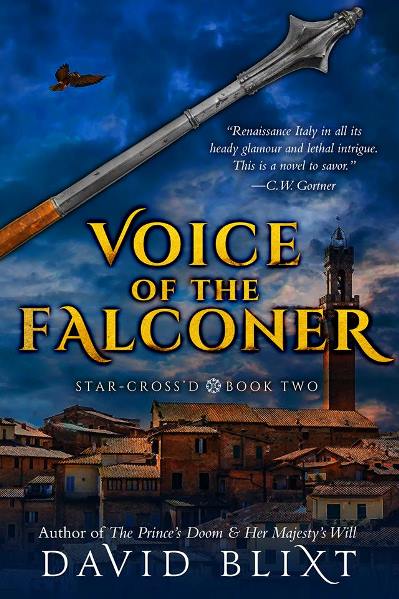
Voice of the Falconer by David Blixt

This is the second volume in David Blixt’s Star Cross’d series, combining the history and politics of 14th century Italy with characters and storylines inspired by Shakespeare. I read the first novel, The Master of Verona, in 2012 and it won a place on my ‘books of the year’ list that year, which gives you an idea of how much I loved it. I really hadn’t meant to let so much time go by before continuing the series, and I worried that I might have trouble picking up the threads of the story again, but as soon as I started to read Voice of the Falconer things fell back into place and I felt as if only five days had passed since reading the first book rather than five years!

Voice of the Falconer opens in 1325, eight years after the events described in The Master of Verona. Pietro Alaghieri, son of the late poet Dante, has been living in exile in Ravenna, entrusted with the guardianship of the illegitimate heir of Cangrande della Scala, the ruler of Verona. The child, Cesco, has already been the target of several assassination attempts so it has been decided that he should be raised in secret, with as few people as possible aware of his location. When news of Cangrande’s death begins to circulate, however, Pietro must hurry back to Verona to ensure that the eleven-year-old Cesco receives his rightful inheritance – but as other members of the della Scala family also have their eyes on the throne of Verona, this won’t be an easy task. And now that Cesco’s existence has been revealed, his life could be in danger again…

Cesco, who was only a baby in the previous novel, has developed into a wonderful character – even if you do need to suspend disbelief to accept that a boy of his age could be so intellectually advanced, quick-witted and talented in every way! I loved the little circle of friends and protectors who surround him, too: Morsicato the doctor, Antonia the nun, Tharwat the Moor and, of course, Pietro himself. The characters in the novel are a mixture of those who are fictitious and those who are based on real historical figures, such as Cangrande and the rest of the Scaligeri family. If you don’t know the history, I would recommend not looking things up until you’ve finished the book; if you just let the story carry you along, there will be one or two surprises in store for you as there were for me.

I won’t say too much more about the plot, then, but I do need to mention another very important aspect of the book…the Shakespearean connection. In The Master of Verona we witnessed the beginnings of a feud between Pietro’s two friends, Mariotto Montecchio and Antonio Capulletto. In this book, we meet Mariotto’s young son Romeo and Antonio’s baby daughter Giulietta (Juliet), as well as Giulietta’s cousin Thibault (Tybalt); obviously there is still a long way to go before the tragedy of the star-cross’d lovers is played out, but the foundations of the story have now been laid. I also had fun spotting other characters from Shakespeare’s plays such as Shalakh (Shylock) from The Merchant of Venice and Petruchio and Kate from The Taming of the Shrew, but if you have no knowledge of Shakespeare I don’t think it would be a problem at all – it’s just another of the novel’s many layers.

In case you can’t tell, I enjoyed this book as much as the first one! I am looking forward to visiting Renaissance Italy again soon with the third in the series, Fortune’s Fool…and certainly won’t be waiting five years this time.

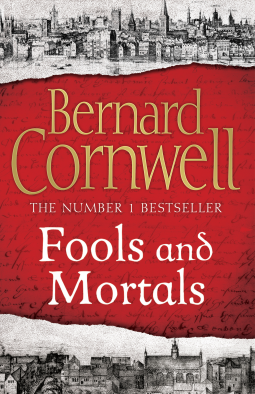
Fools and Mortals by Bernard Cornwell

Despite my love of historical fiction, Bernard Cornwell is not an author I’ve ever really felt like reading. The usual settings and subjects that he writes about don’t appeal to me and although I did once start to read his book on Stonehenge, I didn’t get very far with it before giving up. His latest novel, Fools and Mortals, however, sounded much more like my sort of book, so I thought it was time I gave him another chance.

The title is inspired by Shakespeare’s A Midsummer Night’s Dream (“Lord, what fools these mortals be!”) and it is Shakespeare who is at the heart of the novel – not William, though, but his younger brother, Richard, who has followed him to London in the hope of becoming an actor. I found this slightly confusing, because I remembered from reading Jude Morgan’s The Secret Life of William Shakespeare that it was their other brother, Edmund, who was the actor. I don’t know why Cornwell gave this role to Richard instead; the rest of the background to the novel seems to have been thoroughly researched, so I would be interested to know whether that was a deliberate decision rather than a mistake.

Anyway, Richard Shakespeare is our narrator. The novel opens in 1595 just as The Lord Chamberlain’s Men – the acting company to which both Richard and William belong – are beginning rehearsals for A Midsummer Night’s Dream. Until now, Richard, like several of the other young men in the company, has been given only women’s parts to play. He wants nothing more than to play a man for a change, but it seems that his brother is still determined not to take him seriously as an actor. There are other companies, of course, and other theatres, and Richard receives a tempting offer from Francis Langley of the newly constructed Swan in Southwark. However, this will depend on whether or not he is prepared to steal two of William’s new plays. Will Richard betray his brother and leave The Lord Chamberlain’s Men – or can he find another way to earn William’s respect and win the bigger, better roles he believes he deserves?

I enjoyed this book much more than I’d expected to! I imagine that battle and military scenes probably form a big part of most of Cornwell’s other books, but there was nothing like that in this one, which is set entirely in the world of the Elizabethan theatre. There is still plenty of action, but it takes the form of the attempts of other companies to steal Shakespeare’s plays and the efforts of the Pursuivants to find evidence of heresy and close the playhouses down. As the narrator, Richard is involved in all the drama, both on stage and off, and tells his story in a lively, humorous style. He has his flaws but is a likeable character – although I should warn you that William is not!

The other members of The Lord Chamberlain’s Men are also brought to life, from well known figures of the period such as the comic actor Will Kemp to those who are purely fictional. It was fascinating to see A Midsummer Night’s Dream take shape starting with the earliest stages – the allocation of parts to actors and the learning of lines – to rehearsals at the home of their patron, Lord Hunsdon, and then the final performance (I loved the hilarious description of the Pyramus and Thisbe play-within-a-play). However, I couldn’t help feeling that this all became very repetitive; I felt that the entire plot of the play had been described in detail a hundred times by the time I reached the end of the novel!

The book finishes with an author’s note from Cornwell; this is long and detailed, describing his interest in Shakespeare’s work and discussing the history behind London’s playhouses. Surprisingly, he doesn’t talk about Richard Shakespeare himself or why he was chosen to be the central character in the novel.

It would be nice to think that I would find the rest of Cornwell’s books as entertaining as this one, but I’m still not sure that any of the others would really be to my taste. I do have a copy of The Last Kingdom which I acquired when it was free for Kindle a while ago, so I will try it at some point and will be happy to be proved wrong!

Thanks to HarperCollins for providing a copy of this book for review via NetGalley.
Hamlet, Revenge! by Michael Innes

My first experience of Michael Innes’ writing came earlier this year when I read one of his short stories in the British Library Crime Classics anthology, Miraculous Mysteries. I knew I wanted to read more of his work, so I was was delighted to have an opportunity to read Hamlet, Revenge! via NetGalley.

Published in 1937, this is the second in his series of detective novels featuring Inspector John Appleby. However, Appleby doesn’t appear until the second section of the novel – the first part is devoted to setting the scene and introducing the very large cast of characters. As with many Golden Age mysteries, the action takes place in an English country house – in this case, Scamnum Court, which has been home to the Dukes of Horton for centuries. The novel opens with friends and acquaintances of the family beginning to arrive at Scamnum to take part in an amateur production of Shakespeare’s Hamlet. When one of the guests is murdered during the performance, Appleby is called in to investigate.

This is a wonderfully complex mystery, even more so because Appleby doesn’t know exactly what type of crime has been committed. The murdered man was an important statesman whose death could have serious implications for the government, giving rise to fears that spies are operating at Scamnum Court. On the other hand, a series of revenge-themed messages received by the victim and several other guests indicate that this could be a crime of a more personal nature.

Mild curiosity ran round the table.

‘Yes. I had a telegram at the House just before coming down here. Just two words.’

This time Lord Auldearn spoke: ‘Two words?’

‘Hamlet, revenge!’

With a long list of potential suspects – we are told that there are more than thirty people involved in the play in some way – Appleby is kept busy trying to establish alibis and uncover motives, while avoiding the red herrings that are thrown in his way.

After a slightly overwhelming start (due to the number of characters and the detailed background information on Scamnum Court), once Appleby arrives on the scene and begins his inquiries the pace picks up and the story becomes quite gripping. It’s the sort of mystery I love: one with plenty of clues and several possible solutions – although of course only one is correct, and we have to wait until the end of the novel before everything is revealed. It’s also a very erudite and literary mystery; as well as lots of discussion and analysis of Hamlet, there are also a number of other literary allusions and references. If you know your Shakespeare you will probably get more out of the novel, but if not, don’t worry as it isn’t completely essential.

Although this is described as an Appleby novel, much of the story is actually written from the perspective of one of the other characters, Giles Gott, an academic who also writes crime novels under a pseudonym. As Michael Innes himself is a pseudonym (he also wrote using his real name of J.I.M. Stewart), I wondered whether Gott was a way for Innes to project some of his own personality into the story. There seems to be a previous friendship between the characters of Appleby and Gott, whom I have found out also appears in the first book in the series which I haven’t read yet; I don’t know whether he is in any of the others.

I really enjoyed Hamlet, Revenge! and am looking forward to reading more by Michael Innes.

This is book #1 for the R.I.P XII challenge.