My Classics Club Spin book is…

Number 20!

The Classics Club

Last week I decided to take part in the fifth Classics Club Spin. The rules were simple – list twenty books from your Classics Club list, number them 1 to 20, and the number announced today (Monday) represents the book you have to read during February and March.

The number that has been selected is 20, which means the book I’ll be reading is:

Can You Forgive Her

Can You Forgive Her? by Anthony Trollope

I’m not sure how I feel about this…it’s not one of the titles on my list that I was hoping for, but I wasn’t dreading it either. This is the first of Trollope’s Palliser novels and my copy has been on my shelf unread for three or four years, waiting for me to finish the Barsetshire series. I read the last of the six Barsetshire novels last year so I now have no excuse not to read this one!

If you participated in the spin are you happy with your result?

The Classics Club Spin #5

The Classics Club

The Classics Club Spin is back for the fifth time! I have been lucky with my last three Spin books (Aurora Floyd, Cold Comfort Farm and A Tale of Two Cities) so I’m hoping another great book will be chosen for me again.

Here are the rules:

* List any twenty books you have left to read from your Classics Club list.
* Number them from 1 to 20.
* Next Monday the Classics Club will announce a number.
* This is the book you need to read during February and March!

And here is my Spin List:

1. The House of Mirth by Edith Wharton
2. The Heart of Midlothian by Sir Walter Scott
3. David Copperfield by Charles Dickens
4. The Mill on the Floss by George Eliot
5. The Remains of the Day by Kazuo Ishiguro
6. The Idiot by Fyodor Dostoyevsky
7. Vanity Fair by William Makepeace Thackeray
8. Family Roundabout by Richmal Crompton
9. Excellent Women by Barbara Pym
10. East of Eden by John Steinbeck
11. Howards End by E.M. Forster
12. Cranford by Elizabeth Gaskell
13. A Country Doctor’s Notebook by Mikhail Bulgakov
14. The Heir of Redclyffe by Charlotte M. Yonge
15. Frenchman’s Creek by Daphne du Maurier
16. Germinal by Emile Zola
17. The Sea Hawk by Rafael Sabatini
18. The Mayor of Casterbridge by Thomas Hardy
19. The Vicomte de Bragelonne by Alexandre Dumas
20. Can You Forgive Her? by Anthony Trollope

Now I just need to wait until Monday to find out what I’ll be reading. Which numbers do you think I should be hoping for?

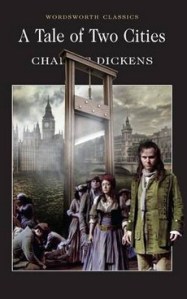
A Tale of Two Cities by Charles Dickens

A Tale of Two Cities When I decided to take part in the Classics Club Spin last month, in which a book would be chosen for me from a list of twenty, A Tale of Two Cities was not one of the titles I was hoping would be picked. I have to be in the right mood to want to read Dickens and I wasn’t really in that mood. Expecting it to be a long and boring read, I thought it would be a good idea to start immediately so that I would have a chance of being finished by the end of December…

I actually finished it within a week and despite my lack of enthusiasm when the spin number was announced, A Tale of Two Cities is one of the best books I’ve read this year!

The novel is set before and during the French Revolution; Paris and London are the two cities of the title. The story begins with Doctor Manette being released from the Bastille after eighteen years as a political prisoner. Reunited with his daughter, Lucie, and returning with her to England, the lives of the Manettes become entwined with the lives of two young men who are both in love with Lucie. One of these is Charles Darnay, a former French aristocrat, and the other is Sydney Carton, an English lawyer. We follow these characters and others as they return to France where they become caught up in the dramatic events of the French Revolution – and the scheming of wine shop owner, Monsieur Defarge, and his sinister wife, who is never seen without her knitting!

This is the sixth Dickens novel I’ve read and my favourite so far. I find it interesting that everyone who reads Dickens has different favourites and least favourites; there doesn’t seem to be one book that is universally regarded as his best. I think part of the reason I loved this book so much was that in many ways it was very different from the others I’ve read but I know that some readers will probably dislike it for that same reason, so it’s really a matter of personal opinion.

One of the things that struck me about this book was the absence of humour, in comparison to the other Dickens novels I’ve read – and as Dickens and I don’t usually share the same sense of humour, this was definitely a positive thing for me! Of course, the French Revolution is a serious subject, so the more serious tone of the writing was quite appropriate. I also thought the characters felt more realistic and well-rounded than usual (if there is a comedy character in the novel, it’s probably Jerry Cruncher). My favourite character, which probably won’t surprise anyone else who has read this book, was Sydney Carton – although I didn’t fall in love with him until the last few chapters. I hadn’t guessed when we first met him that he would turn out to be so heroic and self-sacrificing.

I was also impressed by how tightly plotted the book is. The focus stays firmly on the main storyline which makes it easy to follow, unlike Bleak House or Our Mutual Friend which have more complex structures with lots of subplots and lots of long descriptive passages. In A Tale of Two Cities, everything feels relevant and helps to move the story forward. The novel begins with some of the most famous lines in literature (It was the best of times, it was the worst of times…) and closes with some that are almost as well known (It is a far, far better thing that I do, than I have ever done; it is a far, far better rest that I go to than I have ever known). I’ve seen those final lines quoted many times before but out of context they didn’t mean much to me; now that I know who and what they refer to they have much more significance. I don’t want to say too much and spoil the story for anyone who hasn’t read it yet, but the ending is heartbreaking. This is the first Dickens novel that has made me cry!

The Classics Club spin was a success for me this time, then. I do have some other Dickens novels on my Classics Club list and feel much happier about reading them now!
It was the best of times, it was the worst of times…

The Classics Club

The result of the Classics Club Spin has been announced today! The Spin number is…

Number 10!

This means I have to read the book at number 10 on the list I posted last week.

A Tale of Two Cities

A Tale of Two Cities by Charles Dickens

This is not one of the books I was hoping would be chosen, but I’m happy enough with this result as it’s been a while since I last read anything by Dickens.

Have you read it? What did you think of it?

If you participated too, I hope the Spin has selected something you’ll love!

Time for another Classics Club Spin!

The Classics Club

This is the fourth Spin hosted by the Classics Club this year. I didn’t take part in the last one but enjoyed the previous two so I’ve decided to join in again with this one.

Here are the rules:

* List any twenty books you have left to read from your Classics Club list.
* Number them from 1 to 20.
* Next Monday a number will be chosen.
* This is the book you need to read in November and December!

And here is my Spin List:

In the past I’ve tried to be creative and divide my list into categories. This time it’s less complicated; the odd numbers are books I’m looking forward to reading and the even numbers are books that I do want to read but have been putting off either because of the length or because they don’t appeal to me as much as they did when I first added them to my Classics Club list last year.

Obviously I would prefer an odd number but I’ll be happy to read whatever the Spin chooses for me!

1. The Mayor of Casterbridge by Thomas Hardy
2. Can You Forgive Her? by Anthony Trollope
3. Frenchman’s Creek by Daphne du Maurier
4. Vanity Fair by William Makepeace Thackeray
5. Family Roundabout by Richmal Crompton
6. East of Eden by John Steinbeck
7. The Sea Hawk by Rafael Sabatini
8. The Mill on the Floss by George Eliot
9. The Remains of the Day by Kazuo Ishiguro
10. A Tale of Two Cities by Charles Dickens
11. A Country Doctor’s Notebook by Mikhail Bulgakov
12. Wuthering Heights by Emily Bronte (re-read)
13. Excellent Women by Barbara Pym
14. Crime and Punishment by Fyodor Dostoevsky
15. The Vicomte de Bragelonne by Alexandre Dumas
16. The Heart of Midlothian by Sir Walter Scott
17. Idle Thoughts of an Idle Fellow by Jerome K. Jerome
18. The Charterhouse of Parma by Stendhal
19. The Heir of Redclyffe by Charlotte M. Yonge
20. The Hunchback of Notre Dame by Victor Hugo

Now I just need to wait until Monday to find out what I’ll be reading!

Have you read any of these? Which numbers should I be hoping for or dreading?

Classics Club August Meme: Forewords and Notes

The Classics Club

I haven’t taken part in the Classics Club Meme for a while, but August’s topic is one I feel quite strongly about! This month’s question is:

Do you read forewords/notes that precede many classics? Does it help you or hurt you in your enjoyment/understanding of the work?

I do sometimes read the forewords and notes but I’ve learned from experience to read them at the end rather than the beginning! I’ve never understood why so many publishers think it’s acceptable to give away the entire plot of a novel in the introduction just because it’s a classic. It’s true that many classics have become such a big part of popular culture that most of already know what happens, but that’s not always the case and I hate to think of anyone unsuspectingly reading the introduction first and having the story completely spoiled for them. When I read the Penguin English Library edition of Far from the Madding Crowd recently, I was pleased to find that the ‘introduction’ had been placed at the end of the book as an afterword instead of at the front. I think it would be nice if all publishers could either do the same or at least print a spoiler warning at the beginning the way Wordsworth Classics do.

Personally I like to go into a book knowing as little as possible about the plot and whether it’s a classic or a contemporary novel makes no difference. I might go back to read the introduction after I’ve finished the book, though not always as sometimes I either forget or decide that I’m happy with my understanding of the book and am ready to move straight on to another one. I read classics simply because I enjoy them so I’m not necessarily interested in analysing every little detail. I like to read the information on the author and their life, if any is given, or information that places the story into historical context, but apart from that I don’t usually find the introduction particularly helpful and prefer to interpret a book the way I want to interpret it.

What are your opinions on forewords? Do you like to read them or not?

And the Classics Club Spin number is…

Number 6!

classicsclub

Last week I decided to take part in the Classics Club Spin. The rules were simple – list twenty books from your Classics Club list, number them 1 to 20, and the number announced today (Monday) represents the book you have to read during May and June.

The book at #6 on my list is:

Cold Comfort Farm

Cold Comfort Farm by Stella Gibbons

There were other books on my list that I was looking forward to more, but I’m quite happy with this one, I think. I haven’t read anything by Stella Gibbons yet and have been wanting to for years!

Have you read it? Did you enjoy it?

If you participated too, I hope the Spin has selected a great book for you.