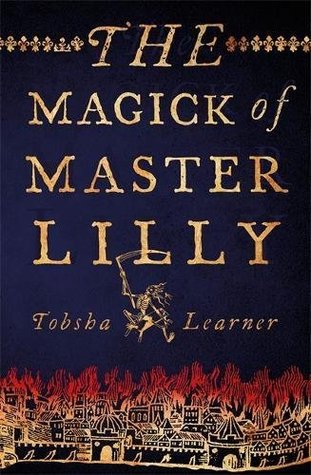
 Although I have read a lot of books set in 17th century England, I can’t remember ever reading anything about the astrologer William Lilly so I was immediately intrigued by the title and premise of Tobsha Learner’s new novel which promised to bring Lilly’s story to life.
We first meet Master Lilly in 1641, living quietly in the Surrey countryside after finding himself out of favour with Parliament. Even in exile, though, he is still famous for his knowledge of the occult and his skill at reading fortunes, and it’s not long before he is summoned back to London to draw up an horary (a form of horoscope) for Charles I. As Master Lilly looks to the future to discover what fate has in store for his King and his country, he sees only war, fire and plague on the horizon. He and his fellow ‘Cunning Folk’ will need to use all the magical powers they possess if they are to avert disaster – but is it really possible to change what is written in the stars? Master Lilly thinks it is:
We are all born with our Fates written like maps across the cosmos, but our faith and humanity give us choice. This is what I, William Lilly, believe: the Stars incline, they do not compel, and it is up to us mortals to know when to play our hand and when to fold.
The Magick of Master Lilly had the potential to be a good book, and in some ways it was. As I’ve said, I knew nothing about William Lilly before I started reading, so it was nice to be introduced to him and to learn about his life and work (the author includes some notes at the end to give some indication of what is based on fact and what isn’t). Whether you believe that some people can really see into the future or not, it seems that Lilly, among his other achievements, quite accurately predicted the Great Fire of London. He is also a healer and herbalist, and a writer of astrological texts and almanacs, although his day to day work, as he explains in the first chapter of the novel, consists mainly of “horaries, Natal figures, seduction of reluctant lovers, the finding of lost things, and the location of errant husbands”.
Lilly is not always the most likeable of characters, particularly where his relationship with his wife, Jane, is concerned, but despite this his narration is warm and lively, pulling us into his story. The tone of the novel reminded me of Rose Tremain’s Restoration and Anna-Marie Crowhurst’s The Illumination of Ursula Flight. I could have done without the long, in-depth descriptions of every horoscope Lilly casts, though! I found myself skimming through those sections as I was much more interested in Lilly himself – his interactions with people at court; his meetings with other magicians; his romance with the (fictional) Magdalene de Morisset – than in the intricate details of his work.
My biggest problem with this book was the language. I’m usually the first to complain when the language used in historical fiction is too modern, but sometimes when the author attempts to write in a style appropriate to the period it can be just as distracting and I felt that was the case here. The word ‘hath’, for example, was used in place of ‘have’, but not consistently and not always when it made grammatical sense within the sentence. Modern words and phrases are used alongside the archaic ones, which just felt wrong to me. Also, Lilly often talks about his wife being a Quaker, a term which wasn’t used until the end of the English Civil War.
Just little things, but there were a lot of them, and they meant that I didn’t enjoy this book as much as I’d hoped to. Still, I was pleased to make Master Lilly’s acquaintance. I do love reading about this period of history and with appearances from characters such as the Witchfinder General Matthew Hopkins and the female painter Artemisia Gentileschi, this was still an interesting read at times.
Thanks to Little, Brown Book Group for providing a copy of this book for review via NetGalley.
 She Reads Novels