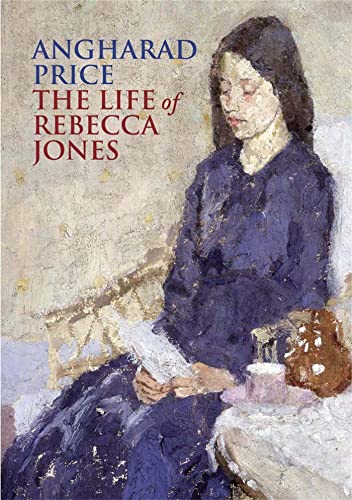
The Life of Rebecca Jones by Angharad Price – #Dewithon24

Translated by Lloyd Jones

I’m aiming to read more books in translation this year so when I started considering possible options for Reading Wales, also known as #Dewithon, hosted this month by Paula at Book Jotter, it seemed like a good opportunity to read something translated from the Welsh language. Eventually I decided on The Life of Rebecca Jones by Angharad Price, first published as O! Tyn y Gorchudd (“oh, pull aside the veil”), in 2002 and translated into English by Lloyd Jones in 2010. It has been listed as one of the top 25 Greatest Welsh Novels by the Wales Art Review (a good resource if you’re looking for Welsh reading ideas).

The novel is a fictional biography, spanning almost the whole of the twentieth century, and is narrated by Rebecca Jones, who looks back on her life in the small rural community of Maesglasau. Beginning with the arrival of her newly wed parents at Tynybraich farm, followed quickly by the birth of Rebecca herself in 1905, she takes us through her entire life, comparing the twists and turns it takes to the path of the stream that flows through the Maesglasau Valley:

“Memories of my childhood reach me in a continuous flow: smells and tastes converging in a surging current. And just like the stream at Maesglasau, these recollections are a product of the landscape in our part of rural mid-Wales at the beginning of the twentieth century. Its familiar bubbling comforts me.
It was not really like that, of course. The flow was halted frequently. Indeed a stream is not the best metaphor for life’s regular flow between one dam and the next.”

Rebecca’s story is not a particularly dramatic or exciting one and is structured as a simple, linear chronicling of events, yet I found it very moving and compelling. As the novel progresses, Rebecca tells us about her daily life on the farm and the different roles performed by men and women, she describes the beautiful landscape and the changing seasons, and looks at some of the customs and traditions of the Maesglasau people. All of this is interspersed with the poetry of Hugh Jones, who was born in Dinas Mawddwy in the 18th century and wrote the hymn that inspired the Welsh title of the novel.

Rebecca is not the only child in the Tynybraich household; she has several younger brothers and sisters, some of whom die in infancy. Three of the brothers – Gruffudd, William and Lewis – are either born blind or become blind later in childhood (is it worse to have never seen the beauty of the world or to have glimpsed it and had it taken away?) and are all sent away to a boarding school for blind children. The education they receive leads to opportunities they would never have had at home in their Welsh valley and while Rebecca is proud of their remarkable achievements she also feels that her brothers’ ties to their own history, culture and language have been broken. This is a pattern she sees repeated in the wider community as the years go by and more and more young people are choosing to leave Maesglasau and make their homes elsewhere. Meanwhile, for those who remain, further changes are brought by modern technology, new ideas, and a greater movement of English people crossing the border into Wales.

When I first started to read, I wasn’t quite sure whether Rebecca and her family were real people or fictional ones, although the book does include photographs and feels historically authentic. I was quickly able to discover that the family at Tynybraich did indeed exist and are ancestors of Angharad Price. There was even a documentary filmed in the 1960s about the three blind brothers. However, not everything Price tells us about Rebecca’s life is the truth, for reasons only explained once we reach the end of the book. That ending was both surprising and perfect.

Have you read this book or are there any others written in the Welsh language that you can recommend?

Book 9/50 for the Historical Fiction Reading Challenge 2024

Silence by Shūsaku Endō

Translated by William Johnston

One of my resolutions for 2024 is to read more historical fiction in translation and where better to start than with a book for the Japanese Literature Challenge (hosted by Dolce Bellezza throughout January and February).

First published in Japanese in 1966 and in English in 1969, Shūsaku Endō’s Silence is set in the 17th century and tells the story of a Portuguese Jesuit priest, Sebastian Rodrigues, who travels to Japan to investigate claims that his old mentor, Father Ferreira, has committed apostasy – in other words, renounced his faith. Rodrigues and his friend Francisco Garrpe, another priest, can’t believe that their teacher would do such a thing. Certain that there must be some mistake, the two set out from Lisbon on the long journey to Japan, where they hope to learn what has really happened to Ferreira.

Rodrigues and Garrpe reach Japan in 1639 and quickly discover that the local Christian communities are being persecuted and forced to hide their religion from the authorities. Anyone the officials suspect of being a Christian is told to trample on an image of Christ, known as a fumie, and if they refuse they are imprisoned and tortured by being suspended upside down over a pit. On his arrival in Japan, Rodrigues goes into hiding with the other Christians, carrying out his missionary work and helping them to worship in secret, but he knows it’s only a matter of time before he is caught and has his own faith put to the test.

Silence is both beautifully written and beautifully translated. From beginning to end, I was completely immersed in another time and place; there’s no jarringly modern language to pull the reader out of the story and everything feels authentic and real. I was intrigued by Endō’s decision to write the novel from the perspective of Rodrigues (first in the form of letters written by the priest and then in the third person) rather than the Japanese Christians and it was interesting to see how Endō viewed his country, its people and its customs through the eyes of a stranger.

I am not a particularly religious person but you don’t need to be to be able to appreciate this novel. I was very moved by the internal struggles Rodrigues faces as he begins to question why God is remaining silent in the midst of so much torture and persecution and whether renouncing his faith, under certain circumstances, could actually be the right thing to do if it helps alleviate the suffering of others. As you can imagine, it’s quite a bleak story, but I loved it and although it’s only been a few days since I finished it, I don’t think it’s a book I’ll ever forget. I would like to try more of Endō’s work and am pleased to see that some of his other novels are also available in English translations.

I read this book for the Japanese Literature Challenge 17 and the Historical Fiction Reading Challenge.

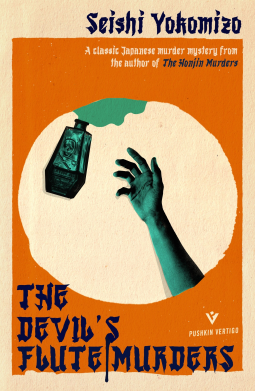
The Devil’s Flute Murders by Seishi Yokomizo (tr. Jim Rion)

The Devil’s Flute Murders, first published in Japanese in 1953, is the fifth of Seishi Yokomizo’s detective novels to be made available in new English translations by Pushkin Press. I’ve now read all five of them and enjoyed some more than others; I think this is one of the best, along with The Inugami Curse and The Honjin Murders.

In this book, set in 1947, Yokomizo’s dishevelled, nervous, stammering detective, Kosuke Kindaichi, is approached by a young woman who wants him to investigate the disappearance of her father, Hidesuke Tsubaki. Tsubaki, who had been a viscount until the recent abolition of the Japanese aristocracy, was found dead in the woods several weeks after leaving his family home, but although his daughter Mineko was the one to identify the body, she now has reason to believe he isn’t dead at all. There have been sightings of a man closely resembling Tsubaki in the grounds of the family estate and sounds of the haunting flute playing for which he was famous in his lifetime.

That evening, Kindaichi is invited to a séance at the Tsubaki home, which has been arranged by the viscount’s widow in the hope of discovering whether her husband is alive or dead. At the end of the event, a recording of Tsubaki’s final composition, The Devil Comes and Plays His Flute, begins to play by itself – and next morning, Kindaichi hears the news that another family member has been found dead in a locked room during the night. Who is responsible for the murder? Is the viscount’s ghost really haunting the family estate? And what is the meaning of the strange symbol found at the scene of the crime?

Yokomizo’s plots are always clever and fascinating and don’t rely quite as heavily on complex puzzle-solving as some of the books I’ve read by other Japanese classic crime authors. Understanding the relationships between the characters, their family secrets and their personalities and motives is just as important as working out how the crimes were committed. I guessed who the culprit was but didn’t know why they did it – I’m not sure if it would have been possible to know until the backstory of each character was revealed, but maybe I missed some clues.

Something else I like about this series is the insight the books offer into life in Japan during the post-WWII years. In The Devil’s Flute Murders the shadow cast by the war is particularly strong. There are mentions of food shortages, problems with electricity supplies and overcrowded, unreliable public transport. The new constitution drafted by the Allies during the occupation of Japan is the reason why Tsubaki and other members of the nobility have lost their titles, while bombed out houses and damage from fire has led to Tsubaki’s extended family all coming to live on the former viscount’s estate, bringing them together in one place for the events of the novel to play out.

This is the first book in the series to be translated by Jim Rion (the others have been translated by Louise Heal Kawai, Bryan Karetnyk and Yumiko Yamazaki). I think all of the translators have done a good job and I haven’t noticed any real differences in quality or readability between the different translations. My only problem with this one came when Kindaichi’s investigations take him from the Tsubaki home in Tokyo to Awaji Island near Kobe in the west and I found the way Rion chooses to write the western accent slightly odd and jarring. Of course, I appreciate how difficult it must be to capture nuances of accent and dialect in a translation!

I’m already looking forward to the next Kindaichi mystery, The Little Sparrow Murders, which is due to be published next May and sounds just as intriguing as the others.

Thanks to Pushkin Vertigo for providing a copy of this book for review via NetGalley.
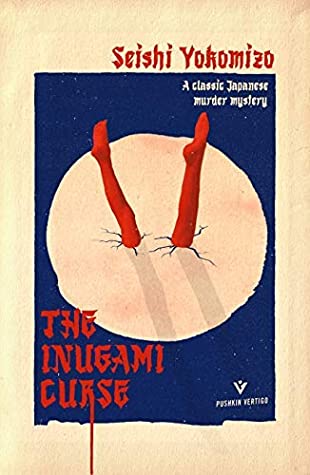
The Inugami Curse by Seishi Yokomizo

Translated by Yumiko Yamazaki

My choice for this year’s Japanese Literature Challenge (hosted by Dolce Bellezza) was easy as I only had one unread Japanese novel on my TBR. The Inugami Curse is one of a series of detective novels by Yokomizo that I’ve been enjoying over the last few years since discovering that they were being released in English translations by Pushkin Vertigo. This book was originally published in 1951 and features the private detective Kosuke Kindaichi. It’s the fourth in the series that I’ve read and one of my favourites – it’s certainly stronger than Death on Gokumon Island and The Village of Eight Graves and maybe even better than The Honjin Murders.

The Inugami Curse is set in the 1940s in post-war Japan. Kosuke Kindaichi, our unassuming, stuttering, head-scratching detective, has been summoned to the lakeside town of Nasu by the lawyer of a wealthy businessman who has recently died. The will is about to be read and the lawyer is afraid that it will cause trouble amongst the heirs. Already one of the young women who is set to benefit has been the target of several suspicious ‘accidents’ and things seem likely to get worse once the full conditions of the will become clear.

The dead man, Sahei, was the head of the Inugami family and as his children, grandchildren and other members of the household gather at the family home for the reading of the will, Kindaichi discovers that Mr Wakabayashi, the lawyer who had requested his presence, has been found dead after smoking a poisoned cigarette. This is only the first of several murders because, as Wakabayashi had predicted, Sahei’s fiendishly clever will sets the family members against each other. But which of them is prepared to kill to get what they think they deserve? There is one obvious suspect – Sahei’s eldest grandson, Kiyo, was repatriated from Burma just a few days earlier and has returned to the Inugami home with his face hidden by a mask, having been severely wounded in the war. Is it really Kiyo behind the mask? Kindaichi is sure that if he can establish the identity of the masked man, he will hold the key to the mystery.

This is a very enjoyable novel and unlike some of the other Japanese mysteries I’ve read, which are excessively puzzle-orientated, this one focuses as much on characters, motives and family secrets as it does on the methods behind the crimes. However, those methods are still very clever. Yokomizo is quite fair with the reader – the clues are there and it’s possible to work out parts of the solution – but I doubt anybody would be able to deduce exactly how each of the murders were committed. I was happy to wait for Kosuke Kindaichi to explain everything at the end! The murders themselves are bizarre and often gruesome – this book is definitely more graphic and more macabre than most British detective novels from that period – but also dramatic and filled with symbolism.

As well as the entertaining plot, the book touches on various aspects of Japanese culture and history, portraying a country in the aftermath of war, with many families like the Inugamis awaiting the repatriation of the Japanese soldiers. There are also descriptions of koto (zither) music and displays of chrysanthemum dolls. With each book in this series I feel I’m learning a little bit more about Japan. I can’t wait to read The Devil’s Flute Murders, another Kindaichi mystery being published in English later this year.

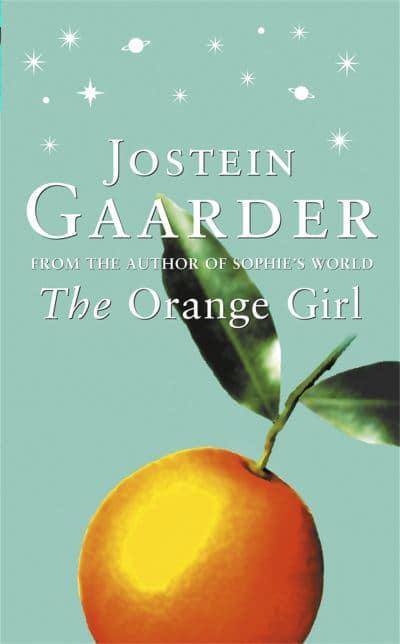
The Orange Girl by Jostein Gaarder (tr. James Anderson) – #NordicFINDS23

What is this great fairytale we live in and which each of us is only permitted to experience for such a short time? Maybe the space telescope will help us to understand more of the nature of this fairytale one day. Perhaps out there, behind the galaxies, lies the answer to what a human being is.

It’s been years since I last read anything by Jostein Gaarder! I loved Sophie’s World and The Solitaire Mystery, which I read around the time they were published in English in the mid-1990s, but although I read a few more of his books after that I found them disappointing in comparison and didn’t explore any of his later work. This month, Annabel is hosting her second Nordic FINDS event, celebrating literature from Finland, Iceland, Norway, Denmark and Sweden, and I thought it would be a good opportunity to try one of the Gaarder novels I never got round to reading.

First published in Norwegian in 2003 and translated into English by James Anderson the following year, The Orange Girl is narrated by Georg Røed, a fifteen-year-old boy whose father, Jan Olav, died eleven years earlier. Georg’s mother has married again and had another child and Georg gets on well enough with both, but he has never stopped wondering about the father he can barely remember. One day, Georg’s grandmother finds a letter written by Jan Olav before his death and addressed to Georg, intended for his son to read when he was old enough to understand it. The Orange Girl includes Jan Olav’s letter in full, interspersed with Georg’s reaction to it and the lessons he learns from it.

In the letter, Jan Olav tells the story of a young woman he meets in Oslo in the 1970s. He comes to think of her as ‘the Orange Girl’ because when he sees her for the first time on a tram, she is wearing an orange dress and carrying a large bag of oranges. When the tram stops, she disappears, leaving Jan Olav desperate to find her again. As the weeks and months go by, he becomes obsessed with tracking down the mysterious Orange Girl and discovering her true identity. Who is she? Why did she need so many oranges? And why is it important for Georg to hear her story so many years later?

On the surface, The Orange Girl is a quick, easy read. Being narrated by a teenage boy, it’s written in simple language (Georg actually feels more like a ten or eleven-year-old than a fifteen-year-old), and like many of Gaarder’s novels, it would be perfect for younger readers. The story of the Orange Girl is entertaining and amusing – particularly when Jan Olav creates a series of imaginary scenarios to explain the huge bag of oranges! I would have liked to have been given a stronger sense of place as Jan Olav follows the girl from Oslo to Seville and back again, but it wasn’t that sort of book; it’s concerned mainly with plot and ideas rather than setting.

However, anyone who has read any of Gaarder’s other books will know that they always contain a philosophical element, and this one is no different. Georg and his father share an interest in the Hubble Space Telescope, which leads to a lot of discussion of the expanding universe and the place of human beings within it. The book also raises the question of whether, if you knew before you were born that you would die early and have all your happiness taken away, would you still choose to be born at all? These are clearly the things Gaarder really wanted to write about here, and the Orange Girl story is just a way of illustrating these philosophical points.

I haven’t been left wanting to immediately search out the rest of Gaarder’s novels, but I did find this one quite enjoyable and am glad I picked it up for Nordic FINDS.

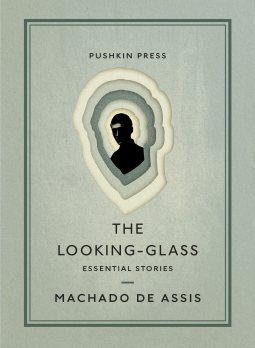
The Looking-Glass by Machado de Assis (tr. Daniel Hahn)

Thanks to the Pushkin Press Essential Stories series I’ve had the opportunity to explore the short stories of Herman Melville (a new author for me) and Fyodor Dostoevsky (an author I’d read before but only in full-length novel form). This latest collection has introduced me to another new author, the Brazilian writer Machado de Assis, who lived from 1839-1908. This book contains ten of his stories, translated from Portuguese into English by Daniel Hahn.

When trying a new author for the first time, you never really know what to expect, but since Joaquim Maria Machado de Assis (usually just referred to by his surnames) is described as one of Brazil’s greatest authors I thought he would surely be worth reading, even if the stories turned out not to be to my taste. Fortunately, I did find most of them quite enjoyable, providing lots of insights into the various sides of human nature. Although the stories were written more than a hundred years ago and on the other side of the world from me, they were still relatable because, of course, human beings aren’t really all that different, no matter where or when they lived.

The longest story in the book, which could probably be considered a novella, is The Alienist, in which Simão Bacamarte, a physician, opens an asylum in the town of Itaguaí. Bacamarte has a genuine interest in the new science of psychology and begins committing patients to the asylum so that he can study their symptoms. However, the numbers being admitted rapidly start to increase as it becomes clear that sane people are being sent there as well. Once most of the population of the town has been locked up and the others begin to rebel, Bacamarte is forced to reconsider his criteria for deciding who is sane and who is not, with surprising results!

Another story, The Stick, follows the story of Damião, a young man who escapes from a seminary and is afraid to return home because he’s convinced his father will send him back. Instead, he seeks the help of Rita, his godfather’s lover, who lets him stay in her house until the situation is resolved. Rita is a teacher of lacework and embroidery and has several young girls working for her. Damião discovers that one of them, a black slave called Lucrécia, is being badly treated and he must decide whether to intervene. I found this story interesting because Machado himself was the mixed-race grandson of freed slaves – and slavery was not abolished in Brazil until 1888.

Apart from The Canon, which describes a noun and an adjective searching for each other inside a man’s brain (too bizarre for me), I found most of the other stories intriguing in different ways. The Fortune-Teller, The Tale of the Cabriolet and Midnight Mass were some I particularly enjoyed. However, although I don’t usually include ‘trigger warnings’ in my reviews, I should mention that in The Secret Cause there are some graphic descriptions of animal cruelty which aren’t very pleasant to read!

At the end of the book, I was interested to read Daniel Hahn’s note on the translation where he explains why he deliberately tried to retain the 19th century feel of the original writing, even though this wasn’t necessarily the easiest option for a translator. I think this was the right decision – it worked for me and I found this collection a good introduction to the work of Machado de Assis.

Thanks to Pushkin Press for providing a copy of this book for review via NetGalley.

Nights of Plague by Orhan Pamuk (tr. Ekin Oklap)

This is the first book I’ve read by Turkish author Orhan Pamuk, who won the Nobel Prize in Literature in 2006. It sounded fascinating – a murder mystery set on a fictional Mediterranean island during an outbreak of plague at the turn of the 20th century. However, it wasn’t quite what I was expecting!

It would be easy to assume that this was a book written in response to the Covid pandemic (I certainly did), but it seems that Pamuk actually started work on Nights of Plague in 2016. Obviously now that we’ve all had experience of living through a pandemic, that element of the novel has taken on new relevance, but it’s made clear that the illness described in the book is a form of bubonic plague rather than a respiratory virus like Covid, so the causes, symptoms, methods of transmission and outcomes are very different. On the other hand, there are also lots of parallels – in 1901, just like in 2020, with no vaccine available the only way to really tackle the progress of the disease is through quarantine and isolation. People protest against the restrictions, members of government break their own rules, and while the crisis brings some communities together it creates division in others.

The fictional island at the heart of all of this is Mingheria, an outpost of the Ottoman Empire with a population made up of both Turkish Muslims and Greek Christians. The governor, Sami Pasha, is doing his best to implement quarantine measures on the island but they are having little effect and he is being held back by having to wait for official orders from the Sultan in Istanbul. As the novel opens, a ship is on its way to Mingheria from Istanbul carrying the Sultan’s niece Princess Pakize, her husband Doctor Nuri, and the Royal Chemist, Bonkowski Pasha. Bonkowski’s job is to investigate the outbreak of plague, but before he is able to draw any conclusions he is murdered.

With Bonkowski Pasha dead, it’s now up to Doctor Nuri to give advice on quarantine arrangements, while also looking into the circumstances of the chemist’s murder. The Sultan, who has become a fan of Sir Arthur Conan Doyle, sends instructions that he must use ‘the methods of Sherlock Holmes’. There’s the basis of an exciting story here – yet the mystery element is virtually abandoned until much later in the novel and even when we return to it, it turns out not to be all that exciting after all. Much more time is spent describing the plague and the attempts to get the outbreak under control. With Covid in mind, I found this quite interesting to read about, but the book is written in such a factual and impersonal style it might as well have been non-fiction. There’s a reason for the dry style – we are told at the beginning that the whole book is supposed to be a history of Mingheria compiled by a modern day historian based on letters sent by Princess Pakize to her sister – but it means the book isn’t much fun to read, there’s not a lot of dialogue and there are pages and pages of exposition.

I felt that what Orhan Pamuk was really trying to do was tell the story of the final years of the Ottoman Empire through the lens of Mingheria’s plague response and the political change that follows on the island as a result. He has a lot to say about national identity, the reclaiming of the Mingherian language (almost forgotten as those who once spoke it grow old and die), the challenges of breaking away from rule by a larger power and the tensions between different religious groups who share the same small island.

So, lots of interesting ideas and themes in this book, but I can’t say that I particularly enjoyed reading it. It was far too long and slow and needed some editing, in my opinion. Ekin Oklap’s translation seemed fine – I think my problems were due to the overall style and pace of the book. I did become quite immersed in it after a while, but I was pleased to reach the end and I think a non-fiction book about the fall of the Ottoman Empire might have been a better use of my time! I don’t know whether this novel is typical of Orhan Pamuk’s work but I’m not really tempted to read any more just yet.

Thanks to Faber and Faber Ltd for providing a copy of this book for review via NetGalley.

Book #62 read for the Historical Fiction Reading Challenge 2022.