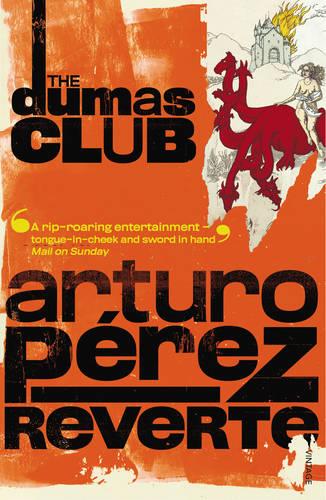
The Dumas Club by Arturo Pérez-Reverte

Translated by Sonia Soto

For Spanish and Portuguese Lit Month, hosted by Stu of Winstonsdad’s Blog, I decided to read a book that sounded perfect for me. A bibliomystery set in the world of antiquarian booksellers, paying tribute to Alexandre Dumas, whose novels I love. What could go wrong?

The Dumas Club (or The Club Dumas – it has appeared under both titles) was originally published in Spanish in 1993 and translated into English three years later by Sonia Soto. You may have watched the 1999 film adaptation The Ninth Gate, starring Johnny Depp; I don’t think I’ve seen it, but apparently it’s very different from the book and completely removes the Dumas connection, which seems strange but maybe they thought there was too much going on and couldn’t include everything.

Lucas Corso is a ‘book detective’ who hunts down rare or valuable books on behalf of his clients. Corso has found that unscrupulous dealers and collectors are prepared to pay large sums of money for the books and don’t really care whether the methods he has used to get hold of them are particularly legal or ethical. In The Dumas Club, we follow Corso as he travels across Europe on two separate missions. The first concerns an early draft of a chapter from Alexandre Dumas’ The Three Musketeers. The chapter, titled Anjou Wine, appears to be written at least partly in Dumas’ own handwriting and Corso’s job is to prove its authenticity.

His second task is more complex and involves a very different kind of book: The Book of the Nine Doors of the Kingdom of Shadows, published by Aristide Torchia in 1666. This rare and sinister book is thought to contain the key to summoning the Devil and Torchia was burned at the stake shortly after its publication. Only one copy is thought to have survived. Corso’s client, Varo Borja, owns a copy of the book which he believes may be a forgery and he wants Corso to examine two other copies, one in Portugal and one in France, to determine which is genuine and which are fakes.

Setting out on his journey, Corso begins to encounter some mysterious strangers who remind him of characters from books. For example, he is pursued by a man with a scar who resembles Rochefort, the ‘Man from Meung’, from The Three Musketeers and he also crosses paths with a young woman who introduces herself as Irene Adler after the character from the Sherlock Holmes stories. Corso is unsure whether these people are interested in The Anjou Wine, The Nine Doors or both, so he must try to keep the manuscripts out of their hands until he has solved the two mysteries.

The Dumas Club is an unusual novel and there were lots of things I liked about it. As a Dumas fan, I enjoyed all the references to The Three Musketeers and other titles; it’s not really essential to be familiar with Dumas, but you’ll definitely get more out of the book if you are. Pérez-Reverte includes a lot of unnecessary information, though, such as a full bibliography of all Dumas’ works inserted into the middle of a chapter. This info-dumping continues throughout the book, as well as lots of long digressions into printing and binding techniques and discussions of first editions, illustrations and rare collections. Some of it is quite fascinating and I think people who love books as physical objects more than for the words they contain will find it particularly interesting, but it doesn’t make for a very quick or easy read.

Although I enjoyed following the Anjou Wine thread of the story, Corso’s second mission revolving around The Nine Doors and the occult was of less interest to me and reminded me too much of The Da Vinci Code. It didn’t help that I didn’t like Lucas Corso at all and found most of the other characters equally unpleasant. Still, the ending is clever and we are given answers to both of the mysteries, so I think my feelings about this book are probably slightly more positive than negative. Another of Pérez-Reverte’s novels was recommended to me a few years ago – Captain Alatriste – and wonder if I would get on better with that one.

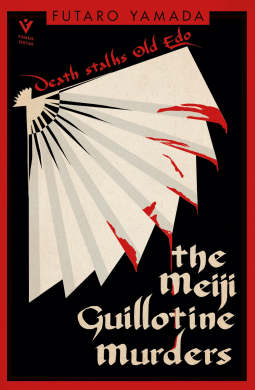
The Meiji Guillotine Murders by Futaro Yamada

Translated by Bryan Karetnyk

It’s 1869 and Japan has entered the Meiji era. The Tokugawa shogunate has fallen and the Emperor Meiji has been restored to the throne. After centuries of isolation, Japan is finally opening up to foreign trade and undergoing social, industrial and military reform. In Tokyo, a group of corrupt rasotsu (policemen) have found ways to exploit this period of change and upheaval for their own gain. With the arrival of two Chief Inspectors from the Imperial Prosecuting Office, Kawaji and Kazuki, it seems that the rasotsu will be forced to mend their ways – although the two men have other things to occupy their time as well as dealing with corruption.

With a number of bizarre murders taking place around Tokyo, Kazuki and Kawaji (based on a real person who is considered the founder of Japan’s modern police system) engage in a friendly competition to see who can solve the crimes first. A separate chapter is devoted to each case, which at first seem to be unrelated, making the book feel almost like a collection of short stories. There are five cases for the two detectives to solve, with the help of Esmeralda, a young Frenchwoman from a family of executioners whom Kazuki has brought to Japan along with that most deadly of French weapons: the guillotine. Despite the title, the guillotine is not necessarily used to carry out all of the murders in the book, but it represents the changes that Japan is experiencing as the country becomes exposed to modern, western influence. It also provides a reason for Esmeralda’s presence in Tokyo, which is important as she has a significant role to play in the solving of the mysteries.

The Meiji Guillotine Murders was first published in 1979 and is one of several Japanese crime novels that have recently been made available in English by Pushkin Press. However, although I’ve loved some of the others, I didn’t enjoy this one quite as much. Bryan Karetnyk’s translation is clear and readable (I’m already familiar with his work through some of his other translated novels), but I had problems with other aspects of the book. I struggled with the number of characters, particularly as so few of them have clearly defined personalities and with more and more of them being introduced with each new case the detectives investigate. My lack of engagement with the characters made it difficult for me to concentrate on following the plot, which is important as all of the separate cases are quite complex and you do need to be paying attention! I persevered and was rewarded with the final section of the book where, after some surprising twists and turns, everything is tied together perfectly.

I did like the historical setting of the book and felt I was learning a lot about Japan during the Meiji era. At times it seemed more like historical fiction than a murder mystery, which was fine with me, but I think someone picking the book up expecting a more traditional crime novel may be surprised by the amount of historical detail. It’s an interesting, unusual book, and although I’m not sure whether I would read any more by Yamada, I do hope more of them are translated into English for those readers who loved this one. I’m enjoying discovering Japanese crime authors through Pushkin and so far my favourites have been Seishi Yokomizo and Akimitsu Takagi.

Thanks to Pushkin Vertigo for providing a copy of this book for review via NetGalley.

This is book 7/20 of my 20 Books of Summer 2024.

Book 24/50 for the Historical Fiction Reading Challenge 2024

The Noh Mask Murder by Akimitsu Takagi

Translated by Jesse Kirkwood

My 20 Books of Summer reading is off to a good start with this 1949 Japanese locked room mystery, now available from Pushkin Press in a new English translation. Thanks to Pushkin, I’ve been able to try several Japanese classic crime authors over the last few years, including Seishi Yokomizo, Yukito Ayatsuji and Soji Shimada. The Noh Mask Murder is the first book I’ve read by Akimitsu Takagi and I thoroughly enjoyed it.

The novel opens with a discussion between Koichi Yanagi, a chemist who has recently returned to Japan after serving in Burma during the war, and his old school friend, Akimitsu Takagi (yes, the author himself, who appears as a character in his own novel – just like Anthony Horowitz in his Horowitz and Hawthorne series). Akimitsu explains to Koichi that he wants to write a new kind of detective novel, one based on a mystery he has solved for himself in real life:

‘I’d tackle some fiendish real-life mystery, then set down precisely how I solved it in the form of a novel. My readers would be provided with the exact same evidence as the author. They’d be able to follow the detective-narrator’s train of thought, assess the appropriateness of his actions – and even come up with their own alternatives. But I don’t imagine an opportunity like that will ever present itself…’

His opportunity comes sooner than he had imagined when Koichi stumbles upon a mystery at the Chizui family mansion, where he has been staying since returning from the war. The head of the household, Professor Chizui, who was once a friend of Koichi’s, died ten years earlier and the house is now inhabited by his two children and the family of his younger brother, Tajiro. The first sign that something is wrong within the Chizui mansion comes when an eerie figure wearing a sinister Noh mask is seen at one of the windows. Soon after this, Tajiro is found dead inside a locked room, with a smell of jasmine in the air and a Noh mask lying on the floor beside him. Akimitsu Takagi joins Koichi at the house to investigate the murder, but when they discover that someone has called the undertaker to order three coffins, it seems that there’s going to be more than just one murder to investigate!

The mystery is a fascinating one and although some time is spent discussing the mechanisms of how the locked room murder took place, the story never becomes too bogged down by the puzzle aspect; the focus is on the characters, their relationships and their motives. I did find the structure slightly confusing at times as we know we’re reading a book within a book written by Akimitsu Takagi (as both character and author), but within that there’s a journal written by Koichi and a long letter written by Hiroyuki Ishikari, the public prosecutor, so the narrative is sometimes three layers deep. There are some clever twists towards the end, however, which might not have worked if it had been structured differently.

Apart from the mystery, I found it interesting to learn about the different types of mask used in Japanese theatre and how although the Noh mask, which represents a demon, cannot change expression the actors can still use it to show various emotions by tilting the mask up and down and by the clever use of lighting. With the story being set in the post-war period, it’s also interesting to hear the characters reflect on the irony of being so concerned with the death of one person after living through a war in which millions died. If you kill a man in peacetime you’re considered a murderer, says Tajiro’s son, Rintaro, but if you kill a man on the battlefield you’re given a medal.

I really enjoyed The Noh Mask Murder, then, but be warned – in the prologue, where Takagi is discussing his plans for a detective novel, he casually spoils the solution of Agatha Christie’s The Murder of Roger Ackroyd. Not a problem for me as I’ve already read it, but I wish authors wouldn’t do that!

Thanks to Pushkin Vertigo for providing a copy of this book for review via NetGalley.

This is book 1/20 of my 20 Books of Summer 2024.

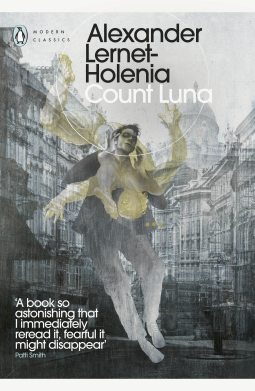
Count Luna by Alexander Lernet-Holenia

Translated by Jane B. Greene

What a strange book this is! I enjoyed it, but I’m not sure I fully understood everything the author was trying to say. It’s the first book I’ve read by Alexander Lernet-Holenia and I’m definitely now interested in reading more.

Count Luna was first published in German in 1955 (Lernet-Holenia was an Austrian author) and appeared in an English translation by Jane B. Greene a year later. It has recently been published in a new edition by Penguin Classics.

The novel begins with Alexander Jessiersky, an Austrian aristocrat, entering the Catacombs of Praetextatus in Rome, apparently in search of two French priests believed to have vanished somewhere in the underground passageways. When Jessiersky himself also fails to emerge from the catacombs, his disappearance is reported to the police, who link him with a series of incidents which occurred in Austria and are still under investigation. The rest of the book is presented as an account of Jessiersky’s life leading up to the disappearance, based on reports by the Italian and Austrian authorities.

We learn that at the start of World War II, Jessiersky is the head of a large Viennese transport company. When the company tries to purchase some land belonging to Count Luna, who refuses to sell, the board of directors come up with a plan to confiscate the land and have Luna sent to a Nazi concentration camp. Jessiersky himself is not involved in this, but does nothing to prevent it from happening – and so, when the war is over, he begins to worry that Luna has survived the camp and is coming back to take his revenge.

On one level, Count Luna could be described as a psychological thriller; told mainly from Jessiersky’s perspective, there’s a growing sense of paranoia and fear as he becomes convinced that Count Luna is following him around Vienna, watching from the shadows, breaking into his house and even trying to poison his children. Whether any of these things are true or only exist in Jessiersky’s imagination I’ll leave you to discover for yourself. The atmosphere becomes very dark and the feeling of tension increases as the novel heads towards its conclusion and Jessiersky enters the catacombs – and from this point the story becomes quite bizarre and even more nightmarish.

At 160 pages, Count Luna is a short novel, but took longer than I expected to read as there are some long, detailed digressions into subjects such as the lineage of the Jessiersky family, which need some concentration from the reader (and don’t really add a lot to the story as a whole). Apart from the references to the war, it felt more like a book written in the 19th century than one written in the 1950s. The war is a crucial part of the story, however, and I’ve seen reviews suggesting that Lernet-Holenia was drawing parallels between Jessiersky’s guilt over Luna’s fate and Austria’s own post-war guilt, which does make a lot of sense. I also think the name Luna (the moon) is no coincidence, as Jessiersky discovers that trying to escape from Luna – and therefore from his guilt – is as useless as trying to escape from the moon.

Although I didn’t love this book as much as I thought I was going to at the beginning, I did find it completely fascinating and it left me with a lot to think about.

Thanks to Penguin Classics for providing a copy of this book for review via NetGalley.

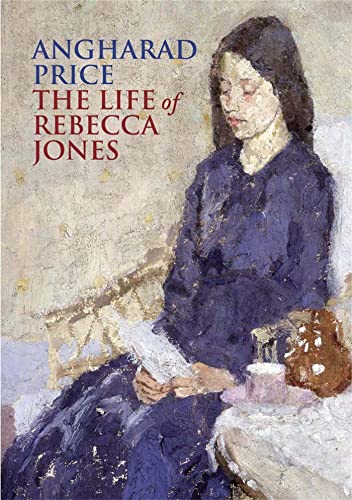
The Life of Rebecca Jones by Angharad Price – #Dewithon24

Translated by Lloyd Jones

I’m aiming to read more books in translation this year so when I started considering possible options for Reading Wales, also known as #Dewithon, hosted this month by Paula at Book Jotter, it seemed like a good opportunity to read something translated from the Welsh language. Eventually I decided on The Life of Rebecca Jones by Angharad Price, first published as O! Tyn y Gorchudd (“oh, pull aside the veil”), in 2002 and translated into English by Lloyd Jones in 2010. It has been listed as one of the top 25 Greatest Welsh Novels by the Wales Art Review (a good resource if you’re looking for Welsh reading ideas).

The novel is a fictional biography, spanning almost the whole of the twentieth century, and is narrated by Rebecca Jones, who looks back on her life in the small rural community of Maesglasau. Beginning with the arrival of her newly wed parents at Tynybraich farm, followed quickly by the birth of Rebecca herself in 1905, she takes us through her entire life, comparing the twists and turns it takes to the path of the stream that flows through the Maesglasau Valley:

“Memories of my childhood reach me in a continuous flow: smells and tastes converging in a surging current. And just like the stream at Maesglasau, these recollections are a product of the landscape in our part of rural mid-Wales at the beginning of the twentieth century. Its familiar bubbling comforts me.
It was not really like that, of course. The flow was halted frequently. Indeed a stream is not the best metaphor for life’s regular flow between one dam and the next.”

Rebecca’s story is not a particularly dramatic or exciting one and is structured as a simple, linear chronicling of events, yet I found it very moving and compelling. As the novel progresses, Rebecca tells us about her daily life on the farm and the different roles performed by men and women, she describes the beautiful landscape and the changing seasons, and looks at some of the customs and traditions of the Maesglasau people. All of this is interspersed with the poetry of Hugh Jones, who was born in Dinas Mawddwy in the 18th century and wrote the hymn that inspired the Welsh title of the novel.

Rebecca is not the only child in the Tynybraich household; she has several younger brothers and sisters, some of whom die in infancy. Three of the brothers – Gruffudd, William and Lewis – are either born blind or become blind later in childhood (is it worse to have never seen the beauty of the world or to have glimpsed it and had it taken away?) and are all sent away to a boarding school for blind children. The education they receive leads to opportunities they would never have had at home in their Welsh valley and while Rebecca is proud of their remarkable achievements she also feels that her brothers’ ties to their own history, culture and language have been broken. This is a pattern she sees repeated in the wider community as the years go by and more and more young people are choosing to leave Maesglasau and make their homes elsewhere. Meanwhile, for those who remain, further changes are brought by modern technology, new ideas, and a greater movement of English people crossing the border into Wales.

When I first started to read, I wasn’t quite sure whether Rebecca and her family were real people or fictional ones, although the book does include photographs and feels historically authentic. I was quickly able to discover that the family at Tynybraich did indeed exist and are ancestors of Angharad Price. There was even a documentary filmed in the 1960s about the three blind brothers. However, not everything Price tells us about Rebecca’s life is the truth, for reasons only explained once we reach the end of the book. That ending was both surprising and perfect.

Have you read this book or are there any others written in the Welsh language that you can recommend?

Book 9/50 for the Historical Fiction Reading Challenge 2024

Silence by Shūsaku Endō

Translated by William Johnston

One of my resolutions for 2024 is to read more historical fiction in translation and where better to start than with a book for the Japanese Literature Challenge (hosted by Dolce Bellezza throughout January and February).

First published in Japanese in 1966 and in English in 1969, Shūsaku Endō’s Silence is set in the 17th century and tells the story of a Portuguese Jesuit priest, Sebastian Rodrigues, who travels to Japan to investigate claims that his old mentor, Father Ferreira, has committed apostasy – in other words, renounced his faith. Rodrigues and his friend Francisco Garrpe, another priest, can’t believe that their teacher would do such a thing. Certain that there must be some mistake, the two set out from Lisbon on the long journey to Japan, where they hope to learn what has really happened to Ferreira.

Rodrigues and Garrpe reach Japan in 1639 and quickly discover that the local Christian communities are being persecuted and forced to hide their religion from the authorities. Anyone the officials suspect of being a Christian is told to trample on an image of Christ, known as a fumie, and if they refuse they are imprisoned and tortured by being suspended upside down over a pit. On his arrival in Japan, Rodrigues goes into hiding with the other Christians, carrying out his missionary work and helping them to worship in secret, but he knows it’s only a matter of time before he is caught and has his own faith put to the test.

Silence is both beautifully written and beautifully translated. From beginning to end, I was completely immersed in another time and place; there’s no jarringly modern language to pull the reader out of the story and everything feels authentic and real. I was intrigued by Endō’s decision to write the novel from the perspective of Rodrigues (first in the form of letters written by the priest and then in the third person) rather than the Japanese Christians and it was interesting to see how Endō viewed his country, its people and its customs through the eyes of a stranger.

I am not a particularly religious person but you don’t need to be to be able to appreciate this novel. I was very moved by the internal struggles Rodrigues faces as he begins to question why God is remaining silent in the midst of so much torture and persecution and whether renouncing his faith, under certain circumstances, could actually be the right thing to do if it helps alleviate the suffering of others. As you can imagine, it’s quite a bleak story, but I loved it and although it’s only been a few days since I finished it, I don’t think it’s a book I’ll ever forget. I would like to try more of Endō’s work and am pleased to see that some of his other novels are also available in English translations.

I read this book for the Japanese Literature Challenge 17 and the Historical Fiction Reading Challenge.

The Devil’s Flute Murders by Seishi Yokomizo (tr. Jim Rion)

The Devil’s Flute Murders, first published in Japanese in 1953, is the fifth of Seishi Yokomizo’s detective novels to be made available in new English translations by Pushkin Press. I’ve now read all five of them and enjoyed some more than others; I think this is one of the best, along with The Inugami Curse and The Honjin Murders.

In this book, set in 1947, Yokomizo’s dishevelled, nervous, stammering detective, Kosuke Kindaichi, is approached by a young woman who wants him to investigate the disappearance of her father, Hidesuke Tsubaki. Tsubaki, who had been a viscount until the recent abolition of the Japanese aristocracy, was found dead in the woods several weeks after leaving his family home, but although his daughter Mineko was the one to identify the body, she now has reason to believe he isn’t dead at all. There have been sightings of a man closely resembling Tsubaki in the grounds of the family estate and sounds of the haunting flute playing for which he was famous in his lifetime.

That evening, Kindaichi is invited to a séance at the Tsubaki home, which has been arranged by the viscount’s widow in the hope of discovering whether her husband is alive or dead. At the end of the event, a recording of Tsubaki’s final composition, The Devil Comes and Plays His Flute, begins to play by itself – and next morning, Kindaichi hears the news that another family member has been found dead in a locked room during the night. Who is responsible for the murder? Is the viscount’s ghost really haunting the family estate? And what is the meaning of the strange symbol found at the scene of the crime?

Yokomizo’s plots are always clever and fascinating and don’t rely quite as heavily on complex puzzle-solving as some of the books I’ve read by other Japanese classic crime authors. Understanding the relationships between the characters, their family secrets and their personalities and motives is just as important as working out how the crimes were committed. I guessed who the culprit was but didn’t know why they did it – I’m not sure if it would have been possible to know until the backstory of each character was revealed, but maybe I missed some clues.

Something else I like about this series is the insight the books offer into life in Japan during the post-WWII years. In The Devil’s Flute Murders the shadow cast by the war is particularly strong. There are mentions of food shortages, problems with electricity supplies and overcrowded, unreliable public transport. The new constitution drafted by the Allies during the occupation of Japan is the reason why Tsubaki and other members of the nobility have lost their titles, while bombed out houses and damage from fire has led to Tsubaki’s extended family all coming to live on the former viscount’s estate, bringing them together in one place for the events of the novel to play out.

This is the first book in the series to be translated by Jim Rion (the others have been translated by Louise Heal Kawai, Bryan Karetnyk and Yumiko Yamazaki). I think all of the translators have done a good job and I haven’t noticed any real differences in quality or readability between the different translations. My only problem with this one came when Kindaichi’s investigations take him from the Tsubaki home in Tokyo to Awaji Island near Kobe in the west and I found the way Rion chooses to write the western accent slightly odd and jarring. Of course, I appreciate how difficult it must be to capture nuances of accent and dialect in a translation!

I’m already looking forward to the next Kindaichi mystery, The Little Sparrow Murders, which is due to be published next May and sounds just as intriguing as the others.

Thanks to Pushkin Vertigo for providing a copy of this book for review via NetGalley.