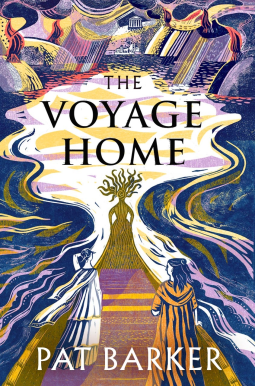
The Voyage Home by Pat Barker

This is the final novel in Pat Barker’s trilogy telling the stories of some of the women involved in the Trojan War. Books one and two, The Silence of the Girls and The Women of Troy, focus on Briseis, who was given to Achilles as a prize of war, although I was surprised by the number of male perspectives that are also included in those two books, considering the titles! In The Voyage Home, we leave Briseis behind to follow three other characters as the victorious Greeks return home from the war.

One of these is Cassandra, the Trojan princess and prophet who is cursed never to be believed. Like Briseis, Cassandra has become a war prize – in her case, she has been taken as a concubine by Agamemnon, King of Mycenae. Then there’s Ritsa, a Trojan slave and healer given the job of accompanying Cassandra on the journey to Mycenae and acting as her personal servant. Finally there’s Clytemnestra, Agamemnon’s wife, who is grimly preparing for her husband’s return. It’s been a decade since Agamemnon sacrificed their daughter Iphigenia to the gods in exchange for a wind to sail to Troy, but Clytemnestra has never forgiven him and is ready to take her revenge.

I enjoyed the first two books in this trilogy and I did like this one as well, but not quite as much. I’ve read several other novels about Clytemnestra and the events of the Oresteia recently (including Elektra by Jennifer Saint and Clytemnestra by Costanza Casati) and I felt that her sections of the novel didn’t offer me much that was new or different. Having said that, the way Barker portrays Clytemnestra’s emotions – her anger, bitterness and grief – was very well done. There are also some atmospheric scenes of ghostly children haunting the palace – although, oddly, chanting British nursery rhymes such as Oranges and Lemons, which pulled me right out of the Ancient Greek setting!

Of the main characters, Ritsa is probably the easiest to like and as a servant, of a lower social status than the others, she has an interesting perspective on the events that unfold. Cassandra is a fascinating, complex character in the unusual position of being both enslaved and the wife of the king. She has already predicted the deaths of herself and Agamemnon but due to the curse she is under, nobody takes her seriously. I would have liked more of the book to have been written from Cassandra’s point of view, but instead Barker concentrates on showing her through the eyes of the other women: Clytemnestra, who views her with suspicion (after all, Agamemnon was her husband first) and Ritsa, who initially resents Cassandra for not being her beloved friend Briseis, who has not accompanied them to Mycenae. Ritsa sees Cassandra as wild and deluded, but gradually starts to have more sympathy for her.

This is a satisfying end to the trilogy, although if you haven’t read the first two books I’m sure you could read this one as a standalone.

Thanks to Hamish Hamilton for providing a copy of this book for review via NetGalley.
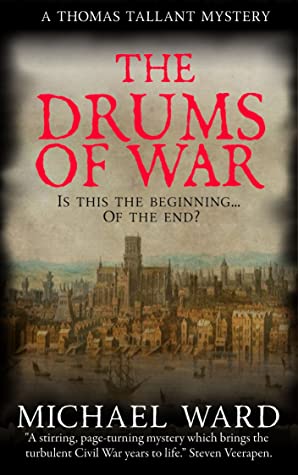
Recent reads: The Drums of War; Ashes in the Snow; Ithaca

I’m falling behind with my reviews again, so here are my thoughts on three recent reads – all very different books.

The Drums of War is the third in Michael Ward’s Thomas Tallant mystery series, continuing the story begun in Rags of Time and The Wrecking Storm. It also works as a standalone novel, so don’t worry if you haven’t read the first two in the series.

This third novel opens in London in 1642. With the divisions between King and Parliament becoming greater, England is rapidly heading towards Civil War and spice merchant Thomas Tallant and his friends are being forced to choose sides. Soon Tom finds himself assisting the Puritan leader John Pym in his search for a consignment of stolen gunpowder being smuggled out of London by Royalist forces. Meanwhile, Elizabeth Seymour is carrying out investigations of her own as she sets out on the trail of a mysterious jewel thief. Although Tom and Elizabeth are separated for most of the book and I missed their interactions, I did find both storylines interesting, particularly Elizabeth’s as she suffers a personal trauma and begins to fall back into some of her former bad habits as a result!

As with the first two books in the series, real historical figures appear alongside the fictional ones and as well as John Pym and the commander of the London Trained Bands, Philip Skippon, we also meet the scientist and physician William Harvey and are reacquainted with the intriguing Lucy, Countess of Carlisle. In the second half of the novel, the focus moves away from the mystery-solving for a while to concentrate on the events of the Civil War, particularly the battles of Edgehill and Brentford. This aspect of the story was of less interest to me, but that’s just down to personal taste (I’m not really a fan of battle scenes) and I still found this an enjoyable novel overall.

~

Ashes in the Snow is Oriana Ramunno’s debut crime novel, written in Italian and translated into English by Katherine Gregor. The book is set in Poland during World War II and begins with a young boy, Gioele Errera, finding the body of an SS officer in the snow. The man appears to have choked on an apple, but it soon seems that there is more to his death than that and German criminologist Hugo Fischer is summoned to investigate. Finding the murderer will not be easy, particularly as the dead man’s wife seems reluctant to cooperate, but Gioele agrees to help – if, in return, Hugo will help him to find his family from whom he has become separated.

This is a beautifully written and translated novel but not an easy one to read because, as we quickly discover, Gioele has a twin brother and the two of them have become subjects of the infamous Josef Mengele’s experiments. Of course this sort of thing is not supposed to be pleasant to read about, but I wasn’t really prepared for the level of detail Ramunno goes into in describing this and other parts of Gioele and Hugo’s stories. Hugo is an interesting and likeable character, a man suffering from a degenerative illness who must keep his condition a secret to avoid becoming a target of the Nazi regime himself. He’s an unusual detective and the crime element of the novel works well, but this book wasn’t for me.

~

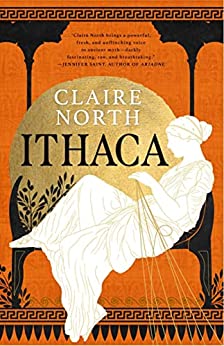
Ithaca by Claire North is the latest of many Greek mythology retellings based on the events surrounding the Trojan War. What makes this one different from the others I’ve read is that it focuses on the story of Penelope as seen through the eyes of the goddess Hera.

It has been seventeen years since Penelope’s husband Odysseus, King of Ithaca, sailed away to war with Troy and although the war is now over, she and her son, Telemachus, are still awaiting his return. Penelope is kept busy running the kingdom with the help of her women, while also trying to defend the island of Ithaca from raiders and fend off the attentions of the crowd of suitors who have descended upon her home in the hope of marrying her if Odysseus never comes back. Meanwhile, Penelope’s cousin Clytemnestra has fled to Ithaca looking for somewhere to hide after murdering her husband, Agamemnon.

Ithaca is quite a long novel and moves at a slow pace; it’s the first in a planned trilogy and Claire North takes her time setting the scene and introducing the characters. I liked the choice of Hera as narrator; she provides a different perspective on a well-known story and I enjoyed her observations of the mortal world and her interactions with other goddesses such as Athena. However, it does mean we are kept at a distance from Penelope herself, which could explain why I found it difficult to form any kind of connection with her – or with any of the other characters. For that reason, I don’t think I’ll be continuing with the second book. Claire North writes beautifully but I needed more than that to sustain my interest and I preferred Margaret Atwood’s The Penelopiad – I didn’t love that one either, but it was a shorter and more memorable read.

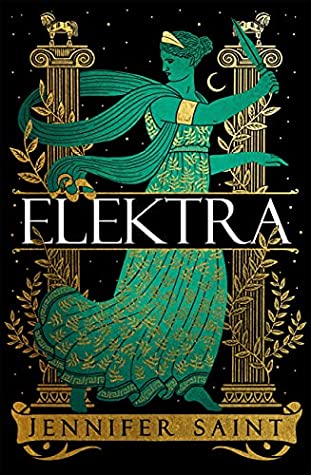
Elektra by Jennifer Saint

I enjoyed Jennifer Saint’s first novel, Ariadne, a retelling of Greek myth from a female perspective, so I was looking forward to reading her new one, Elektra. If you’re familiar with Greek mythology, you’ll know Elektra as the daughter of Agamemnon, King of Mycenae, and his wife Clytemnestra, the sister of Helen of Troy. In this novel, Jennifer Saint tells the stories of both Elektra and Clytemnestra, as well as another woman – Cassandra, the Trojan priestess and prophet.

Elektra begins with the Greeks preparing to go to war against Troy. In order to please the gods so they will produce a wind to allow the fleet to set sail, Agamemnon sacrifices his eldest daughter, Iphigenia. The devastated Clytemnestra vows to take revenge on her husband, but she will have a long time to wait as the Trojan War will last ten years. Meanwhile, Iphigenia’s younger sister Elektra grows up watching in disapproval of her mother’s relationship with her new lover Aegisthus and waiting for her father to return. When Agamemnon does eventually come home – bringing Cassandra with him as a prize of war – further tragedy will strike the family and this time it is Elektra who is left vowing revenge.

This is another beautiful and insightful Greek retelling from Jennifer Saint, but I didn’t like it quite as much as Ariadne, probably because there were large parts of the Ariadne/Phaedra story that were new to me whereas I felt that this book was too similar to others I’ve read recently – Colm Tóibín’s House of Names, Natalie Haynes’ A Thousand Ships and Pat Barker’s The Silence of the Girls, to name a few. If I’d known nothing about Troy or the House of Atreus, I’m sure I would have enjoyed this book much more. Still, there are scenes and moments that never lose their impact no matter how many times you’ve read them: Clytemnestra’s grief and agony when her husband murders their daughter or Cassandra’s desperation as she tries to convince her fellow Trojans that there are Greeks hiding in the giant wooden horse.

I do wonder why Elektra was chosen as the title of the novel, as it’s as much the story of Clytemnestra and Cassandra as it is of Elektra (each of them narrating their own chapters). In fact, for the first half of the book at least, Elektra’s role is the smallest – and she is certainly the most difficult to like of the three narrators. I had a lot of sympathy with the doomed Cassandra, both blessed with the gift of prophecy and cursed to never be believed, and while some of Clytemnestra’s choices may be questionable, how could you not feel for a mother who has lost a child in such a horrifying way? Elektra, though, is harder to understand; I didn’t think it was made very clear why she felt such loyalty to her father and why she could forgive his murderous actions but not her mother’s. Although I did enjoy Cassandra’s chapters, perhaps if they’d been left out there would have been more time to explore the relationship between Clytemnestra and Elektra.

Although this book wasn’t completely successful for me, I’ll look forward to more by Jennifer Saint, particularly if they focus less on Troy and more on other areas of Greek myth.

Thanks to Headline for providing a copy of this book for review via NetGalley.

The Women of Troy by Pat Barker

After reading Pat Barker’s The Silence of the Girls a few years ago, I wasn’t really expecting a sequel, but here it is: The Women of Troy. I’m sure if you wanted to you could read this one as a standalone, but I would recommend reading both as this is a direct continuation of the first. Together, the two novels tell the story of the Trojan War and its aftermath.

The Silence of the Girls was based on the events of Homer’s Iliad; this second novel is set after the fall of Troy, when the victorious Greek invaders are stranded on the shore, waiting for the winds to change so that their ships can sail home. Trapped there with them are the Trojan women they have taken captive, some of whom were once queens and princesses but are now treated as slaves. Among them is Briseis, who had been taken by the great Greek warrior Achilles as a war prize and then married off to his friend Alcimus after Achilles’ death.

As in the previous novel, Briseis is our main narrator, but there are also some chapters written from other perspectives: Pyrrhus, the son of Achilles, desperate to prove himself as great as his father, and Calchas, a priest and prophet. One of my criticisms of The Silence of the Girls was that, despite the title, we only actually heard the voice of one girl, Briseis, while large sections of the book were written from the point of view of Achilles – and the title of The Women of Troy also seems slightly misleading, as we have two male perspectives and only one female. However, this time I felt that, at least through Briseis’ eyes, we do see more of the other women in the camp than we did in the first book. These include Hecuba, the former Queen of Troy and wife of the murdered King Priam; their daughter Cassandra, who has the gift – or curse – of prophecy; and Andromache, the widow of Hector who was killed by Achilles during the war. All of these women have interesting stories of their own, as well as now all sharing the same problem: how to cope with living amongst the men who destroyed their city.

Then – and now – people seem to take it for granted that I loved Achilles. Why wouldn’t I? I had the fastest, strongest, bravest, most beautiful man of his generation in my bed – how could I not love him?

He killed my brothers.

We women are peculiar creatures. We tend not to love those who murder our families.

As this entire novel is set during that period of waiting for the weather to change, it’s a slower paced and more character-driven story than the previous one. The plot, so much as there is one, revolves around the attempts of the Trojans to bury the body of their beloved King Priam, brutally killed by Pyrrhus and denied proper burial. Despite this, I still found the story quite gripping and enjoyed getting to know some of the women better. I’m wondering whether there will be a third book, as this one felt very like the middle book in a trilogy to me.

Thanks to Penguin UK for providing a copy of this book for review via NetGalley.
Book 40/50 read for the 2021 Historical Fiction Reading Challenge.

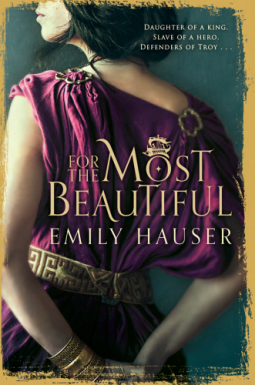
For the Most Beautiful by Emily Hauser

For the Most Beautiful “For the most beautiful”. These are the words inscribed on a golden apple presented by Paris, Prince of Troy, to the goddess Aphrodite whom he has chosen over her rivals, Hera and Athena. In return, the goddess rewards Paris with Helen of Sparta, the most beautiful woman in the world – but unfortunately, Helen is already married. Not surprisingly, her husband, Menelaus, is enraged by the theft of his wife and sends the mighty armies of Greece, led by his brother King Agamemnon, to the shores of Troy to bring her back.

The story of the Trojan War is one that has been told many times before and with which a lot of readers will already be familiar before picking up Emily Hauser’s debut novel, For the Most Beautiful. However, this book retells the story from a feminine perspective and focuses on two female characters – Krisayis and Briseis – who both have important roles to play yet have not been given much attention in other versions such as Homer’s Iliad.

Krisayis (whose name is usually spelled Chryseis) is the daughter of a Trojan priest and companion to Cassandra, a princess of Troy. As the novel begins, we learn that Krisayis is in love with Cassandra’s brother, Troilus, and that, much against her wishes, she is about to become a priestess devoted to the god Apulunas. Our other main character, Briseis, is a princess of Lyrnessus who has unexpectedly found love with her husband Mynes, despite growing up under the shadow of a prophecy which seemed to rule out the possibility of happiness. With the onset of war, the lives of both young women are thrown into turmoil; their paths cross while held captive in the Greek camp, but will they be able to change fate and save Troy?

I found For the Most Beautiful a very enjoyable read. I think it was probably aimed at a younger audience but there was enough depth to keep an adult reader happy too. Having only read two or three other novels about Troy (including Madeline Miller’s The Song of Achilles and Judith Starkston’s Hand of Fire) I found that while I knew the basic outline of the story, a lot of it was new to me and the approach the author took made it feel fresh and original. It was interesting to see how Emily Hauser interpreted the characters of not just Krisayis and Briseis but also Achilles, Patroclus, Paris, Hector, Cassandra and others.

The stories of our two heroines unfold in alternating chapters and I thought these sections of the book were well written and emotionally engaging (both Briseis and Krisayis suffer the death of a loved one and then face further ordeals and difficult decisions after their capture by the Greeks). However, these chapters are interspersed with short scenes in which we witness the gods on their mountain observing and manipulating the lives of the mortals below – and this is the one aspect of the book which really didn’t work for me. The writing style in these sections is quite different – the language feels much more modern and the tense changes from past to present – and the gods come across as bored, shallow and petulant. I think I can see what the author was trying to do here and I’m sure other readers will enjoy the light-hearted, comedy feel of these scenes, but it just made me impatient to get back to Briseis and Krisayis!

After finishing this book, I was pleased to discover that it’s the start of a new Golden Apple trilogy. Greek mythology is not a subject that particularly interests me, but I was still captivated by For the Most Beautiful and am looking forward to reading another two books by Emily Hauser.

I received a copy of this book from NetGalley for review.