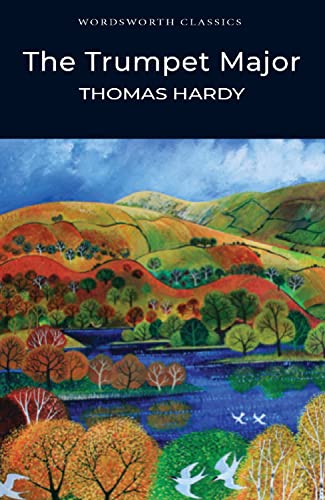
 I love Thomas Hardy so was pleased when The Trumpet-Major was chosen for me in the recent Classics Club Spin. The deadline for finishing our Spin books was 3rd March, but I’m late as usual!
First published in 1880, The Trumpet-Major is set in Hardy’s fictional Wessex during the Napoleonic Wars (making it his only historical novel). Beginning in 1804, it follows the story of Anne Garland and her three suitors: miller’s son John Loveday, who is the Trumpet Major of the title; his brother Bob, a sailor whom Anne has secretly loved since she was a young girl; and Festus Derriman, nephew of the local squire. Anne’s mother, who marries Miller Loveday, would prefer Anne to pick Festus, but it quickly becomes obvious to the reader that he is spiteful and cowardly and that Anne’s choice will be between Bob and John.
With John being a soldier and Bob a sailor in the merchant navy, they each have to spend long periods of time away from home, allowing Anne to grow closer to the other in his absence. It’s difficult to know which, if either, she will eventually accept; John is a typical loyal, steadfast Hardy hero, but Bob, although more immature and less trustworthy, is clearly the one she has lost her heart to. There are lots of twists and turns along the way as the situation becomes complicated by misunderstandings, the arrival of another woman, and the scheming of Festus Derriman. There’s a subplot involving Squire Derriman – known as Uncle Benjy – who is looking for a place to hide his will, but otherwise the novel never really loses its focus on Anne and the three young men, which makes the story easy to follow and, for a Victorian novel, relatively short and quick to read.
The action all takes place in and around Budmouth, a fictional town based on Weymouth on the Dorset coast. This is not a military novel, despite the title and the occupations of two of the main characters, but it plays out against a backdrop of the Napoleonic Wars and the people of Budmouth live in fear of a French invasion at any minute. It’s quite a light story, in comparison with Hardy’s more famous tragedies like Jude the Obscure and Tess of the D’Urbervilles, but the constant threat of war gives it a more serious tone than it would otherwise have had, and there are some dramatic episodes such as a false alarm which causes Anne’s village to begin evacuating in panic and the arrival of a naval press gang.
The Trumpet-Major has a happier ending than many of Hardy’s other books, but I didn’t personally find it very satisfying and would have preferred it to end in a different way. Still, I enjoyed this book and although I would definitely describe it as one of his lesser novels, I can honestly say that I haven’t yet read anything by Hardy that I didn’t like! I only have two of his novels left to read and they are probably his most obscure ones – The Well-Beloved and The Hand of Ethelberta – so I’ll be curious to find out what I think of those two.
This is book 43/50 read from my second Classics Club list.

Book 11/50 for the Historical Fiction Reading Challenge 2024




 She Reads Novels