 Sylvia’s Lovers is set in the final years of the eighteenth century in the small town of Monkshaven on the Yorkshire coast. During this period Britain and France were at war and the men of Monkshaven lived in fear of the press-gangs who regularly captured sailors from the town and forced them into action against France. Against this backdrop we meet Sylvia Robson, the beautiful young daughter of a farmer from nearby Haytersbank, and the two very different men who hope to marry her. One of these is Sylvia’s cousin, Philip Hepburn, a serious, reliable man who works in a draper’s shop; the other is the much more exciting and charismatic Charley Kinraid, a ‘specksioneer’ (chief harpooner) on a whaling ship. When Philip discovers that Kinraid is a rival for Sylvia’s love, he makes a decision that will eventually have tragic consequences for everyone involved.
Elizabeth Gaskell said this was the saddest book she ever wrote and I can definitely understand why she would have said that! Apart from the central storyline involving Sylvia, Philip and Kinraid, there are other characters with their own tragic stories to be told. Hester Rose, for example, who works with Philip in Foster’s shop and has been secretly in love with him for years without ever daring to say so. And Daniel Robson, Sylvia’s father, a former whaler who decides to take action to stop any more of the town’s young men being pressed into the navy.
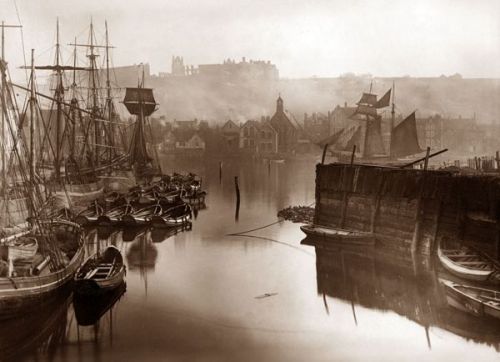
Monkshaven is a fictional town but was based closely on the real North Yorkshire town of Whitby. A few weeks ago I posted a visual tour of Monkshaven – I hope the photos and quotes I included help to convey some of the atmosphere Gaskell created in her descriptions of the town. My own familiarity with Whitby (I’ve been there many times over the years) made it easy for me to picture the scenes. When we were told of a funeral procession slowly winding its way up the steps to the church on the cliff or the crowds gathering to watch a whaling ship coming in, I could see the images clearly in my mind.
Sylvia’s Lovers took a long time to read (it was 500 pages and felt even longer, partly because I had to concentrate on understanding the dialogue – I should probably warn you that this book does contain a lot of Yorkshire dialect) but the setting, the historical background and the characters kept me interested. Sylvia frustrated me at the beginning because she was so silly and immature, uneducated and unwilling to learn; by the end of the book though, she had changed a lot and I found myself starting to like her. I had sympathy for Philip, both before and after he made his terrible mistake, and I loved Hester Rose. Kinraid was the only character who never felt fully developed but I think that was maybe intentional.
This book reminded me of Tess of the d’Urbervilles by Thomas Hardy, with all the descriptions of scenery, the local dialect, the focus on rural working-class life and the overwhelming mood of sadness and misery. As one tragedy followed another through the second half of the book, it started to seem that there were going to be no happy endings for any of the characters. I can honestly say this was one of the most depressing books I’ve read and on a few occasions towards the end I wondered why I was still reading it. The answer to that is because I find Gaskell’s writing so beautiful and moving and because she had really made me care what happened to Sylvia, Philip, Hester and the others. This is only the second Gaskell novel I’ve read; the first was North and South which is a much more popular book, but I think I liked this one more despite it being so heartbreaking.




 She Reads Novels