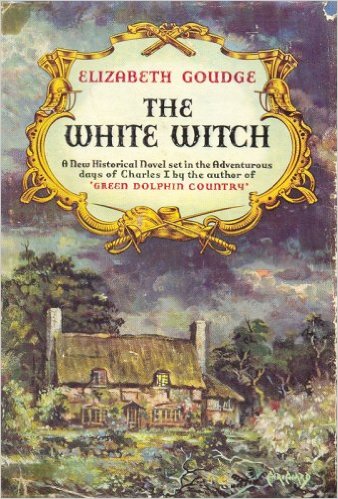
Elizabeth Goudge Day: The White Witch

The White Witch A year ago I read The Child from the Sea as part of Lory of The Emerald City Book Review’s birthday celebrations for Elizabeth Goudge. This year, Lory is hosting another day devoted to the same author and this seemed like a good time to read my second book by Goudge. There were plenty to choose from – some historical and some contemporary, some for adults and some for children – but I decided on The White Witch. I loved The Child from the Sea, which was set in the seventeenth century and told the story of Lucy Walters, a mistress of Charles II, so as The White Witch is set in the same period the chances were good that I would love this book too – and I did.

The English Civil War forms the historical backdrop to the story, but the focus of the novel is on the inhabitants of a small Oxfordshire village and the ways in which their lives are touched by the greater changes taking place in the country as a whole. The ‘white witch’ of the title is Froniga, a healer and herbalist who has family ties with both the Puritan household of Robert Haslewood, the village squire, and with the band of Romany gypsies who camp nearby. Caught between both of these worlds while fully belonging to neither, Froniga is the character around whom all the others revolve.

Froniga is a fascinating character, but there were others whose stories interested me too, particularly Francis Leyland, the secretive stranger who offers to paint a portrait of Haslewood’s two young children, and the mysterious Yoben, who is in love with Froniga. There’s a ‘black witch’ too – and a parson who tries to save her soul – and a vengeful gypsy woman who causes trouble wherever she goes. Whether Parliamentarian or Royalist, Puritan or Catholic, nobleman or gypsy, in the hands of Elizabeth Goudge each of these characters becomes a well-rounded, believable human being – a person we can sympathise with even if we don’t necessarily agree with their views or their choices.

In this novel, the conflicts that take place in an individual’s heart or soul are as important as those which take place on the battlefield, though we do get to see some military action as several of our characters become involved in the major battles and events of the Civil War. But what I loved most about this book were the details of daily village life in the seventeenth century, the beautiful descriptions of the English countryside, and the undercurrents of magic, mystery and mythology which run throughout the story.

The White Witch, although never boring, has a slow pace and – as it was originally published in 1958 – it is written in a style which may not appeal to readers who prefer more modern historical novels and as with The Child from the Sea, there are strong religious and spiritual elements. I love Goudge’s writing style, though; it’s warm and gentle and comforting. I’m looking forward to working through the rest of her novels…and would like to thank Lory for introducing me to her work!

Shadow of Night by Deborah Harkness

Shadow of Night This is the second book in the All Souls Trilogy by Deborah Harkness. I read the first, A Discovery of Witches, earlier this year and the third, The Book of Life, has just been published, which is what made me decide to pick up the middle book last week.

Shadow of Night follows witch Diana Bishop and vampire Matthew Clairmont as they travel back in time to the year 1590 with two goals in mind. The first is to hunt down Ashmole 782, an elusive manuscript which they hope will provide important information on the origins of their species – witches, vampires and daemons (known collectively as ‘creatures’). The second is to find another witch who can help Diana to understand and control her magical powers. Another benefit of leaving the present day behind is that Matthew and Diana will be able to escape the clutches of the other witches, vampires and daemons who have also been trying to get their hands on Ashmole 782.

Arriving in Elizabethan England, Diana discovers that Matthew is one of a group of writers, artists and scientists known as the School of Night, whose other members include Sir Walter Raleigh and Christopher (Kit) Marlowe. Reunited with his old friends again, Matthew also resumes one of his other occupations – spying for Elizabeth I. Meanwhile, Diana’s mission to find a witch willing to train her in the use of magic proves more difficult than expected in a time when public fear and suspicion of witches is increasing. Discovering that life in the past is no less complicated than it was in the present, Diana’s and Matthew’s adventures take them first into the heart of Elizabethan London, then to Matthew’s family estate at Sept-Tours in France and to the court of Rudolf II in Prague.

This book should have been perfect for me as I usually enjoy both historical fiction and time travel, but I think I actually preferred A Discovery of Witches. There were some parts of this book that I loved, but for such a long novel (nearly 600 pages) I found the pace very slow and uneven. It seemed that most of the book’s major developments all took place in the final 50-100 pages.

There are a lot of characters to keep track of in Shadow of Night and the character list at the back of the book was very useful. Diana and Matthew meet a huge number of real historical figures as they travel between London, Sept-Tours and Prague, but while some of these were very intriguing, such as the Rabbi Judah Loew who created the Golem of Prague, many of them had little or no relevance to the story. I couldn’t help thinking that they had been included just for the sake of it; I would rather have had fewer characters so that we could spend more time getting to know each one. I also really disliked the portrayal of Kit Marlowe in the book. I’m sure the real Marlowe would have been a fascinating character to write about in his own right; making him a daemon (a very spiteful, petulant daemon) added nothing to the story.

Matthew began to stretch my belief to its limits. Not only does he belong to the School of Night, he is also a member of at least one other secret organisation and an order of chivalry, a spy for Elizabeth I and a close personal friend of numerous famous historical figures from all over Europe. You may think that as I’m happy to accept that he’s a vampire I should be able to accept the rest of it too, but it all felt too convenient and just not believable in the context of the story. I do like Diana, partly because as she’s the narrator the reader naturally feels closer to her, but I would still like to see her take the lead more often when it comes to decision-making.

The time travel aspect of the book didn’t quite make sense to me either – it seemed that as Matthew was returning to an earlier period in his own life, he simply replaced his previous self for a while, but I’m not sure what was supposed to have happened to the 16th century Matthew in the meantime or what would happen when he came back. Time travel is always confusing, though, so I tried not to think about it too much! I did like the way each section of the book ended with a chapter set in the present day, showing how Matthew and Diana’s actions in the past affect the future. This also gave us a chance to briefly catch up with characters from the previous book such as Diana’s aunts, Sarah and Emily, and Matthew’s mother, Ysabeau.

Although I didn’t find this book as enjoyable as A Discovery of Witches, I think it maybe suffered from being the middle book in a trilogy. I will still be reading The Book of Life and hoping I don’t have any of the problems I had with this one!

Thanks to Headline for providing a copy of this book for review.

A Discovery of Witches by Deborah Harkness

A Discovery of Witches

“It begins with absence and desire. It begins with blood and fear. It begins with a discovery of witches.”

A Discovery of Witches is the first in Deborah Harkness’s All Souls Trilogy. I’ve come to this book years after everybody else, as usual, but it seems I’ve picked a good time to read it as the third book is due out this summer. I did actually receive a review copy of the second one, Shadow of Night, a while ago but as I prefer to start at the beginning of a series I couldn’t read it until I got round to reading this one first. I haven’t been actively looking for a copy of A Discovery of Witches as I really wasn’t sure it was something I would like, but when I noticed it was available through NetGalley I decided it was time to give it a try.

Our narrator, Diana Bishop, is an American academic who has come to England to research the history of alchemy in Oxford’s Bodleian Library. She is also a witch. Not the kind who wears a black hat and flies on a broomstick, but a young woman who is able to live and work alongside humans while possessing magical powers which even she doesn’t fully understand. When Diana discovers an old alchemical manuscript known as Ashmole 782 in the library, it draws the unwelcome attention of several other beings – not just witches, but also vampires and daemons. It seems that the manuscript is bewitched and contains hidden information these other creatures desperately want.

Among the crowds of otherworldly creatures descending on Oxford in search of the manuscript is scientist Matthew Clairmont, who happens to be a vampire. Together, Matthew and Diana attempt to unravel the secrets of Ashmole 782 and in the process they begin to fall in love. But relationships between witches and vampires are strictly forbidden and the Congregation – a council made up of three representatives from each group of creatures – will do anything to put an end to their romance.

This book was a nice surprise, because I enjoyed it much more than I’d expected to! If you’ve been following my blog for a while, you will know that I don’t normally read books about vampires and witches, but I think it was precisely the fact that I don’t normally read books about vampires and witches that explains why I found this one so much fun to read. It was something different for me and the complaint some readers have, that it’s too much like Twilight for adults, meant nothing to me as I haven’t actually read Twilight (am I the only person who hasn’t?) so I’m not really familiar with what might be seen as vampire romance cliches. There were echoes of lots of other books, though. The way the story began with the discovery of a manuscript in the library was reminiscent of The Historian by Elizabeth Kostova (one of the few vampire books I have read) and the backstory involving Diana’s parents reminded me of the Harry Potter books.

There were lots of things to enjoy about A Discovery of Witches. I loved the combination of romance, history, adventure and fantasy. I liked the idea of creatures (the collective term for witches, vampires and daemons) co-existing with humans and doing the normal, everyday things that humans do – studying in libraries, drinking tea, checking their emails, even going to yoga classes. I loved the descriptions of the various locations Diana and Matthew visit, beginning in Oxford before moving on to a remote castle in the French countryside and then finally a haunted house with a mind of its own and several resident ghosts. And I enjoyed all the little scientific and historical details that are dropped into the story – information on evolution, genetics and the history of alchemy.

The book was not without a few flaws, though. I thought the pace was uneven – after a great start there was a long period where not much happened and while I wasn’t exactly bored, I did wonder when the plot was going to move forward again. Somewhere in the middle of the novel I started to feel impatient with Diana as she seemed so content to have Matthew protect her and make all the decisions in their relationship, which was disappointing after she’d appeared to be such a strong character at the beginning. I found it frustrating that she was so reluctant to use her magic, although I did eventually understand the reasons why she couldn’t or wouldn’t.

It also seemed that the sole purpose of the final few chapters of the book was to set things up for the sequel. This was not a big problem for me, as I already have a copy of the second book and could have started it immediately if I’d wanted to, but I’m sure it must have been annoying for people who read the book when it was first published and wanted to know how the story would be resolved!

I don’t think I’ll be rushing to fill my shelves with vampire books now, but I did enjoy this one and will certainly be continuing with Shadow of Night soon.

Thanks to Headline for providing a review copy via NetGalley