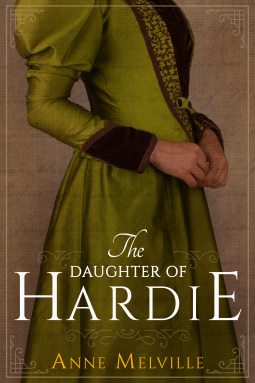
 The Daughter of Hardie, originally published in 1988 as Grace Hardie, is the second in Anne Melville’s trilogy of novels following the story of a family of English wine merchants throughout the late nineteenth and early twentieth centuries. I think this book does stand alone quite well as it concentrates mainly on the younger generation of the Hardie family, but I would still recommend starting with the first one, The House of Hardie, if you can.
This second novel opens in 1898 with Grace Hardie growing up at Greystones, the family estate in the countryside near Oxford, where they have their wine shop. As the only girl in a family of boys and considered an invalid due to her severe asthma attacks, Grace is struggling to find her place in the world but she finds happiness in exploring the grounds of Greystones and playing with her beloved cat, Pepper. Then, one day, a tragic accident destroys Grace’s happiness and things are never quite the same again. Meanwhile, 1914 is approaching and with it the beginning of the First World War. With five brothers, four of whom are old enough to fight, there could be more tragedy ahead for Grace and her family…
I enjoyed the first Hardie novel, but I thought this one was even better. I wasn’t sure about it at first – I found the scenes describing the accident I alluded to earlier quite harrowing and I almost stopped reading at that point, but I’m pleased I didn’t because as the consequences of that incident and its impact on Grace and her brothers became clearer I started to understand why it was depicted in that way. By the time war broke out halfway through the novel I had been fully drawn into the story and was genuinely worried for the characters as they either went off to fight or were left behind to wait for news of their loved ones.
Anne Melville manages to cover almost every aspect of the war you could think of – men sent home from the front wounded, men left suffering from shellshock, gas attacks and zeppelin raids, conscription and desertion, women stepping into roles vacated by men, and the difficulties of keeping a large estate running during and after the war. This could easily have felt overwhelming, but it doesn’t…all of these storylines arise naturally from the stories of the various characters and the types of people they are.
But this is not just a book about war. One of the main themes of the first novel, women’s education, was at the forefront of this one too. Midge Hardie, my favourite of the ‘first generation’ characters, is now a school headmistress – a job she loves, even though she had been forced to make an unfair choice between marriage and a teaching career, as married headmistresses are considered ‘unacceptable’. Grace herself is not as certain as Midge about what she wants to do and it was interesting to follow her internal struggles over whether to marry and have children or to pursue a more independent way of life.
There was so much to enjoy in this book that I really don’t think the two big plot twists that come towards the end of the book were at all necessary. One in particular felt unbelievable and just a way of trying to tie up loose ends that didn’t need to be tied. That was a shame because otherwise I had loved the book, after that uncertain start. Despite those reservations, though, I will definitely be reading the final part of the trilogy, The Hardie Inheritance, and will look forward to finding out how the story ends.
Thanks to Agora Books for providing a copy of this book for review via NetGalley.



 She Reads Novels