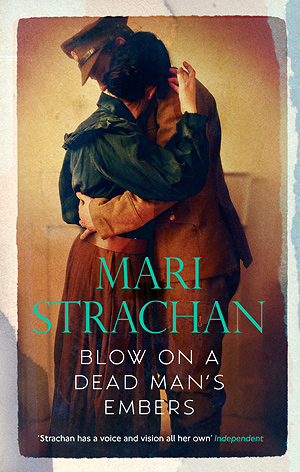
Blow on a Dead Man’s Embers by Mari Strachan

Blow on a Dead Man’s Embers has been sitting patiently on my shelf for a few months waiting until I felt it was the right time to read it. It sounded interesting and I’d heard some positive things about it, but it didn’t seem like a book that was calling out to be read immediately. Looking at the first couple of pages I noticed that it was written in third person present tense, something I often have a problem with, and this was another reason I wasn’t in any hurry to start reading. Well, it seems I was doing this book an injustice because Blow on a Dead Man’s Embers turned out to be a very moving, atmospheric novel and one I loved from beginning to end.

The book is set in a small community in Wales in the 1920s, just a few years after the end of World War I. The war has left many women grieving for a husband, a son or a brother and Non (Rhiannon) Davies is one of the lucky ones whose husband Davey has come home. But although Davey is physically unharmed he is still haunted by his experiences in the trenches. When Non finds him hiding under the kitchen table one morning she grows concerned for his mental health, but she knows that before she can help him she needs to find out exactly what happened to him during the war. Could a letter from a woman called Angela in London hold the answers?

As well as being a story about the aftermath of the Great War, this is also the story of Non and her relationships with the various members of her family. She has two teenage stepchildren to take care of, in addition to seven-year-old Osian who appears to be autistic (although this condition would not have been understood in the 1920s). Then there’s Non’s nephew, Gwydion, whose parents disapprove of his politics and his Irish girlfriend, and her mother-in-law, Catherine Davies, who makes no secret of her dislike for Non. Even the book’s minor characters are well-drawn and believable, from the Davies’ interfering neighbour, Maggie Ellis, to their tame crow, Herman.

One of the things I loved about this book was the way it looks at so many different aspects of World War I and what it was like in the years immediately afterwards. As well as Davey’s shell shock (what we would now call post traumatic stress disorder) we also meet other former soldiers with various physical or mental problems caused by the war. There are also a lot of men who are struggling to find work now that the war is over and are wandering the Welsh countryside in search of food and shelter. And we also see how the women are trying to cope with the loss of their loved ones and how some of them are in denial, unable to accept what has happened.

I don’t think I’ve ever read a novel set in Wales during this period and Mari Strachan’s descriptions of life in 1920s Wales are just how I would have imagined it. The book does use some Welsh terms which, unless you’re Welsh, may seem unfamiliar at first (the children call their grandparents Nain and Taid and their father Tada, for example) but I soon got used to them.

For a book where nothing very dramatic happens this was still a very absorbing story and after a slow start I found that I really cared about the Davies family and I wanted to read on and find out what would happen to them. At first I thought this was going to be a bleak, depressing book but it actually wasn’t because it’s told with a lot of warmth and even some humour.

Have you read any books about World War I? Which ones can you recommend?
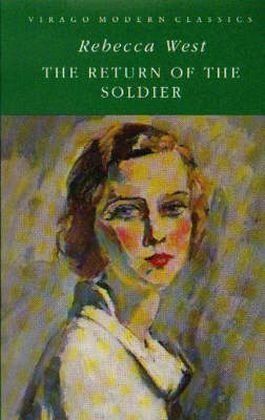
Virago Reading Week: The Return of the Soldier by Rebecca West

Rebecca West’s The Return of the Soldier was written during World War I and published in 1918. The soldier of the title is Christopher Baldry, who has just been sent home from a hospital in Boulogne. Chris is suffering from severe amnesia and is unable to remember the last fifteen years of his life. He can’t wait to be reunited with his girlfriend Margaret Allington, the daughter of an innkeeper on Monkey Island. Unfortunately, though, Margaret is no longer his girlfriend – she’s married to another man and is now Mrs Grey. And to make matters even more complicated, Chris has a wife of his own.

The story is narrated by Jenny, Chris’s cousin, who has been staying at his home, Baldry Court, with his wife, Kitty. Jenny is unmarried but appears to be in love with Chris herself and is devoted to making him happy. When it becomes obvious that Chris really can’t remember Kitty and is still in love with Margaret, the three women are faced with a decision. Is it better for him to be ‘cured’ and regain his memory, even if it means bringing back the horrors of war – or should he be left as he is, blissfully unaware of what has happened during the last fifteen years?

Despite being a quick read at less than 200 pages, The Return of the Soldier raises some interesting issues and leaves the reader with a lot to think about. Although the title character is a First World War soldier, this is not really a book about the war itself and we learn almost nothing about what Chris experienced (in fact, I felt that we didn’t really get to know Chris very well at all). Instead, West takes the war as a starting point to explore some of the consequences that arose from it, such as memory loss as a symptom of the shell shock which many soldiers suffered due to their horrific experiences in the trenches.

But to me, the major theme of this novel was West’s portrayal of class differences, with the rich, spoilt Kitty on one side and the poor, plain Margaret on the other. Kitty treats Margaret with disdain and contempt and Jenny initially shares the same views. I actually found the first couple of chapters quite difficult to read because of their nasty attitudes. For example, this is what Jenny thinks of Margaret on their first meeting:

She was repulsively furred with neglect and poverty, as even a good glove that has dropped down behind a bed in a hotel and has lain undisturbed for a day or two is repulsive when the chambermaid retrieves it from the dust and fluff.

Eventually Jenny’s attitude starts to change and she begins to see why Chris loves Margaret so much. However, Kitty’s character is never really developed at all. I was expecting Kitty and her relationship with Chris to play a bigger part in the story, but this didn’t happen. Instead, as Margaret comes into the forefront of the story and we start to see her inner beauty and warmth, Kitty’s role becomes less significant.

This book can easily be read in one sitting, which is exactly what I did as I didn’t want to put it down. Rebecca West’s writing is beautiful and for such a short book it was very moving and poignant. Just a word of warning, though – don’t read the back cover first as it gives the ending away!

I read this book as part of the Virago Reading Week hosted by Carolyn of A Few of My Favourite Books and Rachel of Book Snob.

The Return of Captain John Emmett by Elizabeth Speller

When Captain John Emmett returns from France at the end of World War I, his mother and sister are worried about his mental condition. John is suffering from shell-shock, which is causing him to become aggressive and violent. After spending some time in a nursing home, John escapes and is later found dead in a nearby wood. It is assumed that he committed suicide.

John’s sister, Mary, contacts one of her brother’s old school friends, Laurence Bartram, in the hope that he can help her discover what really happened to her brother. Why would a man who had survived the horrors of the war shoot himself two years later? As Laurence starts to investigate, he begins to wonder whether someone else was behind John’s death.

The Return of Captain John Emmett is a fascinating story. It works well as a historical fiction novel, with its portrayal of the people of 1920s Britain coming to terms with the aftermath of World War I. But it’s also a gripping psychological mystery in which Laurence Bartram reluctantly takes on the role of detective to investigate the circumstances surrounding his friend’s death. There are clues, suspects, red herrings and all the other elements that make up a compelling and well-structured detective story.

The book is also an interesting and poignant study into the effects, both long-term and short-term, that the war had on individuals and their families. How people came back from the war an entirely different person to when they went away. How men dealt with the memories of the atrocities they witnessed. How their wives felt about the part of their husbands’ lives that they had been unable to share. How people were left with physical disabilities and had to learn to adjust.

We are given insights into the thoughts and emotions of a First World War soldier and we learn what it was like to be part of a firing squad. The War Poets are also touched upon, and so are the loyalties and friendships formed in British public schools.

Due to the subject and setting, the book had a sombre and depressing feel, yet I found myself really enjoying it. As the mystery surrounding John Emmett’s death became more and more complex and involved, I was completely drawn into Laurence Bartram’s investigations. The plot relies quite heavily on coincidences in places, but not so much that it spoiled the story for me at all. I loved it and will definitely be looking out for more novels from Elizabeth Speller!

I received a review copy of this book from NetGalley courtesy of Houghton Mifflin Harcourt.

Review: Testament of Youth by Vera Brittain

I chose to read this book as part of the Women Unbound Reading Challenge. I selected this book for Women Unbound because it is the memoirs of a woman who lived through World War I and it’s considered an important example of feminist literature.

I don’t read many non-fiction books or biographies/autobiographies so this was something different for me.

Vera Brittain was born in 1893 and grew up in Buxton, Derbyshire. Her father was the owner of a paper mill, therefore she had a comfortable, privileged childhood. Vera was well-educated and ambitious and longed to break away from what she frequently refers to as her ‘provincial’ life in Buxton. She already considered herself to be a feminist and wanted more out of life than just to leave school and get married like most of the other girls she knew. Her father finally agreed that she could go to Oxford University, but just as she was beginning her studies, war broke out in Europe. With her fiance Roland, brother Edward, and two close friends fighting on the front line, she was unable to concentrate on her studies and decided to enlist as a V.A.D. nurse.

It was fascinating to read a personal account of the effects the war had on one woman’s life and on society as a whole. Reading this book made me realise how little I actually knew about World War I. A lot of the places and events mentioned in the book were unfamiliar to me and left me wanting to find out more.

Rather than just relying on her memory, Brittain uses a number of different sources, including her private diaries and correspondence and verses from poems, some of which were written by Roland or Vera herself. As I read about all the pain and sorrow she was forced to endure, I became completely absorbed in Vera Brittain’s story. I found it very inspirational that despite having her entire world torn apart by the war, she was still able to go on to build a successful career for herself as a novelist, feminist and pacifist.

Although Testament of Youth was a long, demanding and often heartbreaking book, I’m glad I read it and I feel I learned a lot from it.

Highly Recommended

Genre: Non-Fiction (Autobiography)/Pages: 640/Publisher: Virago/Year: 1933/Source: borrowed a copy