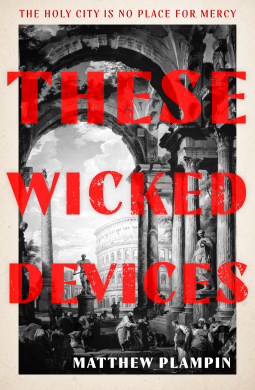
 I’ve only read one Matthew Plampin book – Mrs Whistler, about the life of Maud Franklin, the model and muse of the artist James McNeill Whistler – so I was intrigued by the description of his new one, which is set in an entirely different time and place. These Wicked Devices takes us to Rome in the summer of 1650 and introduces us to three separate characters whose stories become entwined in various ways.
First, we meet Sister Orsola, a Benedictine nun who has fled to Rome after the city of Castro, including the convent that was her home, was razed to the ground on the Pope’s orders. Orsola is accompanied by Sister Serafina, a choir nun who goes into trance-like states where she endlessly recites the lives of the saints. In the final hours before Castro’s destruction, the Mother Abbess had asked Orsola to protect Serafina and help her find another convent where she could live in safety. Orsola agreed, hoping that performing this task would help her to atone for the sin of giving birth to a child who died unbaptised.
Another thread of the novel follows Donna Olimpia Maidalchini, the most important woman in Rome. As the sister-in-law of Pope Innocent X, she is regarded as the real power behind the papal throne, involving herself in politics and the appointment of positions within the church. At the beginning of the novel, Donna Olimpia is negotiating with France to help a French invasion force seize the Kingdom of Naples from Spain.
Finally, we meet Juan de Pareja , newly arrived in Rome from Spain. Juan is an assistant and slave of the Spanish artist, Diego Velázquez, who hopes to paint a portrait of the Pope. When Juan discovers some secret papers hidden inside a metal statue, however, he suspects that there’s also another reason for their presence in Rome.
These three storylines alternate throughout the book, clearly marked with the Latin headings Sorores (sisters), Domina (mistress) and Servus (servant), to indicate whose perspective we’ll be reading from next. The three do merge together a lot, but I did find myself preferring one over the others – the one about Sisters Orsola and Serafina. There’s a real sense of danger as they are suspected of being heretics due to their connection with Castro and Orsola isn’t sure who can and can’t be trusted as she tries to carry out her promise to the Abbess. There was a lot to interest me in Juan de Pareja’s story as well – his relationship with his master, Diego Velázquez, his own ambitions of becoming an artist and his desire to live his life as a free man – but I found Donna Olimpia’s sections less engaging, maybe because she herself is much less likeable as a person.
Plampin creates a strong sense of time and place, with vivid descriptions of the piazzas, fountains, palazzi and churches of Rome as the city bakes in a late spring heatwave. I found the writing style quite dry, though, so for me this was an interesting read rather than an entertaining one. Still, it was good to add to my knowledge of a period in Rome’s history that I knew very little about.
Thanks to The Borough Press for providing a copy of this book for review via NetGalley.

Book 7/20 for 20 Books of Summer 2025.
 She Reads Novels
I’ve found him very hit & miss. I REALLY enjoyed his first book ‘The Street Philosopher’ (2009), but didn’t like ‘The Devil’s Acre’ (2010) very much, although it was interesting in parts it lacked an overall focus.
I’ve been meaning to read The Street Philosopher for years, so I’m pleased to hear you enjoyed it! That’s a shame about The Devil’s Acre, though.
Great review as always. I was just thinking yesterday that I have not read a good historical fiction in a while and as I started to read your post, I thought, maybe this one. But as I read through, I realised maybe not this one, now! But it is an intriguing period of history and a very interesting premises. Wish the writing has been upto the standard.
It’s good to hear from you again, Cirtnecce! This is an interesting book and the historical period is definitely a fascinating one, but the way it’s written stopped me from fully enjoying it. I felt the same way about the other Matthew Plampin book I read, Mrs Whistler.
I’ve followed Matthew Plampin’s writing career with interest since enjoying The Street Philosopher. I agree with Cyberkitten that his novels are a bit hit and miss but there’s usually something of interest. Mrs Whistler came out in 2018 so there’s been quite a wait for this current novel. In fact I thought he might have stopped writing. I think he also lectures in art history so it probably isn’t surprising that the most interesting character in this one is assistant to Velazquez. I will give it a read as I’ve read all the others.
There’s a strong art element in this book (and obviously in Mrs Whistler), so I’m not surprised to hear he’s an art history lecturer. I hope you enjoy this one. I don’t think he’ll ever be a favourite author of mine, but he does write about interesting subjects and I do want to read The Street Philosopher, at least.
Great review, I think I’ll add this to my TBR but not as a high priority read so I doubt I’ll get to it anytime particularly soon. I think the setting and characters sound fascinating. Sometimes I find unlikeable characters interesting so that problem doesn’t worry me too much. I am worried that you found the writing style dry though, hence the lesser priority status.
I think it’s definitely worth reading, although not as enjoyable as I had hoped it would be. I always like Italian settings and I don’t really mind unlikeable characters either, as long as they are interesting.
Shame about the writing style as the interlocking storylines do sound interesting, and I love an Italian early modern city state setting.
It’s well written, but a bit lacking in warmth and emotion which made it hard for me to really connect with it, which is the same problem I had with the other Matthew Plampin book I read. He does write about interesting subjects, though!
I do like the idea of the three stories connecting together, and this time frame!
Thanks for sharing this review with the Historical Fiction Reading Challenge.