The Moonspinners by Mary Stewart

The Moonspinners “Sometimes, when you’re deep in the countryside, you meet three girls, walking along the hill tracks in the dusk, spinning. They each have a spindle, and onto these they are spinning their wool, milk-white, like the moonlight. In fact, it is the moonlight, the moon itself…all they have to do is to see that the world gets its hours of darkness, and they do this by spinning the moon down out of the sky.”

With spring still a few weeks away and the weather still cold, damp and miserable, The Moonspinners with its beautifully described Greek island setting was just what I needed!

The story is narrated by Nicola Ferris, who is taking a break from her job at the British Embassy in Athens to spend a few days visiting Crete. She has arranged to meet her cousin, Frances, there but Nicola arrives a day earlier than planned and decides to go exploring on her own. In the mountains above Agios Georgios, the village where they are going to be staying, Nicola stumbles into adventure when she meets a young Englishman, Mark Langley, who has been wounded after witnessing a crime.

Mark is being tended by his Greek friend, Lambis, but his younger brother, Colin, has been kidnapped by the criminal gang and Mark is worried that he might have been murdered. Nicola wants to help but it’s time to go down to the village and meet Frances, so she reluctantly leaves Mark and Lambis in their hiding place. After arriving at her hotel and speaking to the hotel owner and his assistant, Nicola thinks she has discovered who was responsible for Colin’s disappearance, but will she be able to find him before it’s too late?

I love Mary Stewart’s books because they’re fun and easy to read while still being well-written, intelligent novels with exciting plots and atmospheric settings. Her descriptive writing is so impressive in this book; whether she’s describing the colour of the sea, the warmth of the sun, the fishing boats in the bay, the unspoilt countryside or the picturesque sight of windmills with white sails, she always chooses the perfect words and makes everything sound beautiful and idyllic:

“A clump of tamarisk trees stood where the gravel gave way to the flat rock of the foreshore; this, smoothed and fissured by water, burned white in the sun. In every cranny of rock blazed the brilliant pink and crimson sunbursts of ice daisies, and just beside them, the sea moved lazily, silky and dark, its faint bars of light and shadow gently lifting and falling against the hot rock.”

I have never been to Crete but reading the wonderful, evocative way it is depicted in this book made me wish I was there, though as the book was written in the 1960s before the Greek islands became such popular tourist destinations (Nicola and Frances are the only guests at their tiny hotel in Agios Georgios) I’m sure the culture and landscape must have changed a lot since then!

Of the five Mary Stewart novels I have now read, this is one of my favourites so far and might be a good one to start with if you’ve never read any of her books. There’s also a 1964 Disney film version of The Moonspinners with Hayley Mills, though I haven’t seen it and have heard that it’s very different to the book. Has anyone seen it?

The Gabriel Hounds will be the next Mary Stewart book I read – I found it in the library last week and am looking forward to starting it in the next few days.
The Iron King by Maurice Druon

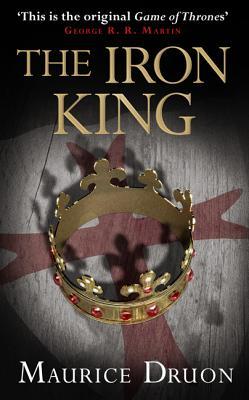
The Iron King “This is the original Game of Thrones” it says on the front cover, but anyone picking this book up hoping for an epic fantasy novel is going to be disappointed. The French novelist Maurice Druon may have been George R.R. Martin’s inspiration (I haven’t read Martin’s books so wouldn’t know how strong the influence actually is), but this is definitely not fantasy – it’s an historical fiction novel and an excellent one too. While I think it’s good that Martin’s recommendation is encouraging people to read The Iron King, I do think it was maybe a mistake for the publisher to market the book in this way, as looking through the various reviews on Amazon it seems a lot of people have not got the novel they were expecting and as a consequence The Iron King has ended up with a lower rating than it deserves.

Anyway, now that we’ve established what type of book this is, let me tell you what it’s about! Originally published in the 1950s, this is the first in the seven-volume “Accursed Kings” series and tells the story of a fascinating period of French history. The Iron King of the title is Philip IV of France, who was also known as Philip the Fair. For seven years Philip has been persecuting the Knights Templar who he wishes to destroy because of their power and riches, and he finally succeeds in having their Grand Master, Jacques de Molay, burned at the stake. But before the Grand Master goes to his death, he puts a curse on the King and his descendants – “accursed to the thirteenth generation!”

Things soon start to go badly for Philip and his family when it emerges that his sons’ wives are cheating on them with two young courtiers. Philip’s daughter Isabella, who is in a loveless marriage to King Edward II of England, sees an opportunity to bring their adultery to light, with the assistance of her ambitious and vengeful cousin, Robert of Artois, who is forming a plot of his own to reclaim his lands from his hated Aunt Mahaut. It seems that the Grand Master’s curse has been successful…

As this is a novel first published in 1955 and translated from French, it does have a very different feel in comparison to most of the historical fiction novels that are being written today and this was something I really liked about the book. Unfortunately I don’t have the language skills to be able to read it in its original French, but as far as I could tell, the translator (Humphrey Hare) has done a good job and The Iron King was one of the most entertaining historical fiction novels I’ve read for a while. There were so many interesting things to learn about – the origins of the famous ‘Tour de Nesle affair’; the demise of the Knights Templar; the community of Lombard bankers in Paris – and with a plot involving murder, torture, poisonings, court intrigue, and family feuds, there was always something happening.

Don’t worry if you know nothing about this period of French history – I had absolutely no previous knowledge of Philip the Fair and his family before reading this book but that was not a problem at all because this edition of the book makes the story easy to understand and follow. Everything you need to know regarding the historical background, the politics or the causes of feuds and disputes is clearly explained in the notes at the back of the book and the character list at the front helped me remember who everyone was and how they were related to each other. I am now looking forward to the second Accursed Kings book, The Strangled Queen. I hope the publisher will continue to reissue the rest of the series!

The Unlikely Pilgrimage of Harold Fry by Rachel Joyce

The Unlikely Pilgrimage of Harold Fry When I started reading The Unlikely Pilgrimage of Harold Fry it occurred to me how few contemporary novels I read these days. Most of the books I’ve read so far this year have been historical fiction, classics or ‘older’ books, so it was actually a refreshing change to read something written and set in the 21st century for once!

As the title suggests, this is the story of a man who embarks on an unlikely journey from one end of England to the other. His name is Harold Fry and his pilgrimage begins when he receives a letter from an old friend, Queenie Hennessey, who is writing to say goodbye because she has been diagnosed with terminal cancer. Harold writes a letter in reply but on his way to post it he becomes aware of the complete inadequacy of his words. And so Harold just keeps on walking…all the way to the hospice in Berwick-upon-Tweed, over five hundred miles away from his home in Devon.

Because it was such a spur of the moment decision, Harold is badly prepared for the walk. He’s wearing the wrong clothes and shoes, he doesn’t have a map and he has left his phone at home. With blistered feet and only a vague idea of the route he needs to take, Harold’s progress is slow but still he continues to put one foot in front of the other, convinced that his pilgrimage will help keep Queenie alive.

As Harold walks, he reflects on the things that have happened in his life, the choices – both good and bad – that he has made, and his relationships with his friends and family. In particular he thinks about what has gone wrong in his marriage to his wife, Maureen, and why he has always found it so difficult to connect with their son, David.

The plot may seem simple but there’s so much emotion and poignancy packed into every page. There’s a sense of mystery too, with lots of questions to be answered. We don’t know at first what exactly happened between Harold and Queenie. What did she do to help him all those years ago? Did they have a romantic relationship or were they just friends? We also don’t know what the problem is with David and why Harold has hardly spoken to him for years. And what was it that caused the rift in Harold and Maureen’s marriage? There are clues to all of these mysteries scattered throughout the story and we learn a little bit more in each chapter, with the truth slowly unfolding as Harold progresses on his journey.

As well as learning about Harold we also spend some time with Maureen, left at home on her own, and it was good to have some of the story told from a different perspective. It was interesting to see how Maureen reacted to her husband’s decision to walk to Berwick and how she tried to come to terms with it, torn between worry, frustration and an understanding that this was something Harold felt he had to do.

During his journey, Harold meets and talks to a variety of people from all walks of life – including a girl who makes him a burger, a Slovakian woman who gives him a room for the night, an American oncologist who explains cancer to him – and most of these are very supportive when they hear about Harold’s mission. Not all of them really understand what he is trying to do, but there’s always the feeling that their lives have been altered in some way by their encounter with Harold. Later his walk starts to attract publicity and Harold finds that he has become a celebrity. He is joined en route by a number of other people, some who have good intentions but others who are walking for the wrong reasons. When the other walkers began to join Harold it felt as if the original purpose of the pilgrimage had been lost, along with the simply beauty of Harold’s walk, and around this point in the book I started to lose interest. But I kept reading because I cared about Harold and Maureen and wanted to know how things would resolve for each of them. And I was rewarded with some wonderful chapters at the end of the book, filled with revelations about Harold, Maureen, Queenie and David.

I didn’t love this book as much as so many other people seem to have done, but I did still enjoy getting to know Harold Fry!

I received a copy of this book from the publisher via Netgalley