A Discovery of Witches by Deborah Harkness

A Discovery of Witches

“It begins with absence and desire. It begins with blood and fear. It begins with a discovery of witches.”

A Discovery of Witches is the first in Deborah Harkness’s All Souls Trilogy. I’ve come to this book years after everybody else, as usual, but it seems I’ve picked a good time to read it as the third book is due out this summer. I did actually receive a review copy of the second one, Shadow of Night, a while ago but as I prefer to start at the beginning of a series I couldn’t read it until I got round to reading this one first. I haven’t been actively looking for a copy of A Discovery of Witches as I really wasn’t sure it was something I would like, but when I noticed it was available through NetGalley I decided it was time to give it a try.

Our narrator, Diana Bishop, is an American academic who has come to England to research the history of alchemy in Oxford’s Bodleian Library. She is also a witch. Not the kind who wears a black hat and flies on a broomstick, but a young woman who is able to live and work alongside humans while possessing magical powers which even she doesn’t fully understand. When Diana discovers an old alchemical manuscript known as Ashmole 782 in the library, it draws the unwelcome attention of several other beings – not just witches, but also vampires and daemons. It seems that the manuscript is bewitched and contains hidden information these other creatures desperately want.

Among the crowds of otherworldly creatures descending on Oxford in search of the manuscript is scientist Matthew Clairmont, who happens to be a vampire. Together, Matthew and Diana attempt to unravel the secrets of Ashmole 782 and in the process they begin to fall in love. But relationships between witches and vampires are strictly forbidden and the Congregation – a council made up of three representatives from each group of creatures – will do anything to put an end to their romance.

This book was a nice surprise, because I enjoyed it much more than I’d expected to! If you’ve been following my blog for a while, you will know that I don’t normally read books about vampires and witches, but I think it was precisely the fact that I don’t normally read books about vampires and witches that explains why I found this one so much fun to read. It was something different for me and the complaint some readers have, that it’s too much like Twilight for adults, meant nothing to me as I haven’t actually read Twilight (am I the only person who hasn’t?) so I’m not really familiar with what might be seen as vampire romance cliches. There were echoes of lots of other books, though. The way the story began with the discovery of a manuscript in the library was reminiscent of The Historian by Elizabeth Kostova (one of the few vampire books I have read) and the backstory involving Diana’s parents reminded me of the Harry Potter books.

There were lots of things to enjoy about A Discovery of Witches. I loved the combination of romance, history, adventure and fantasy. I liked the idea of creatures (the collective term for witches, vampires and daemons) co-existing with humans and doing the normal, everyday things that humans do – studying in libraries, drinking tea, checking their emails, even going to yoga classes. I loved the descriptions of the various locations Diana and Matthew visit, beginning in Oxford before moving on to a remote castle in the French countryside and then finally a haunted house with a mind of its own and several resident ghosts. And I enjoyed all the little scientific and historical details that are dropped into the story – information on evolution, genetics and the history of alchemy.

The book was not without a few flaws, though. I thought the pace was uneven – after a great start there was a long period where not much happened and while I wasn’t exactly bored, I did wonder when the plot was going to move forward again. Somewhere in the middle of the novel I started to feel impatient with Diana as she seemed so content to have Matthew protect her and make all the decisions in their relationship, which was disappointing after she’d appeared to be such a strong character at the beginning. I found it frustrating that she was so reluctant to use her magic, although I did eventually understand the reasons why she couldn’t or wouldn’t.

It also seemed that the sole purpose of the final few chapters of the book was to set things up for the sequel. This was not a big problem for me, as I already have a copy of the second book and could have started it immediately if I’d wanted to, but I’m sure it must have been annoying for people who read the book when it was first published and wanted to know how the story would be resolved!

I don’t think I’ll be rushing to fill my shelves with vampire books now, but I did enjoy this one and will certainly be continuing with Shadow of Night soon.

Thanks to Headline for providing a review copy via NetGalley
Classics Club March Meme: Literary Periods

The Classics Club
It’s been a while since I last answered one of the Classics Club’s monthly memes, but this one appealed to me and I thought I’d join in. The question this month is:

What is your favorite “classic” literary period and why?

This is a very easy question for me to answer. My favourite literary period is, and always has been, the Victorian period (1837-1901). I love the style of Victorian writing and while I do also enjoy reading books from other periods, I usually feel much more comfortable with a Victorian classic than with a classic from the 20th century. The reasons people sometimes give for disliking Victorian novels – the length, the wordiness, the long descriptive passages, the habit of directly addressing the reader – have never really been a problem for me. And some of the greatest characters and most memorable plots in literature can be found in Victorian fiction too.

One of the first Victorian novels I remember reading was A Christmas Carol by Charles Dickens, which I was given as a Christmas present as a child. It was a lovely illustrated hardback edition which I still have and sometimes re-read at Christmas. This was followed several years later by Emily Bronte’s Wuthering Heights and Charlotte Bronte’s Jane Eyre, both of which I read as a young teenager and loved. It took me a lot longer to get to Anne Bronte’s novels but when I eventually did I enjoyed those as well, particularly The Tenant of Wildfall Hall.

Our Mutual FriendDespite enjoying A Christmas Carol when I first read it all those years ago, it’s only more recently that I’ve come to appreciate Charles Dickens’ other work. Our Mutual Friend found its way onto my books of the year list in 2011 and A Tale of Two Cities did the same in 2013.

Dickens and the Brontes are probably the first names that come to mind for most people when they think of Victorian novelists, but there are so many others that I love too. As the Victorian period covers several decades, it obviously encompasses a wide range of different types of books and authors from Gothic novels such as Bram Stoker’s Dracula and Sheridan Le Fanu’s Uncle Silas to the wonderful Victorian sensation novels of Wilkie Collins, Mary Elizabeth Braddon and Ellen Wood (The Woman in White, Lady Audley’s Secret and East Lynne are some of my favourites) and the comedy of Jerome K. Jerome who wrote the hilarious Three Men in a Boat and Three Men on the Bummel.

Sylvia's LoversAnthony Trollope is another of my favourite Victorians (I have now read all six of his Chronicles of Barsetshire and am currently in the middle of his first Palliser novel, Can You Forgive Her?) and so is Thomas Hardy – I’ve loved all of his books that I’ve read so far, especially Tess of the d’Urbervilles and A Pair of Blue Eyes.

As I come to the end of this post I realise I haven’t even mentioned George Eliot or Elizabeth Gaskell – or any of the non-British authors who I’m never quite sure whether to class as ‘Victorian’ or not but who wrote during the same period. And there were some classic children’s novels published during the Victorian era too. I think Black Beauty may actually have been the very first Victorian novel I ever read!

Do you enjoy reading Victorian literature or is there another period that you prefer?

If you do like the Victorians, do you have any favourite authors or books that I haven’t mentioned here?

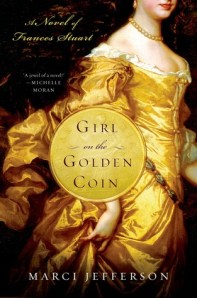
Girl on the Golden Coin by Marci Jefferson

Girl on the Golden Coin For more than three hundred years, an image of Britannia with her shield and spear or trident has been depicted on the reverse of certain British coins. In the 17th century, the model for Britannia was said to be Frances Stuart, who was described by Samuel Pepys as a great beauty and who famously refused to become a mistress of King Charles II. Girl on the Golden Coin is Frances Stuart’s story.

At the beginning of the novel, Frances is one of a family of Royalists who have been living in exile in Paris since Charles I was defeated in the English Civil War. With the Restoration of the monarchy in 1660, the Stuart family return to favour and Frances joins the household of Henriette Anne, Charles II’s younger sister, who has just married the brother of Louis XIV of France (the ‘Sun King’). When Frances catches Louis’ eye, he sends her to the English court where she is faced with the task of seducing Charles, converting him to Catholicism and helping to form an alliance between England and France.

The rest of the novel follows Frances at the court of Charles II, exploring her relationships with the King, his noblemen and the other women of the court including the young Queen, Catherine of Braganza, and the King’s favourite mistress Barbara Palmer, Lady Castlemaine. As Frances grows closer to Charles and begins to replace Castlemaine in his affections, she finds herself under pressure from the Queen Mother, the French ambassadors and various courtiers to use her influence with the King to help further their political intrigues – and failure to do so could result in her own family secrets being exposed.

Girl on the Golden Coin is Marci Jefferson’s first novel and was only published in February, but has been attracting some excellent reviews already. I can see its appeal, but unfortunately I didn’t enjoy it as much as most other readers have. It was fun to read but it was too light for me and didn’t have the depth I prefer in my historical fiction – although to be fair, that’s what I had suspected before I started reading but decided to still read it anyway as the Restoration is such an interesting period of history and I had never come across a book written from Frances Stuart’s perspective before.

I suppose given who Frances was and her position at court, it’s understandable that so much of the novel concentrates on her love life, but I would personally have preferred less romance, fewer descriptions of pretty silk dresses and beautiful jewels, and more focus on the history. The novel does touch on important issues such as religious conflict (in the form of two of Frances’ servants, one of whom is a Catholic and the other a Quaker), and the Anglo-Dutch War but I was disappointed that there were only a few pages devoted to some of the most significant historical events Frances lived through, such as the Great Plague and the Great Fire of London. I couldn’t help making comparisons with Forever Amber by Kathleen Winsor, another historical romance set at the court of Charles II, but which captures the drama and atmosphere of the Restoration period in a way which, in my opinion, this book doesn’t.

I don’t want to sound too negative because I didn’t actually dislike Girl on the Golden Coin – it was a quick read that kept me entertained for a few days and a good introduction to the life of Frances Stuart, someone I previously knew almost nothing about. As the response to this novel so far has been overwhelmingly positive I’m sure Marci Jefferson has a very successful career ahead of her. This just wasn’t the right book for me.

Thanks to the publisher for providing a review copy via NetGalley.

Cat Among the Pigeons by Agatha Christie

Cat Among the Pigeons Cat Among the Pigeons, published in 1959, is one of Agatha Christie’s later Poirot mysteries and combines a girls’ school setting with the story of a revolution in Ramat, a fictional country in the Middle East. I still have a lot of reading to do before I’ll have finished all of the Poirot books, but this is one that I’ve particularly enjoyed.

Most of the action takes place at Meadowbank School, an exclusive girls-only school in England which is still run by its two founders, Miss Bulstrode and Miss Chadwick, but first we visit Ramat, where Prince Ali Yusuf is preparing to escape the uprising in his country. In an attempt to keep some of his fortune safe, the Prince gives some valuable jewels to his pilot and asks him to smuggle them out of the country. The pilot’s sister and young niece, Jennifer, have been visiting Ramat but are due to return to England the next day, so he hides the jewels in their luggage without telling them what he has done.

Back in England, Jennifer begins attending Meadowbank School, one of several new girls to join the school that term. There are also some new teachers, a new secretary and a new gardener. When a murder takes place at the school a few weeks later, it seems that whoever committed the crime may have been trying to find the missing jewels. Is there someone at Meadowbank who shouldn’t be there? In other words, is there a ‘cat among the pigeons’?

Well, I was completely fooled by this one! While I found it very easy to guess the hiding place of the jewels, I did not guess who the murderer was until the truth was revealed. The most annoying thing was that I did originally suspect the right person but was thrown off the scent halfway through the book and decided I must have been wrong. After that, I think I suspected almost everybody!

As I was reading I kept wondering when Hercule Poirot himself was going to enter the story and I was surprised to find that he doesn’t actually make his first appearance until the final third of the book. By the time he arrives on the scene the mystery has already been partially solved and while he does unravel the rest of the clues and identify the murderer, I’m not sure Poirot’s involvement really added anything to the story.

Although the mystery was a good one that kept me guessing, the reason I enjoyed this book so much was the setting rather than the plot. Like many British children I grew up reading Enid Blyton books and still have very fond memories of them. I loved her two school series, St Clare’s and Malory Towers, and in Cat Among the Pigeons Agatha Christie captures the same sort of atmosphere. The school setting, the focus on the lives of the girls and their teachers, and the very late appearance of Poirot, gives this book a slightly different feel from the others I’ve read.

Have you read this one? Which is your favourite Poirot mystery?