The Classics Club Spin #6 – My list

The Classics Club

I was hoping the Classics Club would be hosting another spin this month as I haven’t been making much progress with my Classics Club list recently, so today’s announcement couldn’t have been more welcome!

Here are the rules:

* List any twenty books you have left to read from your Classics Club list.
* Number them from 1 to 20.
* Next Monday (May 12th) the Classics Club will announce a number.
* This is the book you need to read during May and June!

And here is my Spin List:

1. The Mayor of Casterbridge by Thomas Hardy
2. Family Roundabout by Richmal Crompton
3. A Country Doctor’s Notebook by Mikhail Bulgakov
4. The Day of the Triffids by John Wyndham
5. The Vicomte de Bragelonne by Alexandre Dumas
6. The Heir of Redclyffe by Charlotte M. Yonge
7. The Hunchback of Notre Dame by Victor Hugo
8. The Idiot by Fyodor Dostoevsky
9. The Cloister and the Hearth by Charles Reade
10. The Remains of the Day by Kazuo Ishiguro
11. The Glass-Blowers by Daphne du Maurier
12. Around the World in Eighty Days by Jules Verne
13. The Sea Hawk by Rafael Sabatini
14. David Copperfield by Charles Dickens
15. Excellent Women by Barbara Pym
16. Romola by George Eliot
17. Lorna Doone by R.D. Blackmore
18. The Charterhouse of Parma by Stendhal
19. The Leopard by Giuseppe Tomasi di Lampedusa
20. Vanity Fair by William Makepeace Thackeray

I can’t wait for next Monday to find out which book I’ll be reading! Are there any numbers you think I should be hoping for – or hoping to avoid?

Americanah by Chimamanda Ngozi Adichie

Americanah Americanah is the story of Ifemelu and Obinze, two Nigerian people who have very different experiences of immigration. Ifemelu leaves Nigeria as a young woman to complete her studies in America. Thirteen years later she is still there, having established a successful career for herself as a blogger, but she has now made the decision to go home. Before she returns to Lagos, Ifemelu goes to an African hair salon in Trenton, New Jersey, to have her hair braided – a process which takes six hours, giving her time to reflect on all the things she has learned and observed during her years in America.

Obinze, who was Ifemelu’s boyfriend before she left Nigeria, also has dreams of going to America but is unable to obtain a visa and ends up working in London as an illegal immigrant. Obinze and Ifemelu are eventually reunited in Lagos, but will their love have survived so many years of separation?

As promised on the book cover, there is a love story to be found in Americanah, but this is not the main focus of the novel. The focus is on Ifemelu and her life in America, with several chapters following Obinze and his experiences in England. On arriving in the country that will be her home for the next thirteen years, Ifemelu faces a lot of challenges and difficulties, ranging from finding a job to learning how to cook hot dogs! She has many encounters with examples of racism (sometimes very subtle and sometimes much more obvious) and at the other end of the scale, people who are trying too hard to avoid talking about race because they’re afraid that they might cause offence. All of this gives Ifemelu plenty of material for her blog, which she calls Raceteenth, or Various Observations About American Blacks (Those Formerly Known as Negroes) by a Non-­American Black.

Some excerpts from Ifemelu’s blog posts are included in the book and are fascinating to read, particularly when she writes about the differences between being a black American and a non-American black person. Something I found interesting was Ifemelu’s comment that “I came from a country where race was not an issue; I did not think of myself as black and I only became black when I came to America.” This is in contrast to her cousin, Dike, who leaves Nigeria with his mother as a very young child and so has a very different perspective on life.

While I didn’t love Americanah quite as much as I’d hoped to, it was full of insightful observations and it’s a book that I would recommend to everyone, whatever your race, nationality or skin colour. As a white person, I confess that many of the aspects of race discussed in the novel are things that have never even occurred to me. So, as a commentary on race and immigration, I thought this book was excellent – the best I’ve read on these subjects. The various devices Adichie uses (blog posts, discussions at dinner parties, the conversations of the women working in the hair salon) give her an opportunity to explore important issues in an interesting and often witty way rather than just lecturing the reader.

Purely as a novel, though, I thought Americanah was less successful. It felt a lot longer than it really needed to be, considering the plot is not a particularly complex one, and while I was interested in following Ifemelu’s and Obinze’s separate storylines, I found I didn’t really care whether they got back together at the end of the book or not. I think for me personally this is a book I enjoyed on an intellectual level rather than an emotional one, which is not necessarily a negative thing, but probably the reason why, of the two books I’ve now read by Adichie, I prefer Half of a Yellow Sun to this one.
Madame Bovary by Gustave Flaubert

Madame Bovary I read Madame Bovary during April as part of a readalong hosted by Juliana of Cedar Station and CJ of ebookclassics. It was a book I’d been thinking about reading for a while anyway so the announcement of the readalong couldn’t have come at a better time for me.

Madame Bovary is a French realist novel published in 1856. The title character, Emma Bovary, longs to experience the drama and excitement she has read about in romantic novels but she is unlikely to find it in her marriage to Charles Bovary, an unambitious country doctor. Charles loves his wife and is not unkind to her, but Emma finds him boring and her life dull and meaningless. After she and Charles attend a ball hosted by the Marquis d’Andervilliers, Emma becomes depressed and miserable; she has had a glimpse of a more glamorous world and it has left her even more disillusioned and dissatisfied with her own situation.

Charles wonders whether a move to a larger town will make her happy but Emma is no more content in their new home in Yonville-l’Abbaye than she was in the small village they’ve left behind. Seeking an escape from her unhappy existence, Emma has affairs and spends money she can’t afford, but as she becomes more reckless in both her romantic and financial entanglements, her life begins to spiral out of control.

It has been interesting to read the opinions of other readalong participants, because while I think we all agree that Emma’s behaviour is silly and self-destructive, the amount of sympathy we have for her seems to vary widely. Some readers can relate to Emma and admire her for doing something to try to change her life and find some happiness; other readers find her very selfish and annoying.

I’m one of those readers who didn’t like Emma at all, though I did have some pity for her, because I know there weren’t many options open to women in the 19th century, particularly those living in provincial areas, who wanted more from life than just to be a wife and mother. I can see why she may have felt that adultery was a way of escape and a way to find the passion she’d read about in books. I thought it was sad that Emma couldn’t even take any pleasure in her daughter (when Berthe is born, her first emotion is disappointment that the baby isn’t a boy). Later, when Berthe comes up to her hoping for affection Emma pushes the little girl away so that she falls and hurts herself. Poor Berthe – and life doesn’t get any better for her later in the book either.

I don’t think Charles was entirely blameless as he could have made more effort to understand his wife’s feelings and he was so naïve that he seemed completely oblivious to what was going on, but my sympathy was definitely with him and with Berthe more than with Emma. I noticed, though, that Flaubert himself seems to stay neutral throughout the novel, reporting on his characters’ thoughts and actions without actually passing judgment on them and telling us what we should think.

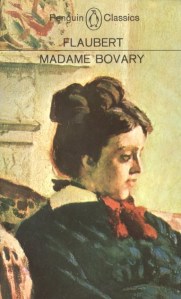
There were parts of this book that I really enjoyed, but I’ll have to be honest and say that much as I wanted to love this book I just didn’t. I think my dislike of Emma was part of the problem, but not the whole problem, as I didn’t find the writing style very engaging either. The version of Madame Bovary that I read was an older Penguin edition (pictured above) translated by Alan Russell – I had no reason for choosing this translation other than that it happened to be the one I already had on my shelf, which seemed as good a reason as any. I didn’t really have any problems with it and found it easy enough to read, but having since read that Flaubert prided himself on always searching for the perfect word, in this case it’s possible that the translation did affect my enjoyment. I didn’t like the book enough to want to read it again in a different translation to find out, though!

While this has not become a favourite classic, I’m still glad I’ve read it. If nothing else, I can now see where Mary Elizabeth Braddon’s inspiration for her novel The Doctor’s Wife came from!