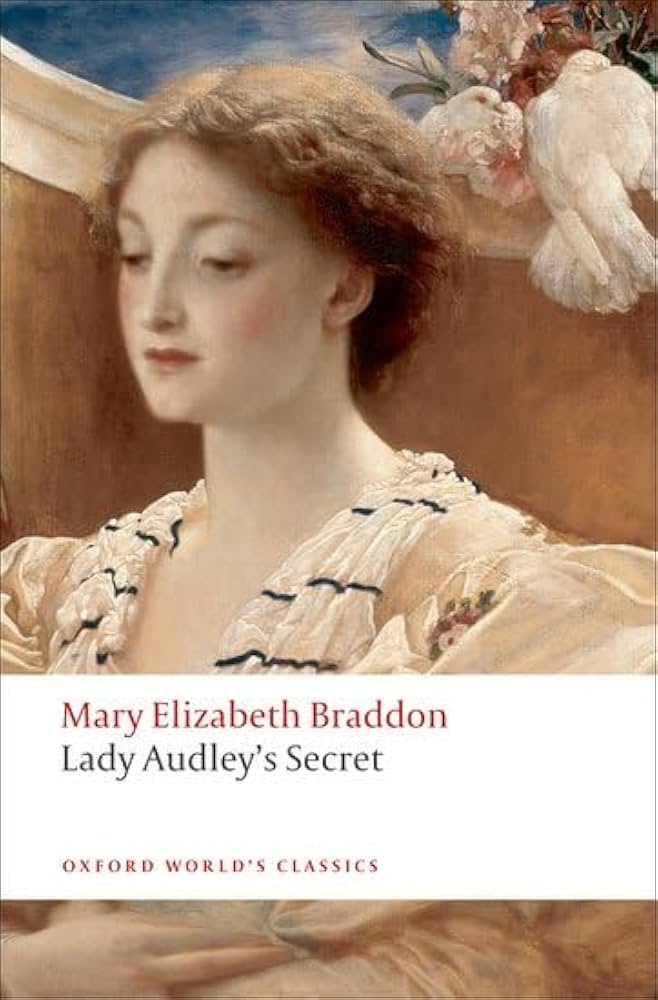
 I hadn’t been planning a re-read of this book, but when FictionFan announced a review-along I couldn’t resist joining in. I’m not sure exactly when I first read it, but it must have been around twenty years ago when I went through a phase of reading Victorian sensation novels (if you’re not familiar with the term, the sensation novel was a popular genre of 19th century fiction featuring shocking crimes in ordinary domestic settings). This is one that I particularly enjoyed so I was happy to read it again and am looking forward to reading the other review-along participants’ reviews to see what everyone else thought!
Lady Audley’s Secret was published in 1862 and was Mary Elizabeth Braddon’s most successful novel, although she wrote more than eighty others, as well as some short stories. The first thing I discovered when I started to re-read it is that I could barely remember anything at all about it, so it was almost like experiencing it for the first time again.
The novel opens with the marriage of Sir Michael Audley and Lucy Graham. Lucy is young and beautiful and Sir Michael, a middle-aged widower, is enchanted by his new wife. Little is known about her past before she arrived in the village as governess to the local doctor’s children, but Sir Michael doesn’t care – Lucy’s happiness is all that matters to him. Meanwhile, his nephew, Robert Audley, has just been reacquainted with his old friend George Talboys, who has been in Australia for three years. George, who had found himself struggling financially, had left his wife, Helen, in England while he went off to improve his fortunes. Now that he’s returned, he’s looking forward to seeing her again and is heartbroken when he discovers that she has died during his absence.
Robert does his best to comfort his friend and brings him to Audley Court to meet Sir Michael, hoping it will help to take his mind off things. However, when George disappears without explanation, Robert begins to grow suspicious of his uncle’s new wife. Convinced that George has been murdered and that the new Lady Audley is implicated, Robert begins to investigate her past and is shocked by what he discovers.
I won’t discuss the plot in any more detail as I don’t want to give too much away, but all the typical elements of a sensation novel are here: murder, arson, family secrets, stolen letters, faked telegrams, blackmail, hidden identities, thunderstorms and all sort of lies and deception! The book also touches on some more serious topics, such as the subject of madness, how it was viewed in the 19th century and how it was often used as a convenient excuse to have women locked away in order to avoid embarrassment or scandal. It’s not really difficult to guess some of the secrets but, remembering that this was one of the first and most influential books of its type, I expect readers at the time would have found it more shocking and unpredictable. It would also have had some extra relevance for Victorian readers, as Braddon took inspiration from the high profile Constance Kent murder case of 1860, which also inspired parts of Wilkie Collins’ The Moonstone and, much later, The Suspicions of Mr Whicher by Kate Summerscale.
One thing I had forgotten from my previous read was how little of the story is actually written from Lady Audley’s perspective. Instead, we spend most of the novel in Robert Audley’s company as he tries to get to the bottom of his friend’s disappearance. Although ‘detective fiction’ didn’t really exist in 1861 in the way we know it today, Robert, who is a lawyer, takes on the role of an amateur detective, tracing clues, gathering evidence and speaking to witnesses. It’s fascinating to watch him gradually begin to unravel the truth, although I didn’t always agree with what he did with the information he uncovered! Because most of what we see and learn of Lady Audley is from Robert’s point of view, she’s very much the villain of the book, but I think it’s clear that Braddon wants us to at least have some sympathy for her circumstances, if not her actions. I was a bit disappointed that George’s sister, Clara Talboys, doesn’t play a bigger part in the story, though – when she’s first introduced, it seems she’s going to join Robert in his investigations, but she barely appears again until the end.
I enjoyed my re-read, then; it’s a very readable book and although it’s quite a long one and the pace slows down at times, I still flew through the pages faster than you would expect. I’ve also read two other books by Mary Elizabeth Braddon, both of which I’ve reviewed on my blog: Aurora Floyd and The Doctor’s Wife. The first has quite a similar feel to Lady Audley’s Secret, although I didn’t find it as exciting, but the latter is very different. I’ll definitely try to explore more of Braddon’s books soon, but I would also like to revisit East Lynne by Ellen Wood and some of my favourite Wilkie Collins sensation novels.
Here are the reviews of the other review-along participants. Let me know if I’ve missed yours!


Great review! Glad you enjoyed your re-read. I love this Victorian style of writing, but it is very slow in comparison to what we’d expect from a thriller today. I was surprised at how much ‘detective novel’ stuff there was in it, at such an early date. But I’m glad Clara wasn’t in it much – I was very definitely Team Alicia! What is it with men and pretty faces – they are so shallow! They really deserve all they get… 😉
Yes, you have to approach Victorian novels with a different mindset, I think, and be prepared for a slower pace. I did like Alicia as well – I just felt that the way Clara was introduced made it seem like she was going to play an important part in the story other than just being a pretty face!
What a great review. And how fun that you barely remembered anything about it so you could enjoy it afresh again.
I’d forgotten about the fake telegrams and the stolen letters. There was quite a lot going on and Lady Audley definitely took cunning to a whole new level.
Thanks. I was surprised by how little of it I could remember, especially as I did really enjoy it the first time!
This sounds really good! I will have to add it to my list. I’d heard of it and of this author but not really paid attention to what it was about. Great review!
Yes, I loved it! I hope you do too if you decide to try it.
I enjoyed your review very much! Although it’s been quite some time ago, I went through my own “Victorian fiction phase;” in my case mostly Trollope rather than sensation novels. Regardless of specific genre, I find fiction from this period to be very interesting — you see the beginnings of so much of our own culture, yet it’s so very different. I’ve never gotten around to Braddon (I did try, briefly, Lady Audley but it was the wrong book at the time) although I hope to at some point — I have The Lawyer’s Secret & The Mystery at Fernwood waiting on the shelf!
Thanks! I love Trollope too and am planning to read the final book in the Palliser series soon, before starting on his standalones. Sorry you didn’t have much success with Lady Audley, but maybe, as you say, it was just the wrong book for that time. I hope you get on better with the one you have on the shelf.
You made a great point about much of the novel being from Robert’s point of view. It would have been a totally different story if Lucy had narrated it all! It’s a bit like reading a biography versus an autobiography (of someone rather infamous).
I think I liked Robert more than most of the reviewers and I agree about Clara. I would like to have seen more of her!
I did start this once and never finished it – I wonder if the slow pacing was the issue? I may have to have another go…
I think it’s worth persevering past the slow start as it does become quite gripping later on!
I really like this one, too. It reminds me a little of Wilkie Collins’ The Woman in White. I’ve also read her book Aurora Floyd, which is similar in many ways to this one. Someday I’ll reread them both. 😀
I love The Woman in White and yes, it does have a similar feel. I’m glad you like this one too – I hope you have a chance to reread it one day!
This was a fun one. I couldn’t participate today because of Literary Wives, but I’m posting my review tomorrow.
Yes, it’s fun. I’ll look out for your review!
Thanks!
I haven’t read anything by Braddon but I’m tempted, one for my next classics list!
Glad you’re tempted! It would be a great choice for your next list.
The quote you shared in your previous post made me curious about this one and now reading your review I’ll definitely be adding it to my TBR. Its especially interesting that it took inspiration from a real life case and has a woman in the villainous role but also manages to evoke some sympathy for her circumstances. I dont think I’ve ever tried a sensation novel either where I’ve only recently started picking up classics. Another lovely review.
Sensation novels are usually very entertaining. Mary Elizabeth Braddon and Wilkie Collins wrote the most popular ones and are both great authors. And yes, I liked the way Lady Audley is portrayed as a villain but also someone I could feel sorry for, at least a little bit!
Robert Audley was one of the great fools,(actually there are less polite ways to describe him) in Victorian literature and beyond. In the process of impressing his uncle or really, feeding his own vanity, he ruins his uncles old age and happiness. All for nothing too, as there was never any real evidence that Lady Audley had any ill intentions towards her new husband. Robert was the kind of person who would think that chasing Dracula across the European continent and breaking into his castle a brilliant idea. Play stupid games, win stupid prizes. Hopefully, Bobby boy’s next doctor was named Fillgrave.
A Victorian audience appreciated that Lady Audley must pay for her crimes, but Stephen King tells a similar tale in Dolores Claiiborne that gives a more satisfying ending; that a late twentieth century audience would appreciate.
To this day, I still wonder about the identity of the French novel that she was reading – about the French noblewoman, that suggests a similarity to her own situation. I know French novels are/were a sign of sophistication, but come on, Mary Elizabeth, what was the title?I have come to feel that it never existed, that it was created by the author for her own purposes. Surely it would have become a best seller of the time had it really existed, as one really wanted to know what that exact book was.
That’s an interesting perspective. I agree that Sir Michael was the innocent victim, but I wouldn’t personally have found it very satisfying if Lady Audley had completely avoided any kind of punishment.
I’m not sure about the French novel either. I’ve just read the description of it again and can’t think of anything it could be. You’re probably right that it’s just something Braddon invented herself to fit the plot.
This sounds like great fun! I am glad you enjoyed your re-read and taking part in the review-along. 😊
Yes, it’s a very entertaining book! I really enjoyed re-reading it for the review-along, especially as I found I could hardly remember it.
I read this as part of a list I compiled for myself of classics by women I’d missed, so it was in there with a bunch of standards, and that’s how I discovered the sensation novel, when I ended up reading this in a fraction of the time it took to read the rest: so much fun! I didn’t know East Lynne would fit there… I’ve had an older copy (i.e. no cover) for many years unread. Thanks for letting me know!
I’m glad you liked this one. East Lynne is definitely a sensation novel – I can’t remember a lot about it now, except that it was fun and another book like Lady Audley that was surprisingly quick to read despite its length!
I was disappointed that Clara didn’t make more of a showing, too, because she had so much potential! There could have been a ‘face off’ between her and Lady Audley!
Yes, that would have been fun! I had expected Clara to have a much bigger part after the way she was introduced into the story.