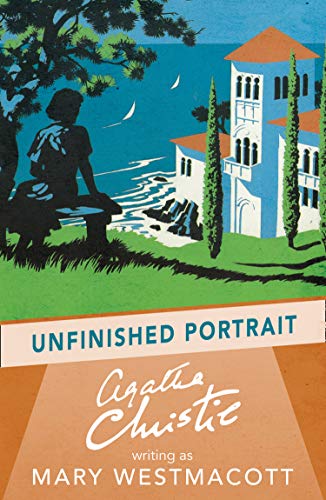
 May’s theme for the Read Christie 2023 challenge is ‘betrayal’ and the suggested title this month is Unfinished Portrait, a 1934 novel which is one of six books Christie published under the pseudonym of Mary Westmacott. Although I haven’t managed to take part in the challenge every month so far this year, I was particularly keen to join in with this one as I’ve previously only read one Westmacott novel – Giant’s Bread – and have been looking forward to reading more of them ever since.
Unfinished Portrait begins by briefly introducing us to Larraby, a portrait painter who is visiting an unnamed island when he comes across a woman sitting alone in a garden. Sensing that something is wrong, Larraby engages her in conversation and discovers that he is correct – she is intending to commit suicide. Not wanting to leave her alone, he accompanies her back to her hotel and listens as she tells him the story of her life and explains the sequence of events that have put such desperate thoughts into her head.
The woman’s name is Celia – at least that’s what Larraby calls her, as he doesn’t know her real name – and her story forms the main part of the novel. A lot of time is spent on Celia’s sheltered childhood, growing up in the late Victorian period in a comfortable home with servants and a nanny until the family’s financial position is affected by the early death of Celia’s father. I only know the basics about Agatha Christie as a person, but apparently Unfinished Portrait is semi-autobiographical, drawing on her own childhood memories to create Celia’s tales of inventing imaginary friends, time spent abroad due to her father’s poor health, the close relationships she had with her mother and grandmother and her first attempts at writing books. Later, Celia finds herself trapped in an unhappy marriage to Dermot, a man who is insensitive, controlling and eventually unfaithful – which again is based on Agatha’s own marriage to Archie Christie. If I’d been more familiar with Christie’s own life I would have appreciated the autobiographical element of the book a lot more, which would probably have added to my enjoyment of it, but I still found Celia’s story compelling in its own right.
After finishing the book, I could see how it fits the challenge topic for this month, exploring the theme of betrayal from several different angles: Dermot betrays Celia with another woman, Celia herself betrays a previous lover, and later in life she feels she has betrayed her daughter. All of these betrayals combine to cause the deterioration in Celia’s mental state that leads to her feeling so unhappy the day she meets Larraby. It’s a sad and emotional story – even sadder knowing that it was how Christie felt about her own situation at that time. Of course, the book was published in the 1930s and so it’s an ‘unfinished portrait’, leaving a lot of things in Celia’s life (and Christie’s) unresolved and incomplete.
I found this book quite different from Giant’s Bread, the only other Westmacott book I’ve read, and I think I preferred that one overall. I’m definitely more of a Christie fan than a Westmacott fan, but these are still great books and I’m looking forward to reading the other four.
 She Reads Novels
Oooh, I enjoyed the Westmacott novel Absent in the Spring (which, also, was semi-autobiographical, being partially set in the Middle East) and wanted then to read more of Christie’s novels under this name. Must look out this, which sounds deeply personal, and then the rest in due course!
Yes, even with my limited knowledge of Christie’s life I could see how personal it was. I’m looking forward to reading Absent in the Spring.
The Westmacott I read was Absent in the Spring, a character study of a forceful woman. I wasn’t that keen on it.
I’ll be interested to see what I think when I read that one.
Yes.
Absolutely fascinating! I am amazed at the shift away from her traditional mystery novels. I had no idea she delved into more personal issues in a book like this and that it was such a departure from other books. Very intriguing!
Yes, it’s completely different from her mysteries – even the writing style feels different. I’m not sure how personal the other Westmacott books are but this one definitely is.
I agree I think there are different betrayals going on and maybe also the death of her father who she loved so much? But the ultimate betrayal of her husband is absolutely raw isn’t it, that must have come straight from her heart?
I forgot about the death of her father when I was discussing the other betrayals. That’s a good point.