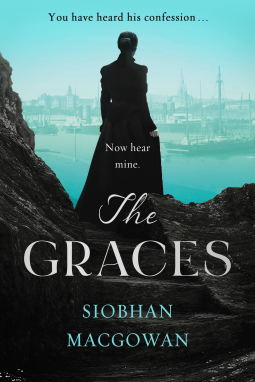
 I found Siobhan MacGowan’s first novel, The Trial of Lotta Rae, a very powerful, emotional read and I was hoping for something similar from her new book, The Graces. I’m pleased to say that I thought this one was even better.
The novel opens on an August evening in 1918, as a group of pilgrims make their way to the bell tower of Mount St Kilian Abbey in Dublin. As Brother Thomas and Father Sheridan watch the candlelit procession weaving through the trees below the abbey, they remember the woman to whom the pilgrims are paying homage – Rosaleen Moore, known as The Rose, who died just three years earlier. On her deathbed, Rosaleen revealed a terrible secret to Father Sheridan, something which has left him so disturbed he decides to discuss it with Brother Thomas tonight.
In a series of long flashbacks, Rosaleen’s story unfolds, beginning with her childhood in rural County Clare, where she first discovers that, like her grandmother, she has been ‘touched by the Graces’ and is blessed – or cursed – with the sight. When her gift gets her into trouble in the village, she is sent away to live with an aunt in Dublin. Here she finds herself befriended by a group of spiritualists and healers who encourage her to use her special talents to help others. However, Rosaleen will learn that meddling in things she doesn’t fully understand is not a good idea and could have disastrous results.
The Graces is a fascinating, moving story, exploring the clashes between superstition and science and the consequences of thinking we know best. It reminded me of Hannah Kent’s The Good People and Emma Donoghue’s The Wonder, which have similar themes and are also set in Ireland, but although it’s bleak at times, the book is also very gripping and leaves you with a lot to think about after reaching the final page. Rosaleen herself is not always an easy character to like – her arrogance leads her to make poor decisions and I was disappointed in the role she plays in a love triangle with two different men, Lorcan and Rian – but I could still have sympathy with her situation because the whole thing is so desperately sad.
Away from the central plot, the political developments in early 20th century Ireland also form an important part of the story. Rosaleen is in Dublin during the time of the Easter Rising, the formation of the Cumann na mBan (an Irish republican women’s paramilitary group) and the move towards independence. Through her relationship with Lorcan, who is involved in all of these things, Rosaleen is exposed to new ideas and new ways of thinking, but she doesn’t fully embrace them herself and feels caught in the middle between two extreme views.
Having enjoyed both of Siobhan MacGowan’s novels (although I always feel that ‘enjoyed’ isn’t quite the right word to use with this sort of book), I’m already hoping for a third!
Thanks to Welbeck Fiction for providing a copy of this book for review via NetGalley.

This is book 5/20 of my 20 Books of Summer 2023
This is book 27/50 for the 2023 Historical Fiction Reading Challenge.
 She Reads Novels
Sounds like a good one!
Yes, I loved it.
I’ve had this one in my hands in a bookshop in London and didn’t buy it (because I already had books enough in my hands). I’ll probably give this author a try one day because it sounds very interesting.
Yes, I think you might enjoy this one.
This does sound like an interesting story.
It is – and very sad!
We really can’t get enough of Irish writers these days. They seem to have a magic touch.
Yes, they do. I can think of a lot of great Irish novels I’ve read recently.
“desperately sad” has gotten my attention. Especially a story about women and their choices.
Harvee at https://bookdilettante.blogspot.com/
Sad stories can often be the most memorable and powerful. I hope you’re able to read this one.
Sounds interesting. But I think I might need to be on the right frame of mind to read it if it’s that emotional.
It’s a great book but you probably do need to be in the right mood.