‘Every object, whether it’s old, new, beautiful or even ugly, has a life. A starting point, a journey, a story, Whatever you want to call it. Some have places where they really belong, which is different from the location where they find themselves.’
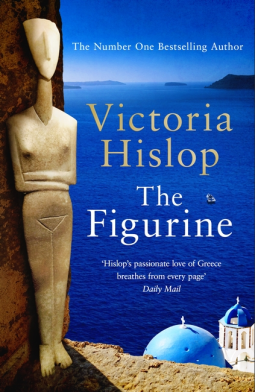 In her new novel, The Figurine, Victoria Hislop tackles the subject of the theft and smuggling of art and antiquities, a problem that has existed for centuries and sadly is still making news headlines today. As Hislop explains in her foreword to the book, ‘the theft of cultural treasures and the falsification of provenance diminishes our understanding of civilisation’. The Figurine explores this topic through the eyes of Helena McCloud, a young woman with a Greek mother and Scottish father.
We first meet Helena in 1968 as an eight-year-old child arriving in Athens to visit her grandparents for the first time. Her mother was born and raised in Greece, but she doesn’t accompany Helena on this trip and appears to have been estranged from her family for many years, although at this point we don’t know why. Everything is new and strange to Helena, but during this visit – and more to follow over the next few summers – she begins to fall in love with Greece and to develop loving relationships with her grandmother and the housekeeper, Dina. Her grandfather, however, remains a cold, remote figure and her dislike of him grows as she discovers that he has connections with the military dictatorship currently in control of the country.
Helena’s summers in Greece come to an end in the 1970s due to political turmoil and by the time it’s safe to return, her grandparents are no longer alive. Heading to Athens to inspect the apartment she has inherited from them, she makes another shocking discovery about her grandfather, this time relating to his involvement in the looting of valuable historical artefacts. Helena’s own interest in antiquities has already led her to take part in an archaeological dig on an island in the Aegean Sea. Can she use her newly gained knowledge to make amends for what her grandfather has done?
This is the third Victoria Hislop novel I’ve read, after Those Who Are Loved, also set in Greece, and The Sunrise, set during the Turkish invasion of Cyprus, and although I didn’t enjoy it as much as those two books, it was still a fascinating story. As well as the exploration of cultural theft and its impact on world heritage, we also learn a lot about the political situation in Greece during the 1960s and 70s and of course, there are lots of beautiful descriptions of the country itself. While there are some horrible characters in the novel, Helena also makes several friends and I loved watching her bond with her grandparents’ servant, Dina – I enjoyed seeing them sneak out onto the streets of Athens in search of somewhere to view the 1969 moon landing, because her grandfather has cruelly removed the television to stop them from watching this historic event.
My main problem with this book was the length; I felt that there were lots of scenes that added very little to the overall story and could easily have been left out. I also found some parts of the plot predictable and others very unrealistic, particularly towards the end of the book where Helena and her friends decide to take matters into their own hands when it would surely have been much more sensible just to have gone to the police.
Although this isn’t a favourite Hislop novel, I do have another one, The Thread, on my shelf which I’m looking forward to reading.
Thanks to Headline for providing a copy of this book for review via NetGalley.
 She Reads Novels
I don’t quite know why, but I haven’t read a Hislop. Something I should change in ’24. Though maybe not start with this one?
Those Who Are Loved is my favourite so far, but I’ve read very few of her books so it’s possible one of her others is better!
👍
The Greek setting certainly sounds tempting, but I guess if I’m going to read Hislop, I should start with another one.
I would probably recommend Those Who Are Loved rather than this one.
OK, thanks!
I have been animated in the past about looted artefacts, especially those from pristine archaeological sites, so despite your reservations I’d be interested to read this – especially as I’ve not tried Hislop up to now.
I definitely think it’s worth reading, despite my reservations! Although most of the book is set in the 70s and 80s, it’s obviously a subject that is sadly still relevant today.