 In 2014, Lucinda Riley published The Seven Sisters, the first of a seven book series, with each book telling the story of one of the seven daughters of a mysterious billionaire they know only as Pa Salt. Six of the girls were adopted by Pa Salt as babies and although they came from different countries and cultures, they all grew up together at Atlantis, Pa’s beautiful estate by Lake Geneva in Switzerland. They are each named after one of the stars in the Pleiades, or ‘Seven Sisters’, star cluster – Maia, Alycone (Ally), Asterope (Star), Celaeno (CeCe), Taygete (Tiggy) and Electra D’Aplièse. The seventh sister, Merope, was never brought home to Atlantis and we found out why in the seventh book of the series, The Missing Sister.
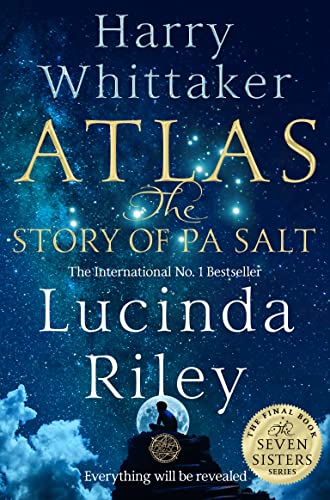
Shortly after the publication of The Missing Sister in 2021 came the sad news that Lucinda Riley had died following a long battle with cancer…and then the happier news that she had been planning an eighth book about the D’Aplièse family and had left her notes with her son, Harry Whittaker, to be completed after her death. Atlas: The Story of Pa Salt is the result. This book should definitely be read after the other seven, but I think I’ve managed to review it here without spoiling anything, so if you’re new to the series it’s safe to read on!
Most of the earlier books in the series started in the same way, with the D’Aplièse sisters mourning the death of Pa Salt in 2007 and learning that he had left each of them a set of clues to point them in the direction of their biological parents. Each novel would then focus on one sister as she traced her family history and discovered her own heritage. In Atlas: The Story of Pa Salt, it’s now 2008 and all of the sisters and their partners have gathered on board Pa’s yacht, the Titan, to sail out into the Aegean to mark the anniversary of his death. However, Pa’s lawyer, Georg Hoffman, has one more surprise for them – a copy of Pa Salt’s diary, intended to be read by his daughters after his death.
The novel alternates between the modern day storyline set on the Titan and the story that unfolds through the diary of a little boy called Atlas who is found sheltering under a hedge in a Paris garden one day in 1928, starving and exhausted. He is taken in by the kind-hearted Landowski family who provide him with a home and an education, but it is not until many years later that he is able to begin to open up about the traumas of his past and his fear that he is still being pursued by a man who wants to kill him. It is this fear that eventually leads him to leave Paris and flee once again, but he quickly discovers that nowhere is safe and his pursuer will manage to track him down no matter where he hides. As he takes refuge in first one country then another, Atlas forms friendships with the ancestors of the girls he will later come to adopt and who will know him as their beloved Pa Salt.
This is a book where a lot of suspension of disbelief is necessary, from the number of characters with names that are ridiculous anagrams from Greek myth – including Atlas Tanit (Titan) and his enemy Kreeg Eszu (Greek Zeus), whose parents happen to be Cronus and Rhea – to the idea that so many people with connections to Pa Salt have babies in need of adoption. The events that lead to his adoptions of Electra and CeCe are particularly hard to believe. The earlier books in the series are also scattered with metaphors, symbolism and coincidences, but they are much more heavy-handed in this book. Still, I managed to overlook those things because at this stage of the series I just wanted to know how everything would be resolved and whether the theories I had been forming about Pa Salt and the other characters were correct.
I’m not sure exactly how much input Lucinda Riley and Harry Whittaker each had into this book, but I do think Whittaker does a good job of capturing his mother’s writing style; there are only a few occasions where it feels obvious that it’s not the same author, mainly where the dialogue between the sisters doesn’t feel quite right. I don’t want to be too critical, though, because we’re lucky to have this book at all and I’m sure it must have been a difficult task for Harry. Although there are some plot holes and some questions that aren’t answered very satisfactorily, overall I was impressed by how well all the separate threads from the previous seven books are brought together in this one. My only real complaint is that there wasn’t a happier ending for one particular character. Anyone who reads this book will know who I mean!
Have you read any books completed by a different author after the original author’s death? What did you think?
 She Reads Novels
I thought the anagrams and Cronus and Rhea and … there were 2 other parents with names from Greek myths, but I can’t remember what they were 😄 were ridiculous, but a lot of people don’t seem to have picked up on them.
Ah, I’ve remembered! I was thinking of Pa Salt’s parents being Iapetus and Clymene, the parents of Atlas 🙄.
Yes, Iapetus and Clymene was stretching things too far, especially if they were supposed to be Russian!
What a tough job to finish writing your mother’s last book! Especially when it kind of wraps up a popular series.
It must be really difficult, but I think he did a good job!
It’s always a bit strange when a son or daughter takes up the work of a parent. I used to read the Tony Hillerbrand mysteries set in Navaho Nation (the Four Corners area of the Southwest), and they were very good, but not so much when his daughter Anne took them over. To just finish one book, though, so that the fans can have it would probably be okay.
Yes, I think just finishing another author’s book is fine, but continuing with a whole series probably isn’t a good idea.
I agree.
I have read none of these, so perhaps this isn’t a great place to start
I think starting with this final book would be quite confusing!