 Welcome to my monthly post on all things historical fiction. For my first Musings post of the year, I am looking back at the historical fiction I read in 2023 and have put together my usual selection of charts and lists! I have kept most of the same categories I’ve used for the previous seven years so that it should be easy to make comparisons and to see if there have been any interesting changes in my reading patterns and choices (here are my posts for 2022, 2021, 2020, 2019, 2018, 2017 and 2016).
Before I begin, just a reminder that I do actually read other genres but for the purposes of this post I haven’t included those books in these stats!
~
Time periods read about in 2023:

No surprises here. Since I started recording these statistics, the 19th and 20th centuries have come out on top nearly every year, apart from in 2020 when the 17th century edged into first place. I tend to read very few books set earlier than the 11th century and that was the case again this time.
~
31% of the historical fiction authors I read in 2023 were new to me.
This is slightly down on the last few years and nowhere near the high point of 54% in 2019! However, I don’t think there’s anything wrong with sticking mainly to favourite authors you know you’re going to enjoy.
Here are three historical novels I read by new-to-me authors in 2023:
Savage Beasts by Rani Selvarajah
These Days by Lucy Caldwell
The Sun Walks Down by Fiona McFarlane
~
I read 0 historical novels in translation in 2023
Although I did read a few books from other genres in translation (including some Japanese crime and a Jostein Gaarder novel), I didn’t read any translated historical fiction. This is something I’m planning to work on in 2024 and have already made a good start with Silence by Shūsaku Endō.
~
Publication dates of historical fiction read in 2023:
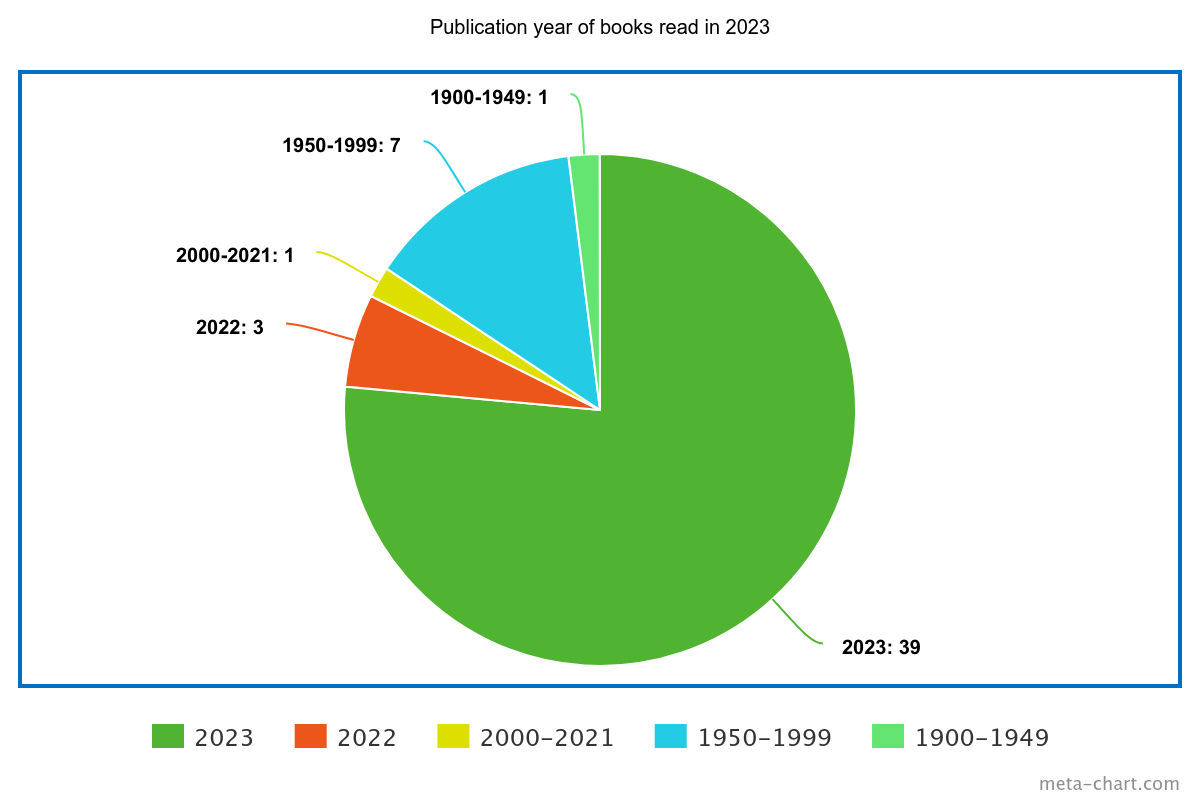
This is always a disappointing statistic for me to look at. Every December when I compile my list of favourite books of the year, it’s older books that dominate – so why am I not reading more older books? I think it’s mainly due to the temptations of all the new books available on NetGalley, so in 2024 I’m determined to pick up more of the books from my own shelves.
The oldest historical fiction novel I read in 2023 was The Spanish Bride by Georgette Heyer (published in 1940).
~
11% of my historical reads in 2023 were historical mysteries.
This is about the same as in previous years. Here are three I enjoyed reading in 2023:
The Murder Wheel by Tom Mead
Voices of the Dead by Ambrose Parry
Death Comes as the End by Agatha Christie
~
I read historical fiction set in 17 different countries in 2023:

As usual, almost half of the historical novels I read were set in England. Although I did read books set in other countries as well, I think I need to be more active in looking for books with different settings, particularly countries I haven’t read about before. Reading more translated fiction should help with that.
In addition to these books, I also read two books set either mainly or partly at sea:
The Ionian Mission by Patrick O’Brian and The Last Lifeboat by Hazel Gaynor.
~
Four historical men I read about in 2023:
Charles Byrne (The Giant, O’Brien by Hilary Mantel)
Hugh O’Flaherty (My Father’s House by Joseph O’Connor)
Henry VIII (Henry VIII: The Heart and the Crown by Alison Weir)
Harry Smith (The Spanish Bride by Georgette Heyer)
Four historical women I read about in 2023:
Empress Maud (The Stolen Crown by Carol McGrath)
Anne Lister (Learned by Heart by Emma Donoghue)
Artemisia Gentileschi (Disobedient by Elizabeth Fremantle)
Princess Nadezhda (The Witch’s Daughter by Imogen Edwards-Jones)
~
What about you? Did you read any good historical fiction last year? Have you read any of the books or authors I’ve mentioned here and have you noticed any patterns or trends in your own reading?
 She Reads Novels
NICE pie charts!
Like you, most of my historical reading from 2023 took place in the 19th or 20th centuries. Most of the rest ended up in ancient Greece or Rome. I’m *trying* to read in other time periods but comfort zones are called that for a reason. I have had a set of books based in ancient Egypt on my shelves for a while now, so maybe I should at least start with those!
Likewise geographical locations… The *vast* majority of my reading takes place in the UK or US with a smattering elsewhere – mostly in Europe. I’m working on that too, but its slow going. SO much to work on! [lol]
I’m looking forward to your 2024 reviews.
Thanks! I enjoy putting these charts together every January. Good luck with branching out into other time periods and locations this year – I don’t think there’s necessarily anything wrong with staying mainly in our comfort zones, but it’s nice to try different things now and then!
What do you use for the charts? I’ve done Chartgo.com in the past, and these look similar to them.
I’ve always used Meta-Chart.com – there might be better sites, but I find that one quick and easy to use.
Thanks! Will keep in mind for next year.
Great stats! You read more diverse in terms of countries. I get always stuck in England :D. But my first two books of the year are not set in England, it’s a start! I never track the publication year, it might be interesting to have a look at it next time.
Yes, it can be hard to move away from books set in England! Tracking the publication date is interesting as I used to read a lot of older books but now most of the historical fiction I read comes from NetGalley.
One of the best historical novels I read this year but have not reviewed yet (so it’ll be on next year’s best list) is Bright Young Women by Jessica Knoll. I also very much enjoyed more than one book by Paulette Jiles, all set in 19th century Texas. I also enjoyed The Flight Portfolio by Julie Orringer, All the Horses of Iceland by Sarah Tolme, and The Marriage Portrait by Maggie O’Farrell. Do you keep track of your historical fiction reading as you go? Because I just tried to get a sense of mine from Goodreads, and it looked like too hard of a job.
Yes, I keep a list with the time period, geographical setting and a few other details, which makes it a lot easier to put this post together every January.
That makes sense.
I think my favourite historical novels last year were the Shadows of London by Andrew Taylor and the Weather Woman by Jane Gardner. I love reading all of your facts and figures although I would never have the patience to do it myself.
I loved The Shadows of London, but still haven’t read The Weather Woman. This post does take a while to put together, but I use the same template every year which helps!
I enjoyed delving into the back catalogues of two authors in particular in 2023, quite different but equally readable – Cynthia Harrod-Eagles and Anthony Quinn. Both maintain a very high standard. If CHE’s Morland dynasty saga feels like a lot to take on I would recommend her Ashmore Castle and War at Home series which are also very engaging.
I’ve never read Cynthia Harrod-Eagles and the Morland saga has always looked quite daunting, so I’ll think about the other two series you’ve mentioned – thanks! I’ve read The Streets by Anthony Quinn but haven’t got round to trying any of his other books yet.
Impressive stats, as always! It’s always a battle resisting the temptations of NetGalley, isn’t it?
I’m grateful to NetGalley for helping me discover some great books and authors, but I often think my time would be better spent reading books from my own shelves. As you say, though, it’s too difficult to resist the temptation!
Stats are always fun, aren’t they, especially if they draw attention to aspects of your reading that you weren’t aware of and want to adjust.
I’m not sure what to count as historical fiction, Helen – I see you count Christie in this category, for example – I assume there needs to be a degree of realism there, but how much should SF and fantasy themes be allowed to impinge (as with Susannah Clarke’s break-out novel set in the Georgian period)? Also, how far back counts as historical – before one was born, before the dawn of the 20th-century? What about classics, and those accounted as ‘modern classics’? You can see how I think some of my stand-out titles may fail to qualify!
I wouldn’t normally count Christie as historical fiction as most of her books were contemporary at the time they were written, but that particular book – Death Comes as the End – is set in Ancient Egypt, so does count in this case. In general, I stick to the definition used by the Walter Scott Prize for Historical Fiction, which states that most of the storyline should be set at least 60 years before publication, but it does get complicated sometimes!
Oh, 60 years – that’s a useful rule of thumb, Helen, thanks; also I’d forgotten the Christie you’d read was set in Ancient Egypt, I should’ve paid closer attention to your commentary. 😐
Wow! that’s all I can say, very impressed with those charts!
Thanks Jane!
This is fun to read! I need to start keeping track of my settings; I do like looking at pub dates. I think I read more books published in the current year last year than I usually do. I don’t use Netgalley much but I do put books on hold in the library before publication so they often turn up soon (although often all at once).
I just started a book called Hazardous Spirits that I could have sworn you recommended but I don’t see it on your blog.
No, Hazardous Spirits must have been someone else, although I have read one or two other books about spiritualists recently, so that could have caused the confusion!