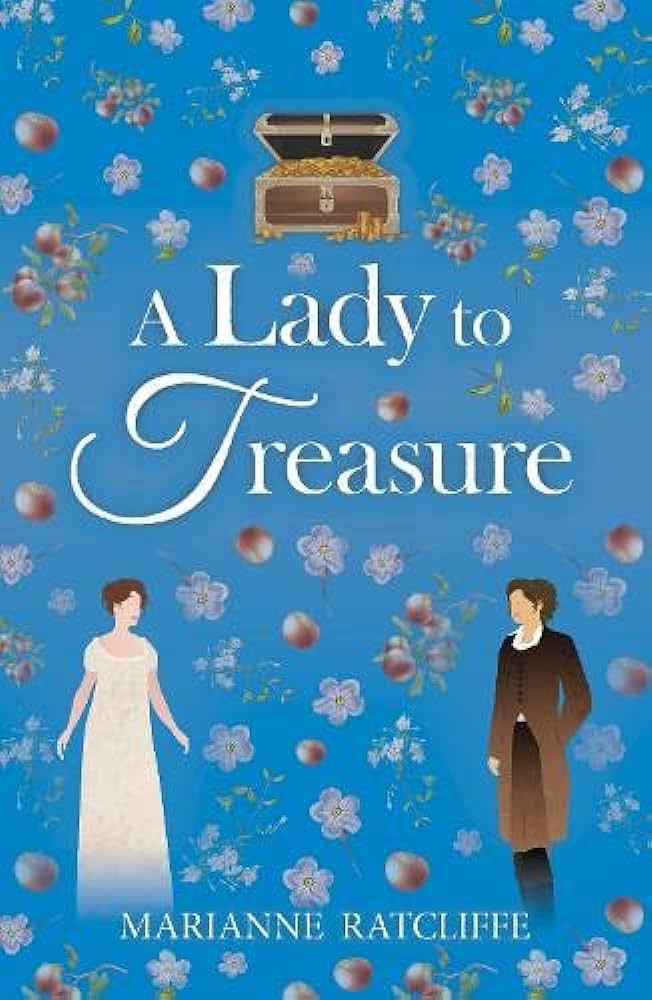
 I enjoyed Marianne Ratcliffe’s previous book, The Secret of Matterdale Hall, a Victorian Gothic novel set at a Yorkshire boarding school, so I was happy to try her new Regency romance, A Lady to Treasure. I had some doubts as to whether I would like this one as much, as Gothic novels are usually more to my taste than romances, but it actually turned out to be my favourite of the two. Both books are published by Bellows Press.
Louisa Silverton is the daughter of a rich American businessman. With the onset of the 1812 War, the Silvertons are beginning to experience financial uncertainties and Louisa is sent to stay with family in England, in the hope that she can find a wealthy husband there. Arriving at Athelton Hall in Northamptonshire, she quickly settles in, forming a friendship with her cousin, Eleanor, and getting to know the neighbouring families.
From her father, Louisa has gained a knowledge of accounting – ‘her first toy was an abacus and her earliest reading matter business receipts, from which she learnt to add and subtract’ – and she is able to use her skills to assist Sarah Davenport, who lives at nearby Kenilborough Hall. The Kenilborough estate is falling into debt due to the mismanagement of Sarah’s father, Lord Kenilborough, and the gambling habits of her stepbrother, and it has been left to Sarah to try to salvage the situation. As Louisa spends more time with Sarah, advising her on how to increase the profitability of the estate and deal with unscrupulous business associates, the two slowly become aware that what they feel for each other is more than just friendship.
The romance element of the book is more subtle and understated than I expected. Louisa and Sarah don’t immediately recognise their feelings as romantic love and it takes them a long time to start to act on it, particularly as they have other matters to deal with, such as Sarah attempting to save Kenilborough and Louisa trying to keep her father happy by looking for a rich husband. I liked both of them, particularly the independent, outspoken Sarah (a character very like the historical Anne Lister, or ‘Gentleman Jack’). Despite Sarah being an unconventional character, I still believed in her, and in Louisa, as realistic 19th century women; nothing in the book felt anachronistic or unconvincing.
As well as the two main characters, there’s also a strong supporting cast – I found Louisa’s cousin, Eleanor, an interesting character as she has curvature of the spine and therefore doesn’t conform to Regency society’s idea of how a woman should look. I wanted Eleanor to find happiness as much as I wanted Louisa and Sarah to do the same!
I knew after reading Matterdale Hall that I liked Marianne Ratcliffe’s writing style. Writing that feels too modern can pull me out of historical fiction and break the spell, but that’s not the case here – the language is carefully chosen to suit the time period and add to the overall sense of authenticity. I hope for more books from this author in the future, having enjoyed these two so much.
Thanks to the author for providing a copy of this book for review.

Bellows Press is a small independent publisher that works with “unagented, unorthodox writers of fiction, particularly queer writers, writers of colour and writers from marginalised genders.”
 She Reads Novels
Nice review–I think I’d enjoy this one.
I liked it a lot more than I expected to!
Glad this one turned out to be such a good read. I like the sound of her other Victorian Gothic one, too. 😀
They’re both really good!
This is a reversal, having the poor girl go to England to try to find a rich husband. I think that the other way around was more usual—or to have a rich girl go to England to find a titled husband. Maybe 1812 was too early for either, though. I know it was more common later in that century.
I hadn’t thought of that, but yes, I suppose it’s quite unusual.