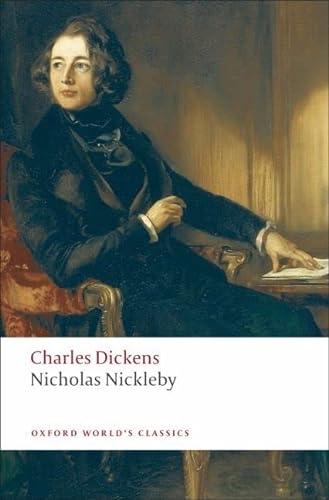
 Nicholas Nickleby was the book chosen for me to read in the Classics Club Spin back in October 2023. It has taken me until now to finish it, partly because it’s a book with over 800 pages and also because I started to find it a bit tedious halfway through and kept putting it aside to read something else. I’m sorry to have to say that, as I know a lot of people consider it a favourite and I really did want to love it, but I just couldn’t. However, I did still find a lot to like, so I certainly don’t feel that I wasted my time reading it!
Originally published as a serial from 1838 to 1839, this is one of Dickens’ earliest novels and is very episodic, lacking any real overarching plot, (which I think is probably one of the reasons I had problems staying engaged with it – and the reason I have so far been avoiding The Pickwick Papers!). Therefore it’s difficult to give a summary, but I think all you really need to know is that at the beginning of the book Nicholas Nickleby’s father dies, leaving Nicholas, his mother and his sister Kate penniless and dependent on Uncle Ralph for support. Ralph is a rich but cold, uncaring man who has little compassion for his late brother’s wife and children. He finds Nicholas a low-paid position as an assistant at Dotheboys Hall, a grim and unpleasant school in Yorkshire, while Kate remains under his own ‘protection’ in London…
The most compelling part of the novel, I thought, was the section set at Dotheboys Hall, where Nicholas finds himself working for the evil Wackford Squeers, who claims to be a ‘schoolmaster’, although it quickly becomes obvious that the establishment he is running is not so much a school as a home for unwanted, neglected boys and that Squeers treats them harshly, starving and beating them. Dickens always includes a lot of social commentary in his novels and here he is clearly drawing attention to the terrible conditions found in 19th century boarding schools; apparently he personally visited Yorkshire in early 1838 to do some background research. It’s interesting to compare his portrayal of Dotheboys to Charlotte Brontë’s Lowood School in Jane Eyre. I was sorry that this only formed a relatively small portion of the novel, although it’s important not only for the social history, but also because it introduces Smike, a frail, badly abused young man whom Nicholas rescues from the school and who becomes his loyal friend and the heart of the most emotional scenes in the book.
I also enjoyed the episode where Nicholas, having fled Yorkshire, travels to Portsmouth and joins an acting troupe, run by the actor-manager Vincent Crummles. A lot of time is devoted to introducing the other members of the company – including Crummles’ daughter, the ‘Infant Phenomenon’, who has been acting in child roles for so long she can’t possibly still be an infant! – and although none of this really has much relevance to the rest of the book, I always like theatrical settings so I found it entertaining. Unfortunately, there were other subplots and characters that didn’t interest me at all, such as the Kenwigs family, Mr Lillyvick and Miss Petowker, and the implausibly saintly Cheeryble brothers. This is a book where the good characters are very good and the bad ones are very bad – although Uncle Ralph at least does have some nuance. I liked both Kate and Nicholas (who definitely fall into the ‘good’ category) and while Dickens isn’t really known for writing strong female characters, Kate is more sensible than some of his others.
This hasn’t become a favourite Dickens, then, but I’m still pleased to have read it! Now I can move on to my next Classics Club Spin book, The Trumpet-Major by Thomas Hardy.
This is book 42/50 read from my second Classics Club list.
 She Reads Novels
This one is a Dickens I’ve yet to read, and I will probably read it more in a serial fashion than as a proper novel. The workhouse scenes would interest me as well; the deception of that whole scenario would add a sombre element of irony (school? pshaw). Maybe you’ll find The Pickwick Papers alright too.
Reading it as a serial is definitely a good idea! That’s how it was originally intended to be read, after all, and I think reading this kind of book straight through from beginning to end is too overwhelming. I’m sure I’ll try The Pickwick Papers eventually!
I read A Tale of Two Cities rather happily, and Bleak House very contentedly, in much the same way I always read novels, but as time went on I found that I had to rely on the serial read in order to stay engaged (even with Great Expectations, which I know is one that many people enjoy straight through, and David Copperfield), so I’d try to mimic the original schedule. Here’s the Pickwick schedule. Let me know if you decide to start in March and want company LOL
https://en.wikipedia.org/wiki/The_Pickwick_Papers (But I would do better with next March I’d guess hee hee) Even though I’m not a classics completist, I do enjoy Dickens when I’m reading him, so I’m always keen on the idea of reading another.
Yes, I found A Tale of Two Cities much easier to read than most of the other Dickens I’ve read. I’m not sure if I feel ready to start Pickwick just yet, but I’ll let you know if and when I decide to give it a try!
Not one I’ve read (yet!) but I’m starting small and (slowly) working my way up to his chunkier tomes. My next read – in the Summer *if* we have one this year – will be ‘Hard Times’.
I haven’t read Hard Times yet but I’m looking forward to it. I need a break from the really chunky ones!
Yes, I like Nicholas Nickleby, but I think you are right that it concentrates more on strange characters than plot. I read some stuff about Wilkie Collins lately to write a bio for The Classics Club, and it said that as they worked together, Collins’s characters became more developed while Dickens’s plots got tighter.
That’s interesting. I knew Collins and Dickens were friends and had influenced each other’s work, but I hadn’t thought about it that way.
Certainly, I can see it once I learned it. Dickens’s early books are almost plotless with loads of odd characters, while Collins’s are full of adventure but poorly characterized.
Well, good for you for tackling it, and sticking with it. I sounds a bit on the rough side for me (even aside from the length)!
Definitely not my favourite Dickens, but I’m glad I stuck with it!
I haven’t read this one yet but as I was reading your very honest (thank you!) review I realised how many of the names I know, Squeers and Smike especially; and how interesting it is to see where these famous characters come from!
Yes, it’s surprising how much of Dickens’ work has found its way into popular culture! I hope you enjoy this one if you decide to read it.
Sounds like it ticks off everything I loathe about Dickens! I’ve found everything I’ve read by him to be frustratingly episodic, with the exception of Great Expectations.
I find that the episodic nature makes it difficult to stay engaged, particularly with the very long books. I’ve enjoyed a few of them, but he’s definitely not a favourite author!