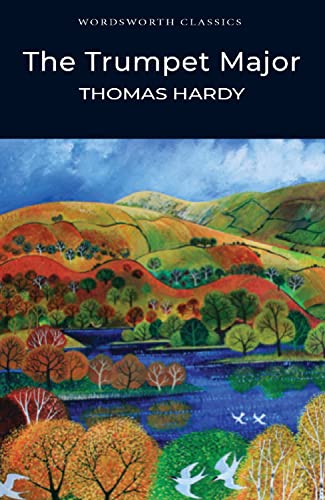
 I love Thomas Hardy so was pleased when The Trumpet-Major was chosen for me in the recent Classics Club Spin. The deadline for finishing our Spin books was 3rd March, but I’m late as usual!
First published in 1880, The Trumpet-Major is set in Hardy’s fictional Wessex during the Napoleonic Wars (making it his only historical novel). Beginning in 1804, it follows the story of Anne Garland and her three suitors: miller’s son John Loveday, who is the Trumpet Major of the title; his brother Bob, a sailor whom Anne has secretly loved since she was a young girl; and Festus Derriman, nephew of the local squire. Anne’s mother, who marries Miller Loveday, would prefer Anne to pick Festus, but it quickly becomes obvious to the reader that he is spiteful and cowardly and that Anne’s choice will be between Bob and John.
With John being a soldier and Bob a sailor in the merchant navy, they each have to spend long periods of time away from home, allowing Anne to grow closer to the other in his absence. It’s difficult to know which, if either, she will eventually accept; John is a typical loyal, steadfast Hardy hero, but Bob, although more immature and less trustworthy, is clearly the one she has lost her heart to. There are lots of twists and turns along the way as the situation becomes complicated by misunderstandings, the arrival of another woman, and the scheming of Festus Derriman. There’s a subplot involving Squire Derriman – known as Uncle Benjy – who is looking for a place to hide his will, but otherwise the novel never really loses its focus on Anne and the three young men, which makes the story easy to follow and, for a Victorian novel, relatively short and quick to read.
The action all takes place in and around Budmouth, a fictional town based on Weymouth on the Dorset coast. This is not a military novel, despite the title and the occupations of two of the main characters, but it plays out against a backdrop of the Napoleonic Wars and the people of Budmouth live in fear of a French invasion at any minute. It’s quite a light story, in comparison with Hardy’s more famous tragedies like Jude the Obscure and Tess of the D’Urbervilles, but the constant threat of war gives it a more serious tone than it would otherwise have had, and there are some dramatic episodes such as a false alarm which causes Anne’s village to begin evacuating in panic and the arrival of a naval press gang.
The Trumpet-Major has a happier ending than many of Hardy’s other books, but I didn’t personally find it very satisfying and would have preferred it to end in a different way. Still, I enjoyed this book and although I would definitely describe it as one of his lesser novels, I can honestly say that I haven’t yet read anything by Hardy that I didn’t like! I only have two of his novels left to read and they are probably his most obscure ones – The Well-Beloved and The Hand of Ethelberta – so I’ll be curious to find out what I think of those two.
This is book 43/50 read from my second Classics Club list.

Book 11/50 for the Historical Fiction Reading Challenge 2024
 She Reads Novels
This is one I haven’t yet read but I do enjoy his books, and especially his nature descriptions. Glad you found it enjoyable even if it didn’t entirely meet expectations.
Yes, his descriptions of the countryside are always beautiful. I really enjoyed this book apart from the way it ended.
I’ve never read this one but after reading your review, I think I’ll probably give it a try. I do love Hardy’s writing and something more optimistic than his usual books would be a pleasant change.
It’s not exactly a happy, uplifting book, but it’s certainly a lot less tragic than some of his others! I would definitely recommend it if you usually like Hardy.
I don’t think Hardy ever did happy exactly 😀
I haven’t read this one, but would like to read all his novels eventually – I have read The Hand of Ethelberta and I’m looking forward to your review (no hurry though!) because I can’t remember anything at all about it. Which do you think is your favourite so far?
The first one I read was Tess of the D’Urbervilles and I think it’s probably still my favourite, but I also particularly loved The Woodlanders and A Pair of Blue Eyes. Looking forward to The Hand of Ethelberta!
I haven’t read The Woodlanders or A Pair of Blue Eyes, thanks!
I am sure I read this years and years ago, but your description didn’t awaken any memories. I’m sorry it didn’t work well for you. I think his earlier books usually have happier endings than his later ones.
I did enjoy it apart from the ending, but I don’t think it’s one of his best books.
Probably not. Maybe sometime I’ll reread it.
This is not one I’ve read…or even heard about really. Glad it wasn’t super depressing or sad. And I actually liked The Well-Beloved. 😀
I’m glad you liked The Well-Beloved! I’ll look forward to it.
This was very nearly my Hardy choice for this year’s B-Sides Project! I went for Two on a Tower instead in the end, but would certainly like to get to this—it sounds, for Hardy, positively pleasant.
I think I enjoyed this one more than Two on a Tower. It’s not exactly a cheerful novel, but definitely not as bleak as some of his others!
It does sound a good deal lighter than some of his books, but it’s usually his description of people’s lives that make his books interesting, rather than the plots, I think. Maybe I’ll get to this one day, but I have many of his books still to read!
I liked it, but I think it would rank quite low on my list of favourite Hardy novels. If you still have plenty of others to read I would probably leave this one until later.
I enjoyed this one for being more cheerful than some but still recognisably Hardy. I did like those last two (I did all of Hardy a few years ago with a friend) esp if you read them as being in the sort of magazine story / gothic tradition.
Yes, it’s nice to read a Hardy that’s not too bleak and unhappy! I’m glad you liked those other two books – I’ll definitely be reading them eventually.
For all that you say that this is slight, although quite enjoyable, I still think I need to read it, having little or no memory of having it as a set text at school in the 60s. I suspect that, being a pupil in an all-boys grammar, any book that focuses on love interests was fated to not be very appealing to me as to the next boy. Now, though, I’m a little bit older and broader in my literary appreciation!
Although I enjoyed this, I think I would have been less receptive to it as a teenager and I can see why a boy might not find it very appealing. I also think being made to read a book at school can sometimes nearly put us off that author for life – I had that experience with Steinbeck, whom I just returned to fairly recently and loved!