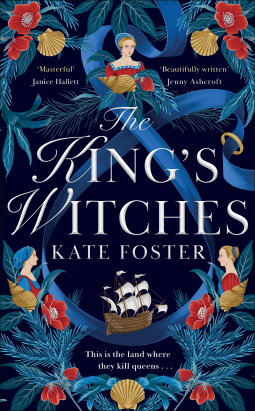
 Historical novels based on real-life witch trials seem to be very popular at the moment; I can think of several I’ve read just in the last two or three years. The King’s Witches is another and takes the slightly different approach of telling the story not only of the so-called witches, but also of the woman married to the man behind the witch hunts, King James VI of Scotland.
The novel opens in Denmark in 1589, where Anna, daughter of King Frederick II, is preparing for the arrival of the Scottish ambassador who will escort her across the sea to her new life in Scotland. Anna is betrothed to James VI and before leaving Denmark, they undergo a handfasting ceremony by proxy, with the Earl Marischal standing in for James. Setting sail for Scotland a few days later, Anna’s ship is hit by violent storms and is forced to turn back several times. Witches are blamed for summoning the winds in an attempt to stop the new queen from reaching her destination and by the time Anna eventually arrives in Scotland the fear of witchcraft is becoming widespread.
In the town of North Berwick, another young woman, Jura, is working as a maid in the Kincaid household. Jura has inherited her mother’s skills as a healer and knowledge of herbs and charms, but when the whispers of witchcraft grow louder – and the unwanted attentions of her master become more difficult to avoid – she is forced to flee to Edinburgh. However, escaping both the witch hunts and the Kincaids is not going to be easy…
The King’s Witches is narrated by both Anna and Jura, as well as a third woman, Kirsten, who is Anna’s lady-in-waiting and accompanies her on the journey from Denmark. Kirsten has been to Scotland before, but is very secretive regarding what happened during her previous visit and we will have to wait until later in the book for her full story to emerge. Kirsten and Jura are both fictional characters, but Anna (usually known as Anne of Denmark) was obviously a real person. However, Kate Foster doesn’t stick entirely to historical fact; for example, the real Anna was only fourteen years old when she married James VI, but Foster makes her slightly older at seventeen. She also uses the Celtic tradition of handfasting, which expires after a year, to introduce the idea that Anna was ‘on trial’ and the marriage would only go ahead if she managed to please James. I didn’t feel that this – or the fictional lover Foster creates for Anna – was really necessary or added much to the book and I would have preferred Anna’s story to follow the facts, considering we already had two other entirely fictional viewpoint characters.
The witchcraft aspect of the book is interesting, particularly the connection between the North Berwick witch trials, in which Jura is involved, and previous trials in Germany and Denmark which inspired James VI to take similar action. The storms that delay Anna’s voyage to Scotland in the novel really happened and really were blamed on witches. The King’s paranoia increases until he decides that the town of North Berwick (not to be confused with Berwick-upon-Tweed, by the way) is a nest of witches plotting to kill him, possibly in league with the Earl of Bothwell, and eventually more than 70 people are implicated. Foster explores all of this not just from the perspective of Jura, who is directly affected as a suspected witch, but also Anna from her position close to the King, and Kirsten, who provides a sort of bridge between the two worlds.
Even with the addition of the Anna and James angle, this book felt a bit too similar to other books I’ve read about historical witches, but obviously that won’t be a problem if you haven’t read as many of them as I have! I did still find it enjoyable and will have to look for Kate Foster’s first book, The Maiden, which I haven’t read.
Thanks to Mantle for providing a copy of this book for review via NetGalley.

This is book 15/20 of my 20 Books of Summer 2024.

Book 33/50 for the Historical Fiction Reading Challenge 2024
 She Reads Novels
I don’t think I’ve read a novel about witch trials since The Witch of Blackbird Pond in high school. I’ve read more history about witch trials lately, which is grim reading. The accused seem so powerless, but I can see the possibilities in fiction to give them a voice and agency – and hopefully a safe ending.
I’m the opposite as I’ve read very little non-fiction about witch trials, but seem to keep coming across the topic in fiction all the time! I actually haven’t read The Witch of Blackbird Pond; it doesn’t seem to have the same classic status here in the UK and I wasn’t even aware of it at school. I’ve always intended to read it as an adult but haven’t got round to it yet.
The Witch of Blackbird Pond is a great book! Last fall, my family was driving to New York and we stopped for lunch in the town where it is set. There is a whole walking tour of places in the book but we did not have time for more than a quick look around.
I agree there are quite a few witch-themed books, fiction and non-fiction lately. I live near Salem, MA which unfortunately but perhaps understandably leans into its witch heritage for tourism. Residents have mixed feelings as in October it can be hard to walk, park, or travel around town.
Anyway, I am disturbed by Anna/Anne being on trial. Had he rejected her, she would have been disgraced and her family embarrassed. It seems odd to make something like that up. However, the book does sound intriguing and I will look for this author.
The trial aspect of the story did seem weird to me. I actually had to look it up to check that nothing like that actually happened, as it seemed such a strange thing to make up. As you say, her family wouldn’t have been likely to agree to it as it would have been humiliating for them if she was sent home. It’s still an interesting book, though, and I would recommend it overall.
Loved this book and The Maiden is excellent too!
I’m sure I’ll read The Maiden eventually. I’m glad you liked it!
Interesting that she changes so much of Anna’s real life in this one…especially if those changes don’t seem to add to the overall story. I think I’d prefer to read a nonfiction about Anna and her life. Has one been written?
I can only find a few biographies of Anna that are now out of print. I’ll keep looking out for a new one!
I DNF’D The Maiden because it seemed to contained too much sexual
content for me. So I am wondering how this book compares. The subject
matter interests me but am wondering if it’s similar. I prefer sex behind
closed doors.
There are a few sex scenes and also some descriptions of sexual assault. I didn’t find any of it particularly excessive, but obviously people have different tolerances for that kind of thing.
Thanks for answering. Think I will pass on this one.
I felt like there were too many books about historical witches about a decade ago so feel like the current glut is just mad! I think the best one I’ve read is The Mercies.
The Mercies is a good one – and a bit different from the others, with that Norwegian setting.
This was the first book about witch trials that I have read. Although I have seen many more on shelves and recommended. So it was new to me and I found it interesting.
The Maiden is very different from this book and I think much better.
I think I would have found this book a lot more interesting if I hadn’t already read so many witch trial stories! I’m pleased you liked The Maiden.
I really don’t like it when an author changes history to suit his or her plots.
I don’t mind so much if there’s a good reason for it, but most of these changes felt pointless.
I do love the cover on this one.
Thanks for sharing this review with the Historical Fiction Reading Challenge.
Yes, there are lots of beautiful covers around at the moment!