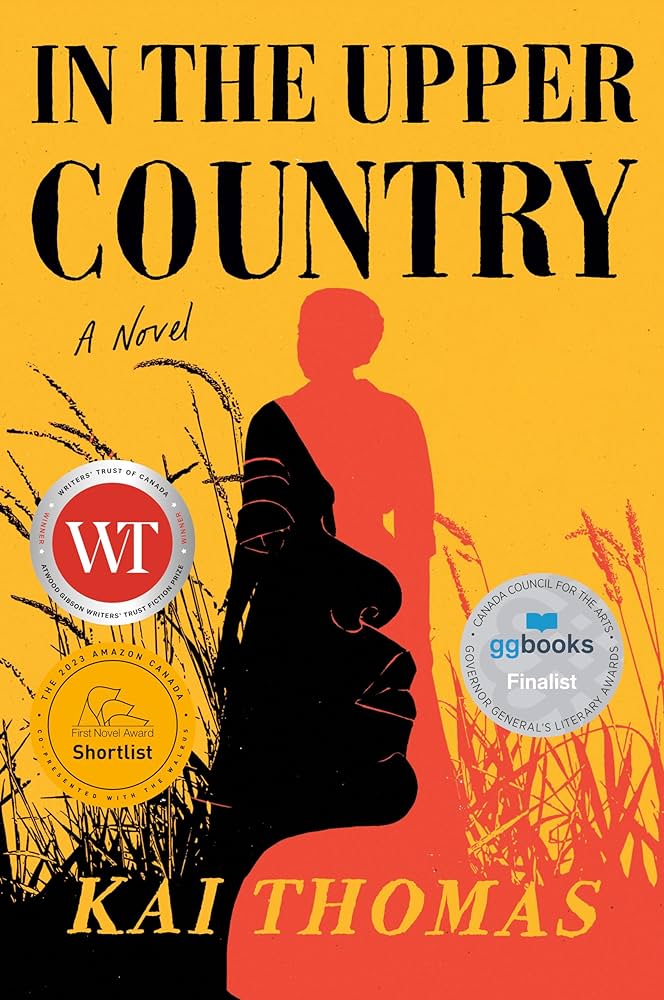
 In the Upper Country came to my attention earlier this year when it was shortlisted for the Walter Scott Prize and as I’ve been looking out for historical fiction set in Canada (see my Historical Musings post from last year) it’s one I was particularly interested in reading.
The novel opens in 1859 in Dunmore, Ontario, a fictional town settled by people fleeing slavery in the American South. It is home to Lensinda Martin, a young black journalist who works for a local newspaper. When an old woman who has recently arrived in Dunmore through the Underground Railroad kills a slave hunter and is arrested, Lensinda is sent to interview her in jail. The old woman insists that if she’s going to tell her story, Lensinda must tell one in return and so, over the course of several days, the two women begin to exchange tales.
The stories they tell reveal not only how the old woman came to be in Dunmore and to kill a man, but also the journeys of other slaves and the significance of all of this on Lensinda’s own life. They also explore the connections between the Black and Indigenous communities of North America – something which Kai Thomas in his author’s note points out is usually ignored in other novels about slavery. It’s certainly not a subject I know much about, so I found that aspect of the book interesting.
Although Dunmore is not a real place, Thomas explains that it’s inspired by similar towns that did exist, such as North Buxton, Ontario. It had never occurred to me that there were whole towns settled by slaves in Canada; in fact, everything I’ve previously read about the Underground Railroad has focused more on how the slaves manage to escape and begin their journey rather than on what happens to them after they reach their destination. It’s a book with lots of interesting themes and topics, then – and it’s always good when you reach the end of a novel feeling that you’ve learned something new.
On a more negative note, the structure of the book didn’t work very well for me at all. There were too many different stories, too many different voices and I found it difficult to follow what was happening and engage with the characters. I almost abandoned it several times because I just couldn’t get into the flow of the writing, but I kept going and did manage to finish it. I don’t regret reading it, but for me it was definitely more of an educational book than an enjoyable one!

This is book 17/20 of my 20 Books of Summer 2024.

Book 35/50 for the Historical Fiction Reading Challenge 2024
 She Reads Novels
I recently read a history of the Underground Railroad, compiled by one of the main “conductors” after the Civil War, which included letters that formerly enslaved persons sent back from Canada (often about the family left behind). It was also very episodic, and unfortunately didn’t always have information on what happened to the correspondents afterwards. I have just put this on reserve at the library.
I hope you enjoy this one. Even though I didn’t love it, I still thought it was fascinating. I need to do more reading about the Underground Railroad.
A pity that the storytelling style and manner were uneven as the overall story is evidently one that needs to be told often and again.
Yes, it’s important that books like this are being written. It didn’t work for me purely as a novel, but I definitely learned a lot from it.
I’ll probably be reviewing this one in September. I too didn’t think that structure worked for me and got confused about who the characters were and their connections.
You’re doing really well at getting through the 2024 shortlist. I have read three of them but haven’t posted my reviews yet.
I’ll look out for your reviews of this and the other two you’ve read.
Actually, I realized it’s just one other besides this one. I have another one in my pile that I haven’t read yet.
I must say I am never quite sure what I am going to get when I read books either long listed or short listed for the Sir Walter Scott Prize. I’m not that confident I’m going to enjoy the books which is a shame as a lover of historical fiction. Though I guess that has happened enough times to encourage me to keep an eye on the books chosen. Also, It does introduce you to authors you might not otherwise come across and that is a good thing.
I feel as if I there were more books I enjoyed on the earlier Walter Scott Prize lists than there have been in recent years. They seem to be choosing more obscure books and authors now and the more mainstream titles don’t often get further than the longlist. As you say, though, it’s good to be introduced to new authors and try something different.
Yes I agree, the books do seem to be less accessible. Whether they are chosen for their subject matter rather than the quality of the writing or the pleasure they may bring I wouldn’t know. Thanks for the review.
The Black-Indigenous connections in this one sound really fascinating – I’ve read so many novels on antebellum slavery and the Civil War that I usually skip them, but that jumps out to me as something fresh.
Even though I didn’t enjoy the book as much as I hoped to, the Black-Indigenous relationships and the Canadian setting both interested me. I haven’t read all that many novels about slavery but there were lots of things about this one that made it different.
I can’t think of a book that tells this story! Pity the book didn’t work better for you!
Thanks for sharing this review with the Historical Fiction Reading Challenge.
It’s definitely not like any other book I’ve read!