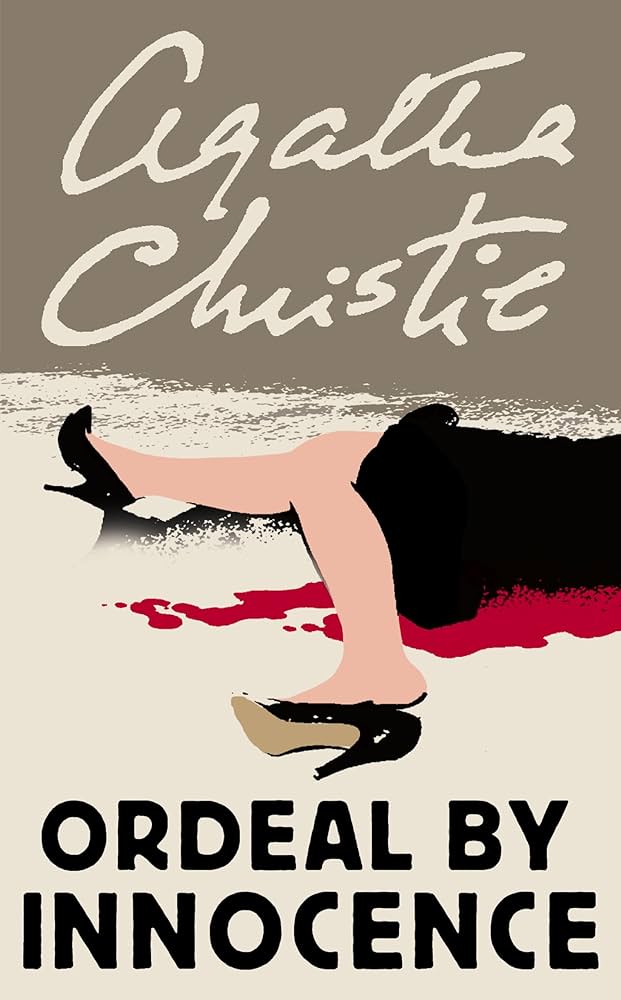
 The September choice for the Read Christie 2024 challenge is Ordeal by Innocence, a book which, along with Crooked House, Christie herself named as one she felt most satisfied with. It was first published in 1958 and is a standalone novel, with no Poirot, Miss Marple or any of Christie’s other recurring characters.
The novel begins with Dr Arthur Calgary visiting the Argyle family at their home, Sunny Point, to give them what he hopes will be some very welcome news. Two years earlier, Jacko Argyle was found guilty of the murder of his adoptive mother. Although he claimed to have an alibi, he was unable to prove it and was sentenced to life imprisonment. Now, Dr Calgary has come forward to confirm that he was with Jacko at the time of the murder, therefore he couldn’t have committed the crime. Calgary seems to have a valid reason for not speaking out sooner – a head injury affecting his memory, followed by a long trip to the Antarctic – but it’s now too late to help Jacko, who has died of pneumonia in prison. Still, Calgary hopes his belated evidence will bring some comfort to the family. However, it has the complete opposite effect…because if Jacko didn’t kill Mrs Argyle, who did?
This is a novel driven by characters, personalities and motives rather than one with a lot of plot. Most of the book is made up of conversations between various members of the Argyle household as they discuss amongst themselves and with Superintendent Huish the events that took place the night of Mrs Argyle’s murder and who they think could be responsible. There’s the dead woman’s husband, Leo Argyle, who is now planning to marry his secretary, Gwenda; there are the other four adopted Argyle children, Mary, Micky, Tina and Hester, all now adults who have had one reason or another to resent their adoptive mother; and Kirsten Lindstrom, their Swedish nurse who has been with the family for many years. It (unbelievably) doesn’t seem to occur to Dr Calgary, until it is pointed out to him, that by clearing Jacko’s name he has simply cast suspicion on the rest of the family again, but this becomes a major theme of the book – the idea that only the guilty person knows the truth, therefore it’s the innocent who suffer the most:
“The family would come under suspicion,” he said, “and it might remain under suspicion for a long time – perhaps for ever. If one of the family was guilty it is possible that they themselves would not know which one. They would look at each other and – wonder… Yes, that’s what would be the worst of all. They themselves would not know which…”
Another theme Christie tackles in this book is adoption and the question of nature vs nurture. Sadly, her opinion of adoption seems to be quite a negative one, with several characters stating that the relationship between a child and their adoptive mother can never be as strong as with their biological mother. It’s also strongly implied that some of the Argyle children have criminal tendencies because they’ve inherited those traits from their birth parents and are destined to be bad people regardless of how much love and attention they receive from their adoptive parents. These are not views I agree with, but clearly they are subjects Christie was interested in and wanted to explore in this novel.
As a standalone, I think this book suffers from not really having a character who does any ‘detecting’. Dr Calgary does take on this role eventually, wrapping things up for us in the final chapter, but otherwise we don’t see much of Superintendent Huish and the only member of the Argyle household who shows any interest in trying to solve the crime is Mary Argyle’s husband, Philip. There’s not much action until very late in the book, so most of the focus is on the characters discussing their memories of Mrs Argyle and what they were doing at the time of her death. In this respect, the book reminded me of Five Little Pigs, another Christie novel which deals with a mystery from the past.
Next month, and for the rest of the year, the Read Christie challenge will be moving on to books published in the 1960s and 1970s. I have plenty of those still to read!
 I’m counting this as my first book towards this year’s RIP challenge.
 She Reads Novels
Thank you for my regular reminder that I need to buy the next Miss Marple book(s)…. [grin]
I haven’t read a Miss Marple book for ages! I think I only have two left, plus some short story collections.
I usually like cosy mysteries driven by character as much as by plot, but this does seem to have failed to fully satisfy – a pity. Still, I continue to harbour a wish to discover a second Mary Westmacott title as a change from Christie’s crime fiction. 🙂
I’ve read two Westmacotts – Unfinished Portrait and Giant’s Bread – and although I prefer her crime fiction, they were both enjoyable and did make a nice change!
Giant’s Bread (1930)
Unfinished Portrait (1934)
Absent in the Spring (1944)
The Rose and the Yew Tree (1948)
A Daughter’s Daughter (1952)
The Burden (1956)
All as by Mary Westmacott. I believe that they’re all in print.
Thanks, that’s useful – I’ve read Absent in the Spring (said to be her favourite of her non-crime novels) but usually rely on serendipity to decide what I’ll go for next. 🙂
I saw a film version of this recently added to Britbox, and I’ve been planning to watch it. Your review makes me realize I’ve never read this one, so I appreciate that you didn’t reveal the murderer!
If that’s the recent BBC adaptation, I haven’t seen it but apparently it’s not completely faithful to the book anyway and parts of the solution were changed. I hope you enjoy it.
For some reason I thought I’d read this one, but it doesn’t sound familiar at all. Something to look forward to. Maybe I saw a TV version or something, but again, it doesn’t sound familiar.
She wrote so many books, it can be hard to remember individual plots. If you haven’t read this one, I definitely think it’s worth reading even though it’s not one of her best.
I’m reading Passenger to Frankfurt right now for the 1970 Club. Also not one of her best.
I’m hoping to read that for 1970 Club as well if I have time, but I’ve seen other reviews that say it’s not a very good one.
Yeah, really far-fetched. I’m about 2/3 of the way through.
When I first started reading Christie’s books years (and years!) ago, I often preferred her standalone mysteries, but now I prefer her mysteries with Poirot or Miss Marple. Funny how your reading preferences can change with time. (Though I still do enjoy her standalone books.) 😀
I do often tend to prefer her standalones, but not this one!
I read this so long ago that my memory is overshadowed by the TV versions. Both inserted Miss Marple and managed a couple more murders by the end. The book sounds much more of a study in psychology.
It doesn’t seem right to turn this into a Miss Marple mystery when it wasn’t originally intended to be, but I can see how this particular book may not have translated well for television otherwise. It’s definitely a psychological one, with very little action or detective work.
I tend to prefer her standalones, but think this would be frustrating given the lack of investigator character that you described—characters discussing the past at length doesn’t often help to push a book forward!
I usually prefer the standalones as well, but not this one. The lack of an investigator really made it difficult to feel engaged with the story. Definitely not a favourite!
So weird that she thought it was one of her best, too!
Generally I prefer the Poirot and Miss Marple novels to her standalones, and this one was just middling for me, as far as I remember. It’s interesting how quite often an author’s personal favourite isn’t such a favourite among her fans!
I’ve loved a lot of her other standalones, but this one is just middling for me as well. I’m surprised it was one of her favourites – I suppose the style and structure are a bit different from some of her others, so maybe that’s why she was proud of it.
Sometimes Poirot or Miss Marple come into the book on the late side, so I was surprised they never did! It wasn’t until the very end that I remembered who the murderer was – until then I wasn’t even sure if it was a reread.
I usually enjoy Christie’s standalones but I think this one would have been better with Poirot or Miss Marple in it. I found it disappointing, especially after learning it was one of Christie’s own favourites.