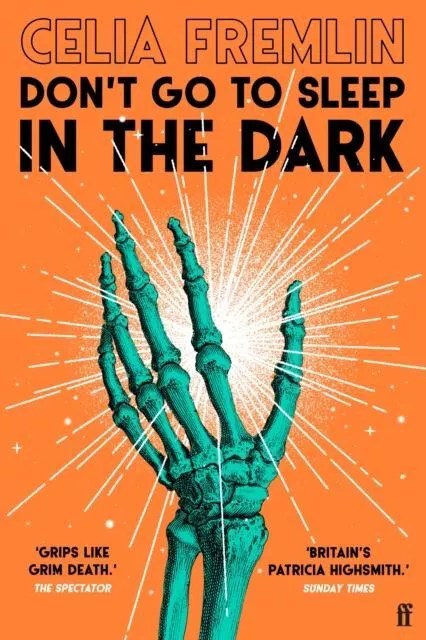
 Today is the first day of 1970 Club, hosted by Kaggsy’s Bookish Ramblings and Stuck in a Book, and I’ve decided to begin with a book by an author who is rapidly becoming a favourite. I’ve read two of Celia Fremlin’s novels, Uncle Paul and The Long Shadow, and loved both, so I was curious to see what I would think of her short stories. Don’t Go to Sleep in the Dark is a collection first published by Gollancz in 1970 (although some websites say 1972, most say 1970 as do the copyright page and preface of the edition I read) and contains thirteen stories. While some are stronger than others, I can honestly say that they are all excellent.
The stories in this collection all have domestic settings, dealing with topics such as marriage, adultery, motherhood, and ageing, and all of them rely on the power of imagination to create a sense of unease. Although some of the stories hint at the supernatural, they are still grounded in reality. Fremlin has a real talent for taking ordinary, everyday situations and using them to build tension and fear.
The book gets off to a great start with The Quiet Game, the story of Hilda Meredith, a woman living in a flat in a high tower block who is struggling to keep her two young children quiet. Faced with constant complaints from the neighbours who claim they can hear every sound the children make – every shout, every laugh, every footstep – Hilda’s mental health begins to suffer as she desperately searches for games that can be played in silence:
From the point of view of the neighbours, it was she who was the cause and origin of all the stresses. She wasn’t the one who was being driven mad, Oh no. That’s what they would all have told you.
But madness has a rhythm of its own up there so near to the clouds; a rhythm that at first you would not recognise, so near is it, in the beginning, to the rhythms of ordinary, cheerful life.
I won’t tell you what happens to Hilda, but this story sets the tone for the rest of the book. Although the thirteen stories are all different and memorable in their own ways, they could all be described as psychological suspense, taking us deep inside the characters’ minds. At the same time, they have perfectly crafted plots, often with a surprise twist in the final paragraph that changes the way we think about everything that came before.
One of my favourite stories was The Baby-Sitter, in which a mother is persuaded to leave her young daughter with a babysitter for the first time so that she and her husband can spend the evening at the theatre. However, she’s not convinced that the tall, stern-looking Mrs Hahn is the right person to be left in charge of little Sally, who has been having nightmares about a ‘Hen with Great Big Eyes’. Her misgivings about Mrs Hahn grow stronger throughout the evening, but is she worrying about nothing? Yet another parent/child story – and another highlight – is Angel-Face, where a woman becomes exasperated by her stepson’s insistence that he is being visited by an angel every night. Things take a more sinister turn when it emerges that he thinks angels have beaks…
Celia Fremlin was in her fifties when this collection was published and three of her stories share the theme of growing older. In For Ever Fair, a story with a humorous twist, a middle-aged wife becomes jealous of her husband’s infatuation with a younger woman, while The Last Day of Spring and Old Daniel’s Treasure are both poignant tales with elderly protagonists and touch on the subject of dementia. Yet Fremlin writes equally convincingly about young characters: in The Hated House, sixteen-year-old Lorna has been left at home alone for the first time and is looking forward to a night without her father’s shouting and her mother’s obsessive cleaning and tidying. Then the telephone begins to ring continuously and an unexpected visitor arrives at the front door:
It was a light, a very light footstep on the garden path that next caught at her hearing; lightly up the steps, and then a fumbling at the front door. Not a knock; not a ring; just a fumbling, as of someone trying to unlock the door; someone too weak, or too blind, to turn the key.
“Be sure you bolt all the doors…” In her head Lorna seemed to hear these boring, familiar instructions not for the fiftieth time, but for the first… “Be sure you latch the kitchen window…Don’t answer the door to anyone you don’t know…”
 There are still another six stories that I haven’t mentioned, but I think I’ll leave you to discover those for yourself if you read the book (which I hope you will as it’s such a great collection). As well as 1970 Club, I’m counting this towards the RIP XIX challenge as many of the stories are very unsettling and perfect for the time of year!
 She Reads Novels
Oh, this sounds good – Celia Fremlin is very good at making the ordinary suddenly become extraordinary and chilling. By the way, Hahn means cockerel in German, so I wonder if there’s a sly hint there…
Yes, it’s a great collection. And you’re right – the name Hahn was deliberately chosen and does have a significance to the plot!
Fun choice! She’s not an author I’ve ever even heard of, but these stories sound very good.
I just discovered her last year, but I’ve loved everything I’ve read by her so far.
After your review of Uncle Paul, I tried to find a copy, but they were all very expensive over here.
That’s a shame. It’s definitely worth reading if you come across a less expensive copy.
I’ll keep looking.
This sounds delicious and your review is brilliant – my spine is well and truly tingling, and I’m pretty sure I’ll have nightmares tonight about Mrs Hahn with a beak, fumbling at my door in the night… 😱
Dagnabit! I appear to have just bought it – how did that happen?? 😉
Oh dear, you must have clicked accidentally! 😉 I think you might enjoy it and hopefully it won’t give you nightmares!
Oh, what a great find for 1970! I had no idea that Fremlin did short stories, but I love the one novel I’ve read of hers – so brilliantly done and so chilling!
I didn’t know Fremlin wrote short stories either until I started researching possible options for 1970. There are another two collections, apparently, so that’s something to look forward to!
Oh, I like the sound of this! 1970s domestic speculative definitely sounds up my street!
They are great stories and the domestic settings make them feel all the more disturbing!
This sounds brilliant, I must start on Celia Fremlin – that’s quite a different cover to the others!
The stories aren’t quite as terrifying as that cover suggests! They are very unsettling, though. Her novels have a similar feel and are brilliant as well.
This sounds fascinating! What genre would you put them in? They sound rather horror, but not sure if they cross into that?
Yes, it’s a fascinating collection! The stories are not quite horror – I would describe them more as psychological suspense in a domestic setting.
This sounds wholly entertaining. I wonder how she fits with writers like Shirley Jackson and Daphne duMaurier: I’m curious!
I would say she’s more similar to Jackson, but with a distinctive style of her own. If you want to try her work, these short stories would be a great place to start, although both of the novels I’ve read are wonderful as well.
I have never heard of Fremlin before, but the stories you’ve highlighted sound deliciously off-kilter.
She’s great! I only discovered her myself last year but have loved everything I’ve read so far.
Thanks for your great review. I see I have The Long Shadow on my TBR, I need to get to it!
My 1970 posts are here: https://wordsandpeace.com/tag/the-1970-club/
I really enjoyed The Long Shadow – I hope you like it!