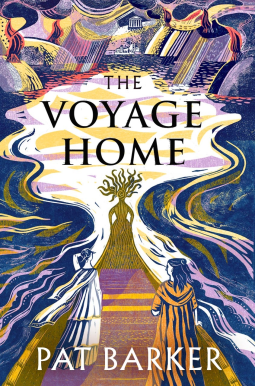
 This is the final novel in Pat Barker’s trilogy telling the stories of some of the women involved in the Trojan War. Books one and two, The Silence of the Girls and The Women of Troy, focus on Briseis, who was given to Achilles as a prize of war, although I was surprised by the number of male perspectives that are also included in those two books, considering the titles! In The Voyage Home, we leave Briseis behind to follow three other characters as the victorious Greeks return home from the war.
One of these is Cassandra, the Trojan princess and prophet who is cursed never to be believed. Like Briseis, Cassandra has become a war prize – in her case, she has been taken as a concubine by Agamemnon, King of Mycenae. Then there’s Ritsa, a Trojan slave and healer given the job of accompanying Cassandra on the journey to Mycenae and acting as her personal servant. Finally there’s Clytemnestra, Agamemnon’s wife, who is grimly preparing for her husband’s return. It’s been a decade since Agamemnon sacrificed their daughter Iphigenia to the gods in exchange for a wind to sail to Troy, but Clytemnestra has never forgiven him and is ready to take her revenge.
I enjoyed the first two books in this trilogy and I did like this one as well, but not quite as much. I’ve read several other novels about Clytemnestra and the events of the Oresteia recently (including Elektra by Jennifer Saint and Clytemnestra by Costanza Casati) and I felt that her sections of the novel didn’t offer me much that was new or different. Having said that, the way Barker portrays Clytemnestra’s emotions – her anger, bitterness and grief – was very well done. There are also some atmospheric scenes of ghostly children haunting the palace – although, oddly, chanting British nursery rhymes such as Oranges and Lemons, which pulled me right out of the Ancient Greek setting!
Of the main characters, Ritsa is probably the easiest to like and as a servant, of a lower social status than the others, she has an interesting perspective on the events that unfold. Cassandra is a fascinating, complex character in the unusual position of being both enslaved and the wife of the king. She has already predicted the deaths of herself and Agamemnon but due to the curse she is under, nobody takes her seriously. I would have liked more of the book to have been written from Cassandra’s point of view, but instead Barker concentrates on showing her through the eyes of the other women: Clytemnestra, who views her with suspicion (after all, Agamemnon was her husband first) and Ritsa, who initially resents Cassandra for not being her beloved friend Briseis, who has not accompanied them to Mycenae. Ritsa sees Cassandra as wild and deluded, but gradually starts to have more sympathy for her.
This is a satisfying end to the trilogy, although if you haven’t read the first two books I’m sure you could read this one as a standalone.
Thanks to Hamish Hamilton for providing a copy of this book for review via NetGalley.
 She Reads Novels
I have the first two in the trilogy, so I’m looking forward to reading it eventually. I’m also hoping that the latest Myth craze will move on – or expand into – other lesser known cultures! Japanese? Native American? Africa?
Yes, Greek myth is fascinating, it’s a shame more authors aren’t writing about myths from other cultures instead. I’ve just started The Morrigan by Kim Curran, which is based on Irish myth and it seems interesting so far.
Cool! I’ll look forward to your upcoming review.
It’s still on my wishlist. Waiting for the price to come down!
I hope it comes down soon!
All these women in Greek mythology did not have very happy endings did they? I’ve always felt sad for Cassandra and her lot.
Yes, I feel sorry for Cassandra. I would like to read a whole book about her.
I’ve read The Silence of the Girls but need to get on with the second one: I loathe Agamemnon. Even when he’s not doing something straightforwardly evil he carries a nastiness around with him; I felt sorry for anyone (male or female) who had anything to do with him so I’m interested in Barker’s take on Clytemnestra.
Yes, Agamemnon is horrible and Barker’s portrayal certainly did nothing to change my opinion of him! I hope you’re able to read the second book soon.
I only read the first one, but you’re right. It seemed as if there were perspectives from more men than women.
Neither of the first two books focused on the women’s perspectives as much as I expected, but this one did.
That’s good.
I’ve been hesitant over this one. I loved The Silence of the Girls but The Women of Troy didn’t really work for me.
I think this was probably a stronger book than The Women of Troy. If I hadn’t read several other novels recently that focus on Clytemnestra’s story, I’m sure I would have enjoyed it more.
The first book ‘The silence of the girls’ is a real asset to the genre. It’s raw, it offered something different to the usual presentation of Achilles and Briseis’ feelings. The second book was already less necessary (and inspired by the succes of the genre?), but it was interesting to read about the women after the war. That was a new take. I haven’t read this one yet – I will some day – but it looks like it’s again the same Clythemnestra – Agamemnon and Cassandra story. I’m now in the middle of reading another book about the Trojan War and it’s quite good but it offers little new to A song for Achilles or Barker’s first book, so I feel already that I’m enjoying it a bit less because of that. While there could be so many new takes: why not write from Agamemnon’s point of view, or Menelaos, or a whole book on Cassandra or Andromache. Or common unknown soldier… so many options :D.
Yes, I think if you’ve read other books about Clytemnestra and Agamemnon, there’s not much here that’s new. I agree there are so many other ways to write about this story. Agamemnon’s point of view would be interesting!