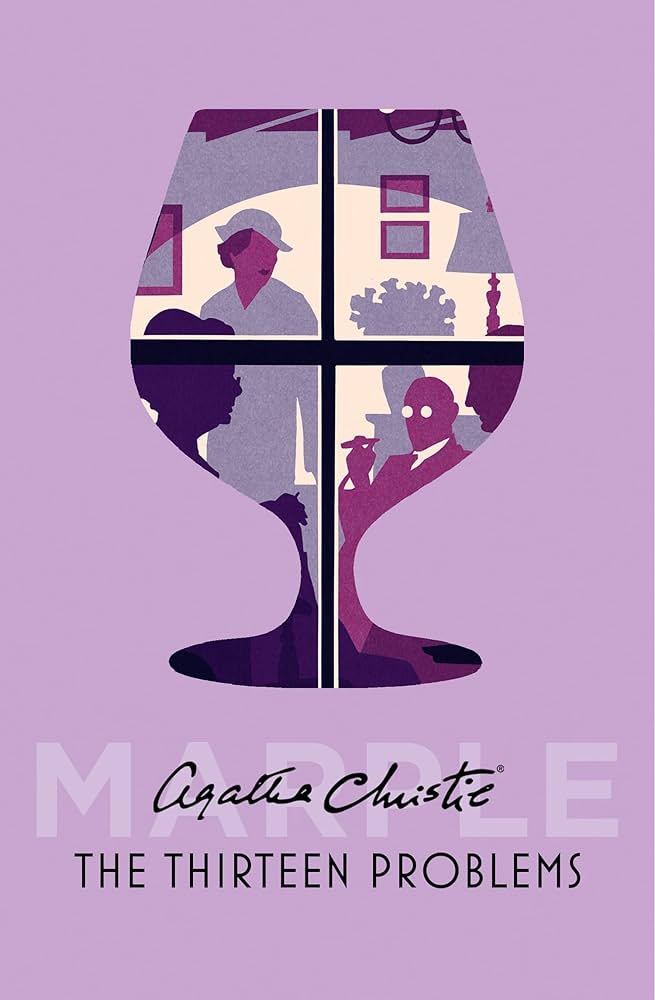
 This month for the Read Christie challenge we’re reading books with authors as characters. The recommended book, The Thirteen Problems, is one I hadn’t read before so I thought this would be a good opportunity to pick it up. First published in 1932, it’s a collection of short stories featuring Miss Marple and her nephew, Raymond West, who is a writer. It has also been published in the US as The Tuesday Club Murders, so you may know it by that title.
There are thirteen stories in the book. In the first, a group of six friends gather at Miss Marple’s home in St Mary Mead and during the evening the conversation turns to mysteries. It seems that each of them has experienced or been involved in some kind of mystery and it’s suggested that over the next few weeks they should take turns telling their story and seeing if the rest of the group can solve it. Five of the friends have professions which they claim are ideally suited for detective work – an artist, a writer, a clergyman, a lawyer and a retired policeman – so they all agree to the plan and the Tuesday Night Club is born! The sixth member of the group, Miss Marple, is just there to make up the numbers; how could an old lady who has barely left her quiet little village possibly know anything about solving mysteries?
After all six have told their stories, several members of the group – with the addition of a doctor and a young actress – meet again at the home of Colonel and Mrs Bantry, where another set of stories are narrated. You won’t be surprised to hear that it’s Miss Marple who provides the correct solution for all thirteen of them, after everyone else has tried and failed!
I tend not to be a big fan of short stories, but I do usually enjoy Agatha Christie’s. This collection isn’t a favourite and I think I know why: it’s because the stories all involve mysteries that have already happened or have already been solved, so we don’t get to see Miss Marple or the other characters actively investigating them at the time. It’s a similar concept to Baroness Orczy’s Old Man in the Corner stories where her detective solves crimes while sitting in the corner of a London tearoom. Still, the stories are all interesting and I even managed to solve one or two of them myself!
Some of the stories have a supernatural feel – although the solutions have more logical explanations. My favourite was Colonel Bantry’s story, The Blue Geranium, in which a woman is visited by a fortune-teller who warns her to beware of a blue primrose, a blue hollyhock and finally, a blue geranium, which means death. When the flowers on her bedroom wallpaper begin to turn blue one by one, the woman begins to fear for her life. Another one I enjoyed was The Blood-Stained Pavement, narrated by the artist Joyce, who was visiting Cornwall to paint some picturesque village scenes. She’s sitting outside working on a painting when she notices drops of blood on the ground that weren’t there just a few minutes earlier. These bloodstains turn out to be important when a woman is reported missing two days later.
Although the stories in this book all stand alone, they are not completely separate as there’s also an overarching narrative, with the group of friends discussing the story that’s just been told and deciding whose turn it is to speak next. By the end of the book, Miss Marple has impressed everyone with her detective skills and has shown them that sometimes all that’s needed to solve a crime is a knowledge of human nature. Just as she does in the full-length novels, she draws on parallels with life in St Mary Mead and people she knows who remind her of the suspects or victims in the stories.
I did enjoy The Thirteen Problems, then, and found the stories just the right length. It’s always a pleasure to spend some time with Miss Marple!
 She Reads Novels
I agree that the short stories aren’t up there with the novels, and sometimes felt to me a bit like an overflow for Christie’s endlessly inventive mind full of ideas! Having said that, I read this more than 20 years ago and don’t remember much – e.g. the examples you give didn’t ring any bells – so I should revisit. The only story I seem to remember from this was Tape Measure Murder, if that was in this collection? For some reason that one has stayed with me. But might have been elsewhere.
I think it would be worth revisiting and after 20 years you hopefully won’t remember the solutions! Tape Measure Murder must be in a different collection. I don’t think I’ve ever read that one.
I re-read this relatively recently and did enjoy it. And was surprised how early it was in her writing career, too!
Yes, this must have been one of the very first Miss Marple books. I enjoyed it, although I do prefer the novels!
It’s been a while since I read these but I enjoyed them; Blood stained Pavement was among my favourites too. I do hope to revisit for ReadChristie this month
I hope you enjoy these stories all over again if you do decide to revisit them. Blood-Stained Pavement was a great one. I loved the Cornish setting and I even managed to guess part of the solution!
I haven’t read this or any of her short stories, but I will one day and I love the idea of the club!
I’ve only read a few of Christie’s short story collections as I’ve been concentrating on her novels, but I’ve enjoyed the ones I’ve read so far. The club did sound fun!
I’ve gone on at length elsewhere about my issues with short story collections so I won’t add to that here, but personally I prefer good solid crime fiction in the form of novels to short bitty puzzles with a twist. However, I have a soft spot for the occasional Miss Marple so I wouldn’t say I’d never try this, especially after your seal of approval for it!
I definitely prefer crime fiction in a longer form as well, but I’ve read a few of Christie’s short story collections and have found them all worth reading. Some of these stories could have been expanded into novels, I think, but were quite satisfying anyway.
Miss Marple is great! Though I do prefer novels to short stories. 😀
Yes, me too!
I think that many of the Christie short stories are like that, for example, The Thursday Murder Club is a bunch of stories about people sitting around talking about old cases.
I looked it up and The Thirteen Problems and The Tuesday Murder Club seem to be the UK/US titles for the same book.
Oh, no wonder!
Okay, so not every full-length novel writer is suited to the short story format. That said, her Tommy & Tuppence short stories worked well, although they were practically just chapters in a novel, with each chapter a different mystery, but mostly connected.
Yes, I enjoyed that Tommy and Tuppence book! I do usually like Christie’s short stories, even though I prefer her novels.
I read this back in early 2016 and was more than a little disappointed in it. Fortunately her novels are MUCH better [grin]. I’m hoping to add at least one (or maybe two) more to my read list this year.
Yes, I definitely prefer her novels. Some of her other short story collections are better than this one, though.
As I haven’t read anything by Agatha Christie before I don’t think I’ll start with this one but I do quite like the sound of the concept and the different approach to mysteries within it. The two that you’ve highlighted as favourites have such interesting premises too. I love mysteries that hint at the supernatural, I think that’s one of the things that tends to draw me towards gothic fiction so much. Lovely review and I’m glad you enjoyed this, even if it wasn’t a favourite.
No, I don’t think this is the best place to start with Christie, although most of the stories are quite entertaining. My favourite of her books and the one that really made me a fan is And Then There Were None, but if you prefer supernatural mysteries I would recommend The Pale Horse, which has a witchcraft storyline and a very eerie atmosphere.
Ooh I may go for The Pale Horse then. I do enjoy normal mysteries too but I already know the twist of And Then There Were None having seen an adaptation of it. I’d still love to give the book a try one day but I think I’d probably have the best first experience with a mystery I don’t know the outcome of. And a good atmosphere and witchy storyline sounds perfect.
Christie has to be one of my all time favourite authors and the person I turn to for a comfort read. Although I’m usually more of a Poriot fan, I love this book for how unassuming Miss Marple is sitting there amongst her friends, and yet how commanding her presence comes, almost like there’s building a sense of leadership from such a quiet place. I love it.
Yes, Christie’s books are perfect comfort reads. I usually prefer Poirot too, but I do love the way everyone continually underestimates Miss Marple until she surprises them by giving the right solution every time!