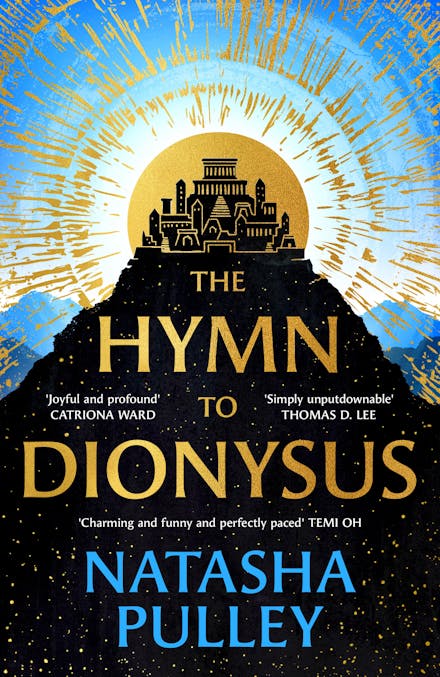
 I know what you’re thinking: not another Greek mythology book! There have been so many in recent years, it would be easy to dismiss this one as just more of the same. However, I found it completely different from any of the others I’ve read, and despite the marketing it’s nothing like the Greek retellings written by Madeline Miller or Jennifer Saint.
The Hymn to Dionysus is narrated by Phaidros, whom we first meet as a child being trained as a knight in a Greek legion (knight is the term Pulley uses, but it clearly just refers to a mounted soldier rather than our image of a medieval knight). Phaidros doesn’t know who his parents are, but that’s not considered important in the Theban army, where your duty and loyalty is to your commander – in this case, Helios, who provides all the love, guidance and leadership Phaidros needs. He never questions his commander’s orders until the day when, during a trip to Thebes, Phaidros rescues a blue-eyed baby from a fire at the palace and Helios insists on the baby being abandoned at a temple, never to be mentioned again.
Many years later, Phaidros is a commander himself, training new recruits in Thebes. When Pentheus, the crown prince, disappears, desperate to escape an arranged marriage, Phaidros is drawn into the search, something which leads him to an encounter with a blue-eyed witch, Dionysus. The arrival of Dionysus coincides with an outbreak of madness amongst the knights of Thebes and stories of a mysterious new god. Is there a connection between Dionysus and the baby boy rescued by Phaidros all those years ago?
I read Natasha Pulley’s The Bedlam Stacks, set in 19th century England and Peru, when it was published in 2017 and although it was getting glowing reviews from everyone else at the time, I didn’t like it very much, mainly because I found the language irritatingly modern and anachronistic and the magical realism elements were stronger than I expected. I haven’t tried any of her other novels since then, but I loved one of her short stories which appeared in The Winter Spirits, a ghost story anthology, so I thought it would be worth giving her another chance. I’m glad I did, because I found this book a lot more enjoyable. It’s still written in very modern language, but that doesn’t seem to bother me quite as much when a book is set in the ancient world, although I would find it difficult to explain why.
Although I’ve read other Greek mythology novels in which Dionysus and some of the other characters appear, I don’t really have a very extensive knowledge of the myths surrounding them (I haven’t read Euripides’ play, The Bacchae, in which some of this is covered) and I think this was probably actually a good thing, as it meant I could just enjoy the story without having too many preconceived expectations. As I’ve said, it’s not a typical retelling anyway; as far as I can tell, it draws on various aspects of different myths and blends them together to form an original story. There are elements of magic – ivy that suddenly begins to grow when Dionysus is around; masks that bestow new characteristics on the wearers – but the book never quite becomes full-blown fantasy. I loved Pulley’s descriptions of the giant mechanical statues she calls ‘marvels’ and although I doubt they would have existed in the way she describes, there are examples of automata dating back to Ancient Greece so it could have been possible.
The main focus of the book, though, is on Phaidros and his relationships – particularly the one with Dionysus, which develops slowly as Phaidros wonders whether Dionysus is the baby he rescued all those years ago or whether he isn’t, whether he’s the ‘mad god’ everyone is talking about or whether he is just the witch he claims to be. I liked Phaidros and enjoyed the way he narrated his story, so even though this is a long book I felt that the pages went by quite quickly. I would probably consider reading some of Natasha Pulley’s other books, if anyone has any recommendations.
Thanks to Gollancz for providing a copy of this book for review via NetGalley.
 She Reads Novels
The Half Life of Valery K would be the one I’d recommend to you—it’s set in a version of Stalinist Russia, so the more modern-sounding dialogue isn’t a problem in the same way, and I think it’s the one of her books in which she reins in her tics as an author best and makes them work for her most effectively.
Thank you! Yes, that sounds like it could be a good one for me to try next. I’ll leave her other Victorian ones for now.
Perhaps the modern language didn’t bother you because they would have been speaking Greek rather than English. We all have our, probably inaccurate, idea of what old English might sound like, but speaking another language is different.
Yes, that’s probably the reason, and also it was so long ago, almost any words the author used would be anachronistic.
True!
….adds to ‘The List’. [grin]
It’s worth it as it’s a bit different from the usual Greek retelling!
Sounds very interesting! I have not read anything by this author but dislike magical realism and anachronistic language so would definitely not like The Bedlam Stacks either.
Please make sure you don’t read The Phoenix Bride (despite its lovely cover). The heroine wanders around London in her night clothes, falls for her Jewish doctor (and he falls for his gentile patient), she accuses him of having a martyr complex – all while the Great Fire of London rages.
Thanks for the advice! I hadn’t been considering reading The Phoenix Bride, but will definitely avoid it now as I’m sure those things would irritate me too. That is a beautiful cover, though.
The Bedlam Stacks is my favourite Pulley, tbh (I know the period when it’s set very well but didn’t find her choices there to be a problem), but I’ve rated most of her novels very highly and so I’m keen to check this one out! I agree with Elle that the one most likely to appeal to you if you struggled with Bedlam Stacks is Valery K, which I also liked a lot.
Modern language in historical settings seems to bother me more with some books than with others and I’m not sure why. I wish I had liked The Bedlam Stacks more, but I’m glad you enjoyed it! I’ll take your advice (and Elle’s) and think about trying Valery K next.
There have been a lot of books written lately that are centered around Greek mythology. I’m glad this one turned out to be such a good read. 😀
Yes, I enjoyed it! It felt more like just a book set in Ancient Greece with a little bit of fantasy rather than a straight mythological retelling like the others I’ve read.