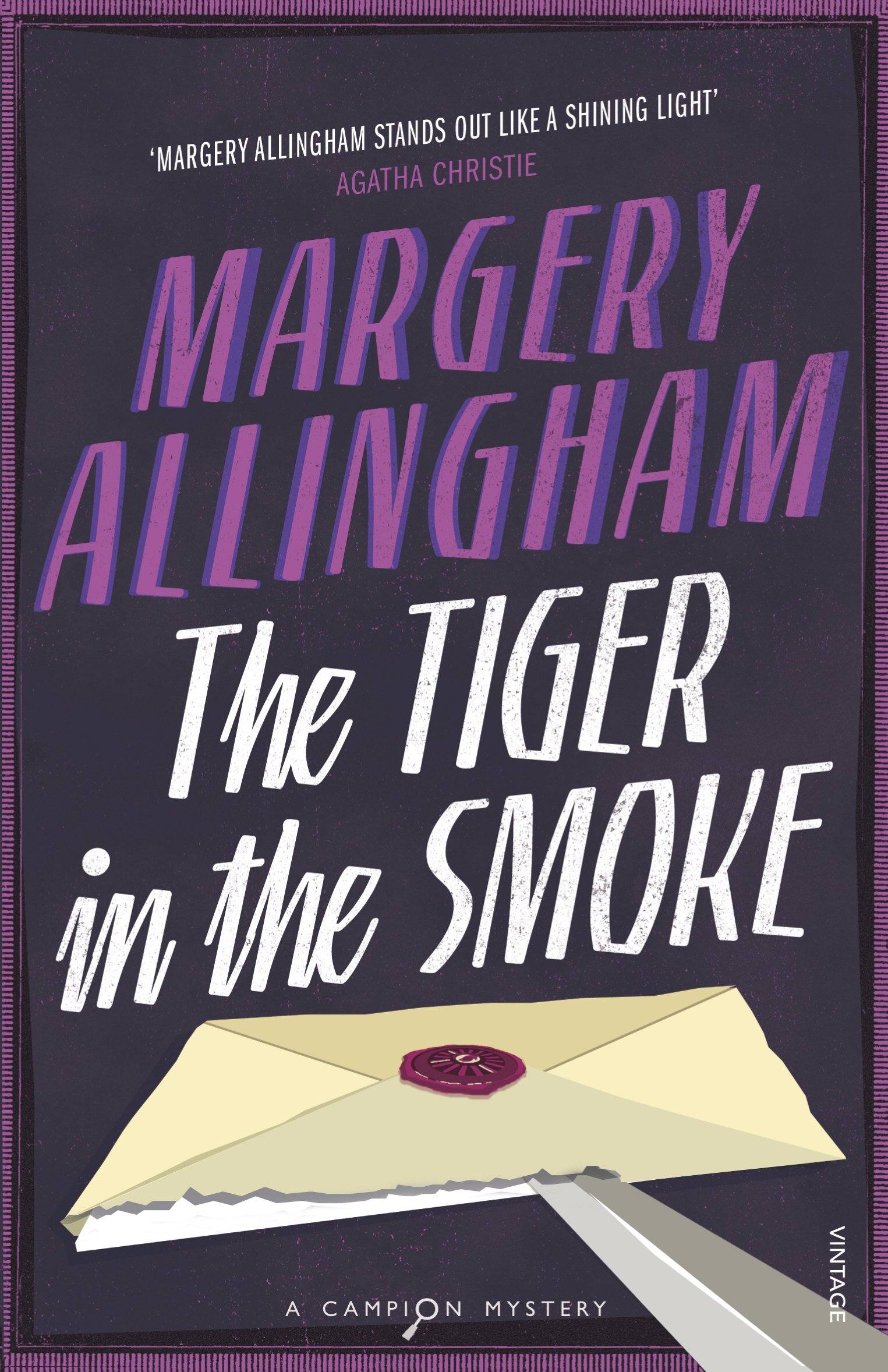
 I’ve read a lot of Margery Allingham’s books but, maybe surprisingly, not many of the Albert Campion ones and not the book that is often described as her best, The Tiger in the Smoke. When I saw that it was published in 1952, it seemed an ideal choice for this week’s 1952 Club, hosted by Karen and Simon.
The Tiger in the Smoke is the fourteenth novel in the Albert Campion series – although Campion himself barely appears in it. Despite the exotic title, the Tiger refers to an escaped prisoner, Jack Havoc, and the Smoke is a nickname for London. At the beginning of the book, we meet Meg, who has believed herself to be a war widow since her husband, Major Martin Elginbrodde, was reported dead in Normandy during the D-Day landings. Meg has recently become engaged to another man, Geoffrey Levett, but has started receiving mysterious photographs which seem to show that Martin is still alive. As a thick fog descends on London, Meg asks her cousin Albert Campion and Chief Inspector Charlie Luke to help her find out who is sending the photos and what they mean.
The connection between all of this and the escape of Jack Havoc – whom Campion’s friend Superintendent Oates describes as ‘a truly wicked man’ – is not immediately obvious, but gradually becomes clear as the story progresses. First, though, we meet a gang of ex-Army men trying to make a living as a band of street musicians, all with some kind of disability or war injury. They are also criminals and associates of Havoc, so portraying them all with disabilities is something I’m sure a modern author would avoid, even if Allingham got away with it in the 1950s. Havoc himself is a great villain, surrounded by a real aura of danger due to his unpredictability and ruthlessness.
This book is much more of a thriller than a mystery. In fact, there’s very little mystery at all, beyond the question of who is responsible for the photographs and how Martin Elginbrodde is linked to Havoc and his gang. There’s nothing for the reader to really try to solve, so you just have to sit and watch as the story unfolds. This probably explains why we see so little of Campion, as there’s not much for him to do from an investigative point of view. I have to admit that I was quite happy with his absence as I’ve found so far that I tend to prefer Allingham’s books without Campion to the ones with him – although having said that, this is one of the later books in the series and he seems to have matured a lot since the earliest book I’ve read (Mystery Mile).
 I loved the atmospheric descriptions of London in the fog in the first half of the book, with the limited visibility making it easier for the criminals to avoid capture. Allingham finds so many evocative ways to describe the fog and it really adds to the sense of tension and confusion. I’m pleased I decided to read this one for 1952 Club – and I have another Campion novel, The China Governess, on the TBR which I hope to get to soon as well.
 She Reads Novels
I really must try Allingham – this is the one on all the lists of greatest crime novels, etc., and I’m pleased to hear that you prefer the novels where Campion does little to nothing; I’ve watched a few of the TV adaptations of some Campion novels and found him rather irritating as a character.
I usually find Campion irritating, but he wasn’t too bad in this book. I definitely prefer him to stay in the background!
I’ve only read one Campion mystery, I must get back to them – all that London fog is very atmospheric isn’t it?!
Yes, I loved the way she used descriptions of the fog to create atmosphere. I haven’t read many Campion books either and really should read more of them!
Although I enjoy Campion and miss him when he’s not in the books much, I did love this one – the peasouper and the tension were just wonderful!
I haven’t read many Campion books, but this one is my favourite so far. The fog made it so atmospheric!
Yes, I only tried a few Campion mysteries, but in more than one, I seem to remember, he is not very present.
I haven’t read many either. Campion irritates me, so I’m happy when he doesn’t have a big part.
I have read so few that I have no sense of him.
I was quite happy that Campion was largely absent from this one too, since I always find him annoying. And I thought she used the fog really well to create atmosphere. Although I agree with you that a modern author would be a bit more sensitive about the gang of criminals and their disabilities, it worked really well to give the whole thing a sense of Gothic horror! And I felt she was maybe making a point that so many men had been left with life altering injuries after the war and didn’t have many options open to them. I still don’t love Allingham, but I did think this was one of her best—of the ones I’ve read so far, at least.
Campion irritates me too, although I didn’t mind him in this book, probably because we saw so little of him! That’s a good point about the injured men being pushed into a life of crime due to the lack of other options. It did all add to the horror aspect of the book, though, along with the fog!
Allingham’s an author I’ve wanted to check out. My library only has a few of her Albert Campion mysteries, so I guess I’ll start with one of those. Of her other books, do you have a favorite?
The Albert Campion mysteries are her best known books, so it’s probably a good idea to start with those, but of her other books I’ve enjoyed some of her short story collections, particularly The Allingham Minibus, and also her WWII memoir, The Oaken Heart.