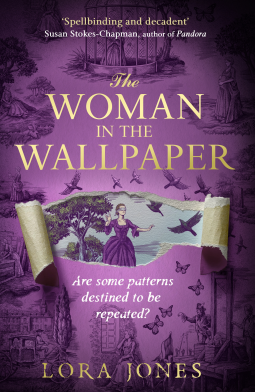
 The French Revolution is a fascinating subject and I’ve read several novels set during that period. The Woman in the Wallpaper, Lora Jones’ debut novel, is another and is written from the unusual perspective of two sisters working at a wallpaper factory in northern France.
Sofi and Lara Thibault are the daughters of a stonemason who dies suddenly under tragic circumstances early in the book. In need of work to support themselves, the sisters and their mother move to Jouy-en-Jouvant, a town near Paris, where all three have been offered employment at the Oberst factory. The factory produces wallpaper with a unique design featuring a woman thought to be the late Mrs Oberst, who died several years ago and may or may not have been murdered. As they settle into their new jobs, both girls are drawn to Josef Oberst, the heir to the factory, but Josef is soon to be a married man, with an aristocratic young wife due to arrive from Versailles.
With political turmoil brewing in France, Sofi finds herself caught up with the revolutionaries and longs to play a part in shaping her country’s future. Lara, however, has other things to worry about – like the resemblance between herself and Mrs Oberst and the way incidents from her own life seem to be replicated in the pictures on the factory wallpaper. Meanwhile, Josef’s new wife, Hortense, discovers that as a member of the aristocracy she could be in the most danger of them all as the revolution picks up pace.
I enjoyed The Woman in the Wallpaper, although I wish authors would stop writing in present tense! I’ve never read a book set in a wallpaper factory before and it was fascinating to read about the process of making the paper and preparing the coloured pigments, as well as the work carried out in the printhouse, where the designs are carved onto the wooden blocks which are then coated with ink and pressed onto the paper. The parts of the novel dealing with the French Revolution are also interesting. Some of the key events, such as the storming of the Bastille and the arrival of the guillotine, are included, but the main focus is on the role of women and how the Revolution seemed unlikely to bring about the level of change they were hoping for.
The novel is narrated by both of the Thibault sisters and at first, even though the name of the narrator is given at the start of each chapter, I found myself forgetting which one I was reading about as their voices felt very similar. Later in the book, as their stories began to diverge, the two became easier to distinguish and this wasn’t a problem anymore. Lara is the gentler, quieter, more mature sister but Sofi, the impetuous younger sister, was my favourite. However, there’s also a third narrator – Hortense, Josef’s selfish, entitled wife from Versailles. Hortense makes no attempt to adapt to the changes in society or to endear herself to the people of Jouy; in one memorable scene, she deliberately hosts an elaborate birthday party for her pet dog, knowing that peasants are starving and workers are protesting. I thought perhaps I would warm to her as the book went on, but that didn’t happen – I found her cruel and heartless right to the end.
As for the central mystery surrounding the images in the wallpaper and their connection with Lara’s life, I found it easy to guess what was really going on, but it was still quite unsettling! This is an impressive first novel and I hope Lora Jones will be writing more.
Thanks to Sphere for providing a copy of this book for review via NetGalley.
 She Reads Novels
This sounds good and the wallpaper manufacturing is the part I’ll find the most interesting as well probably, it’s funny how there’s often something in the background that catches our imagination!
The plot was interesting as well, but the wallpaper factory setting was definitely my favourite thing about the book as it was quite unusual!
I think the only book I’ve read with the French Revolution as the setting is A Tale of Two Cities. The two sisters and their work at the wallpaper factory do sound interesting. But I really don’t enjoy reading books written in present tense either.
I loved A Tale of Two Cities. I’m putting a post together with other French Revolution recommendations, which should probably be up sometime next week.
I guess writing in the present tense doesn’t bother me any more.
I don’t like it, but can’t really avoid it as so many books are written like that now.
Writing in the present tense annoys me too. It makes me feel like I’m about 4 and reading a book which says “This is Peter, this is Jane”!
Yes, it’s so childish!
The French Revolution is definitely an interesting setting!
Thanks for sharing your review with the Historical Fiction Reading Challenge