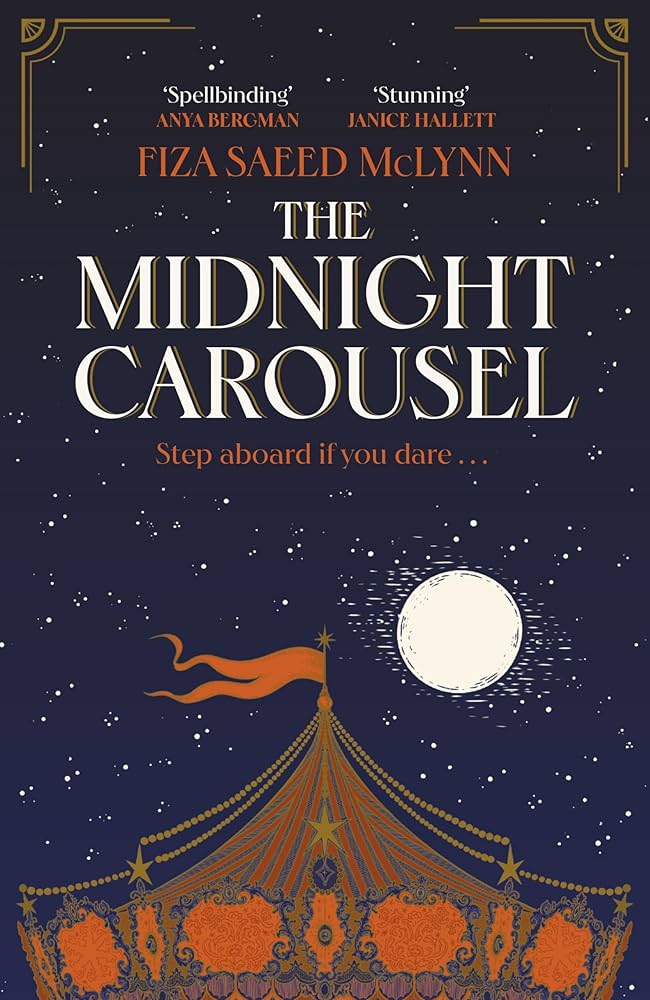
The Midnight Carousel by Fiza Saeed McLynn

Whenever you decide to read a book by an author who’s new to you, you never really know what to expect and there’s always a risk you won’t like it, particularly when it’s a debut novel like this one. Fortunately, I loved The Midnight Carousel from the beginning; it’s such an original, unusual story that I was completely captivated by it.

The carousel of the title is built in 1900 by Gilbert Cloutier for the Grand Exhibition in Paris. Gilbert is struggling to come to terms with his grief over the recent loss of his young son, so he decides to add some special features to the carousel in memory of the boy. This is the last thing he does before disappearing without trace. Over the years that follow, the carousel gains a sinister reputation when it becomes linked with further disappearances and Detective Laurent Bisset is asked to investigate. He thinks he has caught the culprit, but several years later history begins to repeat itself, leaving Laurent questioning whether he has made a terrible mistake.

Meanwhile, in England, Maisie Marlowe is being raised by abusive foster parents in Canvey Island, Essex. Maisie has no idea who her real parents are and the only things that sustain her through this miserable period of her life are her friendship with her foster brother and a picture of a beautiful carousel that she found on the beach. Eventually, an aunt comes to rescue her and takes her to live in the home of Sir Malcolm Randolph where she has just taken a job as housekeeper. Due to an unexpected sequence of events, Maisie ends up emigrating to America with Sir Malcolm where they open an amusement park in Chicago with a magnificent carousel as the star attraction – the exact same carousel as the one in Maisie’s picture and the same one that was built at Gilbert Cloutier’s factory in Paris.

When the disappearances begin again, Laurent Bisset is sure there must be a connection with the earlier incidents in France, so he travels to Chicago determined to uncover the truth this time. Here he crosses paths with Maisie, bringing the two threads of the novel together. I loved both characters and was interested in their personal stories – Maisie’s Dickensian childhood and her incredible change of fortune and Laurent’s dedication to making amends for his past mistakes – but I also enjoyed watching their relationship develop as they come together over the mystery of the carousel.

The mystery element of the book is not so much a whodunit as a howdunit. How can people be disappearing into thin air while riding the wooden jumping horses? Is the carousel itself haunted? Did Gilbert Cloutier place a curse on it? Is someone somehow snatching people from the horses without being seen? Although there were a few clues that I thought could and should have been noticed by Laurent and the police, I can also understand how they could have been missed. When we eventually get some answers, they are both clever and creepy and what I found particularly unsettling is that all through the book I never really knew whether I was reading magical realism or something with a more human explanation. The eerie atmosphere, along with the fairground setting, kept reminding me of Erin Morgenstern’s The Night Circus, but I think this is a better book.

I thoroughly enjoyed The Midnight Carousel and loved getting to know Laurent, Maisie and the secondary characters – I particularly liked Mrs Papadopoulos the dairy seller and Madame Rose the fortune-teller. I’ll certainly be putting Fiza Saeed McLynn on my list of authors to look out for in the future.

Thanks to Michael Joseph for providing a copy of this book for review via NetGalley.

Six Degrees of Separation: From Rapture to The Graces

It’s the first Saturday of the month which means it’s time for another Six Degrees of Separation, hosted by Kate of Books are my Favourite and Best. The idea is that Kate chooses a book to use as a starting point and then we have to link it to six other books of our choice to form a chain. A book doesn’t have to be connected to all of the others on the list – only to the one next to it in the chain.

This month we’re starting with Rapture by Emily Maguire, which is loosely based on the legend of Pope Joan, who was supposedly the first and only female pope. I haven’t read it and am not sure if I want to, but it does sound interesting.

I found it very easy to decide on my first link this month, particularly with the recent death of Pope Francis. It’s Conclave by Robert Harris (1), a fictional account of a papal conclave, the process by which cardinals gather at the Vatican to elect a new pope. It may not sound like the most exciting subject for a thriller, but Harris makes it gripping and suspenseful.

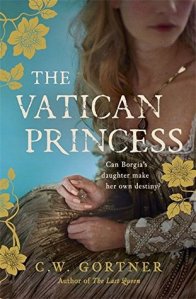
The Vatican is my next link and leads me to The Vatican Princess by CW Gortner (2). Set in Renaissance Italy, this novel is narrated by Lucrezia Borgia, whose father Rodrigo bribes his way to the papal throne and becomes Pope Alexander VI.

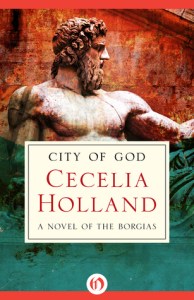
City of God by Cecelia Holland (3) also tells the story of the Borgias, this time seen through the eyes of Nicholas Dawson, secretary to the Florentine ambassador to Rome. This is a complex novel, mainly concerned with political intrigue and spying, and gives a completely different perspective from the Gortner book.

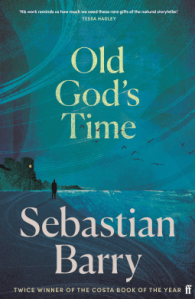
Another book with the word ‘God’ in the title is Old God’s Time by Sebastian Barry (4). Set in Ireland, this novel follows Tom Kettle, a retired police detective looking back at his memories of a case from the 1960s which has been reopened. It involves one of the darkest episodes in the recent history of the Catholic Church.

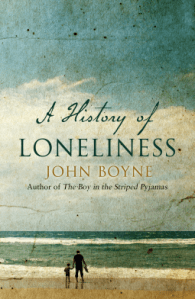
In A History of Loneliness (5), John Boyne tackles the same subject from the perspective of Odran Yates, a Catholic priest. This is a fascinating novel, raising the question of whether choosing to look the other way and do nothing makes us complicit in crime.

The John Boyne novel is set in Dublin and so is The Graces by Siobhan MacGowan (6), the final book in my chain. This is the story of Rosaleen Moore, known as The Rose, who becomes known for her gifts of prophecy and healing in the early 20th century and makes a shocking deathbed confession to the priests of Mount St Kilian Abbey.

~

And that’s my chain for May! My links have included: popes, the Vatican, the Borgias, the word God, Irish authors writing on a shared theme and Dublin. The books are also all connected to the topic of religion and the Catholic Church.

In June we’ll be starting with All Fours by Miranda July.

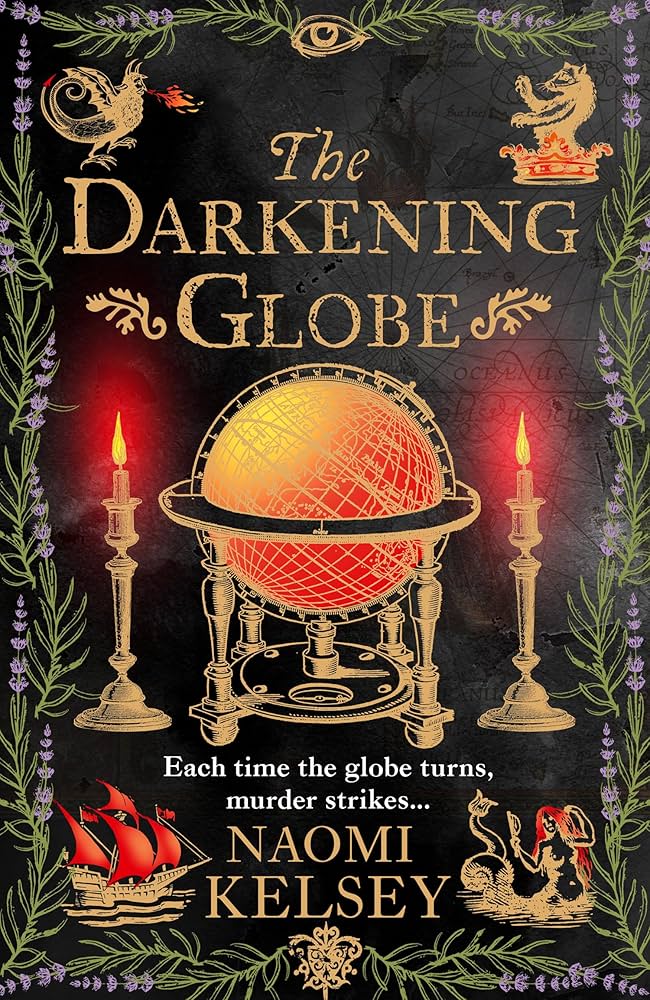
The Darkening Globe by Naomi Kelsey

Naomi Kelsey is a new author for me – I haven’t read her debut novel, The Burnings – but I was drawn to this book by the cover and title, which hinted at an atmospheric Gothic story.

The Darkening Globe is set in 1597, towards the end of the Elizabethan period. It’s a time of travel and adventure, of great explorers like Sir Francis Drake and Sir Walter Raleigh – and the fictional Sir Hugh Radclyffe. As the novel opens, Sir Hugh is returning to England from a voyage to the New World and his wife, Beatrice, is both happy and apprehensive. She’s pleased to have him back, but afraid he’ll find out she’s been having an affair with one of the male servants. However, Hugh doesn’t come home alone – he is accompanied by Catalina, a beautiful woman with dark hair and skin. Because Hugh refuses to explain who she is, Beatrice comes to the conclusion that he has also been unfaithful and her resentment grows as Catalina settles into their home and shows no sign of leaving.

There’s also another new addition to the Radclyffe household: an enormous painted globe, decorated with mermaids, serpents, lions and a multitude of other illustrations. Other courtiers have been commissioning them for their houses and Hugh is very proud of his. Beatrice, though, is less impressed – in fact, she finds the globe threatening and creepy. Her fear of it appears justified when she sees it start to spin one night and then a sinister new drawing appears on its face. Not long afterwards, a death takes place in a way that seems to resemble the picture. Beatrice is sure she’s not imagining things and is determined to uncover the truth. Has someone been tampering with the globe – and could it start to rotate again? What really happened on Hugh’s expedition? And why has he brought Catalina home with him?

I enjoyed The Darkening Globe, particularly the parts of the story involving the globe itself – it’s quite eerie every time it starts to spin and a new picture appears, hinting that another death will happen soon. It’s not immediately obvious what is going on with the globe, as it really does seem to have a mind of its own. The other mystery, involving Catalina, is also interesting. I jumped to a conclusion about her very early in the book, but I was wrong and her connection with Hugh Radclyffe was not what I’d expected. I was pleased to be wrong as the real explanation for her presence was much more intriguing than I had assumed.

Although I felt that Beatrice, as our heroine, could have been a stronger character and the villains could perhaps have been given more depth, this was an entertaining novel with an imaginative plot. I’ll have to find time to read The Burnings and will also look out for future books by Naomi Kelsey.

Thanks to HarperNorth for providing a copy of this book for review via NetGalley.