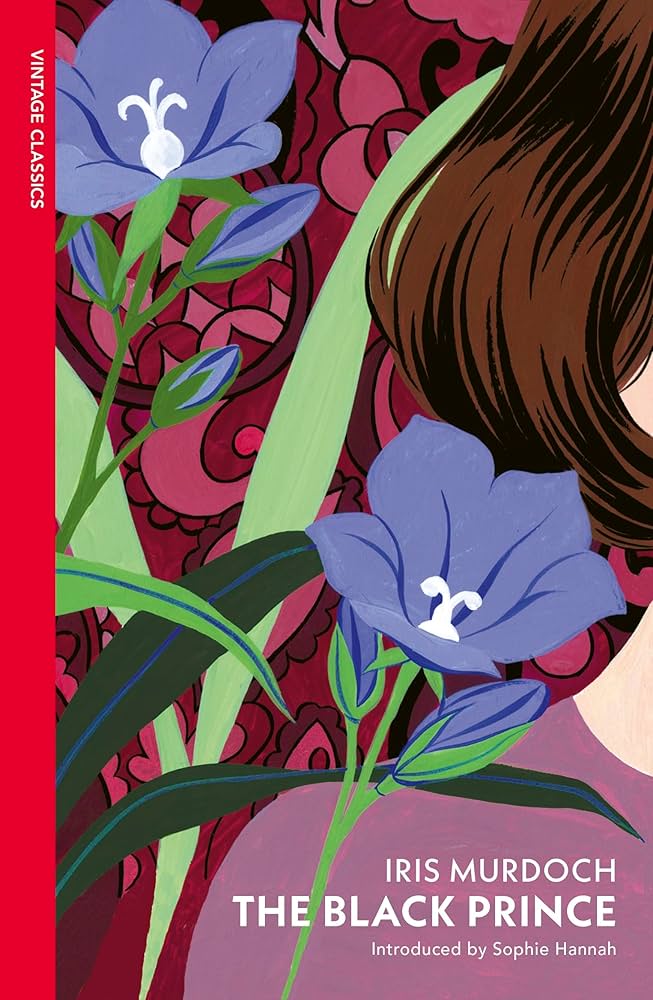
 I’ve read very little of Iris Murdoch’s work – her Booker Prize winner The Sea, The Sea many years ago, which I can barely remember but know I struggled with, and a lesser known novel, A Word Child, which I really enjoyed. When picking another book by Murdoch for my new Classics Club list, then, I had plenty to choose from and decided on The Black Prince almost at random. I started to read it in March for Reading Ireland Month (although the book is set in England, Murdoch is an Irish author) but I had too many other books needing to be read at that time, so I put it aside and came back to it last week.
Published in 1973, The Black Prince is presented as a manuscript written by Bradley Pearson who has recently retired from his job as Inspector of Taxes to concentrate on his writing. Bradley’s book – an account of some life-changing events which occurred when he was fifty-eight years old – is framed by a foreword from his editor, P. Loxias, and a series of postscripts written by the other characters in the story. Although it’s easy to become absorbed in Bradley’s narrative and forget that it’s a book-within-a-book, the different perspectives we see at the end are a reminder that Bradley isn’t necessarily the most reliable of narrators and may not have been entirely honest with us. Of course, there’s no guarantee that the other characters are telling the truth either, so be prepared for a novel that’s ambiguous, thought-provoking and doesn’t tie everything up neatly at the end.
Bradley’s story begins as he decides to leave London for the summer and rent a cottage by the sea where he can work on his book in peace. Before he manages to depart, however, he is repeatedly delayed by a sequence of frustrating and unwelcome incidents. First, there’s an urgent telephone call from his friend and rival, Arnold Baffin, a much more successful and popular author than Bradley himself. Arnold is convinced he has killed his wife, Rachel, so Bradley rushes to their house only to find that it’s a false alarm and Rachel is not dead after all. Bradley’s involvement in the Baffins’ domestic disputes, though, leads to Rachel believing she’s in love with him. Then, Bradley’s sister, Priscilla, arrives at his flat tearful and distraught; her marriage has broken up and she’s depressed and homeless. And a third woman has also reappeared in Bradley’s life – his ex-wife, Christian, who has just returned from America along with her annoying brother, Francis.
The first half of the novel deals with Bradley’s relationships with these people as he tries to disentangle himself from the various situations he’s become caught up in and I have to admit, at this point I was finding the book a bit tedious and didn’t think I was going to enjoy it. That changed halfway through when Bradley falls in love with the Baffins’ twenty-year-old daughter, Julian, who has been pleading with him to tutor her in classic literature, particularly Shakespeare. Needless to say, Arnold and Rachel are not happy when they find out – there’s a thirty-eight year age difference – but the ensuing drama makes the second half of the novel much more compelling than the first.
Before I started reading, I wasn’t sure of the relevance of the title. In history, the Black Prince refers to Edward of Woodstock, the eldest son of Edward III, but in the context of Murdoch’s novel, the reference is actually to Hamlet. The play is alluded to many times during the novel and specifically discussed by Bradley and Julian (it’s while Julian is describing how she once dressed in black to play Hamlet that Bradley discovers he’s in love with her). I’m sure it’s no coincidence that Bradley Pearson himself shares initials with the Black Prince. Other names are also significant, including P. Loxias, the name of the fictional editor – Loxias is another name for Apollo, the Greek god of truth and prophecy, very appropriate in a book that makes us question what is true and what isn’t. And I spotted other examples of symbolism throughout the novel, such as the bronze water buffalo lady, an ornament which is passed from one character to another and is broken and mended at various points in the story.
This is a fascinating novel, then, and although I found it slow to start, I had been drawn in by the middle of the book and was glad I’d persevered. I’ve also been left with a lot to think about; as I said, it’s all very ambiguous and there are lots of unanswered questions at the end. If you’ve read it, let me know what you thought.
This is book 3/50 from my third Classics Club list.


I couldn’t really enjoy this one because I found Bradley (actually all of the characters) so unlikable and the age difference and some of the other scenes were disturbing…but I agree it’s an interesting book, lots of layers and things to think about.
Yes, it is disturbing at times and obviously intended to be, but reading the various postscripts at the end made me think differently about some of the things that happened and how to interpret them. I can understand why you didn’t get on with this one – I liked it overall but didn’t think I would at first.
Sounds interesting. She’s not an author I’ve ever read.
Her books are always fascinating, but I’ve read very few of them!
I skimmed your review since I’ll be listening to this one very soon, but I’m glad to know that I should be prepared for a slow start but it’s worth sticking with! I’ll come back and read your review properly once I’ve read the book…
I hope you like it. I didn’t think I was going to at first, but was glad I stuck with it!
I was the same as you with this one. I thought it started slowly and I wasn’t sure if I was enjoying it, but then it kicked in about halfway through.
Yes, I was glad I kept going with it. I really enjoyed the second half.
It seems we all have – and maybe are meant to have – the sense of tedium in the first third or so of the novel, Murdoch’s joke I suspect about the worth of BP as a novelist. Yet, as you say, there’s a lot to enjoy and consider in this novel as I suggest in my review and as I’ll be expanding on in a later discussion.
At any rate, I’m glad you got a lot out of this reading – though I fear I shall get indigestion if I leap too soon into reading another of Murdoch’s offerings, especially so soon after also completing A Severed Head!
Yes, that’s a good point – I hadn’t considered that maybe we were supposed to find it tedious! I’ll look forward to your review and discussion. There’s definitely enough material for more than one post. I can understand why you feel the need for a break before starting another Murdoch novel, though!
I remember disliking this book about thiry years ago, but it’s been coming up lately all over the place, and my tastes have changed quite a bit.
I think I would have disliked it when I was younger as well, or at least not fully appreciated it.
Yes, I might try it again.
I find I have to really concentrate with IM but then it is worth it in the end; I read this years ago but can’t remember anything about it but after reading The Red and the Green I feel full of enthusiasm to read more so a re read is in order!
Her books definitely need a lot of concentration and perseverance, I find. I haven’t read The Red and the Green yet, but hope to get to it eventually!