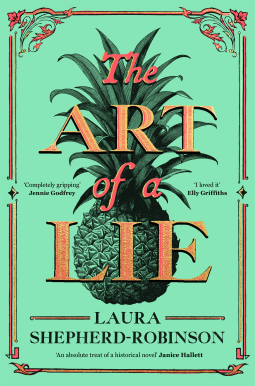
 I’ve enjoyed all of Laura Shepherd-Robinson’s previous books, particularly The Square of Sevens, so this is one of the new releases I’ve been most looking forward to reading this year. It has many of the same elements as her others – an 18th century setting, a mystery to be solved, lots of surprising plot twists and characters who are not quite as they seem! This one also features ice cream, which makes it a perfect summer read.
The Art of a Lie opens in London in 1749 and the first section is narrated by Hannah Cole, whose husband Jonas was found dead in the street several months earlier, seemingly the victim of a robbery. Since his death, Hannah has continued running their business, a confectionery shop known as the Punchbowl and Pineapple, but is struggling financially. A visit from the magistrate, Henry Fielding – who is also the author of the recently published Tom Jones – brings her some welcome news: Jonas had a large sum of money in his bank account that she knew nothing about. Unfortunately, her excitement is short-lived because Fielding also tells her that he suspects the money was acquired illicitly and that Jonas was probably not just the victim of a random attack as first thought, but was murdered by someone he knew.
A second way of improving her financial position soon presents itself to Hannah when a gentleman enters the Punchbowl and Pineapple and introduces himself as William Devereux, a friend of her late husband’s. William gives Hannah a recipe for ‘iced cream’, a frozen dessert made by his mother, who was raised in Italy. Despite some initial problems – freezing cream without the aid of an electric freezer is not an easy task – the new treat proves a big success. And soon William is helping her to solve a bigger problem – the question of who killed Jonas Cole and where the money in his bank came from.
The perspective switches between Hannah and William several times throughout the novel, with each narrator being given a distinctive narrative voice of their own. I felt a stronger connection with Hannah, but seeing things from William’s point of view provides a whole different side to the story. It quickly becomes clear to the reader that neither one of them is being completely honest with the other (or with anyone else) and that, as the title suggests, this really is a novel about the art of telling lies! It was fascinating to follow both of their narratives, wondering who was going to come out on top. The ending of the book wasn’t really what I’d expected and although I would have preferred the ending I had expected, it was good to be taken by surprise!
I loved the setting of the book, particularly the descriptions of Hannah’s shop and all the cakes, chocolates and sweets she sells. I enjoyed reading about her experiments with different varieties of ice cream (don’t miss the author’s note at the end of the book, which has some factual information about the history of ice cream in the UK). The inclusion of Henry Fielding as a character in the book was also interesting – he really was Chief Magistrate of Westminster at the time the story is set and was the founder of the Bow Street Runners, London’s first police force.
The Square of Sevens is still my favourite Laura Shepherd-Robinson book, but I think it’s just a matter of personal taste and I’m sure some readers will like this one better. It reminded me very much of The Queen of Fives by Alex Hay and I think if you enjoyed that one you’ll probably enjoy this one as well.
Thanks to Pan Macmillan/Mantle for providing a copy of this book for review via NetGalley.
Book 9/20 for 20 Books of Summer 2025.
 She Reads Novels
I haven’t read this author yet but look forward to doing so.
I did not like the Alex Hay book about the housekeepers as much as you did, although it was original. It just seemed so over the top and unlikely – which I can enjoy if presented the right way.
Her books have a more serious tone than Alex Hay’s, but this particular book shares some plot elements with Hay’s Queen of Fives. I hope you enjoy it – or whichever Shepherd-Robinson book you decide to start with.
I hadn’t thought about the similarities with this and Queen of Fives but you’re so right although Queen of Fives felt lighter in tone. I did love all of the food descriptions too.
Yes, I agree Queen of Fives was a bit lighter, but had a similar theme of lies and deception. I’m glad you enjoyed this one too.
I do love a story that transports you to another time and place and I love the whole ice cream thing in this one. What a fun historical detail to highlight. This one and her other book are both I want to read. 😀
Laura Shepherd-Robinson’s books always have a great sense of time and place. I loved reading about ice cream and how it was made in the 18th century!
I will eventually get to Laura S-R, encouraged by reviews by your good self – but not just now! The title alone attracts …
The title and cover would have drawn me to this book even if I hadn’t already known I liked her work. I hope you enjoy whichever one you eventually read!
I’ll probably stick to your original advice and try The Square Of Sevens first but this does sound interesting. I love the fact that one of its characters is based on a real individual from the past and I think reading about the ice cream making progress could be fun so this is definitely one I hope to check out if I get on well with the authors other book. Great review
The Square of Sevens is a darker, more atmospheric book, so I think you might prefer that one, but they are both great books and so are her earlier historical mysteries, Blood & Sugar and Daughters of Night. And yes, it’s fun to see how ice cream was made in the 18th century!
I have this from NetGalley and hope to get to it soon so I’ve only skimmed your review. I loved The Square of Sevens and wonder if this will turn out to be a little too light in comparison.
I hope you enjoy it – I’ll be interested to hear your thoughts! I did find it a little bit lighter than The Square of Sevens, but not too light.
I am adding this to my TBR! I love the idea of the ice cream elements!
Thanks for sharing this review with the Historical Fiction Reading Challenge.