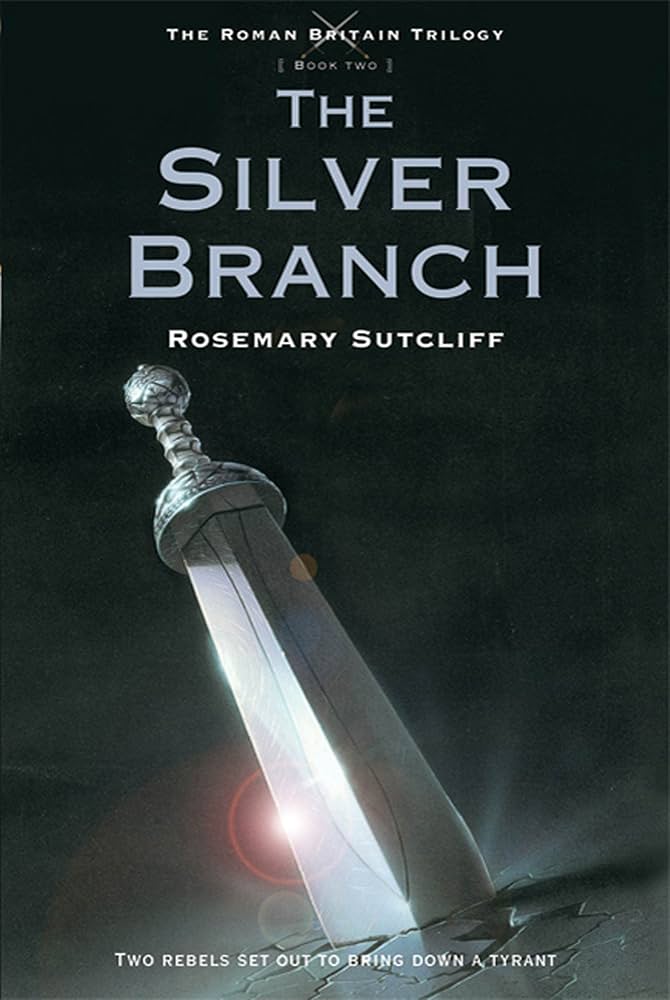
 After reading Rosemary Sutcliff’s The Eagle of the Ninth a few years ago, the first book in her Dolphin Ring Cycle, I wasn’t sure which one to read next. I was advised that it wouldn’t really matter as the books are all separate stories, but as I’m interested in reading all of them anyway, I decided to continue with the one listed next chronologically, which is The Silver Branch.
First published in 1957, The Silver Branch is set in Roman Britain more than a century after the events of The Eagle of the Ninth. The two main characters, Justin and Flavius, are descendants of Marcus Flavius Aquila, which provides the link between the two books. Towards the end of the 3rd century, Justin (Tiberius Lucius Justinianus) completes his apprenticeship as an army surgeon and is posted to Britain for the first time. Arriving at the fort of Rutupiae in Kent, he meets the centurion Flavius (Marcelus Flavius Aquila) and the two discover that they are distant cousins.
The Roman military commander Carausius has recently declared himself emperor of Britain and North Gaul. When the cousins overhear Allectus, the finance minister, plotting against Carausius, they try to warn the emperor but he seems reluctant to believe them and instead they find themselves sent north to Magnis, a fort near Hadrian’s Wall, apparently in disgrace. Worse still, they have now made an enemy of the powerful Allectus, who still has his sights set on the throne…
Although I thought The Eagle of the Ninth was the stronger book, I enjoyed this one as well. I knew nothing at all about this particular period of Roman history so I was able to learn a lot from it, not just about the historical and military events, but also about life in general in Roman Britain during and after Carausius’s reign. This is all described in vivid detail, making the novel completely immersive, and Sutcliff never talks down to the reader – it’s marketed as a children’s book, but it doesn’t actually feel like one and it definitely has a lot to offer readers of all ages.
Not all of the characters are Roman – for example, we meet Evicatos of the Spear, an exiled Dalriad hunter (Dalriada was an ancient Gaelic kingdom from western Scotland/north-eastern Ireland) – and although it’s a very male dominated story, Flavius’s great-aunt Honoria has an important role to play. The main focus of the book, though, is always on our two young protagonists and I found both of them very easy to like, particularly the shy, quiet Justin who grows as a person through his relationship with the more confident Flavius. It’s as much a story of male friendship as it is of the politics of Roman Britain.
If you’re wondering about the ‘silver branch’ of the title, it refers not to a tree but to an unusual musical instrument with silver apples on it belonging to Cullen, the emperor Carausius’s Fool, an eccentric man who calls himself a hound and wears a dog’s tail. The silver branch is a motif that appears several times throughout the novel, along with the dolphin signet ring, an Aquila family heirloom, and the lost eagle standard of the Ninth Legion.
This is book 50/50 from my second Classics Club list. Yes, I’ve completed it at last!
 She Reads Novels
I enjoyed The Eagle of the Ninth a few years ago too and may need my memory jogged a little but I am going to look for this next one. I like her writing for the way that you learn a great deal about history but the characters are so well drawn.
If you can’t remember all the details of The Eagle of the Ninth, that shouldn’t be a problem as this one works as a standalone with different characters and setting. I hope you like it!
Rosemary Sutcliff is one of my top five all-time great historical novelists, and I read and re-read all of her books when I was a child and a teenager. It’s not just that her characters are so good, and her writing so immersive, but she also writes so beautifully. Her adult novels are also well worth checking out, especially The Rider of the White Horse (Sir Thomas Fairfax), The Flowers of Adonis (Alcibiades), and Sword at Sunset (Arthur – and the culmination of her Roman Britain novels). With the exception of The Rider of the White Horse, which is largely told from the point of view of Fairfax’s wife Anne, they are all fairly ‘masculine’, but back then ‘women’s history’ was non-existent and the prevailing view was that boys got all the fun in the past, so they were the ones to write about (I concurred at the time, but I attended a boys’ school for four years, so I’d had it demonstrated to me, over and over, that girls were a lesser form of life). Even more remarkable is that Sutcliff’s particularly vivid descriptions of battles were written when she was largely confined to a wheelchair because of a virulent form of arthritis that worsened throughout her life. Her imagination was extraordinary.
I’ve read The Rider of the White Horse and one of her other adult novels, Blood and Sand, both of which I enjoyed. I’m sure I’ll read the others you mentioned eventually. I agree that she writes beautifully and even though the Roman period isn’t really one of my favourites, I found this book very immersive. She does have a wonderful imagination.
I haven’t read any Rosemary Sutcliffe but my husband loves her so there are plenty of copies about, you make me think I should give her a go though. . .
And congratulations, that’s brilliant, what a tidy way to start the new year!
Your husband has good taste! I hope you like her too if you decide to give her a go. And thanks – I’m looking forward to starting a new list now.
I haven’t read thos author before but maybe I should. Roman Britain is a favorite time period of mine.
Congratulations on completing the second list as well! What an accomplishment! Also great review. I did not even realise it was marketed as a children’s book until you mentioned it.
Thank you! It took me a lot longer to complete the second list than the first one, but I’m pleased I’ve done it at last!
I enjoyed the movie adaptation of ‘The Eagle of the Ninth’ and have been thinking about (at least) reading it and (maybe) the entire series. I do like Roman historical novels especially those based in England/Scotland.
I still haven’t seen the adaptation of Eagle of the Ninth, but the book is great. I hope you like it if you decide to read it!
Oh, you’ve taken me right back to my childhood by mentioning The Eagle of the Ninth! I’m pretty sure it’s one of the books that got me into historical fiction and I’m still attracted to books set in the Roman age. And, congratulations on completing your Classics Club list 👏
The Roman period isn’t really one of my favourites, but I did enjoy this book and The Eagle of the Ninth! And thanks – I’m so happy to have completed the list at last.
I thought I had read this one, but your description doesn’t sound familiar. There are a few that go with The Eagle of the Ninth, though, and I read at least one of them. Oh, I think it was The Lantern Bearers.
The Lantern Bearers is the next one I’m planning to read.
I absolutely love her work and still have my copies – due a re-read, obviously. They spurred my interest in history, not so much historical fiction as such: I had a phase of Anya Seton, etc., in my teens but prefer nonfiction for my history. But you can’t go wrong with Sutcliffe and also Barbara Willard, whose Mantlemass Chronicles are wonderful.
I’ve only read a few of her books but have enjoyed all of them so far. I hope you can find time for a re-read soon!
I haven’t read a lot of books set during any time period in Roman history. I’ll have to keep this author in mind, because these sound very interesting.
Roman history has never been one of my favourite periods to read about, but I’m slowly becoming more interested in it. I would definitely recommend trying one of Rosemary Sutcliff’s books.
I havent heard of these books before but I love a historical setting and will have to look into them. I know you’ve said chronological order doesn’t really matter here but Id probably start where you did too as im terrible at picking up books out of order, whether it matters or not.
Also congratulations on completing your classics challenge 🥰
Yes, I always like to read books in order too, even if it’s not necessary. And thank you – it has taken me years to complete my Classics Club list, so it’s a good feeling to have finished it at last!
I enjoyed a few of Sutcliff’s historical novels as an older teen but have found myself reluctant to take them up again in recent years, though I’m not sure why. Maybe they’re just too serious for my taste now? She can be quite intense, with little humour or lightness of tone to alleviate the storytelling. That’s not to say I don’t think she’s a good writer – she certainly treated her readers with respect.
Yes, I think I know what you mean. Her books do have quite a serious tone, which is maybe why they don’t really feel like ‘children’s books’, despite being described that way.
I am very impressed that you have completed your second Classics List! I have only just created my first list. Perhaps I should put the ones I have read on there for completeness!
I do have Eagle of the Ninth here somewhere and I think I read it many, many years ago.Thank you for sharing your review with The Historical Fiction Reading Challenge! I appreciate your continued support of the challenge.
It took me years to finish my list, but I’m pleased to have done it at last! Good luck with yours.