Some thoughts on Emerald Fennell’s Wuthering Heights (2026)

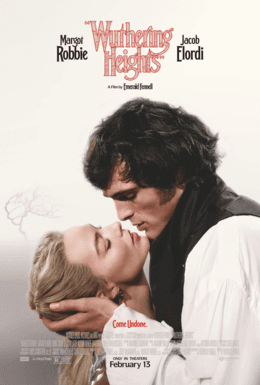
I hadn’t intended to go and see Emerald Fennell’s new Wuthering Heights adaptation as I’d been put off by the trailer and the early reviews being almost universally negative, but I wasn’t doing much else yesterday and made a last minute decision to go, in the hope that it wouldn’t be as bad as it sounded!

Wuthering Heights is one of my favourite books and I’m under no misconceptions about it being a ‘romantic love story’, no matter how much the book and various film versions may have been marketed that way. I first read it when I was thirteen and I wasn’t particularly interested in reading romance novels at that age anyway, so I loved it for the dark, twisted, passionate Gothic novel it is. To me, it’s the perfect book and I would probably be critical of any adaptation that’s not completely faithful. I tried to go in with an open mind, although I knew it would be difficult.

There’s been a lot of criticism of the casting of Jacob Elordi as Heathcliff, due to him not being the ‘dark-skinned gypsy’ Emily Brontë describes (we don’t know exactly what his racial background is, but the general consensus is that he’s not white like Elordi). Interestingly, Fennell has cast Asian actors in the roles of Edgar Linton and Nelly Dean, taking away the whole idea of Heathcliff being looked down upon because of his skin colour. As for Edgar’s sister, Isabella, she’s reduced to a comedy character in this version, with a silly, childish voice (and there’s a strong implication that she’s actually enjoying the abuse she receives from Heathcliff). The biggest problem with the casting, though, at least for me personally, was 35-year-old Margot Robbie playing Cathy, a brown-haired teenager in the book. She was completely wrong for the part, with her age, her blonde hair and bright red dresses, all of which kept breaking any immersion in the story that I was starting to feel.

As usual, the whole second half of the book is missed out (so no younger Catherine, Linton Heathcliff or Hareton Earnshaw), eliminating some of the novel’s important themes and subplots. I don’t understand why it’s apparently so difficult to adapt the whole book – yes, there would have to be flashbacks, a framing story, shifting timelines etc, but surely that’s not impossible to deal with? In this version, there’s also no Mr Lockwood, which means we don’t get the famous ghost scene – and most inexplicably, no Hindley Earnshaw. Instead, the characteristics of Hindley and his (and Cathy’s) father, old Mr Earnshaw, are combined into one character, played wonderfully by Martin Clunes, who does a great job and is the star of the show, in my opinion! Leaving out Hindley, though, removes the whole storyline involving his rivalry with Heathcliff and later, Heathcliff’s scheme to take revenge.

Despite everything I’ve said, this wasn’t a bad way to pass a few hours on a cold, wet Sunday afternoon and I’m sure other people were probably enjoying it more than I was. The film does at least look great – beautiful cinematography, dramatic Yorkshire Dales scenery and dark and brooding interior sets. If you’ve seen it, let me know what you thought. I’m particularly curious to know whether it worked better for people who’ve never read the book or don’t love the book as much as I do.

The Classics Club 26 in 2026

The Classics Club recently posted a questionnaire for members to complete. It’s a shorter, updated version of an earlier questionnaire from 2014 with 50 questions – I participated in that one and found it interesting to go back and look at my answers! There are 26 questions in this version (because it’s 2026) and here they are:

1. When did you join The Classics Club? How many titles have you read for the club so far? Share a link to your latest classics club list.

I joined in 2012 when it was first formed. Since then I’ve read 150 books for the club (100 from my first list and 50 from my second). I recently posted a third list of 50, which you can see here.

2. What classic are you planning to read next? Why? Is there a book first published in 1926 that you plan to read this year?

I just posted my new Classics Club list last week and am still deciding which book I want to pick up first! I have one title published in 1926 on the list – Lolly Willowes by Sylvia Townsend Warner, which I’m definitely intending to read this year.

3. Best book you’ve read so far with the club? Why?

My re-reads of The Count of Monte Cristo, Rebecca and Wuthering Heights, but I already knew I was going to love those books before I read them again, so that’s probably not a fair answer! Considering only books I read for the first time as part of the club, my favourites include Scaramouche by Rafael Sabatini, A Tale of Two Cities by Charles Dickens and The Woodlanders by Thomas Hardy.

4. Classic author who has the most works on your club list? Or, classic author you’ve read the most works by?

I’ve restricted myself to no more than two books per author on my current club list. The classic author I’ve read the most works by overall, not just from my club lists, must definitely be Agatha Christie. Since I started blogging in 2009, I’ve read 64 of her books and still have more left to read!

5. If you could explore one author’s literary career from first publication to last — meaning you have never read this author and want to explore him or her by reading what s/he wrote in order of publication — who would you explore? Obviously this should be an author you haven’t yet read, since you can’t do this experiment on an author you’re already familiar with. Or, which author’s work you are familiar with might it have been fun to approach this way?

I can’t really think of an author I haven’t read who I would want to explore in that way, because if I haven’t tried them yet I don’t know if I would like them enough to read everything they wrote. However, I think it would have been interesting to work through Agatha Christie’s books from the beginning – I’ve just been reading them at random as I come across them. Daphne du Maurier is another author I wish I’d approached in that way; I’ve read all of her novels and short stories and have noticed differences between her earlier and later books so it would have made sense to read them in order.

6. First classic you ever read?

I see there’s a separate question coming up about children’s classics, so for this one I’ll stick to adult classics. I think the first one I read was probably Wuthering Heights when I was thirteen (at least the first one I read on my own rather than at school). At that age I loved the passion of the writing and the dark, Gothic atmosphere. I’m not sure how I would have felt if I’d read it for the first time as an adult.

7. Favorite children’s classic?

There are so many! My absolute favourite is probably Watership Down by Richard Adams – I still loved it when I re-read it as an adult – but others that I enjoyed as a child include The Secret Garden, The Hobbit, The Chronicles of Narnia, Black Beauty, Anne of Green Gables and anything by Enid Blyton!

8. Which classic is your most memorable classic to date? Why?

Memorable in a good or a bad way? I don’t think I’ll ever forget the experience of reading Samuel Richardson’s Clarissa as part of a year-long readalong in 2012 – all 1,536 pages of it! It wasn’t actually the length that was the problem – it was the repetitiveness and the way the plot just seemed to go round in circles for hundreds of pages at a time without moving forward. The good parts were good enough to make it worth persevering.

9. Least favorite classic? Why?

I don’t think I could single out a ‘least favourite’. There are some very popular classics that I just didn’t get on with at all, such as To the Lighthouse by Virginia Woolf, A Farewell to Arms by Ernest Hemingway and Tender is the Night by F. Scott Fitzgerald. I also hated John Steinbeck’s The Pearl when we read it at school, but I suspect I was probably just too young to appreciate it.

10. Favourite movie or TV adaptation of a classic?

My favourite is probably Alfred Hitchcock’s Rebecca starring Joan Fontaine and Laurence Olivier. I also love The Lady Vanishes, Hitchcock’s adaptation of Ethel Lina White’s The Wheel Spins – one of the few cases where I’ve enjoyed the film much more than the book!

11. Favorite biography about a classic author you’ve read, or the biography on a classic author you most want to read, if any?

I haven’t read a lot of biographies of classic authors, but I did like Daphne du Maurier and Her Sisters by Jane Dunn; Daphne is a favourite author of mine, but it was also interesting to learn more about her sisters Angela, also an author, and Jeanne, an artist. Another biography I enjoyed is The Real Enid Blyton by Nadia Cohen, a fascinating exploration of Blyton’s life and work.

12. Favourite classic author in translation? Do you have a favorite classics translator? What do you look for in a classic translation?

As The Count of Monte Cristo is my all-time favourite classic and I also loved The Black Tulip and The Three Musketeers and its sequels, I’ll say Alexandre Dumas as my answer to the first part of the question. I don’t think I have a favourite classics translator, though.

13. Do you have a favorite classic poet/poem, playwright/play? Why do you love it?

I don’t read a lot of either poetry or plays (the title of my blog is a clue) but I do enjoy both from time to time. I loved The Importance of Being Earnest by Oscar Wilde, so I included another of his plays on my current club list, and I can also highly recommend Edmond Rostand’s Cyrano de Bergerac. Both were very clever and witty in different ways!

14. Which classic character most reminds you of yourself? Which classic character do you most wish you could be like?

I never really think about whether characters remind me of myself, but maybe someone like Elinor Dashwood from Sense and Sensibility – the quiet, sensible sister rather than the impulsive, passionate one.

15. What is the oldest classic you have read or plan to read? Why?

The oldest I’ve read is definitely The Epic of Gilgamesh which was composed 4000 years ago in ancient Mesopotamia. The second oldest would be Homer’s Odyssey, dating from the 8th or 7th century BC. I enjoyed both!

16. If a sudden announcement was made that 500 more pages had been discovered after the original “THE END” on a classic title you read and loved, which title would you be happiest to see continued?

The Mystery of Edwin Drood by Charles Dickens! I knew before I started reading it that Dickens never completed it, but it was still frustrating not knowing how it ends. I don’t think it would need another 500 pages, though – just enough to finish the story!

17. Favorite edition (or series) of a classic you own, or wished you owned, if any?

My lovely hardback copy of A Christmas Carol, which I’ve had since my childhood, with beautiful colour illustrations and black and white line drawings by Arthur Rackham.

18. Do you reread classics? Why, or why not?

Yes, I do, but not as much as I used to before I started blogging. I should really do more of it, because the handful of classics that I have reread over the last few years were just as great on a second (or subsequent) read as they were the first time. I also find that I get different things out of books when reading them at different stages of my life.

19. Has there been a classic title you simply could not finish?

Not really. There are some that I started to read then got distracted by other books, but that doesn’t mean I wasn’t enjoying them and don’t want to try again. Dickens’ The Old Curiosity Shop is one of those, which is why I’ve put it on my current Classics Club list. There are also titles that I abandoned and dismissed as not for me, but later had another attempt and made it to the end – for example, Middlemarch and Crime and Punishment.

20. Has there been a classic title you expected to dislike and ended up loving?

I was convinced I wouldn’t like East of Eden by John Steinbeck, after my experience at school with The Pearl, so I was surprised by how much I loved it. When I looked back at my answers to the 2014 version of this questionnaire I noticed I had named East of Eden as the book on my list that I was most avoiding. I’m glad I did eventually read it!

21. List five fellow Classic Clubbers whose blogs you frequent. What makes you love their blogs?

I follow a lot of great bloggers who are part of the Classics Club and don’t like leaving people out, but the first five that come to mind are FictionFan, What? Me Read?, BooksPlease, Just Reading a Book and What Cathy Read Next. It made me sad to see my original answer to this question as three of the bloggers I listed in 2014 are no longer blogging.

22. If you’ve ever participated in a readalong on a classic, tell us about the experience? If you’ve participated in more than one, what’s the very best experience? the best title you’ve completed? a fond memory? a good friend made?

I already mentioned the experience of taking part in a Clarissa readalong in my answer to question 8. I’ve participated in several others during my time as a blogger, including a War and Peace readalong which was supposed to take a full year, but I decided halfway through that the schedule wasn’t working for me and finished it at my own pace. I also joined in with a group read of The Moorland Cottage by Elizabeth Gaskell, which I enjoyed because the book was only eleven chapters long and the host posted helpful annotated summaries of each chapter with pictures and facts (sadly her blog has since been deleted).

23. If you could appeal for a readalong with others for any classic title, which title would you name? Why?

I’m not sure about this one. I would consider joining a readalong of any of the books on my current list or any other book that sounds interesting, but I don’t have any specific titles to suggest.

24. What are you favourite bits about being a part of The Classics Club?

The Classics Spins, which are always fun to join in with and help motivate me to read the books on my list. Otherwise, I like the sense of community that comes with being part of a group of people who all enjoy reading classics.

25. What would you like to see more of (or less of) on The Classics Club?

Maybe more features like this questionnaire that encourage members to interact and get to know each other. I used to enjoy the monthly memes, but I appreciate that things like that create more work for the moderators, who are doing a great job as it is!

26. Question you wish was on this questionnaire? (Ask and answer it!)

Name five classics you loved and haven’t mentioned yet in this questionnaire: The Woman in White by Wilkie Collins, Persuasion by Jane Austen, Alone in Berlin by Hans Fallada, The Private Memoirs and Confessions of a Justified Sinner by James Hogg and The Tenant of Wildfell Hall by Anne Brontë.

~

I hope you enjoyed reading my answers to these questions!
Historical Musings #2: Books about Ancient Rome

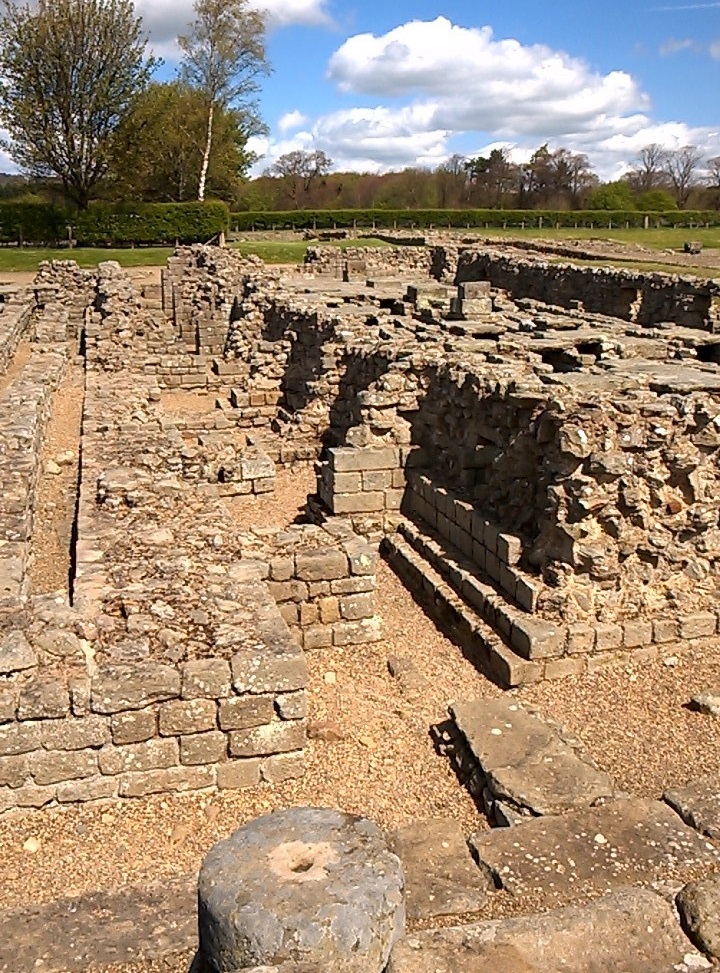
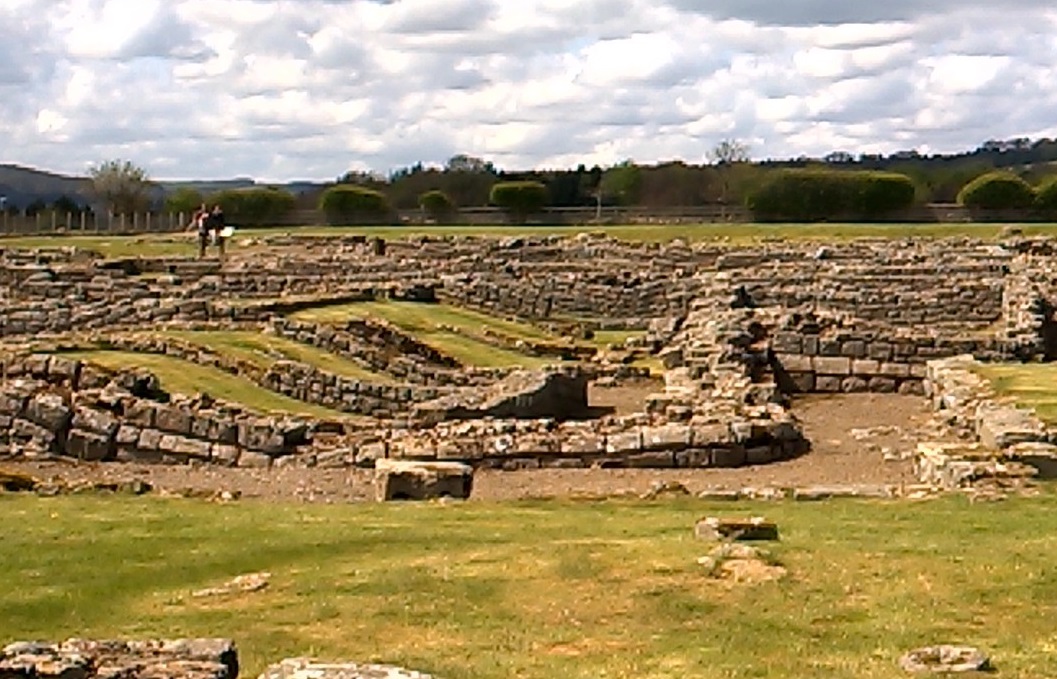
Historical Musings For my second monthly post on history and historical fiction (see last month’s here) I’m going to focus on a topic I know very little about: Ancient Rome. Despite living close to Hadrian’s Wall, I’ve never been particularly interested in Roman history and have only ever explored one or two of the many sites along the wall, but last weekend I decided to take advantage of my English Heritage membership and visit Corbridge Roman Town.

The granary at Corbridge Roman Town

The granary at Corbridge Roman Town

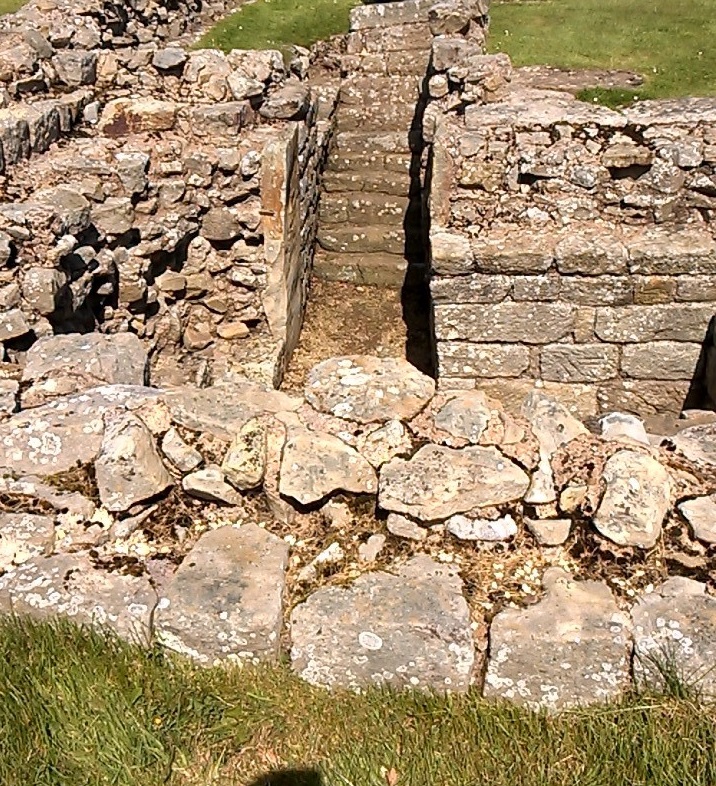
Hadrian’s Wall was built in AD122-30 during the reign of the Emperor Hadrian and stretches for 73 miles across the north of England. It does not separate England from Scotland, as many people believe! Corbridge, in Northumberland, was the site of a busy Roman town and supply base and the remains of the streets and buildings can still be seen today. As well as walking around the ruins, there’s also a museum where you can see a display of some of the items excavated from the site, including the Corbridge Hoard (a collection of Roman weapons and armour found buried in a chest) and the Corbridge Lion (a large stone statue which was originally an ornament from a tomb).

Steps leading to the 'Strongroom'

Steps leading to the ‘Strongroom’

This brief sojourn into Roman history made me wonder why it is that I so rarely choose to read books about the Romans. It’s just not a time period I’ve ever felt drawn to, though I’m not sure why that should be. A quick search for posts using the ‘Ancient Rome’ tag on my blog brings up only two novels set in Rome that I’ve read in the last few years – Colossus: The Four Emperors by David Blixt and Cleopatra’s Daughter by Michelle Moran – and I’m having trouble thinking of any others that I may have read before I started blogging. I would love some recommendations!

Corbridge Roman Town

Corbridge Roman Town

I already have copies of The Eagle of the Ninth by Rosemary Sutcliff and I, Claudius by Robert Graves. Do you think I would like either of these or is there something else you would recommend? Fiction or non-fiction, books set in Rome itself or in other parts of the Roman Empire – all suggestions are welcome!

What are your favourites?

Historical Musings #1: Do you read historical fiction?

Historical Musings Something a bit different today – and hopefully on the second Sunday of every month to come. I am conscious that my blog is, and always has been, very review-dominated and that despite experimenting with different types of weekly or monthly features in the past I have never managed to keep posting them regularly. I’m hoping that I’ll be more successful if I stick to a book-related topic that I’m particularly interested in and passionate about – and one of those topics, as will be obvious to any visitor to my blog, is historical fiction!

I have a whole list of potential ideas for future posts (and I know not everyone shares my interest in historical fiction, so some posts will be less specific to the genre than others) which include discussions, lists and recommendations. For my first post in the series, though, I just want to ask a very simple question:

Do you read historical fiction?

If you answered yes, what is it that attracts you to this genre? And if you answered no, can you tell me why not?

I enjoy reading historical fiction for many reasons. If I’m honest, one of them is purely escapism. I spend every day living in the 21st century and as I unfortunately don’t possess a time machine, I rely on books to take me somewhere different. The term ‘historical fiction’ encompasses a huge variety of books covering almost any time period, person or event you can think of, so I can usually find a book that will take me wherever and whenever I want to go!

Another reason is that reading historical fiction gives me an opportunity to learn about other times and places while also enjoying an entertaining story. I often struggle with non-fiction and find that I’m more likely to retain historical facts if they are presented to me in the form of a novel. Also, many of the themes and ideas in historical fiction are universal and timeless; understanding the past can sometimes help us to understand the present.

There are many, many other things I love about historical fiction but I’ll talk about some of those in future posts.

Now, what about you?

Lost, Found and Conjured: A guest post by Andrea Chapin

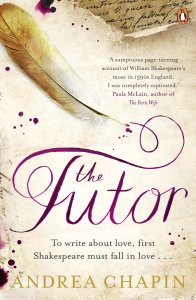
Today I would like to welcome author Andrea Chapin to the blog to tell us about her research for her new novel about William Shakespeare, The Tutor.

thetutor Lost, Found and Conjured
By Andrea Chapin

A wonderful and unexpected alchemy took hold while I wrote my novel about a year in the life of Shakespeare.

When I traveled from New York to England to do research for The Tutor, one of my first stops was Hoghton Tower, a remarkable fortified manor house that sits high on a ridge between Preston and Blackburn in Lancashire. I’d scheduled an interview with Sir Richard Bernard Cuthbert de Hoghton, 14th Baronet, and was delighted when I met him that he looked the part–light hair, brilliant blue eyes, tweed jacket and gold signet pinky ring that I imagined dated back to William the Conqueror. Indeed, for over nine hundred years Sir Bernard’s family has owned the land where the current Hoghton Tower, circa 1565, stands.

Sir Bernard’s ancestor, Alexander Hoghton, Esq. wrote a will in 1581 that mentions a “William Shakeshafte,” who, by the context of the reference, might have worked at Hoghton Tower as an actor-musician. Spelling of proper names, or words in general, were not standardized in the sixteenth century; the Shakespeare family name appears in documents in various forms including Shakstaff and Shakeschafte. At that time, Shakespeare would have been, perhaps, a year or two out of Stratford Grammar School, where John Cottom, who was from a town near Preston, was the schoolmaster.

Much of Shakespeare’s life is undocumented. Where was he before his marriage at eighteen in 1582? Was he employed at Hoghton Tower? And what was he up to between twenty-one, when he was living in Stratford with three children, and twenty-eight, when he emerged as an actor, playwright and poet in London? The speculation as to what he was doing during those “lost years” includes: deer poacher in Stratford, horse handler for theaters in London, soldier, sailor, actor, and schoolmaster in the country.

Sir Bernard recounted stories and anecdotes about his ancestors and shared his boundless knowledge of Lancashire and the Catholics during the Elizabethan era. All of which was very helpful because the story I was creating involved a recusant Catholic family in 1590 in Lancashire and William Shakespeare, who arrives to tutor the children and to finish his first poem. I hadn’t told Sir Bernard anything about my novel, other than I was interested in the theories about Shakespeare’s “lost years.” At one point, I asked Sir Bernard if his family kept books in the late 16th century, and he replied yes they did and that they had a great library. He then said that in the 1600s a Catharine de Hoghton asked her father, Sir Gilbert, for a hundred books for her dowry.

My protagonist was named Katharine, and in the hundred pages I had already written, she loved books and enjoyed her uncle’s vast library. Here was Sir Bernard recounting his ancestor with the same name and the same love of books. A chill ran down my spine. As I continued to research and to write The Tutor, there were other instances when I felt this sort magic sweep over me, where fact and fiction, history and inspiration, co-mingled in a surprising and thrilling way.

Andrea Chapin’s novel, The Tutor, was published last week by Penguin Random House UK.

Remember These? Books beginning with F and G

Before I started blogging I used to keep a list of the books I read in an A-Z notebook – the title, the author and a rating out of 5, but no other information. I did this from the mid-1990s to around the year 2000, but sadly kept no records after that until October 2009 when I started my blog.

I still have the notebook and a few years ago I began writing a series of blog posts highlighting some of the books listed under each letter, but only got as far as E before getting distracted and forgetting to do the rest. I did enjoy working on those posts, so I have decided to continue and try to get all the way to Z this time – and yes, I do have a book listed under Z!

So, without further ado, here is a selection of the books that appeared on the ‘F’ and ‘G’ pages of my notebook. I originally gave the books ratings out of 5 and the additional symbol * means that I particularly loved the book while X means I didn’t finish it. Although I’ve included my original ratings here, these do not necessarily reflect what I would feel about the books if I read them again today!

Books beginning with F and G:

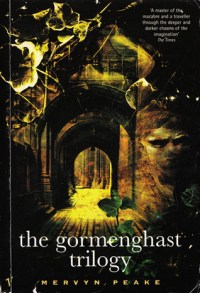
Gormenghast The Gormenghast Trilogy by Mervyn Peake 5/5*
I remember buying this book after watching the BBC adaptation in 2000. My edition includes all three novels in the trilogy – I didn’t like the third one, Titus Alone, but loved the first two, Titus Groan and Gormenghast.

The Far Pavilions by M.M. Kaye 5/5*
This wonderful novel set in India is one of my favourite historical fiction novels. I loved it the first time I read it and when I re-read it in 2010 I was pleased to find that it was still as good as I remembered.

Gone with the Wind by Margaret Mitchell 5/5*
I have read Gone with the Wind several times and don’t know if this particular entry refers to my first read or a later re-read. It’s another favourite, though, so it would get 5/5 from me every time.

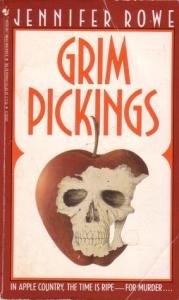
Grim Pickings Grim Pickings by Jennifer Rowe 5/5
This was a great Agatha Christie-style mystery novel set in Australia and revolving around a murder that takes place in an old woman’s orchard where her family have gathered to pick apples. I think it was part of a series, but I never read any of the others.

The Ghost of Thomas Kempe by Penelope Lively 3/5
This is one of Penelope Lively’s children’s books. I can remember what the front cover of my copy looked like (and I think I still have it somewhere) but the story has faded from my mind. I would like to read it again as I think I might appreciate it more now than I did the first time.

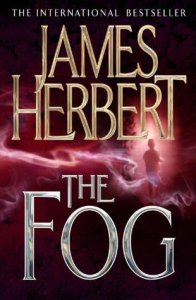
The Fog The Fog by James Herbert 3/5
I very rarely read horror novels these days but I used to read a lot of them. I enjoyed this one, about a mysterious fog that spreads across Britain, altering the minds of everyone who comes into contact with it.

Freezing by Penelope Evans 3/5
I have no memories at all of reading this book. According to Goodreads, it’s a crime novel about a photographer who works in a mortuary and tries to find the identity of a drowning victim who is brought into the morgue one day. It sounds a bit gruesome but I must have enjoyed it enough to give it a 3/5 rating.

First Impression by Margot Dalton 3/5
I can’t remember this one either. It’s another crime novel, this time about a detective trying to solve a missing child case.

Fog Heart The Ghost Road by Pat Barker 2/5
If you’d asked me whether I’d read anything by Pat Barker I would have said no, but obviously I did read this one. I think I’ll have to read it again as I can’t remember anything about it and I suspect it deserves more than 2/5! It’s the third in the Regeneration trilogy and I don’t have any record of reading the previous two, so maybe that was the problem.

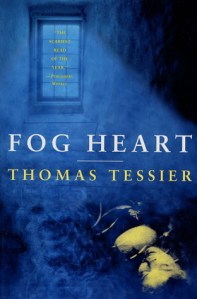
Fog Heart by Thomas Tessier 2/5
The story of two couples who are drawn together when they attend a séance and meet a young medium called Oona. I do vaguely remember reading this book, but I wasn’t very impressed by it.

The Ghosts of Candleford by Mike Jeffries 2/5
Neither the title nor the author sound familiar to me but Amazon tells me that this is a ‘classic tale of the supernatural’. Seeing how many books I’ve read and then completely forgotten about has confirmed for me (if I needed to have it confirmed) that starting a book blog was an excellent idea!

Have you read any of these books? Can you shed any light on the more obscure ones?

I’ll be back soon with another selection, but if you missed my earlier Remember These? posts you can see them here.

A Glimpse into 1960s Paris – a guest post by Rachel Hore

It’s not often that I have the chance to introduce a guest post here at She Reads Novels, but today I’m pleased to welcome author Rachel Hore to the blog to tell us about researching 1960s Paris for her new novel A Week in Paris which has been published in the UK this week.

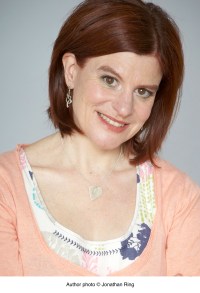
Rachel Hore

Rachel Hore

A GLIMPSE INTO 60s PARIS by Rachel Hore

My new novel, A Week in Paris, opens in 1961, when Fay Knox, a young English violinist, visits the city with her orchestra and learns secrets of her family’s wartime past. What was Paris like at that time and how did I go about researching it?

Reading histories of the period gave me the context. Paris, though glamorous, elegant and romantic, a cradle of new ideas in philosophy and high art, was still socially conservative, France as a whole even more so. In 1958, after a period of unstable government and succeeding crises over the war of independence in Algeria, General de Gaulle was recalled as President and a period of strong rule ensued. It wasn’t until the students’ riots and sit-ins of May 1968 that the young and dispossessed really challenged the aging, authoritarian head of government, and change was finally, if painfully slowly, set in motion.

Boutique off Rue de Rivoli

Boutique off Rue de Rivoli (2014)

In other ways, too, the liberal sixties came late to Paris. A glance at the popular music hits of 1961 reveals months of No.1s for traditional French crooners Edith Piaf and Charles Aznavour, with a young Johnny Hallyday making an appearance with ‘Kili Watch’ and, bizarrely for January, Richard Anthony singing ‘Itsy Bitsy Petit Bikini’. This picture had not changed much by early 1964 when the Beatles played a series of concerts at the Olympia music hall. An interviewer had to ask, ‘What is Beatlemania?’ and there were no girls screaming and fainting. Jazz is still big in this period. On her arrival in the city, Fay spots a poster about the trumpeter Miles Davis playing the Olympia.

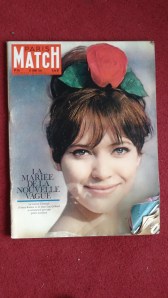
Paris Match March 1961

Paris Match March 1961

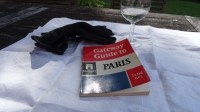
Guidebooks for 1961 were immensely helpful for my research. The Dolphin Guide to Paris, written for American tourists, was full of black and white photographs of the period; a student jazz band jamming on the quays of the Left Bank of the Seine and haute couture models wearing the latest boxy coats – like Fay’s. My copy of Paris Match magazine featuring film-maker Jean-Luc Godard’s elegantly sexy wife Anna Karina made its way into my narrative, as did the Gateway Guide’s advice to fashion-hunters on a budget to visit Worth, Dior and Schiaparelli’s ’ cheaper ‘boutiques’ or to satisfy themselves with the big department stores, Printemps and Galeries La Fayette.

A Bout de Souffle

Poster of A Bout de Souffle

Much has been written about French film of the time. Fay’s fellow musician Sandra is excited when her French boyfriend holds out the possibility of meeting Alain Delon, the heart-breaker star of 1960’s Purple Noon. In the same year came A Bout de Souffle (Breathless) by Jean-Luc Godard, which with its bold visual style and innovative use of jump cuts was hailed as an important example of French Nouvelle Vague (New Wave). Other practitioners included Francois Truffaut (The 400 Blows) and Alain Resnais (Hiroshima, Mon Amour), both released in 1959. Movies, of course, can be a gift to the novelist conducting research as long as one weighs up their veracity.

A rest from sightseeing

A rest from sightseeing

Research can only take the fiction-writer so far. The trick for me was to recognize when to leave it all behind and to enter instead the world of 1961 Paris I’ve imagined – the world Fay sees and in which she lives and loves. When I could hear her voice I knew that it was time to put the books away.

Text and photos ©Rachel Hore 2014 unless stated otherwise.