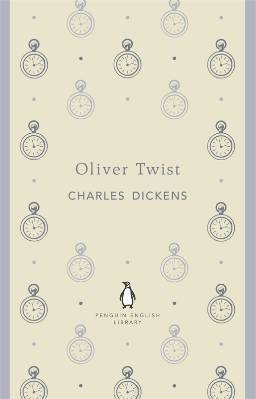
 I know it’s the middle of January, but I still have a few books that I read towards the end of 2015 to write about – and Oliver Twist is one of them. I’ve been trying to read at least one Dickens novel a year and having started 2015 with David Copperfield I decided to end it with another of his books. Of the two, I much preferred David Copperfield, but I did still enjoy Oliver Twist. As I’ve mentioned before, I find it difficult to think of anything new to say about books that are so well known and widely studied, so I’m just posting some general impressions of the novel here rather than attempting any sort of analysis.
I think most people, even without reading the book, probably have a basic idea of what it is about: an orphan boy who is raised in a workhouse in Victorian London – where he famously says, “Please, sir, I want some more” – and who later becomes involved with a gang of thieves and pickpockets. Maybe you have seen one of the many films, adaptations and musicals and so will know a little bit more, but the only way to discover the whole of Oliver’s story in the way Charles Dickens intended is to read the book!
This is the first time I have read Oliver Twist in its entirety and I was surprised by how much of it was completely unfamiliar to me. I had either forgotten or was unaware of whole chunks of the plot and of the roles played by characters such as Rose Maylie, Noah Claypole and Monks, so I was in the unusual position of reading a story that I both knew and didn’t know!
While this hasn’t become a favourite, I found Oliver Twist an enjoyable, entertaining read (one of the easiest to read and to follow of all the Dickens novels I’ve read so far) and as you would expect from Dickens, the pages are populated with colourful, larger than life characters, from Mr Bumble the beadle and the brutal Bill Sikes to the Artful Dodger and the villainous Fagin. The characters are mostly either ‘very good’ or ‘very bad’. Nancy, Bill Sikes’ lover, is the only one I found significantly more complex and she makes an interesting contrast with the novel’s other main female character, the pure, gentle Rose Maylie.
This is one of the earliest of Dickens’ major works, first published as a serial from 1837-1839, and it’s a relatively short novel by his standards (there are over 500 pages in the edition I read, but in comparison with books like Our Mutual Friend and Bleak House that’s not long at all). The amount of social commentary in the book is also particularly heavy; it was written just a few years after the Poor Law Amendment Act was passed by parliament in 1834, stating that relief for the poor would only be provided within the workhouse. The idea was that conditions inside the workhouse would be so harsh and unpleasant that only those people desperately in need of help would consider entering one. Telling Oliver’s story gave Dickens a chance to express his own views on the Poor Laws and related issues such as poverty and child labour.
Oliver Twist was the final novel by Dickens on my list for the Classics Club, but I will continue to work my way through his other books, as I have about half of them still to read. I think either Dombey and Son or Little Dorrit might be next.


 She Reads Novels