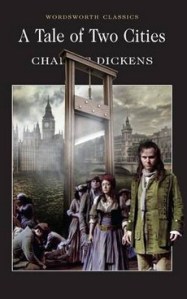
A Tale of Two Cities by Charles Dickens

A Tale of Two Cities When I decided to take part in the Classics Club Spin last month, in which a book would be chosen for me from a list of twenty, A Tale of Two Cities was not one of the titles I was hoping would be picked. I have to be in the right mood to want to read Dickens and I wasn’t really in that mood. Expecting it to be a long and boring read, I thought it would be a good idea to start immediately so that I would have a chance of being finished by the end of December…

I actually finished it within a week and despite my lack of enthusiasm when the spin number was announced, A Tale of Two Cities is one of the best books I’ve read this year!

The novel is set before and during the French Revolution; Paris and London are the two cities of the title. The story begins with Doctor Manette being released from the Bastille after eighteen years as a political prisoner. Reunited with his daughter, Lucie, and returning with her to England, the lives of the Manettes become entwined with the lives of two young men who are both in love with Lucie. One of these is Charles Darnay, a former French aristocrat, and the other is Sydney Carton, an English lawyer. We follow these characters and others as they return to France where they become caught up in the dramatic events of the French Revolution – and the scheming of wine shop owner, Monsieur Defarge, and his sinister wife, who is never seen without her knitting!

This is the sixth Dickens novel I’ve read and my favourite so far. I find it interesting that everyone who reads Dickens has different favourites and least favourites; there doesn’t seem to be one book that is universally regarded as his best. I think part of the reason I loved this book so much was that in many ways it was very different from the others I’ve read but I know that some readers will probably dislike it for that same reason, so it’s really a matter of personal opinion.

One of the things that struck me about this book was the absence of humour, in comparison to the other Dickens novels I’ve read – and as Dickens and I don’t usually share the same sense of humour, this was definitely a positive thing for me! Of course, the French Revolution is a serious subject, so the more serious tone of the writing was quite appropriate. I also thought the characters felt more realistic and well-rounded than usual (if there is a comedy character in the novel, it’s probably Jerry Cruncher). My favourite character, which probably won’t surprise anyone else who has read this book, was Sydney Carton – although I didn’t fall in love with him until the last few chapters. I hadn’t guessed when we first met him that he would turn out to be so heroic and self-sacrificing.

I was also impressed by how tightly plotted the book is. The focus stays firmly on the main storyline which makes it easy to follow, unlike Bleak House or Our Mutual Friend which have more complex structures with lots of subplots and lots of long descriptive passages. In A Tale of Two Cities, everything feels relevant and helps to move the story forward. The novel begins with some of the most famous lines in literature (It was the best of times, it was the worst of times…) and closes with some that are almost as well known (It is a far, far better thing that I do, than I have ever done; it is a far, far better rest that I go to than I have ever known). I’ve seen those final lines quoted many times before but out of context they didn’t mean much to me; now that I know who and what they refer to they have much more significance. I don’t want to say too much and spoil the story for anyone who hasn’t read it yet, but the ending is heartbreaking. This is the first Dickens novel that has made me cry!

The Classics Club spin was a success for me this time, then. I do have some other Dickens novels on my Classics Club list and feel much happier about reading them now!
The Odyssey – translated by T.E. Lawrence

The Odyssey - Homer Ten years have passed since the Trojan War ended but Odysseus has still not returned home, having been held captive by the nymph Calypso, who has fallen in love with him. At home in Ithaca, his wife, Penelope, has found herself besieged by a large group of suitors who are hoping to persuade her to marry one of them. The suitors have taken over Odysseus’s palace and are helping themselves to his food and drink; his son, Telemachus, is desperate for them to leave but doesn’t have the courage to throw them out.

The Odyssey tells the story of Odysseus and his journey home to Ithaca – a journey involving encounters with the one-eyed Cyclops, the witch Circe, the sea monster Scylla, and the tempting music of the Sirens. But it’s also the story of Telemachus and his quest to find out what has happened to his father; of Penelope, faithfully waiting for her husband to return; and of the Greek gods and goddesses who try to help or hinder Odysseus on his travels.

I’m so happy to have finally read The Odyssey as it was one of the least appealing books on my Classics Club list, not necessarily because I was intimidated by it (well, maybe a little bit) but because I’m just not very interested in mythology. I can’t really explain why I’m not a fan; I did enjoy reading Greek myths as a child, but since then my reading has taken me in other directions. I know that probably puts me in a minority as most people seem to love mythology and have a lot more knowledge of the subject than I do!

I’ve started to read The Odyssey before but didn’t finish it so this is the first time I’ve actually read it from beginning to end. I did already know most of the story, partly from school and partly because this is the sort of story that I think many people will have at least some familiarity with even if they’ve never read it in its entirety. There were some things I wasn’t aware of, though – for example, I was surprised by how little time is actually devoted to Odysseus’s journey. This section of the epic, in which Odysseus describes his adventures and the monsters and mythical beings he outwits, is by far the most well-known section, but it actually only takes up four of the twenty-four books that make up The Odyssey. The rest of the time is spent on the suitors, Telemachus and Penelope, and what Odysseus does after he eventually returns to Ithaca.

There are lots of different themes and ideas contained in The Odyssey – storytelling, disguise and deception, temptation, and the relationship between mortals and gods are a few that I noted and I’m sure there are others that I missed. There is also a lot of focus on hospitality. It seemed a weary traveller would be made welcome wherever they went, offered food, a bath and a bed for the night.

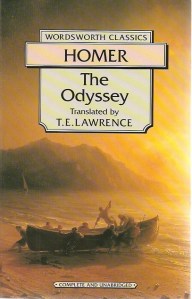
There are many different editions and translations of The Odyssey, some in verse and some in prose, but the book I read was the Wordsworth Classics edition pictured above from 1992 with a 1932 prose translation by T.E. Lawrence (better known as Lawrence of Arabia). There was no special reason why I decided to read this version, other than that I happened to have it on my shelf (I can’t remember where I got it from). I’m not sure if you can even still buy this particular translation in this edition anymore. However, this turned out to be a perfect translation for me. I know I’ve probably missed out on a lot of the beauty of The Odyssey by reading a prose version, but I don’t get on very well with narrative poems – apart from The Epic of Gilgamesh which I loved in verse form – so reading it in prose was probably a much better choice for me personally.

I have no idea how technically accurate Lawrence’s translation might be, but all I was really hoping for was something enjoyable and reasonably easy to read, and that’s what I got. I was surprised by how exciting and readable it actually was; I wonder if the fact that Lawrence himself had such an eventful life was an influence here in helping him to convey the drama of Odysseus’s adventures in such a compelling way.

I’m sorry about the lack of insight and analysis in this post. It doesn’t seem right to just ‘review’ an epic like The Odyssey as I would any other book, but that’s what I’ve had to do as I really don’t feel that there’s much I can add to everything that’s already been said about it over the centuries. It’s actually been a lot harder to write about The Odyssey than it was to read it!

Have you read The Odyssey? If I read it again, is there a translation you would recommend?

She reads poetry…Lyrical Ballads 1798 and 1802

Lyrical Ballads 1798 - 1802

It is an ancyent Marinere,
And he stoppeth one of three:
“By thy long grey beard and thy glittering eye
Now wherefore stoppest me?”

I’m not someone who reads a lot of poetry but that’s something I would like to change, so I was pleased to have the opportunity to try this new Oxford World’s Classics edition of Lyrical Ballads, a collaboration by William Wordsworth and Samuel Taylor Coleridge, first published in 1798. This book contains both the original 1798 version and the revised, expanded one from 1802, together with their prefaces and appendices. There’s also an extensive introduction, chronology and notes, though I didn’t personally find the notes particularly helpful – and they were sometimes a distraction when I would have preferred to just concentrate on reading the poem.

From the point of view of a casual reader of poetry I don’t think it was really necessary to have both the 1798 and 1802 versions together in one book. I would have been happy with just the second one, as it seems to include all the poems from the first edition (though in a slightly different order) as well as a large number of new poems. For students of Romantic poetry, though, it will probably be useful to be able to compare the earlier edition with the later one and see how each was originally presented (any significant changes to wording etc are mentioned in the notes).

The only poem in this collection that I was already familiar with was The Rime of the Ancient Mariner by Coleridge. It’s here in two different versions; in the 1802 one the language has been ‘modernised’, replacing some of the archaic spellings used in the original. I’ve liked this poem since the first time I read it at school and it really stands out among the other poems in the book as something special and unique. There are only a few other poems by Coleridge in Lyrical Ballads and the overwhelming majority are by Wordsworth; the most famous of Wordsworth’s is probably Lines written a few miles above Tintern Abbey. I’ve never thought Wordsworth would be a poet that I would like, but there are quite a few of his poems here that I enjoyed, including Goody Blake and Harry Gill, We Are Seven and The Thorn, all of which appear in both volumes, and in the 1802 collection I also liked his anti-hunting poem, Hart-Leap Well.

Whether or not you like William Wordsworth and Samuel Taylor Coleridge, it can’t be denied that their Lyrical Ballads was an important work with an influence on both the Romantic Movement and the development of poetry in general. While there were only a few poems in this book that I thought had any real brilliance, I did enjoy reading most of them and found them all easy enough to read even for someone like myself who isn’t really a fan of poetry. The idea behind Lyrical Ballads was to make poetry accessible to the average person by using simple language that could be understood by everyone, so in this respect I think it was a success.

As this Oxford World’s Classics edition is quite academic it would probably be a good choice for students of Romanticism but I think for the general reader like myself it might be better to look for a collection of the most popular works of Wordsworth or Coleridge.

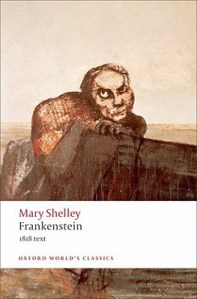
Frankenstein by Mary Shelley

Frankenstein I’ve had this book on my list for the RIP challenge for the last four years and finally, this year, I found time to read it! This was technically a re-read for me as I know I read it in when I was in my teens, but I had almost completely forgotten the story so it did feel as though I was reading it for the first time again. I also think I was maybe a bit too young to fully appreciate it the first time (I remember skipping through the ‘boring’ parts at the beginning to get to the parts with the monster).

Frankenstein, or the Modern Prometheus was written while Mary Shelley and her husband, the poet Percy Bysshe Shelley, were staying at Lake Geneva with Lord Byron and John Polidori in the summer of 1816. Shelley’s novel is said to have come about as a result of a challenge from Byron that also led to Polidori’s The Vampyre (a story that influenced Bram Stoker’s Dracula) and the beginnings of Byron’s own unfinished vampire story.

Frankenstein begins with some letters written by Arctic explorer Robert Walton to his sister in which he describes his voyage to the North Pole and how he saw a huge figure crossing the ice in a sledge pulled by dogs. Soon after this, Walton and his companions rescue another man, who is frozen and exhausted. His name is Victor Frankenstein and he tells Walton that he was trying to catch up with the giant figure they saw earlier. What follows is Victor’s story, beginning with his childhood in Geneva and his early interest in chemistry and other sciences. At university, his study of science continues and he secretly begins the construction of a human-like being which he plans to bring to life.

Victor’s experiment is a success, but after his creature is brought to life he panics and runs away, leaving the monster alone to fend for itself. The rest of the book follows Frankenstein’s nameless monster, abandoned and rejected by his creator, as he searches for acceptance and friendship. Meanwhile, Victor is convinced that he has unleashed a terrible evil upon the world and that he will have to destroy the monster before it destroys him.

Like Dracula, Frankenstein has become a part of popular culture, but most film versions of Frankenstein have very little in common with this book, so it’s still worth reading even if you think you already know the story. We probably all have an image in our mind of what Frankenstein’s monster looks like (green skin, bolt through the neck etc) but in the book, there are only a few descriptions of the monster’s physical appearance. We are told that he’s hideously ugly and much bigger than ordinary men, but he is also agile, intelligent and sensitive. The monster is also never given a name (his name is not Frankenstein, which is another common misconception) and Shelley refers to him most often as ‘the wretch’.

It’s the chapters that are told from the monster’s perspective that are the most interesting and also the most moving. Despite some of the horrific acts the monster commits, it would be difficult not to feel sympathy for him and anger towards Victor, who has created a living being and then abandoned it. The clear message of the book is that we need to think before we act and be prepared to accept responsibility for our actions. I think another thing Shelley is trying to show us is that rather than being born a monster we can become a monster because of the way we are treated by others. When we first meet Victor’s creature he is gentle and compassionate but after he is repeatedly rejected by society he begins to carry out violent, monstrous actions.

To the modern day reader there are some aspects of Frankenstein that are maybe not very satisfying or believable, such as the way the monster teaches himself to speak and to read. I would also have liked more details of the scientific methods Victor uses to create the monster and bring him to life, but I suppose that would have been beyond the scope of someone writing in the 1800s. As an early nineteenth century gothic novel, though, this is a true classic and I’m glad I took the time to re-read it.

Twenty Years After by Alexandre Dumas

Twenty Years After At last! I’ve been meaning to read the sequel to The Three Musketeers for about five years now and I regret not having read it earlier as I loved it every bit as much as I expected to. I’ve done my best to avoid any big spoilers here but if you haven’t read The Three Musketeers yet you might prefer not to read the rest of this post until you have.

Twenty Years After, as you might have guessed, is set twenty years after The Three Musketeers. The political situation in France has changed during this time period: Cardinal Richelieu is dead and has been succeeded by the Italian Cardinal Mazarin, who is in league with the widowed Anne of Austria, mother of the young King Louis XIV of France. The French people are divided between Mazarin’s supporters and his opponents, the Frondeurs, who are unhappy with the way the country is being run. As Twenty Years After begins, France is close to civil war and when Mazarin meets our old friend d’Artagnan and hears of the brave exploits he has performed in the past, he asks him for help, along with his companions, the three musketeers – Athos, Porthos and Aramis.

D’Artagnan and his three friends have drifted apart over the years but he sets out to find them and invite them to join him in the Cardinal’s service. But while Porthos (hoping that Mazarin will reward him with a barony) is happy to go along with d’Artagnan, the other two have already taken the opposite side in the conflict. The story that follows is the story of how the friendship between d’Artagnan, Athos, Porthos and Aramis is tested by their differing political views and loyalties. Their work takes them to England, where King Charles I is facing capture and execution, and again they find themselves in opposition – but ultimately their loyalty is still to each other, especially when faced with a new enemy in the form of Mordaunt, the son of Milady, the previous book’s villain.

I found Twenty Years After a much more complex book than The Three Musketeers; I’m completely unfamiliar with this period of French history and even after finishing the book I’m not sure I really understood all of the historical background or exactly which of the various princes and dukes was on which side of the conflict. It’s a more mature book too – the characters are twenty years older and have different motivations and priorities, which allows Dumas to explore some different ideas and themes. But there’s still plenty of swashbuckling adventure and I definitely thought this book was just as much fun to read as the first one. As in The Three Musketeers there are some great and memorable scenes and set pieces – the scene on the scaffold during the execution of Charles I is one of the best – and I also loved the sequence of chapters describing the imprisonment of the Duc de Beaufort and his attempts to escape (which involved a trained dog, lobsters, some tennis balls and a giant pie).

The novel begins with an introduction to Cardinal Mazarin, but we don’t have to wait too long until we meet d’Artagnan again, still a lieutenant in the musketeers and dreaming of a captaincy. The other three musketeers and their servants are then reintroduced gradually one by one: first d’Artagnan’s old valet, Planchet, then Aramis with Bazin, Porthos and Mousqueton, Athos and finally Grimaud. I was a bit disappointed, though, that I had read more than 200 pages before all four of our heroes were reunited and together again in the same scene. And that was really the only problem I had with this book – the fact that throughout most of the story the four are divided into two pairs working towards different goals, with Porthos and d’Artagnan on one side and Athos and Aramis on the other.

The basic personality traits of the musketeers are the same, but they have also changed in many ways since the previous book, which is what you would expect after a gap of twenty years. D’Artagnan has matured from the naïve, passionate, brave young man we met in The Three Musketeers into a clever, cunning, quick-thinking man of forty who is now the natural leader of the group. Aramis has fulfilled his ambition of entering the church but isn’t fully committed, still being too interested in women and fighting. As d’Artagnan tells him, “when you were a musketeer you were forever becoming the abbé, and now you are an abbé you appear to me to have a strong leaning to the musketeers.”

Athos was my favourite character in The Three Musketeers but in this book he has become so honourable and saintly that I found him very frustrating at times. I still liked him but I much preferred the younger Athos of the wine cellar and the Bastion Saint-Gervais! In contrast, Porthos, who was never the brightest of the four, seems to have become even less intelligent. I’m sure he wasn’t quite as stupid in the first book! It does result in some great comedy moments though, and I do admire Dumas for making changes rather than leaving his characters static and undeveloped. It was also good to see that the musketeers’ four servants are given more personality in this book, particularly Grimaud and Mousqueton who even have some separate adventures of their own.

As I expected, Twenty Years After has definitely been one of my most enjoyable reads of the year! The Vicomte de Bragelonne awaits…

The Midwich Cuckoos by John Wyndham

The Midwich Cuckoos The Midwich Cuckoos begins as our narrator, Richard Gayford, and his wife, Janet, attempt to return to their home in the quiet English village of Midwich after a trip to London to celebrate Richard’s birthday. As they approach the village they discover that the road has been closed by the police; something very strange is happening in Midwich, a place where, as Richard tells us, things just did not happen. That night, Monday 26th September, everyone within the boundaries of Midwich has fallen asleep and anyone who tries to enter the village also loses consciousness.

The next day this phenomenon, which becomes known as the ‘Dayout’, disappears as suddenly as it arrived – the invisible barrier is lifted and people begin to wake up. At first it seems that most of the villagers have been completely unharmed by the ‘Dayout’, but a few months later they make a shocking discovery. Something did happen during their twenty-four hours of unconsciousness and it’s going to have a big effect on the lives of everyone in Midwich.

I’ve decided to end my summary of the plot here rather than tell you exactly what happened to the people of Midwich. I’m sure some of you will already know (maybe you’ve seen the film based on the book, Village of the Damned, or maybe the title of the book and the cover of my old Penguin edition pictured here have given you some clues) but I don’t really want to spoil things for anyone new to the story so I won’t go into any more details. All I will say is that I thoroughly enjoyed this book from beginning to end!

I don’t often choose to read science fiction (looking back through my blog archives I can only see five or six that I’ve read since 2009) and I wasn’t sure what to expect from this book, but The Midwich Cuckoos was probably the perfect type of science fiction for me – instead of being filled with too much action or violence, it’s a subtle, thought provoking portrayal of a small, seemingly normal community trying to cope with something that is threatening their way of life. I think it was the ordinariness of the setting that made the story so effective; this, combined with Wyndham’s thoughtful, undramatic writing style, made it possible to almost believe in what happened in Midwich, while also creating quite an eerie atmosphere.

The only problem I had with this book was that I didn’t feel any connection with the characters. The narrator himself doesn’t have a big part to play and is actually absent from the village for long periods of time, leaving large portions of the story to be told through second-hand accounts, particularly through the philosophical musings of one of the Midwich residents, Gordon Zellaby. It was also disappointing that despite the women of Midwich having such an important role in the story, we never really get to know any of them and they are rarely given a chance to participate in any of the discussions or decisions being made by the men. But although there were a few aspects of the book that I thought could have been better, I did love my first John Wyndham book and am now wondering which one I should read next.

Thoughts on finishing War and Peace

War and Peace

To study the laws of history, we must change completely the object of observation, leave kings, ministers, and generals alone, and study the uniform, infinitesimal elements that govern the masses.

I wasn’t expecting to start writing this post until the end of December! At the beginning of the year I signed up for a year-long readalong of War and Peace hosted by Iris and Amy, attracted by their reading schedule which looked very realistic and manageable. I did stick with the schedule for the first few months and was enjoying being part of the group read (thank you, Amy and Iris!) but somewhere in the middle of the book I discovered that the pace wasn’t really working for me anymore. I found that I was finishing the month’s reading then forgetting about the book for a few weeks, which made it difficult to get back into the story again when I eventually picked it up to read the next month’s section. Once I abandoned the schedule and found a pace I was happy with, I flew through the rest of the book and really enjoyed it.

I didn’t think War and Peace was a particularly difficult book to read (I’m actually finding writing about it much more difficult!) and while it was certainly long, I have read other books of similar length. And yet it’s still a book that has always sounded very intimidating to me, so I felt a real sense of achievement when I reached the final page – especially after persevering through that Second Epilogue (if you’ve read it I’m sure you’ll know what I mean). If you’re wondering what War and Peace is actually about, I’m afraid I’m not going to tell you much about the plot because I don’t even know where to begin! It’s about war, of course – specifically the French invasion of Russia during the Napoleonic Wars – and the way it affects the members of several families of Russian aristocrats, not just in the army but also at home, in their domestic lives and in their interactions with each other.

I loved the ‘peace’ parts of War and Peace and getting to know Natasha, Marya and Sonya, Pierre, Nikolai and Andrei. The ‘war’ sections, however, were much more challenging for me as I often tend to struggle with battle scenes and find discussions of military tactics difficult to follow. This wasn’t helped by the fact that I had absolutely no previous knowledge of the Russian involvement in the Napoleonic Wars and to make things worse, from my point of view, there are lots of long philosophical passages in which Tolstoy spends a lot of time musing on war and its causes; for me to feel involved in what’s happening, I need to be actually ‘on the battlefield’ seeing things through the eyes of our protagonists, otherwise I just feel like a passive observer. Still, some of the book’s most moving and powerful moments occur during the war chapters. I included the following quote in one of my monthly readalong posts, but I’m copying it again here as I thought it really captured the shift from Nikolai’s view of war as something abstract and romantic to something real and harsh:

“Who are they? Why are they running? Can it be they’re running to me? Can it be? And why? To kill me? Me, whom everybody loves so?” He remembered his mother’s love for him, his family’s, his friends’, and the enemy’s intention to kill him seemed impossible.

Now, a note on the format and translation that I read. After reading mixed opinions on the various translations of War and Peace, I decided on the Kindle version of the Vintage Classics edition translated by Pevear and Volokhonsky (I wanted to avoid the Maude translation as I didn’t get on with their translation of Anna Karenina at all – though I know other readers recommend that one, so it’s just a matter of personal taste, I suppose). This P&V translation was very readable and I didn’t have any big problems with it, apart from, as I mentioned in another of my readalong update posts, not liking the way they chose to present the speech impediment of one character, Denisov. It distracted me so much I found it impossible to concentrate on what Denisov was actually saying! Also, I should point out that there’s a lot of French in War and Peace and in this edition, it is left untranslated in the dialogue with translations given at the end of each chapter. This was good as it gave an accurate understanding of how widely French was spoken by the Russian aristocracy and how its use gradually decreased as the war with France progressed, but it did mean a lot of turning back and forth was needed – and this was much more inconvenient with the Kindle than it would have been with a physical book.

Finally, some advice based on my experience with War and Peace: Reading with a friend or with other bloggers can be helpful and is a good way to stay motivated, but it’s important to find a pace you feel comfortable with. Read regularly and don’t leave the book unread for too long. If, like me, you know nothing about this period of Russian history, you might want to think about doing some background reading first to help put things into context – I didn’t and wished I had! And keep a list of the characters beside you as you read…as you would expect from a book of this length, there are a huge number of characters and it can be hard to remember who they all are. Be aware though that searching for character lists online can lead you to see spoilers you might prefer not to know about!

If you’ve read War and Peace too I would love to know what you thought of it – and if you have any more tips for future War and Peace readers please share them with us!