Frankenstein by Mary Shelley

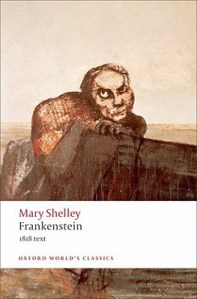
Frankenstein I’ve had this book on my list for the RIP challenge for the last four years and finally, this year, I found time to read it! This was technically a re-read for me as I know I read it in when I was in my teens, but I had almost completely forgotten the story so it did feel as though I was reading it for the first time again. I also think I was maybe a bit too young to fully appreciate it the first time (I remember skipping through the ‘boring’ parts at the beginning to get to the parts with the monster).

Frankenstein, or the Modern Prometheus was written while Mary Shelley and her husband, the poet Percy Bysshe Shelley, were staying at Lake Geneva with Lord Byron and John Polidori in the summer of 1816. Shelley’s novel is said to have come about as a result of a challenge from Byron that also led to Polidori’s The Vampyre (a story that influenced Bram Stoker’s Dracula) and the beginnings of Byron’s own unfinished vampire story.

Frankenstein begins with some letters written by Arctic explorer Robert Walton to his sister in which he describes his voyage to the North Pole and how he saw a huge figure crossing the ice in a sledge pulled by dogs. Soon after this, Walton and his companions rescue another man, who is frozen and exhausted. His name is Victor Frankenstein and he tells Walton that he was trying to catch up with the giant figure they saw earlier. What follows is Victor’s story, beginning with his childhood in Geneva and his early interest in chemistry and other sciences. At university, his study of science continues and he secretly begins the construction of a human-like being which he plans to bring to life.

Victor’s experiment is a success, but after his creature is brought to life he panics and runs away, leaving the monster alone to fend for itself. The rest of the book follows Frankenstein’s nameless monster, abandoned and rejected by his creator, as he searches for acceptance and friendship. Meanwhile, Victor is convinced that he has unleashed a terrible evil upon the world and that he will have to destroy the monster before it destroys him.

Like Dracula, Frankenstein has become a part of popular culture, but most film versions of Frankenstein have very little in common with this book, so it’s still worth reading even if you think you already know the story. We probably all have an image in our mind of what Frankenstein’s monster looks like (green skin, bolt through the neck etc) but in the book, there are only a few descriptions of the monster’s physical appearance. We are told that he’s hideously ugly and much bigger than ordinary men, but he is also agile, intelligent and sensitive. The monster is also never given a name (his name is not Frankenstein, which is another common misconception) and Shelley refers to him most often as ‘the wretch’.

It’s the chapters that are told from the monster’s perspective that are the most interesting and also the most moving. Despite some of the horrific acts the monster commits, it would be difficult not to feel sympathy for him and anger towards Victor, who has created a living being and then abandoned it. The clear message of the book is that we need to think before we act and be prepared to accept responsibility for our actions. I think another thing Shelley is trying to show us is that rather than being born a monster we can become a monster because of the way we are treated by others. When we first meet Victor’s creature he is gentle and compassionate but after he is repeatedly rejected by society he begins to carry out violent, monstrous actions.

To the modern day reader there are some aspects of Frankenstein that are maybe not very satisfying or believable, such as the way the monster teaches himself to speak and to read. I would also have liked more details of the scientific methods Victor uses to create the monster and bring him to life, but I suppose that would have been beyond the scope of someone writing in the 1800s. As an early nineteenth century gothic novel, though, this is a true classic and I’m glad I took the time to re-read it.

Twenty Years After by Alexandre Dumas

Twenty Years After At last! I’ve been meaning to read the sequel to The Three Musketeers for about five years now and I regret not having read it earlier as I loved it every bit as much as I expected to. I’ve done my best to avoid any big spoilers here but if you haven’t read The Three Musketeers yet you might prefer not to read the rest of this post until you have.

Twenty Years After, as you might have guessed, is set twenty years after The Three Musketeers. The political situation in France has changed during this time period: Cardinal Richelieu is dead and has been succeeded by the Italian Cardinal Mazarin, who is in league with the widowed Anne of Austria, mother of the young King Louis XIV of France. The French people are divided between Mazarin’s supporters and his opponents, the Frondeurs, who are unhappy with the way the country is being run. As Twenty Years After begins, France is close to civil war and when Mazarin meets our old friend d’Artagnan and hears of the brave exploits he has performed in the past, he asks him for help, along with his companions, the three musketeers – Athos, Porthos and Aramis.

D’Artagnan and his three friends have drifted apart over the years but he sets out to find them and invite them to join him in the Cardinal’s service. But while Porthos (hoping that Mazarin will reward him with a barony) is happy to go along with d’Artagnan, the other two have already taken the opposite side in the conflict. The story that follows is the story of how the friendship between d’Artagnan, Athos, Porthos and Aramis is tested by their differing political views and loyalties. Their work takes them to England, where King Charles I is facing capture and execution, and again they find themselves in opposition – but ultimately their loyalty is still to each other, especially when faced with a new enemy in the form of Mordaunt, the son of Milady, the previous book’s villain.

I found Twenty Years After a much more complex book than The Three Musketeers; I’m completely unfamiliar with this period of French history and even after finishing the book I’m not sure I really understood all of the historical background or exactly which of the various princes and dukes was on which side of the conflict. It’s a more mature book too – the characters are twenty years older and have different motivations and priorities, which allows Dumas to explore some different ideas and themes. But there’s still plenty of swashbuckling adventure and I definitely thought this book was just as much fun to read as the first one. As in The Three Musketeers there are some great and memorable scenes and set pieces – the scene on the scaffold during the execution of Charles I is one of the best – and I also loved the sequence of chapters describing the imprisonment of the Duc de Beaufort and his attempts to escape (which involved a trained dog, lobsters, some tennis balls and a giant pie).

The novel begins with an introduction to Cardinal Mazarin, but we don’t have to wait too long until we meet d’Artagnan again, still a lieutenant in the musketeers and dreaming of a captaincy. The other three musketeers and their servants are then reintroduced gradually one by one: first d’Artagnan’s old valet, Planchet, then Aramis with Bazin, Porthos and Mousqueton, Athos and finally Grimaud. I was a bit disappointed, though, that I had read more than 200 pages before all four of our heroes were reunited and together again in the same scene. And that was really the only problem I had with this book – the fact that throughout most of the story the four are divided into two pairs working towards different goals, with Porthos and d’Artagnan on one side and Athos and Aramis on the other.

The basic personality traits of the musketeers are the same, but they have also changed in many ways since the previous book, which is what you would expect after a gap of twenty years. D’Artagnan has matured from the naïve, passionate, brave young man we met in The Three Musketeers into a clever, cunning, quick-thinking man of forty who is now the natural leader of the group. Aramis has fulfilled his ambition of entering the church but isn’t fully committed, still being too interested in women and fighting. As d’Artagnan tells him, “when you were a musketeer you were forever becoming the abbé, and now you are an abbé you appear to me to have a strong leaning to the musketeers.”

Athos was my favourite character in The Three Musketeers but in this book he has become so honourable and saintly that I found him very frustrating at times. I still liked him but I much preferred the younger Athos of the wine cellar and the Bastion Saint-Gervais! In contrast, Porthos, who was never the brightest of the four, seems to have become even less intelligent. I’m sure he wasn’t quite as stupid in the first book! It does result in some great comedy moments though, and I do admire Dumas for making changes rather than leaving his characters static and undeveloped. It was also good to see that the musketeers’ four servants are given more personality in this book, particularly Grimaud and Mousqueton who even have some separate adventures of their own.

As I expected, Twenty Years After has definitely been one of my most enjoyable reads of the year! The Vicomte de Bragelonne awaits…

The Midwich Cuckoos by John Wyndham

The Midwich Cuckoos The Midwich Cuckoos begins as our narrator, Richard Gayford, and his wife, Janet, attempt to return to their home in the quiet English village of Midwich after a trip to London to celebrate Richard’s birthday. As they approach the village they discover that the road has been closed by the police; something very strange is happening in Midwich, a place where, as Richard tells us, things just did not happen. That night, Monday 26th September, everyone within the boundaries of Midwich has fallen asleep and anyone who tries to enter the village also loses consciousness.

The next day this phenomenon, which becomes known as the ‘Dayout’, disappears as suddenly as it arrived – the invisible barrier is lifted and people begin to wake up. At first it seems that most of the villagers have been completely unharmed by the ‘Dayout’, but a few months later they make a shocking discovery. Something did happen during their twenty-four hours of unconsciousness and it’s going to have a big effect on the lives of everyone in Midwich.

I’ve decided to end my summary of the plot here rather than tell you exactly what happened to the people of Midwich. I’m sure some of you will already know (maybe you’ve seen the film based on the book, Village of the Damned, or maybe the title of the book and the cover of my old Penguin edition pictured here have given you some clues) but I don’t really want to spoil things for anyone new to the story so I won’t go into any more details. All I will say is that I thoroughly enjoyed this book from beginning to end!

I don’t often choose to read science fiction (looking back through my blog archives I can only see five or six that I’ve read since 2009) and I wasn’t sure what to expect from this book, but The Midwich Cuckoos was probably the perfect type of science fiction for me – instead of being filled with too much action or violence, it’s a subtle, thought provoking portrayal of a small, seemingly normal community trying to cope with something that is threatening their way of life. I think it was the ordinariness of the setting that made the story so effective; this, combined with Wyndham’s thoughtful, undramatic writing style, made it possible to almost believe in what happened in Midwich, while also creating quite an eerie atmosphere.

The only problem I had with this book was that I didn’t feel any connection with the characters. The narrator himself doesn’t have a big part to play and is actually absent from the village for long periods of time, leaving large portions of the story to be told through second-hand accounts, particularly through the philosophical musings of one of the Midwich residents, Gordon Zellaby. It was also disappointing that despite the women of Midwich having such an important role in the story, we never really get to know any of them and they are rarely given a chance to participate in any of the discussions or decisions being made by the men. But although there were a few aspects of the book that I thought could have been better, I did love my first John Wyndham book and am now wondering which one I should read next.

Thoughts on finishing War and Peace

War and Peace

To study the laws of history, we must change completely the object of observation, leave kings, ministers, and generals alone, and study the uniform, infinitesimal elements that govern the masses.

I wasn’t expecting to start writing this post until the end of December! At the beginning of the year I signed up for a year-long readalong of War and Peace hosted by Iris and Amy, attracted by their reading schedule which looked very realistic and manageable. I did stick with the schedule for the first few months and was enjoying being part of the group read (thank you, Amy and Iris!) but somewhere in the middle of the book I discovered that the pace wasn’t really working for me anymore. I found that I was finishing the month’s reading then forgetting about the book for a few weeks, which made it difficult to get back into the story again when I eventually picked it up to read the next month’s section. Once I abandoned the schedule and found a pace I was happy with, I flew through the rest of the book and really enjoyed it.

I didn’t think War and Peace was a particularly difficult book to read (I’m actually finding writing about it much more difficult!) and while it was certainly long, I have read other books of similar length. And yet it’s still a book that has always sounded very intimidating to me, so I felt a real sense of achievement when I reached the final page – especially after persevering through that Second Epilogue (if you’ve read it I’m sure you’ll know what I mean). If you’re wondering what War and Peace is actually about, I’m afraid I’m not going to tell you much about the plot because I don’t even know where to begin! It’s about war, of course – specifically the French invasion of Russia during the Napoleonic Wars – and the way it affects the members of several families of Russian aristocrats, not just in the army but also at home, in their domestic lives and in their interactions with each other.

I loved the ‘peace’ parts of War and Peace and getting to know Natasha, Marya and Sonya, Pierre, Nikolai and Andrei. The ‘war’ sections, however, were much more challenging for me as I often tend to struggle with battle scenes and find discussions of military tactics difficult to follow. This wasn’t helped by the fact that I had absolutely no previous knowledge of the Russian involvement in the Napoleonic Wars and to make things worse, from my point of view, there are lots of long philosophical passages in which Tolstoy spends a lot of time musing on war and its causes; for me to feel involved in what’s happening, I need to be actually ‘on the battlefield’ seeing things through the eyes of our protagonists, otherwise I just feel like a passive observer. Still, some of the book’s most moving and powerful moments occur during the war chapters. I included the following quote in one of my monthly readalong posts, but I’m copying it again here as I thought it really captured the shift from Nikolai’s view of war as something abstract and romantic to something real and harsh:

“Who are they? Why are they running? Can it be they’re running to me? Can it be? And why? To kill me? Me, whom everybody loves so?” He remembered his mother’s love for him, his family’s, his friends’, and the enemy’s intention to kill him seemed impossible.

Now, a note on the format and translation that I read. After reading mixed opinions on the various translations of War and Peace, I decided on the Kindle version of the Vintage Classics edition translated by Pevear and Volokhonsky (I wanted to avoid the Maude translation as I didn’t get on with their translation of Anna Karenina at all – though I know other readers recommend that one, so it’s just a matter of personal taste, I suppose). This P&V translation was very readable and I didn’t have any big problems with it, apart from, as I mentioned in another of my readalong update posts, not liking the way they chose to present the speech impediment of one character, Denisov. It distracted me so much I found it impossible to concentrate on what Denisov was actually saying! Also, I should point out that there’s a lot of French in War and Peace and in this edition, it is left untranslated in the dialogue with translations given at the end of each chapter. This was good as it gave an accurate understanding of how widely French was spoken by the Russian aristocracy and how its use gradually decreased as the war with France progressed, but it did mean a lot of turning back and forth was needed – and this was much more inconvenient with the Kindle than it would have been with a physical book.

Finally, some advice based on my experience with War and Peace: Reading with a friend or with other bloggers can be helpful and is a good way to stay motivated, but it’s important to find a pace you feel comfortable with. Read regularly and don’t leave the book unread for too long. If, like me, you know nothing about this period of Russian history, you might want to think about doing some background reading first to help put things into context – I didn’t and wished I had! And keep a list of the characters beside you as you read…as you would expect from a book of this length, there are a huge number of characters and it can be hard to remember who they all are. Be aware though that searching for character lists online can lead you to see spoilers you might prefer not to know about!

If you’ve read War and Peace too I would love to know what you thought of it – and if you have any more tips for future War and Peace readers please share them with us!

Captain Blood by Rafael Sabatini

Captain Blood

“Thief and pirate is what you heard Miss Bishop call me today – a thing of scorn, an outcast. And who made me that? Who made me thief and pirate?”

One of my favourite books of last year was Scaramouche by Rafael Sabatini, a classic historical adventure novel set during the French Revolution. I loved it so much I immediately added two more of Sabatini’s books to my Classics Club list – Captain Blood and The Sea-Hawk – though not without some reservations as these are both books about pirates and with my general dislike of books set on ships I thought the seafaring elements might be too much for me. I was wrong. Captain Blood is another wonderful book and I enjoyed it almost as much as Scaramouche!

Peter Blood, an Irish physician and former soldier, is arrested during the Monmouth Rebellion of 1685 when he is discovered tending the wounds of an enemy of King James II. Wrongly found guilty of treason, he is lucky enough to avoid hanging but instead he is sent into slavery on a sugar plantation in Barbados. Here Blood meets two people who will have a huge influence on his future: Colonel Bishop, the cruel, brutal plantation owner and his beautiful niece, Arabella, with whom Blood falls in love. When the island is attacked by Spanish raiders, he seizes his chance to escape by commandeering one of their ships and after transforming himself into the notorious Captain Blood, our hero becomes a pirate both feared and respected throughout the Caribbean.

Sailing up and down the shores of Barbados, Jamaica and Tortuga, Captain Blood becomes involved in a series of exciting adventures and daring escapades, while being pursued by both Colonel Bishop and a Spanish rival, Don Esteban, who has sworn revenge – but what sets Blood apart from the other pirates he meets is his sense of honour and his dream of one day clearing his name and settling down to a peaceful life with Arabella. To the reader, it’s obvious that Peter Blood has become a pirate because he feels he has no choice – his only other option is to remain in slavery – but Arabella doesn’t understand this and when she tells him she can never love a “thief and pirate”, he must find a way to redeem himself in her eyes.

It amazes me that Rafael Sabatini’s books are not more widely read. As well as his great writing style, clever plots and vividly described characters, his novels also have well-researched and believable historical settings. While I was reading this book, I never questioned that I was in the Caribbean of the 17th century, just as when I read Scaramouche I was fully immersed in revolutionary France. And my fears that I might struggle with the pirate theme proved to be completely unfounded!

Sabatini keeps the sailing terminology to a level that even I could cope with and I found that even without understanding every nautical reference it didn’t affect my understanding of the story (which is what I also discovered when I read Master and Commander by Patrick O’Brian earlier this year). Although there were a lot of sea battles, they weren’t too difficult to follow and in fact, not only could I follow them but I actually enjoyed them too, which is something I never thought I would say! I suspect that the descriptions of these battles were not completely realistic and in real life Blood would never have been able to overcome such great odds every time, but with my total lack of naval knowledge I’m happy to pretend that he could.

But Captain Blood is more than just a swashbuckling adventure story and even if it had only been half as exciting, I would still have loved it solely for the great characterisation of Peter Blood, a true romantic hero (in the old-fashioned sense of the term). Like Andre-Louis Moreau from Scaramouche, Edmond Dantes from The Count of Monte Cristo or Francis Crawford from the Lymond Chronicles, Blood is one of those characters who can sometimes seem to be almost superhuman. He has an intelligence and wit superior to everyone else’s, he’s charismatic and quick thinking, multilingual, as talented a swordsman as he is a surgeon, and when it comes to buccaneering, he’s a brilliant leader and tactician. However difficult the situation he and his men might find themselves in, he never fails to come up with an imaginative and ingenious way to get out of it. But despite his perfection or perhaps because of it, things don’t always go smoothly for Captain Blood and like the other characters I’ve mentioned, he experiences a series of injustices and misfortunes that makes him a character we can sympathise with and believe in.

Captain Blood was published in 1922 and is available online as a free ebook, though the edition I read was the Vintage Classics paperback pictured here. I recommend giving it a try even if pirate stories don’t sound appealing to you, as it’s worth reading this one just to meet Peter Blood!

Julius by Daphne du Maurier

Julius This book was originally published under the title The Progress of Julius and is the chilling story of an ambitious and ruthless man who goes through life determined to get “something for nothing” and not caring who gets hurt in the process.

The novel begins in 1860 when Julius Levy is born into a family of French peasants who live in a small village on the banks of the Seine. The biggest influences on Julius’s early life are his loud, coarse grandfather and irresponsible mother, but he later grows closer to his father, Paul, a quiet Jewish man. With the outbreak of the Franco-Prussian war the Levys take refuge in Paris until a tragedy results in Julius and his father fleeing for the safety of Paul’s home country, Algeria.

At first, Julius plans to follow a religious life, but he soon finds that buying and selling in the marketplace holds more attraction for him and that he enjoys cheating people out of their money. When life in Algeria starts to bore him, Julius travels to England where he begins to build up a huge business empire. But even as Julius becomes one of the richest and most successful men in the world, he continues to show a complete lack of regard for the people around him, using and manipulating them to get what he wants…until his daughter Gabriel is born.

This was Daphne du Maurier’s third novel, published in 1933 when she was only twenty six years old and it amazes me that she was able to write such a sophisticated, powerful novel at such an early stage of her career. I’ve found that all of du Maurier’s books have some dark and disturbing elements, but this must surely be the darkest and most disturbing of them all – though not in a gothic way like Rebecca or Jamaica Inn. The main reason I found this book so disturbing is because Julius Levy is one of the most horrible, despicable characters I’ve ever come across in literature.

He’s completely heartless, cruel and callous with no redeeming features at all. Early in the story when the Levy family are forced to leave their village for Paris, Julius drowns his beloved cat rather than leave her with a neighbour, because if he can’t have her he doesn’t want anyone else to have her. This is an early indication of what Julius is like and as the story continues there are dozens of other examples of his selfishness and cruelty. And yet, for some reason, he still inspires feelings of love and friendship in other people, which is hard to understand as he rarely, if ever, shows any consideration or compassion for anybody but himself – they always come second to his latest money-making schemes.

As usual, du Maurier’s settings are wonderfully atmospheric, from the small French village of Puteaux to the dusty marketplaces of Algeria to the area of London in which Julius gets his first job in a bakery. The historical setting, beginning with the Franco-Prussian War and the Siege of Paris, is interesting too. This was not one of my favourite du Maurier novels (it was much too uncomfortable and unpleasant for that) but, like all of her books, it kept me gripped and fascinated from the first page to the last.

A Hero of Our Time by Mikhail Lermontov

A Hero of Our Time - Lermontov

Again, you’ll tell me, no man can be as bad as that; and I’ll ask you why, if you have believed in the possibility of the existence of all the villains of tragedy and romance, you should not believe in the reality of Pechorin? If you have admired inventions far more terrible and monstrous, why does this character, even as an invention, not deserve your mercy? Could it be because there is more truth in him than you would like?

A Hero of Our Time is described as one of the first great Russian novels, though I have to confess that until recently I had never even heard of it or Mikhail Lermontov. Having read the biographical information about the author included in this book, it seems Lermontov’s life was almost as unusual and interesting as his fiction! A Hero of Our Time was published in 1840, just before he was killed in a duel at the age of twenty six.

This is not a novel with a chronological structure or a conventional plot with a beginning and an end. Instead it consists of five separate stories, some very short and some much longer. Together they create a portrait of Grigory Pechorin, a young army officer – though as the author tells us in the preface, it’s also “a portrait built up from the vices of our whole generation, in all the fullness of their development”.

Far from being the hero suggested by the title, Pechorin is actually much more of an anti-hero, selfish, cruel, manipulative and motivated by boredom and disillusionment. He is not a likeable character at all and isn’t supposed to be, but as the novel unfolds and we are given his own version of events as well as seeing him from the perspective of others, we come to understand him better. By the end of the book I found I didn’t hate Pechorin as much as I thought I would at first and for all his faults and flaws I thought he was a fascinating character.

In the first story, an unnamed narrator is travelling through the Caucasus where he is joined by an army captain, Maxim Maximich. As they travel together, the captain tells the narrator about his friendship with Pechorin. In the second story the narrator briefly meets Pechorin and the final three stories are entries from Pechorin’s own journal. With each of these five chapters we learn a little bit more about Pechorin’s life and follow him through a series of adventures, romances and even a thrilling duel. Despite the disjointed and episodic feel of the book it’s fast-paced and never boring. I was also pleased to find that although the main characters are soldiers, the story concentrates on their personal lives and there are no long battle scenes or detailed descriptions of military tactics to struggle with – though there are some great descriptions of the landscape of the Caucasus, where the novel is set.

I really enjoyed A Hero of Our Time. Of all the Russian novels I’ve read, I found this one by far the easiest to read, despite it being written in the early 19th century. This Oxford World’s Classics edition is translated by Nicolas Pasternak Slater (the nephew of Boris Pasternak who wrote Dr Zhivago) and I think it’s an excellent translation; it flows so effortlessly it hardly feels like a translation at all. It’s a very short novel too (the actual story is less than 140 pages long – the rest of the book is made up of the introduction, notes, maps and other additional material) so could be a good choice if you want to read some Russian literature but feel intimidated by Tolstoy or Dostoyevsky.

This edition also includes a piece of writing by Alexander Pushkin entitled A Journey to Arzrum in which Pushkin describes his own travels through the Caucasus. It’s really more of a travelogue or journal than a story but it works as an interesting companion to Lermontov’s novel.

Have you read this book? Which other Russian classics would you recommend?