Mr Harrison’s Confessions by Elizabeth Gaskell

Mr Harrison's Confessions Mr Harrison’s Confessions is a novella often described as a prequel to Gaskell’s longer novel, Cranford. Published in 1851, it’s the story of a young doctor and his adventures in the provincial town of Duncombe – and at just over 100 pages it can easily be read in an afternoon.

In the first chapter, Mr Harrison agrees to entertain his friend, Charles, with the story of how he and his wife met. While his wife goes upstairs to put the baby to bed, Mr Harrison begins his tale, starting with his arrival in Duncombe as a newly qualified surgeon. After becoming a partner in Mr Morgan’s medical practice, Mr Harrison gets to know his patients, many of whom are unmarried women. Needless to say, the appearance of a handsome young man in a small, rural community causes a lot of excitement and it’s not long before Mr Harrison has attracted the attentions of several of Duncombe’s female residents. Unfortunately, though, none of them is Sophy, the vicar’s pretty daughter and the only girl Mr Harrison himself is interested in…

Mr Harrison’s Confessions is a lovely, witty story and although it is not actually set in Cranford, but in a similar small town, it has all the humour and charm I remember enjoying when I read Cranford. There’s not a lot of plot, but what you’ll find instead is a mixture of domestic scenes, funny anecdotes and moments of poignancy and sadness: the same combination that makes Cranford such a success.

For such a short book, Gaskell also manages to incorporate a good variety of interesting characters into the story, from Mr Morgan, the traditional country doctor with a suspicion of modern medicine, to Mr Harrison’s friend, Jack, who is fond of practical jokes, and the widowed housekeeper, Mrs Rose, obsessed by the memory of her late husband. The only disappointment is that Sophy, the woman Mr Harrison loves, is kept in the shadows and we don’t have an opportunity to really see romance blossoming between them.

While this is the same type of book as Cranford, the characters are different and it’s certainly not necessary to read one before the other. For those readers who enjoyed Cranford and want to return to that world, Mr Harrison’s Confessions should satisfy your craving, but I also think it might be a good introduction to Gaskell’s work for newcomers who don’t want to commit to a longer novel.

Thanks to Hesperus Press for my copy of Mr Harrison’s Confessions.

The Idiot by Fyodor Dostoevsky

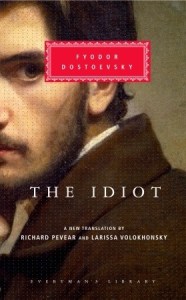
The Idiot The Idiot was the book chosen for me by the Classics Club Spin earlier this month. I have to confess I wasn’t thrilled when I saw that this was the book I’d have to read but, as so often seems to happen with my spin books, I ended up enjoying it much more than I’d expected to. This wasn’t my first experience of Dostoevsky’s work; I’ve tried twice to read Crime and Punishment and both times gave up after a few chapters. Luckily, I’ve had more success with The Idiot!

The ‘idiot’ of the title is Prince Lev Nikolaevich Myshkin, a young man who, as the novel opens, is returning home to Russia after spending several years at a Swiss clinic receiving treatment for his epilepsy. On the train to St Petersburg he meets for the first time the man whose fate will become entwined with his own: Parfyon Semyonovich Rogozhin. Rogozhin is passionately in love with the beautiful but self-destructive Nastasya Filipovna, who has suffered a series of misfortunes that have led to her being labelled a ‘fallen woman’.

With no family of his own in the city, the prince introduces himself to the Epanchins, to whom he is distantly related. This family consists of General Epanchin, his wife Elizaveta, and their three daughters, Alexandra, Adelaida and Aglaya. As the story progresses, Myshkin becomes romantically involved with both Nastasya Filipovna and Aglaya Epanchin, but his inability to read between the lines and understand that people don’t always say what they really mean leads to trouble in his relationships with both women. His path will also cross again and again with Rogozhin’s, but while the prince pities Nastasya and hopes to save her from herself, Rogozhin’s love is of the violent and obsessive kind.

The intensity of Rogozhin’s personality is very different from the prince’s own gentle, peaceful nature. In fact, Myshkin seems to possess such simplicity of character, to be so trusting and gullible, so incapable of dealing with the subtleties of St Petersburg society that people think he must be an idiot. Of course, Myshkin is not really an idiot – that is, he doesn’t lack intelligence – but he is what Dostoevsky himself described as a portrayal of a ‘completely beautiful human being’. He is a genuinely good, kind-hearted person, but ironically it’s his goodness and his willingness to always see the best in people that are his weaknesses when it comes to negotiating complex social situations and dealing with people who are less honest than himself.

The edition of The Idiot that I read was the one pictured above, published by Everyman’s Library and translated by Pevear and Volokhonsky. This would maybe not have been my first choice of translation (this is the third of P&V’s Russian translations I’ve read and I’ve decided I’m not really a fan) but this is the book I already had on my shelf so it made sense to at least try it. Having said that, I found their translation of this particular book perfectly readable – though with a few strange word choices – and I’m sure I would still have found The Idiot a challenging read regardless of who it was translated by!

To clarify what I mean by ‘challenging’, I didn’t have any problem actually following the plot and understanding what was going on. This is really more of a character-driven novel than a plot-driven one anyway. Although I found it quite absorbing and was never bored, the pace is uneven and there are some long diversions in which various characters discuss religion or politics or philosophical ideas. Three chapters, for example, are devoted to a long confessional letter written by Ippolit, a young man who is dying from consumption – however, I thought this was one of the most powerful and moving sections of the book.

What I did struggle with at times was trying to interpret the actions and motivations of the characters, particularly the two main female characters, Nastasya and Aglaya. I won’t attempt an analysis of those two characters here, except to say that they are both so complex I’m not surprised the unsophisticated, unworldly Myshkin found it difficult to understand what they were really saying to him!

I enjoyed The Idiot a lot more than I thought I would, but I know I would have to read it again to be able to fully appreciate it. I don’t think I would want to do that in the near future but I will certainly try Crime and Punishment again and maybe The Brothers Karamazov as well.

Cranford by Elizabeth Gaskell

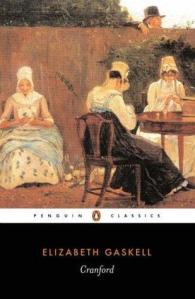
Cranford “In the first place, Cranford is in possession of the Amazons; all the holders of houses above a certain rent are women. If a married couple come to settle in the town, somehow the gentleman disappears; he is either fairly frightened to death by being the only man in the Cranford evening parties, or he is accounted for by being with his regiment, his ship, or closely engaged in business all the week in the great neighbouring commercial town of Drumble, distant only twenty miles on a railroad. In short, whatever does become of the gentlemen, they are not at Cranford.”

Cranford is the fourth Elizabeth Gaskell book I’ve read, following North and South, The Moorland Cottage and Sylvia’s Lovers. I had been hesitant to read this one, despite it being highly recommended by other bloggers, because I wasn’t sure it sounded like the sort of book I would enjoy. A few weeks ago, though, Hesperus Press sent me a review copy of Gaskell’s novella, Mr Harrison’s Confessions, which is described as a prequel to Cranford, so I thought it would make sense to actually read Cranford first.

Originally serialised in Charles Dickens’ journal Household Words in 1851, Cranford is set in a small English town populated mainly by women, most of whom have either never married or are widows. Our narrator is a young woman called Mary Smith who lives in nearby Drumble but who spends a lot of time staying with her friends in Cranford. Through Mary we meet the ladies of Cranford, listen to their gossip, join them at their tea parties, and watch as they go about their everyday lives. The book has a very episodic feel and feels almost like a collection of short stories, particularly throughout the first half of the book. Later in the novel, we focus more on one storyline – the collapse of the Town and County Bank and its impact on the people of Cranford – as well as returning to some of the earlier storylines and developing them further.

At first it seems that the narrator doesn’t have an active role in the novel and that her main purpose is to act as an observer, reporting on the daily lives and routines of her Cranford friends. Unless I missed something we don’t even learn that her name is Mary Smith until the fourteenth chapter, yet she is obviously an integral part of Cranford society, a loyal friend to several of the ladies and regularly invited to their parties and gatherings. Towards the end of the book we finally get to know a little bit more about Mary and she does eventually play an important part in resolving some of the novel’s storylines.

If the novel has a main character, though, it is not Mary but her friend, Miss Matty Jenkyns. Matty’s story is quite sad: her brother Peter left for India years ago and has never been heard from again, and now that her parents and older sister are dead, Matty is the only member of her family left in Cranford. She’d also been romantically linked with a Mr Holbrook decades earlier but their relationship ended as Matty’s sister, Deborah, disapproved. As the narrator observes: “She had probably met with so little sympathy in her early love, that she had shut it up close in her heart; and it was only by a sort of watching…that I saw how faithful her poor heart had been in its sorrow and its silence.” Despite her troubles, Matty remains a loving, kind-hearted person, liked and respected by everyone in the town and also by the reader – this reader at least!

The story of Matty and Mr Holbrook is an indication that although many of the Cranford women are happy with the absence of men in their lives, not all of them are single by choice. I also thought it was interesting that it’s mainly the more genteel ladies who are unmarried, while their servants do have ‘followers’, as they call them. Matty’s early heartbreak makes her more sympathetic to her twenty-two-year-old maid, Martha, and she allows her to have a follower and consider marrying him, whereas some of the other women would never have agreed to such a thing.

Cranford is also a very witty book filled with lots of funny little anecdotes about the women of Cranford. I won’t go into too many details here, but I particularly enjoyed the stories of Miss Betty Barker’s cow who fell into a lime-pit, Miss Matty’s habit of rolling a ball under her bed to check that there’s nobody hiding under it, and the time Mrs Forrester’s cat swallowed her favourite piece of lace. But while there’s a lot of humour in Cranford, there’s also a good balance between funny scenes and moments of sadness and even tragedy.

It seems I was wrong about Cranford not being my sort of book, because I did enjoy it much more than I thought I would. If I’d known it was such a short book (only about 200 pages) I’m sure I would have read it before now. When I reached the end I was sorry to have to leave the world of Cranford behind, but at least I can still look forward to reading Mr Harrison’s Confessions!

Stoner by John Williams

Stoner Stoner was published in 1965 and is considered to be an American classic but I have to admit I hadn’t even heard of it until quite recently when it started to appear on some of the blogs I follow. It didn’t really sound like the sort of book I would usually choose to read, but when I saw a copy in the library I thought I would try it. I liked it much more than I’d expected to; it’s a quiet, reflective book about a university professor whose life is marked by disappointments and unfulfilled potential, but it’s beautifully written and surprisingly gripping at times.

William Stoner is the son of a poor farmer from Missouri. Sent to the University of Missouri in 1910 to study agriculture, William discovers that his true passion is for literature and changes his degree course without telling his parents. After graduating, Stoner decides not to return to the family farm and stays on at the university to teach English Literature where he remains for the next forty years. During those forty years he marries, but the marriage is not a happy one, has a daughter whose life also turns out to be quite miserable, and faces problems at work with students and colleagues. When he retires in 1956 and dies soon afterwards, most of those who knew him quickly forget he ever existed.

This is certainly not an exciting, action-packed novel, but that was obvious from the very first page which sums up Stoner’s whole life in one paragraph (I haven’t spoiled anything above by telling you when he dies) and then continues with:

“An occasional student who comes upon the name may wonder idly who William Stoner was, but he seldom pursues his curiosity beyond a casual question. Stoner’s colleagues, who held him in no particular esteem when he was alive, speak of him rarely now; to the older ones, his name is a reminder of the end that awaits them all, and to the younger ones it is merely a sound which evokes no sense of the past and no identity with which they can associate themselves or their careers.”

The story of Stoner’s life is a mediocre and uneventful one and yet somehow, despite that, it’s fascinating to read. It’s proof of the quality of John Williams’ writing that he could make me feel so interested in the boring life of a man I didn’t even always particularly like. Probably the most dramatic part of the novel, if you can describe any of it as dramatic, is when Stoner tries to fail an incompetent student and finds himself opposed by the student’s tutor, who happens to be the head of the English department. I was completely engrossed by this section of the book, where Stoner tries to do what he believes is right despite the attempts of the other professor to make things as difficult as possible for him.

The character I was most intrigued by was Edith, Stoner’s wife. Her behaviour is very difficult to understand and I’m not sure what conclusions we are supposed to make about her character. She seems to be suffering from a form of mental illness which is never specified and while it is hinted that she may have been abused by her father, this is never explained in any detail either. She was a mystery to me from beginning to end and I never felt that I (or even Stoner) ever really got to know her at all, which was the one thing that disappointed me about this book.

I know I’ve probably given the impression that Stoner is a very sad and bleak story, but it’s actually not quite as depressing as it sounds and I do recommend reading it, especially if you enjoy novels with an academic setting. Now I’m curious about John Williams’ other books – if you’ve read any of them please let me know what they’re like.

The Mayor of Casterbridge by Thomas Hardy

The Mayor of Casterbridge - Thomas Hardy This book was chosen for me in the recent Classics Club Spin. My strategy with spin books is to pick it up and start reading as soon as possible after the number is announced – that way I don’t put it off until the last minute and end up not wanting to read it. This worked well with my last two spin books, A Tale of Two Cities and Can You Forgive Her? and it worked again with this one – once I started reading The Mayor of Casterbridge I didn’t want to put it down, though that wasn’t entirely surprising as I’ve loved everything else I’ve read by Thomas Hardy and fully expected to love this one too.

The Mayor of Casterbridge is the story of Michael Henchard, whom we first meet as a young man, out of work and walking from town to town in search of employment as a hay-trusser. On arriving in a small village near the town of Casterbridge and discovering that a country fair is taking place, Michael proceeds to get drunk and sells his wife, Susan, and baby daughter Elizabeth-Jane to a sailor for five guineas. In the morning he regrets what he has done, but Susan, Elizabeth-Jane and their new owner have already disappeared without trace. After swearing not to touch another drop of alcohol for twenty-one years – the length of time he has been alive – Henchard begins to rebuild his life.

Almost twenty years later, we rejoin Susan and her daughter as they return to Casterbridge. The sailor, Mr Newson, has been lost at sea and having only recently learned that her second ‘marriage’ was not legally binding, Susan is hoping that she and Elizabeth-Jane can find and be reconciled with Michael Henchard. Things have changed in the intervening years and Henchard has transformed himself into the sober and respectable Mayor of Casterbridge. How will he react to having his wife and daughter back in his life? With the arrival of two more newcomers – Lucetta, a pretty young woman from Jersey, and Donald Farfrae, a Scottish traveller – Henchard’s fortunes begin to change yet again and in typical Thomas Hardy fashion a series of mistakes and misunderstandings follow, sometimes with tragic consequences.

I loved this book as much as I expected to and enjoyed being back in Hardy’s Wessex (now that I’ve read quite a few of his books it’s fun to be able to notice the occasional references to characters and places from previous novels). There are some lovely descriptions of Casterbridge with its Roman ruins, and the beautiful countryside surrounding it. However, this is a less pastoral book than most of the others I’ve read – the action takes place in and around the market town of Casterbridge itself, which gives this book a slightly different feel to the more rural, farm-based ones such as Far From the Madding Crowd.

The plot is a great one, with lots of twists and turns and plenty of drama; I was never bored once. There are lots of scenes and images that I’m sure will stay with me from this novel – the ‘furmity tent’ at the fair, the goldfinch in its cage, the noise of the ‘skimmington ride’ – but the main focus of the story is on Michael Henchard and his rise and downfall. There is no doubt that what Henchard does in the first chapter of this book is cruel and shocking, but he’s not just a two-dimensional villain; he is much more complex than that and his character is not written completely without any sympathy. It’s up to the reader to decide whether they can find any forgiveness for him or whether they think he deserves everything he gets. Personally, although I thought the way he behaved was terrible at times, I still found his story very sad, particularly as so much of his misery was self-inflicted and a result of his own flaws and impulsive decisions. And of course, as with many of Hardy’s novels, there is a sense of impending tragedy that hangs over everything and you know from the beginning that there is unlikely to be a happy ending.

I’m now looking forward to reading the other Thomas Hardy novels on my Classics Club list. I think The Return of the Native will probably be the next one I read.

Cider with Rosie by Laurie Lee

Cider with Rosie Laurie Lee was a British novelist and poet most famous for his autobiographical trilogy which begins with Cider with Rosie and continues with As I Walked Out One Midsummer Morning and A Moment of War. Published in 1959, this first volume looks back on Lee’s childhood in the small Cotswold village of Slad in Gloucestershire. Lee moved there at the age of three with his mother and siblings at the end of the First World War. In Cider with Rosie he writes about his family and friends, his school days and the eccentric characters who lived and worked in Slad.

I had never considered reading this book until now, partly because it reminded me of being at school (we never actually read the whole book, but I remember having to study excerpts from it for English comprehension exercises) and I think that was enough to put me off! The scene that I particularly remembered was the one where Laurie’s sisters send him off for his first day at school wrapped in scarves with a hot potato in his pocket. When he comes home he tells the family about his disappointing day:

“They never gave me the present!”
“Present? What present?”
“They said they’d give me a present.”
“Well, now, I’m sure they didn’t.”
“They did! They said: ‘You’re Laurie Lee, ain’t you? Well, just you sit there for the present.’ I sat there all day but I never got it. I ain’t going back there again!”

I’m glad I waited until now to read this book, as I don’t think I would have appreciated it when I was younger. It’s not the most exciting book to read – it doesn’t seem that anything particularly dramatic happened to Lee in his early years and being an autobiographical work (or semi-autobiographical, as Lee admits at the start that “this is a recollection of early boyhood and some of the facts may be distorted by time”), it is not a book with a ‘story’ or a plot. However, it is still worth reading for the beauty of Lee’s descriptions and imagery and because it paints a portrait of a world that has gone and will never come back again.

The book has quite an interesting structure with each chapter devoted to a different theme with titles such as ‘Village School’, ‘The Kitchen’ and ‘Mother’. Laurie does age gradually throughout the book, so that the earlier chapters are seen through the innocent eyes of a small child and the later ones are more mature (including the famous scene drinking cider under a hay wagon with the Rosie of the title), but otherwise the book doesn’t follow strict chronological order.

Some chapters are more enjoyable than others (I loved ‘Grannies in the Wainscot’, which describes two of the Lees’ elderly neighbours) but my favourite is actually the final chapter, which shows how life in the village starts to change with the coming of progress. With the arrival in Slad of cars and electricity, for example, the world suddenly becomes a different place and the simple life Laurie Lee has always known begins to disappear forever.

Cider with Rosie has been reissued by Vintage Classics in a beautiful new edition and I received a copy for review via NetGalley. The book includes drawings by John Ward and although I don’t think you really get the full benefit of them when you’re reading an ebook version, it’s always nice to see illustrations!

Madame Bovary by Gustave Flaubert

Madame Bovary I read Madame Bovary during April as part of a readalong hosted by Juliana of Cedar Station and CJ of ebookclassics. It was a book I’d been thinking about reading for a while anyway so the announcement of the readalong couldn’t have come at a better time for me.

Madame Bovary is a French realist novel published in 1856. The title character, Emma Bovary, longs to experience the drama and excitement she has read about in romantic novels but she is unlikely to find it in her marriage to Charles Bovary, an unambitious country doctor. Charles loves his wife and is not unkind to her, but Emma finds him boring and her life dull and meaningless. After she and Charles attend a ball hosted by the Marquis d’Andervilliers, Emma becomes depressed and miserable; she has had a glimpse of a more glamorous world and it has left her even more disillusioned and dissatisfied with her own situation.

Charles wonders whether a move to a larger town will make her happy but Emma is no more content in their new home in Yonville-l’Abbaye than she was in the small village they’ve left behind. Seeking an escape from her unhappy existence, Emma has affairs and spends money she can’t afford, but as she becomes more reckless in both her romantic and financial entanglements, her life begins to spiral out of control.

It has been interesting to read the opinions of other readalong participants, because while I think we all agree that Emma’s behaviour is silly and self-destructive, the amount of sympathy we have for her seems to vary widely. Some readers can relate to Emma and admire her for doing something to try to change her life and find some happiness; other readers find her very selfish and annoying.

I’m one of those readers who didn’t like Emma at all, though I did have some pity for her, because I know there weren’t many options open to women in the 19th century, particularly those living in provincial areas, who wanted more from life than just to be a wife and mother. I can see why she may have felt that adultery was a way of escape and a way to find the passion she’d read about in books. I thought it was sad that Emma couldn’t even take any pleasure in her daughter (when Berthe is born, her first emotion is disappointment that the baby isn’t a boy). Later, when Berthe comes up to her hoping for affection Emma pushes the little girl away so that she falls and hurts herself. Poor Berthe – and life doesn’t get any better for her later in the book either.

I don’t think Charles was entirely blameless as he could have made more effort to understand his wife’s feelings and he was so naïve that he seemed completely oblivious to what was going on, but my sympathy was definitely with him and with Berthe more than with Emma. I noticed, though, that Flaubert himself seems to stay neutral throughout the novel, reporting on his characters’ thoughts and actions without actually passing judgment on them and telling us what we should think.

There were parts of this book that I really enjoyed, but I’ll have to be honest and say that much as I wanted to love this book I just didn’t. I think my dislike of Emma was part of the problem, but not the whole problem, as I didn’t find the writing style very engaging either. The version of Madame Bovary that I read was an older Penguin edition (pictured above) translated by Alan Russell – I had no reason for choosing this translation other than that it happened to be the one I already had on my shelf, which seemed as good a reason as any. I didn’t really have any problems with it and found it easy enough to read, but having since read that Flaubert prided himself on always searching for the perfect word, in this case it’s possible that the translation did affect my enjoyment. I didn’t like the book enough to want to read it again in a different translation to find out, though!

While this has not become a favourite classic, I’m still glad I’ve read it. If nothing else, I can now see where Mary Elizabeth Braddon’s inspiration for her novel The Doctor’s Wife came from!