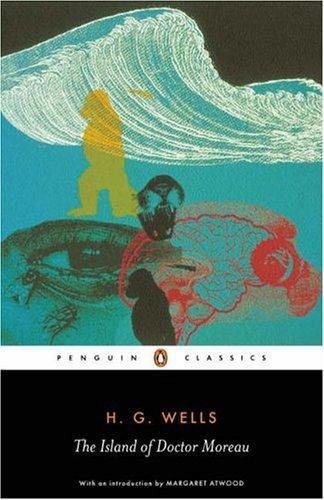
The Island of Doctor Moreau by H.G. Wells

After reading my first H.G. Wells book, Ann Veronica, in March I mentioned that I now felt ready to try one of his science fiction books. The Island of Doctor Moreau is the one I chose to read, and it certainly couldn’t be more different from Ann Veronica!

The story is narrated by Edward Prendick who, having been shipwrecked, is rescued by the crew of the Ipecacuanha. Whilst on board, he becomes acquainted with one of the other passengers, the mysterious Montgomery, who is transporting a cargo of wild animals home to the island where he lives. When the drunken captain of the Ipecacuanha attempts to have Prendick thrown overboard, Montgomery takes pity on him and invites him to accompany him to the island. Here Prendick meets the famous vivisectionist Doctor Moreau, who is carrying out some secret experiments on animals – and as the true horrors of Moreau’s island are revealed, Prendick begins to realise that his own life could be in danger.

I’ve never been a fan of science fiction and wasn’t sure what to expect from this book, but I enjoyed it more than I thought I would. The opening chapters were a bit slow, but things became much more interesting when Prendick arrived on the island and after that the pages flew by.

I didn’t think the story was frightening, although I did feel a growing sense of disgust and repulsion. Some of Moreau’s nightmarish creations were truly horrible to read about. Whatever your personal views on animal testing may be, the way Wells describes the unnecessary pain and suffering Moreau inflicts on his animals is very sad and disturbing. Like Frankenstein and more recently, Jurassic Park, The Island of Doctor Moreau can be seen as a warning of the negative effects of science and the dangers of ‘playing God’. When this book was published in 1896, the kind of technology Wells described only really existed in fiction. But during the 20th and 21st centuries the advances scientists have made in areas such as genetic engineering and cloning mean that Wells’ ideas are no longer so far-fetched. And that’s what really is frightening!

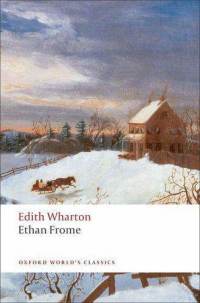
Ethan Frome by Edith Wharton

Ethan Frome is married to Zeena, a woman he doesn’t love. Trapped in his unhappy marriage, Ethan has no joy in his life and no hope for the future. One day Zeena’s cousin, Mattie Silver, comes to stay with the Fromes. Mattie is everything Zeena isn’t – warm and loving and pretty – and soon she and Ethan begin to fall in love.

Ethan Frome is a short book with a simple but very effective plot, so for those of you who haven’t read it yet, I don’t want to go into any more detail about it and risk spoiling the story for you. But although this is not a particularly complex story, it is a powerful and memorable one.

The tone of the book is very bleak, filled with foreboding and a hint of tragedy to come. The only characters explored in any depth are the three main ones (Ethan, Zeena and Mattie) but all three are realistic, believable people. Ethan and Mattie’s relationship felt real and natural, and I wanted them to find happiness together. Zeena, as seen through Ethan’s eyes, was portrayed as such an unpleasant person I found it difficult to have much sympathy for her, but it was clear that she was also stuck in a desperately sad situation.

The most striking thing about this book, for me, was the tense, claustrophobic atmosphere Wharton created, making the reader feel locked within Ethan’s miserable world. The town of Starkfield, Massachusetts is as stark as its name suggests; the descriptions of the snow, the ice and the cold all contribute to the heavy feeling of oppression which hangs over the entire book. The wintry landscapes are so vivid I wished I’d saved this book to read on a snowy day, as I think it would have made a perfect seasonal read! As well as the winter imagery, I also loved the way the book ended. I thought it was obvious what was going to happen but I was wrong; there was a twist at the end that gave the story an unexpected conclusion.

This is the first book I’ve read by Edith Wharton and although I did like it, it hasn’t become an instant favourite. I can definitely understand why people love it, but it didn’t affect me emotionally as much as I had expected it to. I don’t know why not because it was certainly a tragic story, so maybe I just wasn’t in the right mood for it. Overall, my first experience of Wharton’s work was a good one, but I think I’ll have to try another of her books before I can decide if she’s my type of author or not – any suggestions as to which one I should read next?

Three Men in a Boat (To Say Nothing of the Dog) by Jerome K. Jerome

I have book blogging to thank for the fact that I’ve finally read this wonderful classic. It’s not a book I would ever have thought of reading until I started to notice other bloggers giving it glowing reviews and decided I really had to read it for myself. I’m pleased to say that it lived up to my expectations – I found it an easy, entertaining read, not to mention a genuinely hilarious one! I can’t remember the last time I read such a funny book and I would recommend it to anyone who feels daunted by the thought of reading a Victorian classic.

The ‘three men’ are our narrator, J., and his two friends, George and Harris. When they decide they need a break, the three men (accompanied by Montmorency the dog), set off on a boat trip along the River Thames – and everything that can go wrong does go wrong!

What makes Three Men in a Boat so funny is that, despite the book being written such a long time ago, so much of it is still true of modern day life. The accuracy of the British weather forecast, for example, doesn’t seem to have improved at all since Victorian times!

I do think that, of all the silly, irritating tomfoolishness by which we are plagued, this “weather-forecast” fraud is about the most aggravating. It “forecasts” precisely what happened yesterday or the day before, and precisely the opposite of what is going to happen to-day.

Most people should be able to identify with at least a few of the disasters that J. and his friends recount. I’m sure anybody who has ever been camping will laugh at the descriptions of two people trying to put up a tent in the rain. And what about Uncle Podger hanging a picture on the wall? Does this scenario sound familiar?

“There!” he would say, in an injured tone, “now the nail’s gone.”

And we would all have to go down on our knees and grovel for it, while he would stand on the chair, and grunt, and want to know if he was to be kept there all the evening.

The nail would be found at last, but by that time he would have lost the hammer.

“Where’s the hammer? What did I do with the hammer? Great heavens! Seven of you, gaping round there, and you don’t know what I did with the hammer!”

Some of the funniest parts are when the three men relate to each other little anecdotes about things that happened to them in the past – my favourite was George getting up and going to work in the middle of the night because his watch had stopped and he thought it was morning. I also loved the story Harris told about the time he got lost in Hampton Court Maze.

During their journey up the Thames, we are given lots of historical and geographical facts about the places the three men pass in their boat; these sections read almost like a travel guide and I suspect they might have been of more interest to me if I lived near the Thames and was more familiar with the area. I also don’t have any interest at all in sailing, rowing or boats in general so a lot of the boating jokes went over my head – but I suppose I shouldn’t really complain about there being too much boating terminology in a book called Three Men in a Boat!

Whether you’ll enjoy this novel or not will depend on whether you can connect with Jerome K. Jerome’s sense of humour. If you can’t then you might be disappointed because the book doesn’t really have a plot, other than the outline I’ve given above – so if you do read it I hope you’ll be able to laugh at it as much as I did!

Ann Veronica by H.G. Wells

I’ve never read anything by H.G. Wells before and never thought he would be an author I would enjoy. In fact, I hadn’t even realised he had written anything other than the science fiction books he’s famous for (The War of the Worlds, The Invisible Man, The Time Machine etc) and as I’m not a lover of science fiction, none of those have ever really appealed. So when I noticed this one in the library, sounding entirely different to the books I’ve just mentioned, I was intrigued and decided to give it a try.

The story is set in the early years of the 20th century and the title character is twenty-one-year-old biology student Ann Veronica Stanley. Tired of being locked in a constant battle of wills with her father, a strict and conservative solicitor who has very strong opinions about women and their place in society, she decides to run away to London to start an independent life of her own. In London, she is exposed to a range of influences and experiences (including the suffragette movement), becomes involved with several different men, and discovers that life can be difficult for a young single woman living on her own.

I wouldn’t recommend this novel to people who are looking for something with lots of action but if you’re in the mood for a slower, more character-driven story this is a very interesting read. And as a book about feminism written by a male author, I’m sure it must have caused controversy when it was first published in 1909. The book wasn’t perfect though – the main character started to irritate me after a while and at times it felt less like a novel and more of a vehicle for Wells to express his views on feminism, politics and science.

The first half of the book is concerned mainly with Ann Veronica’s struggle to gain independence from her father. She considers it unreasonable that he won’t let her go to a party in London with her friends and that he refuses to let her attend Imperial College to study for her science degree. And yet Ann Veronica’s father clearly loves his daughter and is not trying to be unkind to her – he truly believes women should behave in a certain way and it puzzles him that Ann Veronica doesn’t want to conform.

After a promising beginning, the second half of the book was dominated by a romantic storyline which became very sentimental and started to bore me. And although I can’t say too much because I don’t want to spoil the story for anyone, I was quite disappointed with the way the book ended and felt confused as to exactly what point Wells was trying to make. So, although I was left with mixed feelings about this book, at least it’s taught me not to have pre-conceived ideas about certain authors. I do feel happier about maybe trying one of his science fiction books now.

The version I read was the Penguin Classics one, but for those of you who like to collect Virago Modern Classics it has also been published as a VMC (and is one of the few written by a man).

Villette by Charlotte Bronte

I wanted so much to love this book. Jane Eyre is one of my all-time favourite books and although it has taken me a long time to get round to reading another Charlotte Bronte novel, I had high hopes for this one. Unfortunately, for a long time Villette just wasn’t working for me and I’m not really sure why not.

I actually read this book at the end of January and discovered too late that there was a readalong taking place in February/March. I wonder whether reading it along with other people would have helped, as there were times when I really started to lose the motivation to continue with the book. There was a point where I didn’t think I was going to be able to keep reading, but eventually things improved and I finally became immersed in the story. I ended up enjoying it, but sadly it was too late for this book to become another favourite.

Villette is the story of Lucy Snowe who, after an unspecified family tragedy, finds herself completely alone in the world. She travels to Europe on her own and starts a new life teaching English to the girls at Madame Beck’s school in the city of Villette.

I think part of my problem with the first half of the book was that it took me a long time to warm to Lucy Snowe. I didn’t like her at all at the beginning of the novel, but eventually I did begin to feel a lot more sympathetic towards her and this coincided with the point where I started to enjoy the story more. My perceptions of Lucy changed as I learned more about her and saw how badly other people treated her. She was so lonely and isolated and my heart broke for her at times. Despite her cold exterior, underneath she was a person who desperately needed love and friendship. It’s quite sad that she doesn’t make this observation until two thirds of the way through the book:

“I liked her. It is not a declaration I have often made concerning my acquaintance, in the course of this book: the reader will bear with it for once.”

Lucy is also quite secretive and often withholds important information from the reader. And throughout the early chapters, although Lucy is our narrator, we learn more about the people around her than we do about Lucy herself. She’s an intensely private person and doesn’t open up to the reader very often. But as I got to know Lucy better, I found a lot of things to admire about her – her independence, for example, and her bravery in leaving England and travelling to another country with no idea of where she would go once she got there.

There is a romantic aspect to the book, but it’s not the most passionate of romances and not love at first sight. I already knew who Lucy’s love interest was going to be because it told me on the back cover, but things developed so slowly and so subtly it might not have been immediately obvious to me otherwise. Because of this though, the relationship feels believable and real.

Apart from the length of time it took me to get into the book, there are a couple of other negative points I should mention. Firstly, I thought the racism and religious prejudice was excessive, even by the standards of Victorian literature. Lucy considers the girls at Mme Beck’s school to be inferior to English girls in every way, and she doesn’t like Catholics or the Irish much either. Also, a lot of the book is written in French. I do have a basic understanding of French and am fine with books incorporating a few French phrases but this one has whole paragraphs where I kept wondering if I was missing something crucial.

Although I did end up enjoying this book and could eventually appreciate the complexity of Lucy Snowe’s character, it still doesn’t come close to Jane Eyre in my opinion. However, I know a lot of people think Villette is the better of the two. If you’ve read them both, what do you think?

Group Read: The Moorland Cottage by Elizabeth Gaskell

Having signed up for the Elizabeth Gaskell Reading Challenge I’m intending to read some of Gaskell’s full-length novels this year, but when I saw that Katherine of Gaskell Blog was hosting a group read of the novella, The Moorland Cottage, it seemed like a perfect way to start the challenge.

The Moorland Cottage is a short but very moving and emotional story. Mrs Browne and her children, Edward and Maggie, live with their elderly servant, Nancy, in a cottage near the town of Combehurst. It’s no secret that Edward is their mother’s favourite child but while she dotes on her son, she never has a kind word for her daughter. In a big house nearby live the wealthy Mr Buxton and his gentle, loving wife. There are also two children in the Buxton household: their son, Frank, and their niece, Erminia. The Buxtons attempt to befriend the Brownes, but while they can all see the goodness in Maggie, they find it difficult to like the spoilt, selfish Edward and the cold, snobbish Mrs Browne. As the years go by and the lives of the Brownes become more and more entwined with their neighbours’, Maggie is forced to make a decision which could potentially affect the future of both families.

The Moorland Cottage shows us the ways in which boys and girls were treated differently in Victorian society and I felt so sorry for Maggie. Throughout the first few chapters my heart was breaking for her as I saw how she was constantly pushed aside in favour of her brother. It was very, very sad to see the way, as a child, she meekly accepted her mother’s cruelty. For example, when Frank Buxton brings a pony for Maggie to ride, Mrs Browne decides “to spoil the enjoyment as far as possible, by looking and speaking in a cold manner, which often chilled Maggie’s little heart, and took all the zest out of the pleasure now”. How spiteful!

Maggie is also treated badly by Edward, and again, she allows him to do so, accepting that his needs are more important than her own. It’s not until she’s older and has spent more time in the company of the Buxtons and been exposed to other ideas that she starts to become aware of her brother’s faults. In the adult Edward, we see what happens to a child who is brought up always getting their own way and not being taught the difference between right and wrong.

I loved Gaskell’s descriptions of the Brownes’ home and the surrounding scenery throughout the changing seasons. Because the book was so short these descriptive passages had to be kept fairly brief which I thought made them even more effective.

The air on the heights was so still that nothing seemed to stir. Now and then a yellow leaf came floating down from the trees, detached from no outward violence, but only because its life had reached its full limit and then ceased. Looking down on the distant sheltered woods, they were gorgeous in orange and crimson, but their splendour was felt to be the sign of the decaying and dying year. Even without an inward sorrow, there was a grand solemnity in the season which impressed the mind, and hushed it into tranquil thought.

Finally, a few words on the group read itself: I thought this book was an excellent choice for a readalong. For such a short book it contains a wealth of interesting topics and issues. At only eleven chapters I could easily have read it in one day but I found that reading it slowly meant I had a better understanding of it and got more out of the story. And Katherine’s beautifully annotated chapter summaries were very useful and helped to bring the story to life. Visit Gaskell Blog to see them for yourself!

Our Mutual Friend by Charles Dickens

I’m planning to read a lot of Victorian classics this year for the Victorian Literature Challenge (and because I love reading them anyway, of course) so I decided to start with one that has been on my TBR pile for a long time: Our Mutual Friend by Charles Dickens.

Last year I read Bleak House and although I didn’t love it, it didn’t put me off reading more Dickens. However, this one at first felt very similar and some of the aspects of Bleak House that I didn’t like were present here too (a huge number of characters were introduced within the first 100 pages and a lot of different storylines were begun then abandoned for several chapters). I wondered if I really wanted to continue, or if I should choose a different Dickens book to read instead. Then suddenly, things improved. The story started to make sense and I found I was enjoying it. Really enjoying it!

Our Mutual Friend opens with Gaffer Hexam and his daughter Lizzie discovering a dead body in the Thames. The body is assumed to be that of John Harmon, who was on his way to London to marry Bella Wilfer. John’s father had recently died and one of the conditions of his will was that unless John married Bella, he would not be allowed to claim his inheritance.

Bella is disappointed when she learns that he has drowned. It’s not fair: not only has she missed out on the money, now she’s going to have to wear mourning for a man that she’s never met and who died before they were even married! Mr and Mrs Boffin, the kind-hearted couple who inherit the Harmon fortune in John’s absence, feel sorry for her and invite her to stay with them. However, the Boffins soon become the target of fortune hunters and blackmailers such as Silas Wegg and Mr Venus.

Being almost 800 pages long, and being Dickens, this is only one small part of the story. There are several other plots and sub-plots which eventually become woven together – and some very memorable characters, including Jenny Wren, the ‘Dolls’ Dressmaker’, Mrs Higden, who lives her life in terror of the workhouse, and Bradley Headstone, a murderous schoolmaster who falls in love with Lizzie Hexam.

Although I did enjoy this book and found most of it entertaining and gripping, I did struggle with the chapters that took place in the ‘fashionable world’ of the Veneerings’ dining room. This world of dinner parties and politics contrasts sharply with the other main setting of the book, the River Thames, where most of the action takes place. We meet the people who earn their living from the river, we spend some time in the riverside inns and taverns, and in a way the river becomes the most important ‘character’ in the book.

And as the great black river with its dreary shores was soon lost to her view in the gloom, so she stood on the river’s brink unable to see into the vast blank misery of a life suspected, and fallen away from by good and bad, but knowing that it lay there dim before her, stretching away to the great ocean, Death.

I liked both of the two main female characters. Lizzie Hexam is a typical Dickens heroine, but she didn’t irritate me like Esther Summerson did in Bleak House. Bella Wilfer, though, turned out to be a surprisingly complex character. Although she was quite self-absorbed and materialistic, I liked her because she was warm-hearted and despite admitting she wanted to marry a man with money, she also seemed to feel genuinely guilty about it. Money, and how it can change people, is one of the main themes of the book, as Bella explains to her father here:

And yet, Pa, think how terrible the fascination of money is! I see this, and hate this, and dread this, and don’t know but that money might make a much worse change in me. And yet I have money always in my thoughts and my desires; and the whole life I place before myself is money, money, money, and what money can make of life!’

Fathers and daughters play a big part in the story and it’s interesting that with only a few exceptions, the relationship is always the same – a strong, loyal and loving daughter with a weak, villainous or child-like father. Mr Wilfer is described as ‘cherubic’ and devoted to Bella, who treats him like a baby. Then there’s Pleasant Riderhood and her criminal father, Rogue, as well as Lizzie and her father, Gaffer, who was a former associate of Rogue’s. And there’s Jenny Wren, who refers to her alcoholic father as her ‘bad child’ and makes him sit in the corner in disgrace.

Our Mutual Friend is such a big, complex novel it does require the reader to invest a lot of time and effort in it, but it was definitely worth it for me! I now feel much happier about reading more Dickens in the future.