Barchester Towers by Anthony Trollope

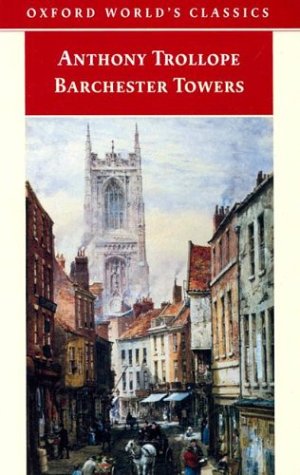
Back in April I read my first Anthony Trollope book, The Warden, and enjoyed it so much I immediately bought a copy of Barchester Towers, the second Chronicle of Barsetshire, with the intention of going on to read the whole series. As it turned out though, other books seemed more tempting and poor Barchester Towers was pushed further and further down my tbr pile until The Classics Circuit’s Anthony Trollope Tour reminded me that it really deserved to be read as soon as possible!

Barchester Towers is set five years after the conclusion of The Warden. At the beginning of the story, the Bishop of Barchester dies, leaving a vacancy to be filled. It is expected that the Bishop’s son, Archdeacon Grantly, will take his place, but a change of government ruins his chances and newcomer Dr Proudie is appointed instead. When the new Bishop and his wife, the formidable Mrs Proudie, arrive in Barchester accompanied by their chaplain Mr Slope, Grantly becomes determined to prevent them from gaining too much power and changing the Barchester way of life.

This might not sound like a very exciting plot, and I have to admit it isn’t. Barchester Towers is a character-driven novel, and fortunately, the characterisation is excellent. Trollope’s characters are multi-faceted, complex and real; the villains are not completely evil and the heroes have their flaws. Archdeacon Grantly, for example, was portrayed quite negatively in the previous novel, but we see things more from his perspective in this book and I found that I was rooting for him against the Proudies and Slope.

Almost all of the characters are well-rounded and interesting. There’s the Signora Madeline Vesey Neroni, left crippled by her abusive Italian husband, who manages to get every man in Barchester to fall in love with her. There’s Miss Thorne, the local squire’s sister who lives in the past, dreaming of the days of knights and chivalry. And I was pleased to meet some old friends from The Warden, including my favourite characters, Mr Harding and his daughter Eleanor.

I’m not sure who I would recommend Trollope to. As far as comparisons to other Victorian authors go, I would say his style is a lot closer to George Eliot than Charles Dickens, for example. He tells his stories at a gentle, leisurely pace with some subtle humour, witty observations, and clever insights into human nature. He has a habit of talking directly to the reader and never lets us forget that we’re reading a novel, but rather than being annoying or disruptive, this style gives his writing the warm, conversational feel that I love. If you prefer stories with a lot of suspense and tension, though, you’ll be disappointed because Trollope keeps telling us in advance what is and is not going to happen, which has the effect of building an intimate and trusting relationship between the author and the reader. But even though it may seem quite obvious what the outcome of the book is going to be, the fun is in seeing how the outcome is reached.

Much as I love Trollope though, I can see that he won’t appeal to everyone – the gentle pace that I mentioned, in addition to the long descriptions and character introductions, might make the book too slow for some readers (it did take me almost 100 pages before I really got absorbed in the story). Some of his comments on gender, race and religion could also be considered offensive, although as a male Victorian author his views were probably consistent with the time period and society in which he lived. If you have read and enjoyed other Victorian writers, I would highly recommend giving Trollope a try to see what you think.

Although this one was a better book, I think I would still suggest that newcomers to this series start with The Warden. The shorter length means it’s less of a commitment if you find you don’t like Trollope’s writing style. It’s also the first in the series and although I’m sure Barchester Towers would work as a stand-alone novel, The Warden does introduce us to several of the characters and their backgrounds.

Based on the two books I’ve read so far, Trollope is quickly becoming one of my favourite Victorian authors. I definitely don’t want to let seven months go by again before I pick up another of his books! I’m already looking forward to the third Barsetshire novel, Doctor Thorne.

Anthony Trollope has been visiting my blog today as part of the Classics Circuit Anthony Trollope Tour. See this post for a list of other stops on the tour.

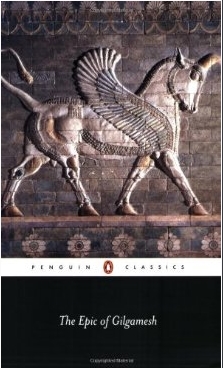
The Epic of Gilgamesh

When I signed up for the Really Old Classics Challenge I had no idea what to read, as I’m completely new to ‘really old classics’. I finally picked The Epic of Gilgamesh, which proved to be the perfect choice because I loved it!

The Epic of Gilgamesh is one of the earliest known pieces of literature in the world. It was written on a set of clay tablets from ancient Mesopotamia which were discovered by the archaeologist Hormuzd Rassam in the 19th century and are thought to date from around 2000 BC. It’s fascinating to think that something written so long ago has survived and is still being read today.

The epic tells the story of Gilgamesh, a powerful Sumerian king who is feared by his subjects. The gods respond to the pleas of the people by sending a wild man called Enkidu to be Gilgamesh’s equal. The first half of the epic shows how Gilgamesh and Enkidu form a close friendship and have some great adventures together, including a journey into a cedar forest to slay the monster Humbaba. Later, when Enkidu dies, the devastated Gilgamesh sets out in search of the secrets of immortality.

There have been several different translations of The Epic of Gilgamesh but the one I read was the Penguin Classics version translated by Andrew George. I’m not sure how this would compare to the other translations that are available (this is in verse form and I know that some of the others are in prose, for example); I might try reading a different one at some point in the future to find out.

The story is very repetitive with some verses being repeated two or three times in quick succession, with only a few words being changed each time. I actually really liked this structure, as it produced an almost hypnotic effect, as well as helping to emphasise the points that were being made. I was surprised at how easy it was to read and understand, despite some missing words and disjointed sentences (the Epic of Gilgamesh does not exist in its entirety – the various translators have had to piece it together from the surviving fragments of text). Some parts of the story feel very familiar, such as when Gilgamesh, during his quest for immortality, meets Utnapishtim who tells him about a great flood. This is obviously very similar to the biblical story of Noah.

There are lots of references to Sumerian gods and place names, which I am not familiar with at all, but the book has a lot of helpful extras including a glossary, character list and map. There’s also an introduction which helps to explain the historical context of the epic and describes how the tablets were discovered.

The Epic of Gilgamesh is relatively short in comparison to many other ‘really old classics’, but despite its shortness, it gives us a lot to think about. One thing we can learn from the epic is that although the world has changed in many ways over the last four thousand years, there are some things that are still the same: for example, friendship, love, grief at losing a loved one, fear of death, and every other human emotion you can think of.

Recommended

Northanger Abbey by Jane Austen

I feel embarrassed admitting that I still haven’t read all of Jane Austen’s books, knowing how popular she is both with book bloggers and the world in general. The reason for that is because although I enjoyed Pride and Prejudice I was less impressed with Mansfield Park and Emma. I didn’t dislike them but I didn’t love them, so I haven’t been in any hurry to read the rest of her books.

Northanger Abbey is the story of Catherine Morland, a seventeen-year-old girl who is obsessed with reading gothic novels. On a visit to Bath with some friends of the Morland family, Mr and Mrs Allen, Catherine gets to know Henry Tilney and his sister Eleanor. The Tilneys invite Catherine to stay at their family home and she is thrilled to discover they live in an abbey! But when on her first night at Northanger Abbey, in the middle of a thunderstorm, she finds a mysterious cabinet in her bedroom, Catherine’s imagination starts to run away with her…

This seems to be a book of two distinct halves. The first half, set in Bath, follows Catherine as she begins to fall in love with Henry Tilney and tries to escape the unwelcome attentions of her brother’s obnoxious friend, John Thorpe. She also meets John’s shallow, self-absorbed sister Isabella, who quickly becomes her ‘best friend’. In the second half, after Catherine accompanies the Tilneys to Northanger Abbey, the book becomes a parody of the gothic novel for a while before everything starts to tie together at the end. I’ve read a lot of gothic novels (including Catherine’s favourite Ann Radcliffe book, The Mysteries of Udolpho) and I think this probably helped me understand the humour, although all you really need is a basic knowledge of what a gothic novel involves (crumbling castles, dark passageways, sinister secrets, a gloomy atmosphere, melodrama etc). I imagine a lot of people are inspired to pick up a gothic novel for the first time after reading this book, rather than the other way round though!

Northanger Abbey could also be described as a coming of age novel. At the start of the book Catherine is very naïve and innocent, with romantic notions and an over-active imagination. As the story continues she begins to discover that there are some big differences between the world she lives in and the world of Ann Radcliffe’s novels. She also learns to be a better judge of character and to understand other people’s motives. Catherine is not a particularly strong character but she’s amusing and likeable, and so is Henry Tilney.

I found this a lot easier to read than the other Austen books I’ve read. The writing feels very bright and lively. This is the first Jane Austen book that I’ve really found funny and been able to understand why her wit and irony are so highly regarded. I know a lot of people don’t like it when an author ‘intrudes’ into the story and speaks directly to the reader, but it’s not actually something that bothers me at all. Austen does quite a lot of it in this book, particularly in chapter 5 when she defends novel-reading:

There seems almost a general wish of decrying the capacity and undervaluing the labour of the novelist, and of slighting the performances which have only genius, wit, and taste to recommend them. “I am no novel-reader — I seldom look into novels — Do not imagine that I often read novels — It is really very well for a novel.” Such is the common cant. “And what are you reading, Miss — ?” “Oh! It is only a novel!” replies the young lady, while she lays down her book with affected indifference, or momentary shame. “It is only Cecilia, or Camilla, or Belinda”; or, in short, only some work in which the greatest powers of the mind are displayed, in which the most thorough knowledge of human nature, the happiest delineation of its varieties, the liveliest effusions of wit and humour, are conveyed to the world in the best-chosen language.

I think I can see why this is considered one of Austen’s less popular books, because although it was a fun, entertaining and relatively quick and easy read, it did somehow feel less satisfying than the other books of hers that I’ve read. The ending seemed slightly rushed and some of the characters not as well developed as they could have been. But those are only minor criticisms because overall I loved this book. I still have two more Jane Austen books left to read and as I enjoyed this one so much, I’m now looking forward to reading the other two!

Final thoughts on Bleak House by Charles Dickens

I was hoping to have this review ready to post at the end of Amanda’s readalong, but as usual things didn’t go according to plan and I’m almost a week late!

I had tried to read Bleak House once or twice in the past but gave up after a few chapters, so I hoped that taking part in the readalong would give me the motivation to actually finish the book. And it did. However, I was reminded of the reasons why I had given up on the book on my previous attempts. Dickens’ writing can be very long-winded, descriptive and detailed, even in comparison to other Victorian authors, and there were many parts of the book where I really had to force myself to concentrate – particularly during the first two chapters.

The plot is so complex I’m not even going to try to write a summary, other than to say that the story revolves around a court case called Jarndyce and Jarndyce with which many of the characters are in some way involved. The action moves back and forth between the foggy streets of London and a quiet country estate in Lincolnshire. Half of the story is told by an unnamed narrator in the third person present tense, and the other half is narrated by Esther Summerson. There are some characters who appear in only one of the narratives and some who feature in both, so that the two cross and intersect from time to time.

If you’re thinking of reading Bleak House you should be aware that a huge number of characters are introduced throughout the first half of the book. As I mentioned in one of my readalong update posts, it felt as if storylines were being started then abandoned for hundreds of pages at a time. It takes a long time for the separate storylines to start coming together so you’ll need to have patience, but when they do the book becomes much more enjoyable.

Although many of the characters lacked depth, they were all different and memorable enough that I never had a problem remembering who was who. There were some that I liked (Mr Jarndyce, Inspector Bucket and George), and some that I hated (Skimpole, Smallweed and Tulkinghorn). As for Esther, she appeared to be Dickens’ portrayal of what an ideal woman should be like (i.e. perfect in every way, loved by everyone, happy to be nicknamed ‘little housewife’ and ‘Dame Durden’). But although Esther irritated me, I would probably have enjoyed the book more if it had all been told from her perspective. I found I could get more absorbed in the story while she was narrating and her chapters were much easier to follow than the others.

Bleak House has everything I would normally love in a book: an intricate plot, secrets and revelations, humour, a mystery, unusual characters. Unfortunately there was something about the book that didn’t quite work for me; I’m not sure whether it was the writing style or the narrative structure or a combination of both. But although I didn’t love it, I didn’t dislike it either and as this was only the second Dickens book I’ve read (the other being A Christmas Carol), I’ll definitely be giving him another chance.

Review: The Haunted Hotel & Other Stories by Wilkie Collins

Time for one more review before the RIP challenge ends!

Having read so many of Wilkie Collins’ books and loving them all, I’m starting to worry now whenever I pick up one that I haven’t read yet, in case that’s going to be the one that disappoints me. Luckily it wasn’t this one! This collection published by Wordsworth Editions includes the novella The Haunted Hotel and eight other short stories, all with a ghostly, spooky or supernatural theme.

Part ghost story and part gothic mystery, The Haunted Hotel begins in London but soon moves to Venice, an atmospheric setting complete with dark canals and ancient palaces. At the heart of the story is the mysterious Countess Narona, who marries Lord Montbarry after he breaks off his engagement to Agnes Lockwood. When Montbarry dies in Venice soon after insuring his life for ten thousand pounds, rumours abound that the Countess may have had something to do with his death.

While I enjoyed The Haunted Hotel, I wouldn’t class it among Collins’ best work and the shortness of the story means the characters aren’t as well developed. I did love the second half of the story in which the palace where Montbarry died is converted into a hotel. There’s a very creepy sequence of events where each member of the Montbarry family who stays in the hotel feels a ghostly influence that manifests itself in a different way to each person.

You can buy The Haunted Hotel on its own, but I recommend looking for this edition because the additional short stories are well worth reading too. In every story, Collins gradually builds the suspense and draws the reader into the story. One of my favourites was Miss Jeromette and the Clergyman, a short ghost story in which the ghostly happenings are accompanied by mysterious clouds of white fog. I loved the way even though the story was quite predictable, it was still a pageturner. The same can be said about Nine O’Clock, in which a man condemned to death during the French Revolution tells his friend about a family curse. We know almost from the beginning what will happen, but the story still manages to be suspenseful.

Another favourite was A Terribly Strange Bed, an Edgar Allan Poe-like tale which creates a feeling of claustrophobia and terror as the narrator finds himself trapped in a room with a very unusual bed. Another story on a similar theme is The Dead Hand, in which a man attempts to find a room at an inn for the night, but finds that everywhere is full. When he’s eventually offered a bed in a double room, he makes a surprising discovery about the stranger who’s occupying the other bed.

I also enjoyed the final story in the book, The Devil’s Spectacles, which is about a man who is given a pair of spectacles that allow him to see the true thoughts and feelings of anyone he looks at.

I don’t generally like reading short story collections straight through from beginning to end, but I didn’t have a problem with this book. There are only eight stories (plus The Haunted Hotel) and most of them are less than twenty pages long. This was a perfect book to read in the week before Halloween.

Review: Dracula by Bram Stoker

“My friend. – Welcome to the Carpathians. I am anxiously expecting you.”

When Jonathan Harker travels to Count Dracula’s castle in Transylvania to advise the Count on the subject of buying property in England, he quickly becomes aware that there’s something not quite normal about his host – and after making some terrifying discoveries, he finds himself imprisoned in the castle. Back in England, Harker’s fiancée Mina Murray is anxiously waiting in Whitby for news of Jonathan. But as if she didn’t already have enough to worry about, her friend Lucy Westenra becomes mysteriously ill, with inexplicable puncture wounds on her throat. Could Lucy’s illness have anything to do with the ship that was recently swept into the harbour during a storm?

Interspersed with the main storyline are Dr Seward’s medical notes on one of his patients, a man called Renfield who likes to eat flies and spiders – but what is the connection between Renfield, Lucy and Dracula? Dr Seward brings in his friend Van Helsing, an expert in unusual diseases, and with the help of Mina, Jonathan, Lucy’s fiance Arthur Holmwood and a friend, Quincey Morris, they attempt to solve the mystery and defeat Dracula.

Dracula was an obvious choice for me for the RIP challenge, particularly as it’s one of those books I feel as if I should have read years ago, yet never have (apart from a children’s version which doesn’t really count as it was so heavily abridged). Yet even though I had never read it, a lot of the story was familiar as it has become so firmly entrenched in popular culture. Dracula is not the first vampire story (a few weeks ago I wrote about John Polidori’s The Vampyre and Byron’s Fragment of a Novel) but it’s definitely the most famous.

The book is written in an epistolary style with the entire story being told through letters, journal entries, telegrams and newspaper reports. This structure kept the story moving forward and it was interesting to see so many different perspectives, but I did feel that some of the entries were too short and the story kept switching too abruptly from one person’s journal to another. I would have liked to have spent longer with one character before switching to the next. Some of the ‘voices’ were very similar, but I really liked the character of Mina, who was a strong, sensible, intelligent woman and although she was subjected to the usual Victorian attitudes of the time, she played an important role in the story. In comparison, Lucy is more of a typical Victorian heroine.

The opening section in Transylvania was my favourite part of the book. I loved the atmosphere Stoker created, with the snow falling and the wolves howling.

Though we were in shelter, we could hear the rising wind, for it moaned and whistled through the rocks, and the branches of the trees crashed together as we swept along. It grew colder and colder still, and fine, powdery snow began to fall, so that soon we and all around us were covered with a white blanket. The keen wind still carried the howling of the dogs, though this grew fainter as we went on our way. The baying of the wolves sounded nearer and nearer, as though they were closing round on us from every side. I grew dreadfully afraid, and the horses shared my fear.

When the story moved from Transylvania to Whitby, the pace slowed down and I started to get bored. I did enjoy all the descriptions of Whitby though, with its harbour and ruined abbey. Whitby is only a couple of hours’ drive from where I live, so we go there a lot, and it’s always nice to read about a place you know well.

I actually didn’t find the book very frightening, though maybe that’s just because I was already so familiar with the story. There were some very creepy scenes though, such as when Harker sees Dracula emerging through a window and crawling headfirst down the castle walls:

I was at first interested and somewhat amused, for it is wonderful how small a matter will interest and amuse a man when he is a prisoner. But my very feelings changed to repulsion and terror when I saw the whole man slowly emerge from the window and begin to crawl down the castle wall over the dreadful abyss, face down with his cloak spreading out around him like great wings…I saw the fingers and toes grasp the corners of the stones, worn clear of the mortar by the stress of years, and by thus using every projection and inequality move downwards with considerable speed, just as a lizard moves along a wall.

I’m glad I finally read Dracula, but it’s not going to become a favourite classic of mine. Although I didn’t love it, I thought it was surprisingly easy to read and the first few chapters were great, so if you have any interest at all in vampire stories or gothic horror novels, I think it’s worth reading at least once.

Review: The Canterville Ghost by Oscar Wilde

The Canterville Ghost is a ghost story with a difference. It takes place in an English country house, Canterville Chase, which for centuries has been said to be haunted. When a rich American called Mr Otis moves into the house with his wife and children, Lord Canterville feels he should warn them about Sir Simon, the resident ghost. However, the Otis family aren’t afraid of ghosts and no matter how hard Sir Simon tries, they simply refuse to be frightened!

For anyone reading this review and thinking this book is not for you because you’re scared of ghost stories, I can promise you that it’s really not scary at all – I would describe it as more of a comedy and a clever satire. Wilde juxtaposes an atmospheric gothic setting, the typical British ‘haunted house’, with a practical American family who have an amusing way of reacting to the appearance of Sir Simon.

Right in front of him he saw, in the wan moonlight, an old man of terrible aspect. His eyes were as red burning coals; long grey hair fell over his shoulders in matted coils; his garments, which were of antique cut, were soiled and ragged, and from his wrists and ankles hung heavy manacles and rusty gyves.

“My dear sir,” said Mr. Otis, “I really must insist on your oiling those chains, and have brought you for that purpose a small bottle of the Tammany Rising Sun Lubricator.”

Wilde is clearly having fun creating British and American stereotypes and using them to explore cultural differences, though he does it in a witty and inoffensive way. Another thing I liked is that some of the story is told from the ghost’s perspective, so that our sympathy is with him rather than the Otis family.

Although the ending is a bit too sweet and sentimental, I really enjoyed this unusual little book! It’s funny, imaginative, and so easy to read it’s suitable for younger readers as well as adults.

(As a side note, I read this book on Saturday 16th October, which happened to be Oscar Wilde’s 156th birthday. I had no idea of this until after I’d finished the book, turned on my laptop and saw that Google were honouring the occasion with a Google Doodle. Very appropriate!)