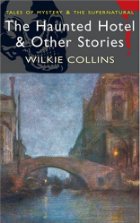
Review: The Haunted Hotel & Other Stories by Wilkie Collins

Time for one more review before the RIP challenge ends!

Having read so many of Wilkie Collins’ books and loving them all, I’m starting to worry now whenever I pick up one that I haven’t read yet, in case that’s going to be the one that disappoints me. Luckily it wasn’t this one! This collection published by Wordsworth Editions includes the novella The Haunted Hotel and eight other short stories, all with a ghostly, spooky or supernatural theme.

Part ghost story and part gothic mystery, The Haunted Hotel begins in London but soon moves to Venice, an atmospheric setting complete with dark canals and ancient palaces. At the heart of the story is the mysterious Countess Narona, who marries Lord Montbarry after he breaks off his engagement to Agnes Lockwood. When Montbarry dies in Venice soon after insuring his life for ten thousand pounds, rumours abound that the Countess may have had something to do with his death.

While I enjoyed The Haunted Hotel, I wouldn’t class it among Collins’ best work and the shortness of the story means the characters aren’t as well developed. I did love the second half of the story in which the palace where Montbarry died is converted into a hotel. There’s a very creepy sequence of events where each member of the Montbarry family who stays in the hotel feels a ghostly influence that manifests itself in a different way to each person.

You can buy The Haunted Hotel on its own, but I recommend looking for this edition because the additional short stories are well worth reading too. In every story, Collins gradually builds the suspense and draws the reader into the story. One of my favourites was Miss Jeromette and the Clergyman, a short ghost story in which the ghostly happenings are accompanied by mysterious clouds of white fog. I loved the way even though the story was quite predictable, it was still a pageturner. The same can be said about Nine O’Clock, in which a man condemned to death during the French Revolution tells his friend about a family curse. We know almost from the beginning what will happen, but the story still manages to be suspenseful.

Another favourite was A Terribly Strange Bed, an Edgar Allan Poe-like tale which creates a feeling of claustrophobia and terror as the narrator finds himself trapped in a room with a very unusual bed. Another story on a similar theme is The Dead Hand, in which a man attempts to find a room at an inn for the night, but finds that everywhere is full. When he’s eventually offered a bed in a double room, he makes a surprising discovery about the stranger who’s occupying the other bed.

I also enjoyed the final story in the book, The Devil’s Spectacles, which is about a man who is given a pair of spectacles that allow him to see the true thoughts and feelings of anyone he looks at.

I don’t generally like reading short story collections straight through from beginning to end, but I didn’t have a problem with this book. There are only eight stories (plus The Haunted Hotel) and most of them are less than twenty pages long. This was a perfect book to read in the week before Halloween.

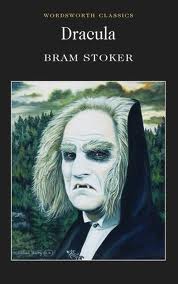
Review: Dracula by Bram Stoker

“My friend. – Welcome to the Carpathians. I am anxiously expecting you.”

When Jonathan Harker travels to Count Dracula’s castle in Transylvania to advise the Count on the subject of buying property in England, he quickly becomes aware that there’s something not quite normal about his host – and after making some terrifying discoveries, he finds himself imprisoned in the castle. Back in England, Harker’s fiancée Mina Murray is anxiously waiting in Whitby for news of Jonathan. But as if she didn’t already have enough to worry about, her friend Lucy Westenra becomes mysteriously ill, with inexplicable puncture wounds on her throat. Could Lucy’s illness have anything to do with the ship that was recently swept into the harbour during a storm?

Interspersed with the main storyline are Dr Seward’s medical notes on one of his patients, a man called Renfield who likes to eat flies and spiders – but what is the connection between Renfield, Lucy and Dracula? Dr Seward brings in his friend Van Helsing, an expert in unusual diseases, and with the help of Mina, Jonathan, Lucy’s fiance Arthur Holmwood and a friend, Quincey Morris, they attempt to solve the mystery and defeat Dracula.

Dracula was an obvious choice for me for the RIP challenge, particularly as it’s one of those books I feel as if I should have read years ago, yet never have (apart from a children’s version which doesn’t really count as it was so heavily abridged). Yet even though I had never read it, a lot of the story was familiar as it has become so firmly entrenched in popular culture. Dracula is not the first vampire story (a few weeks ago I wrote about John Polidori’s The Vampyre and Byron’s Fragment of a Novel) but it’s definitely the most famous.

The book is written in an epistolary style with the entire story being told through letters, journal entries, telegrams and newspaper reports. This structure kept the story moving forward and it was interesting to see so many different perspectives, but I did feel that some of the entries were too short and the story kept switching too abruptly from one person’s journal to another. I would have liked to have spent longer with one character before switching to the next. Some of the ‘voices’ were very similar, but I really liked the character of Mina, who was a strong, sensible, intelligent woman and although she was subjected to the usual Victorian attitudes of the time, she played an important role in the story. In comparison, Lucy is more of a typical Victorian heroine.

The opening section in Transylvania was my favourite part of the book. I loved the atmosphere Stoker created, with the snow falling and the wolves howling.

Though we were in shelter, we could hear the rising wind, for it moaned and whistled through the rocks, and the branches of the trees crashed together as we swept along. It grew colder and colder still, and fine, powdery snow began to fall, so that soon we and all around us were covered with a white blanket. The keen wind still carried the howling of the dogs, though this grew fainter as we went on our way. The baying of the wolves sounded nearer and nearer, as though they were closing round on us from every side. I grew dreadfully afraid, and the horses shared my fear.

When the story moved from Transylvania to Whitby, the pace slowed down and I started to get bored. I did enjoy all the descriptions of Whitby though, with its harbour and ruined abbey. Whitby is only a couple of hours’ drive from where I live, so we go there a lot, and it’s always nice to read about a place you know well.

I actually didn’t find the book very frightening, though maybe that’s just because I was already so familiar with the story. There were some very creepy scenes though, such as when Harker sees Dracula emerging through a window and crawling headfirst down the castle walls:

I was at first interested and somewhat amused, for it is wonderful how small a matter will interest and amuse a man when he is a prisoner. But my very feelings changed to repulsion and terror when I saw the whole man slowly emerge from the window and begin to crawl down the castle wall over the dreadful abyss, face down with his cloak spreading out around him like great wings…I saw the fingers and toes grasp the corners of the stones, worn clear of the mortar by the stress of years, and by thus using every projection and inequality move downwards with considerable speed, just as a lizard moves along a wall.

I’m glad I finally read Dracula, but it’s not going to become a favourite classic of mine. Although I didn’t love it, I thought it was surprisingly easy to read and the first few chapters were great, so if you have any interest at all in vampire stories or gothic horror novels, I think it’s worth reading at least once.

Review: The Canterville Ghost by Oscar Wilde

The Canterville Ghost is a ghost story with a difference. It takes place in an English country house, Canterville Chase, which for centuries has been said to be haunted. When a rich American called Mr Otis moves into the house with his wife and children, Lord Canterville feels he should warn them about Sir Simon, the resident ghost. However, the Otis family aren’t afraid of ghosts and no matter how hard Sir Simon tries, they simply refuse to be frightened!

For anyone reading this review and thinking this book is not for you because you’re scared of ghost stories, I can promise you that it’s really not scary at all – I would describe it as more of a comedy and a clever satire. Wilde juxtaposes an atmospheric gothic setting, the typical British ‘haunted house’, with a practical American family who have an amusing way of reacting to the appearance of Sir Simon.

Right in front of him he saw, in the wan moonlight, an old man of terrible aspect. His eyes were as red burning coals; long grey hair fell over his shoulders in matted coils; his garments, which were of antique cut, were soiled and ragged, and from his wrists and ankles hung heavy manacles and rusty gyves.

“My dear sir,” said Mr. Otis, “I really must insist on your oiling those chains, and have brought you for that purpose a small bottle of the Tammany Rising Sun Lubricator.”

Wilde is clearly having fun creating British and American stereotypes and using them to explore cultural differences, though he does it in a witty and inoffensive way. Another thing I liked is that some of the story is told from the ghost’s perspective, so that our sympathy is with him rather than the Otis family.

Although the ending is a bit too sweet and sentimental, I really enjoyed this unusual little book! It’s funny, imaginative, and so easy to read it’s suitable for younger readers as well as adults.

(As a side note, I read this book on Saturday 16th October, which happened to be Oscar Wilde’s 156th birthday. I had no idea of this until after I’d finished the book, turned on my laptop and saw that Google were honouring the occasion with a Google Doodle. Very appropriate!)

Review: The Monk by Matthew Lewis

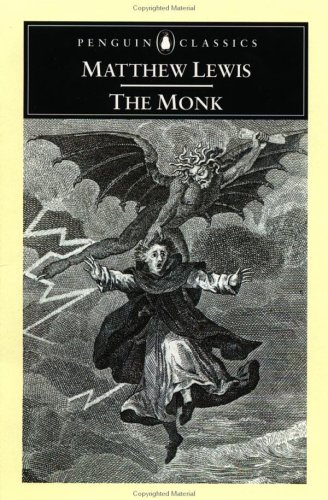
The Monk, published in 1796, is an early gothic novel by Matthew Gregory Lewis, which completely dispels the notion that classics are dull and boring! While I wouldn’t say this was an easy read (due to the 18th century writing style and language you do need to concentrate) it was a real pageturner. I actually started to write this review when I was only halfway through the book and I was going to say that although I was enjoying it, I didn’t think it was a great book. Then, as I continued to read, I changed my mind. It is a great book and the best gothic novel I’ve read so far!

The book cover shown above is the Penguin Classics edition of the book. However, my copy of this novel is actually part of a four books-in-one anthology called Four Gothic Novels, which also includes The Castle of Otranto by Horace Walpole, Vathek by William Beckford and Frankenstein by Mary Shelley. I’ve been reading the novels in the order that they appear in the book, but The Monk was the one that I had really been looking forward to reading.

The novel is set in a monastery in Spain, during the time of the Spanish Inquisition. The plot is very complex, but basically there are three main storylines.

The first storyline revolves around Ambrosio, the Monk of the title, who is highly respected within the monastery and attracts large crowds to his sermons. Ambrosio is regarded almost as a saint yet when a beautiful young woman called Matilda tries to seduce him, he is tempted into breaking his vows. After succumbing to this first temptation, Ambrosio goes on to commit one crime after another, each worse than the one before.

We are also given a long account of the adventures of the young Marquis de las Cisternas. When the Marquis rescues a baroness from a gang of bandits, he is invited to accompany her to the Castle Lindenberg in Germany where he meets and falls in love with her niece, Agnes – and learns the legend of the Bleeding Nun. Finally we follow a friend of the Marquis, Lorenzo de Medina, who also happens to be the brother of Agnes. When a young girl from Murcia named Antonia arrives in Madrid, she and Lorenzo fall in love – but things don’t go smoothly for the pair and Antonia soon finds herself in serious danger.

At first it seemed that Agnes and Antonia’s storylines were unrelated to the Ambrosio and Matilda plot, but I soon began to see how cleverly Lewis was weaving the threads of the story together. Ambrosio is a complex character and his downfall was fascinating to read about. Some of my favourite passages were those which gave us an insight into the different facets of his personality.

He pronounced the most severe sentences upon Offenders, which, the moment after, Compassion induced him to mitigate: He undertook the most daring enterprizes, which the fear of their consequences soon obliged him to abandon: His inborn genius darted a brilliant light upon subjects the most obscure; and almost instantaneously his Superstition replunged them in darkness more profound than that from which they had just been rescued…The fact was, that the different sentiments with which Education and Nature had inspired him were combating in his bosom: It remained for his passions, which as yet no opportunity had called into play, to decide the victory.

Some parts of the book are quite gruesome and disturbing, and the passages which describe the sufferings of Agnes and Antonia are horrifying. I thought the final chapter of the book was stunning. There were several different ways the story could have ended, but the ending Lewis chose was absolutely perfect.

This book has almost every element of the gothic novel that you can think of: ghostly apparitions, haunted castles, ancient monasteries, bad weather, fortune telling gypsies, an evil prioress, dark dungeons and shadowy crypts, witchcraft, magic and pacts with the devil. It’s also very daring for the 18th century; with themes of murder, rape, incest, violence and torture, I can see exactly why it was so controversial in its day.

So don’t let the fact that the book was written in the 1700s prevent you from picking it up!

Recommended

If you enjoy this book you might also like The Italian by Ann Radcliffe which I read a few years ago. It’s very similar to this one in both the setting and the atmosphere (and anyone who was put off Radcliffe by the long scenic descriptions in The Mysteries of Udolpho will be pleased to know there are a lot less of those in The Italian).

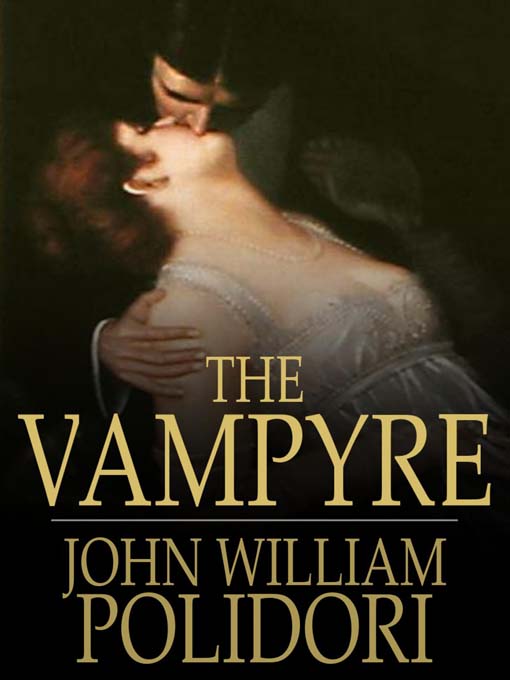
Short Story: The Vampyre by John Polidori

As I’m hoping to read Dracula soon, I thought it might be a good idea to also read one of Bram Stoker’s influences – John Polidori’s The Vampyre. This short story is considered to be one of the first vampire stories in literature and the first to portray a vampire in the way we would recognise today. I have actually been interested in reading this story since I read The Count of Monte Cristo by Alexandre Dumas and was intrigued by the references to the vampire Lord Ruthven. (If you’ve read The Count of Monte Cristo you might remember the scene where the Countess G- is remarking on the Count’s pale skin and nicknames him ‘Lord Ruthven’.)

The origins of The Vampyre are fascinating. John William Polidori was Byron’s personal physician and in 1816, went with him to Switzerland. At the Villa Diodati, on Lake Geneva, Byron and Polidori were joined by the poet Percy Bysshe Shelley, his future wife Mary Wollstonecraft Godwin and her stepsister Claire Clairmont, and decided to amuse themselves by writing horror stories. Mary began work on what would become Frankenstein, and Byron wrote the beginning of a vampire story (which survives today as Fragment of a Novel) based on the various vampire myths and legends. Although Byron abandoned his vampire story, Polidori took inspiration from it and The Vampyre was the result. Unfortunately for Polidori, The Vampyre was wrongly attributed to Byron, despite Byron’s attempts to set the record straight.

As a story, it really isn’t very satisfying. Our narrator is a young Englishman called Aubrey, who travels to Rome with his acquaintance, the nobleman Lord Ruthven. The more time he spends with Ruthven, the more Aubrey begins to distrust him and to realise that Ruthven is not what he seems… The plot is so thin that there’s not much more I can tell you without spoiling it – although really, there’s nothing to spoil as the story is very predictable (for the modern reader anyway – I’m sure it would have been more compelling at the time when it was first published).

The Vampyre is interesting historically because of its portrayal of Lord Ruthven as a mysterious, pale-faced aristocratic figure who preys on innocent young ladies, which is the way many future vampires would be described (the vampires of folklore had generally been described as hideous-looking monsters). If you’re interested in how vampire stories began and how they evolved over the years, this is worth reading. If you’re just looking for a good short story to read, you might be disappointed with this one.

Read The Vampyre online here

Byron’s Fragment of a Novel is also available online and is so short it only takes a few minutes to read. It’s a shame he decided not to continue with this, as I think it had the potential to be much better than The Vampyre. I’ve read a few of Byron’s poems but this is my first experience of his prose and even based on such a short sample of his work I find his writing superior to Polidori’s.

Read Fragment of a Novel online here


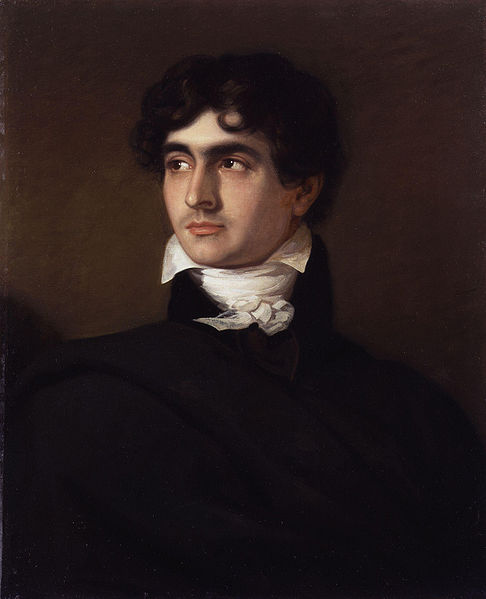
John William Polidori (1795-1821)

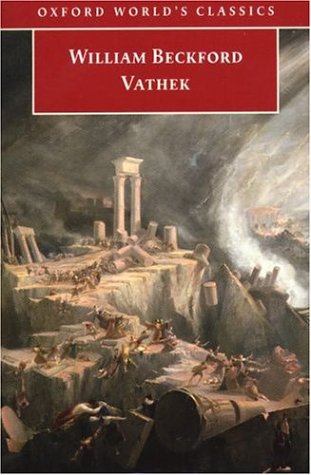
Review: Vathek by William Beckford

This is my first book for the RIP V challenge and one of the strangest novels I have ever read! It’s the story of Vathek, ninth Caliph of the race of the Abassides, and his temptation by a supernatural being (known as ‘the Giaour’), who promises to bestow on him the treasures and talismans of the ‘palace of subterranean fire’. Encouraged by his ambitious mother, the sorceress Carathis, Vathek embarks on a journey through exotic landscapes and begins a descent into hell.

Although William Beckford was English, Vathek was originally written in French and translated into English by Reverend Samuel Henley in 1786. The best way I can describe Vathek is that it’s a sort of dark, twisted fairy tale reminiscent of The Arabian Nights. Beckford mixes eastern mythology and Islamic culture with elements of the gothic novel (ghouls, spirits, graveyards, an atmosphere of evil) and throws in some magic, fantasy and romance for good measure. There are some long and poetic descriptive passages which become quite surreal and dreamlike in places.

Bababalouk had pitched the tents, and closed up the extremities of the valley with magnificent screens of India cloth, which were guarded by Ethiopian slaves with their drawn sabres; to preserve the verdure of this beautiful enclosure in its natural freshness, the white eunuchs went continually round it with their red water-vessels. The waving of fans was heard near the imperial pavilion, where, by the voluptuous light that glowed through the muslins, the Caliph enjoyed at full view all the attractions of Nouronihar.

The book is short in length but it’s not a quick, easy read. The entire story is told in one big chunk, rather than being broken into chapters, which made it seem quite daunting. If it had been any longer I probably wouldn’t have finished it because although the beginning and the ending were great, I started to lose interest during the middle section.

The characters are two-dimensional and impossible to like. At the beginning of the book, Vathek is popular with his subjects as he is fond of the pleasures of life and rarely becomes angry (although when he does lose his temper, one of his eyes becomes ‘so terrible that no person could bear to behold it, and the wretch upon whom it was fixed instantly fell backward, and sometimes expired’). After the Giaour arrives in his kingdom and begins to tempt him with stories of the palace of subterranean fire, however, Vathek becomes a cruel and greedy ruler. One of the conditions the Giaour imposes on him in return for admitting him into the subterranean palace is that he must renounce Islam and perform a series of atrocious crimes. Vathek never shows any remorse for his actions and I found him completely undeserving of any sympathy from the first page of this book to the last. His mother, Carathis, is even worse…

“…by my formidable art the clouds shall sleet hailstones in the faces of the assailants, and shafts of red-hot iron on their heads; I will spring mines of serpents and torpedos from beneath them, and we shall soon see the stand they will make against such an explosion!”

Vathek is completely bizarre and probably a book that you’ll either love or hate. It’s worth reading if you’re interested in the origins of gothic literature, fantasy or horror – and it apparently influenced both Byron and H.P. Lovecraft, among others. If you don’t take this book too seriously, it’s quite entertaining.

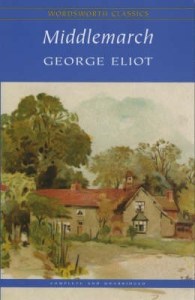
Readalong: Middlemarch by George Eliot

I have had two previous attempts at reading George Eliot’s Middlemarch but both times abandoned the book after a few chapters. When I saw that Nymeth was planning a readalong this summer, I thought this might give me the motivation to persevere and actually finish the book. I think part of the problem with my past attempts was that I found the book so long and slow-moving it didn’t hold my attention and I ended up being tempted by other books on my shelf. This time round I decided to do things differently. I started reading the book at the end of June alongside other books (something I don’t usually do – I prefer to concentrate on one book at a time) and worked slowly through it, interspersing it with an occasional shorter book. As it turned out, this was the perfect way for me to read Middlemarch, as it meant I could take my time and give it the attention it deserved. And this is a book that really benefits from being read slowly.

The plot is so layered, every sentence filled with so much meaning, that I’m sure there are a lot of things that I’ve missed and will have to pick up on a subsequent reading. It certainly is a book that you need to concentrate on. There are so many characters, who all seem to be related by marriage in some way, that I had to make notes as I was reading and would never have kept all the characters straight otherwise.  I highly recommend you do the same as I found my amateurish family trees became invaluable as I progressed through the book!

So what is Middlemarch about? Well, even after finishing the book I don’t really know how to describe the plot.  Middlemarch is the story, not just of one or two people, but of an entire town and its inhabitants. It portrays the atmosphere of life in a small community where everybody knows everybody else’s business and most people’s biggest concern is what their neighbours will think of them. The relationships and interactions between the characters are wonderfully complex and Eliot cleverly weaves their storylines together, so that the actions of one person may have unforeseen consequences on the life of another.

The prologue certainly seems to refer to Dorothea Brooke and at first it appears that the book is going to be about Dorothea and her marriage to the dry and scholarly Edward Casaubon.  Dorothea is an intelligent, sincere, idealistic girl who despite the warnings of her friends and family becomes determined to marry Mr Casaubon, insisting that he has a “great soul” and that nothing will give her greater happiness in life than assisting him with his studies.

“In this latter end of autumn, with a sparse remnant of yellow leaves falling slowly athwart the dark evergreens in a stillness without sunshine, the house too had an air of autumnal decline, and Mr. Casaubon, when he presented himself, had no bloom that could be thrown into relief by that background.”

Just as we’re becoming absorbed in her story, however, Dorothea disappears for several chapters and we are introduced to some new characters.  The first is a newcomer to Middlemarch: Tertius Lydgate, a young doctor with some new and radical ideas.  Soon after his arrival, Lydgate enters into a relationship with Rosamond Vincy, which proves to be just as difficult and disappointing as Dorothea’s marriage to Mr Casaubon.

“Lydgate could only say, “Poor, poor darling!” – but he secretly wondered over the terrible tenacity of this mild creature. There was gathering within him an amazed sense of his powerlessness over Rosamond. His superior knowledge and mental force, instead of being, as he had imagined, a shrine to consult on all occasions, was simply set aside on every practical question.”

We also follow Rosamond’s brother Fred Vincy as he tries to find his true vocation in life and to earn the respect of Mary Garth, the woman he loves.  These three storylines (and several other subplots) all run alongside each other, meeting and intersecting from time to time.

There are many things that make this book so impressive and so notable but the most striking, in my opinion, is the incredibly detailed characterisation. Every character Eliot introduces us to is interesting, nuanced and believable. She even gives her characters distinctive voices (literally!) – we are repeatedly told that Celia speaks “with a quiet staccato” and that Mr Brooke has a habit of repeating himself (“I thought you had more of your own opinion than most girls. I thought you liked your own opinion – liked it, you know”).

We see almost every conceivable personality type; we experience almost every imaginable human emotion. And most importantly, the characters develop throughout the book – they mature, they learn from their mistakes, they become better people.  I could find something to admire in almost all of the characters. They all have their own flaws and faults but also have some good qualities – this makes even less likeable people such as Mr Bulstrode interesting to read about and allows us to empathise with them.  There are plenty of characters who are very likeable, though.  I particularly loved Mary Garth and her father Caleb.

“Mary was fond of her own thoughts, and could amuse herself well sitting in twilight with her hands in her lap; for, having early had strong reason to believe that things were not likely to be arranged for her peculiar satisfaction, she wasted no time in astonishment and annoyance at that fact. And she had already come to take life very much as a comedy in which she had a proud, nay, a generous resolution not to act the mean or treacherous part. Mary might have become cynical if she had not had parents whom she honored, and a well of affectionate gratitude within her, which was all the fuller because she had learned to make no unreasonable claims.”

I am not usually very good at spotting themes in books, but I could find several in Middlemarch. The most obvious is marriage and how it often fails to live up to our expectations (i.e. Dorothea Brooke and Mr Casaubon; Rosamond Vincy and Tertius Lydgate). In her portrayals of these marriages, George Eliot never places the blame entirely on either the husband or the wife.  Instead, she shows how an unhappy or problematic marriage can be caused by personality differences, unrealistic idealism and a failure to understand the person we are married to.

“All these are crushing questions; but whatever else remained the same, the light had changed, and you cannot find the pearly dawn at noonday. The fact is unalterable, that a fellow-mortal with whose nature you are acquainted solely through the brief entrances and exits of a few imaginative weeks called courtship, may, when seen in the continuity of married companionship, be disclosed as something better or worse than what you have preconceived, but will certainly not appear altogether the same.”

Another theme is change: we should remember that although Middlemarch was published in the 1870s, it was set around forty years earlier at a time of great change: there were changes in politics (the Reform Bill of 1832); changes in transport (the arrival of the railway) and changes in medicine (as portrayed through Tertius Lydgate’s new ideas and theories).

There are so many other aspects of this book that I wanted to discuss here, but I have to stop somewhere!  I haven’t even mentioned Will Ladislaw, who is made to feel unwelcome in Middlemarch by his relative, Mr Casaubon; or Mr Farebrother, who is in love with Mary Garth; or Raffles, who is as close to a villain as we get in Middlemarch.

After reaching the final page I can now see why so many people love this book so much. I would recommend Middlemarch to all lovers of Victorian fiction who are prepared to invest the time it takes to read such a long and complex novel. I don’t think this book would be for everyone though. If you prefer faster-paced stories you may have trouble getting into it, as I did on my earlier attempts. My advice to you would be to stick with it, take your time and savour every word, and the story does become more compelling as it goes on.

If I’m going to be completely honest, there are a lot of classics that I’ve enjoyed a lot more than this one, but I can’t think of any that are greater in scope, more insightful or offer a more penetrating study of humanity. After spending the summer with Dorothea and Will, Tertius and Rosamond, Fred and Mary, and the others, I’m really going to miss them all.

I’ll leave you with some more quotes from the book:

“But indefinite visions of ambition are weak against the ease of doing what is habitual or beguilingly agreeable; and we all know the difficulty of carrying out a resolve when we secretly long that it may turn out to be unnecessary.”

“And certainly, the mistakes that we male and female mortals make when we have our own way might fairly raise some wonder that we are so fond of it.”

Please see this post at Things Mean a Lot for other bloggers’ thoughts on Middlemarch