Review: The Monk by Matthew Lewis

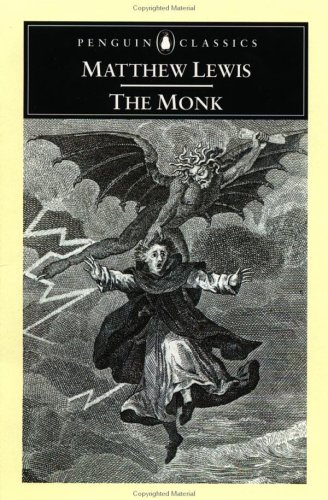
The Monk, published in 1796, is an early gothic novel by Matthew Gregory Lewis, which completely dispels the notion that classics are dull and boring! While I wouldn’t say this was an easy read (due to the 18th century writing style and language you do need to concentrate) it was a real pageturner. I actually started to write this review when I was only halfway through the book and I was going to say that although I was enjoying it, I didn’t think it was a great book. Then, as I continued to read, I changed my mind. It is a great book and the best gothic novel I’ve read so far!

The book cover shown above is the Penguin Classics edition of the book. However, my copy of this novel is actually part of a four books-in-one anthology called Four Gothic Novels, which also includes The Castle of Otranto by Horace Walpole, Vathek by William Beckford and Frankenstein by Mary Shelley. I’ve been reading the novels in the order that they appear in the book, but The Monk was the one that I had really been looking forward to reading.

The novel is set in a monastery in Spain, during the time of the Spanish Inquisition. The plot is very complex, but basically there are three main storylines.

The first storyline revolves around Ambrosio, the Monk of the title, who is highly respected within the monastery and attracts large crowds to his sermons. Ambrosio is regarded almost as a saint yet when a beautiful young woman called Matilda tries to seduce him, he is tempted into breaking his vows. After succumbing to this first temptation, Ambrosio goes on to commit one crime after another, each worse than the one before.

We are also given a long account of the adventures of the young Marquis de las Cisternas. When the Marquis rescues a baroness from a gang of bandits, he is invited to accompany her to the Castle Lindenberg in Germany where he meets and falls in love with her niece, Agnes – and learns the legend of the Bleeding Nun. Finally we follow a friend of the Marquis, Lorenzo de Medina, who also happens to be the brother of Agnes. When a young girl from Murcia named Antonia arrives in Madrid, she and Lorenzo fall in love – but things don’t go smoothly for the pair and Antonia soon finds herself in serious danger.

At first it seemed that Agnes and Antonia’s storylines were unrelated to the Ambrosio and Matilda plot, but I soon began to see how cleverly Lewis was weaving the threads of the story together. Ambrosio is a complex character and his downfall was fascinating to read about. Some of my favourite passages were those which gave us an insight into the different facets of his personality.

He pronounced the most severe sentences upon Offenders, which, the moment after, Compassion induced him to mitigate: He undertook the most daring enterprizes, which the fear of their consequences soon obliged him to abandon: His inborn genius darted a brilliant light upon subjects the most obscure; and almost instantaneously his Superstition replunged them in darkness more profound than that from which they had just been rescued…The fact was, that the different sentiments with which Education and Nature had inspired him were combating in his bosom: It remained for his passions, which as yet no opportunity had called into play, to decide the victory.

Some parts of the book are quite gruesome and disturbing, and the passages which describe the sufferings of Agnes and Antonia are horrifying. I thought the final chapter of the book was stunning. There were several different ways the story could have ended, but the ending Lewis chose was absolutely perfect.

This book has almost every element of the gothic novel that you can think of: ghostly apparitions, haunted castles, ancient monasteries, bad weather, fortune telling gypsies, an evil prioress, dark dungeons and shadowy crypts, witchcraft, magic and pacts with the devil. It’s also very daring for the 18th century; with themes of murder, rape, incest, violence and torture, I can see exactly why it was so controversial in its day.

So don’t let the fact that the book was written in the 1700s prevent you from picking it up!

Recommended

If you enjoy this book you might also like The Italian by Ann Radcliffe which I read a few years ago. It’s very similar to this one in both the setting and the atmosphere (and anyone who was put off Radcliffe by the long scenic descriptions in The Mysteries of Udolpho will be pleased to know there are a lot less of those in The Italian).

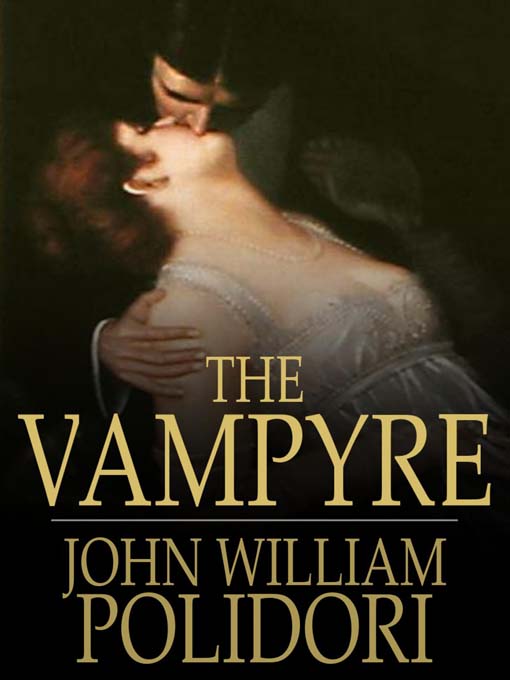
Short Story: The Vampyre by John Polidori

As I’m hoping to read Dracula soon, I thought it might be a good idea to also read one of Bram Stoker’s influences – John Polidori’s The Vampyre. This short story is considered to be one of the first vampire stories in literature and the first to portray a vampire in the way we would recognise today. I have actually been interested in reading this story since I read The Count of Monte Cristo by Alexandre Dumas and was intrigued by the references to the vampire Lord Ruthven. (If you’ve read The Count of Monte Cristo you might remember the scene where the Countess G- is remarking on the Count’s pale skin and nicknames him ‘Lord Ruthven’.)

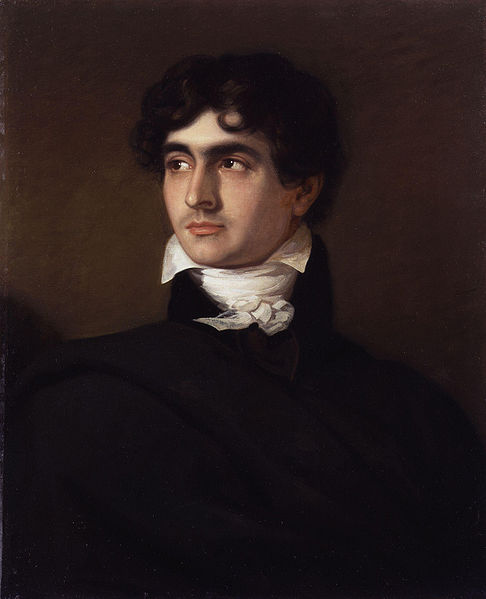
The origins of The Vampyre are fascinating. John William Polidori was Byron’s personal physician and in 1816, went with him to Switzerland. At the Villa Diodati, on Lake Geneva, Byron and Polidori were joined by the poet Percy Bysshe Shelley, his future wife Mary Wollstonecraft Godwin and her stepsister Claire Clairmont, and decided to amuse themselves by writing horror stories. Mary began work on what would become Frankenstein, and Byron wrote the beginning of a vampire story (which survives today as Fragment of a Novel) based on the various vampire myths and legends. Although Byron abandoned his vampire story, Polidori took inspiration from it and The Vampyre was the result. Unfortunately for Polidori, The Vampyre was wrongly attributed to Byron, despite Byron’s attempts to set the record straight.

As a story, it really isn’t very satisfying. Our narrator is a young Englishman called Aubrey, who travels to Rome with his acquaintance, the nobleman Lord Ruthven. The more time he spends with Ruthven, the more Aubrey begins to distrust him and to realise that Ruthven is not what he seems… The plot is so thin that there’s not much more I can tell you without spoiling it – although really, there’s nothing to spoil as the story is very predictable (for the modern reader anyway – I’m sure it would have been more compelling at the time when it was first published).

The Vampyre is interesting historically because of its portrayal of Lord Ruthven as a mysterious, pale-faced aristocratic figure who preys on innocent young ladies, which is the way many future vampires would be described (the vampires of folklore had generally been described as hideous-looking monsters). If you’re interested in how vampire stories began and how they evolved over the years, this is worth reading. If you’re just looking for a good short story to read, you might be disappointed with this one.

Read The Vampyre online here

Byron’s Fragment of a Novel is also available online and is so short it only takes a few minutes to read. It’s a shame he decided not to continue with this, as I think it had the potential to be much better than The Vampyre. I’ve read a few of Byron’s poems but this is my first experience of his prose and even based on such a short sample of his work I find his writing superior to Polidori’s.

Read Fragment of a Novel online here


John William Polidori (1795-1821)

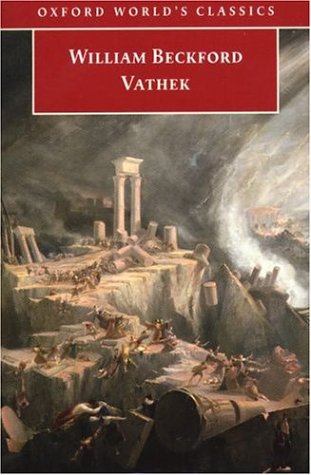
Review: Vathek by William Beckford

This is my first book for the RIP V challenge and one of the strangest novels I have ever read! It’s the story of Vathek, ninth Caliph of the race of the Abassides, and his temptation by a supernatural being (known as ‘the Giaour’), who promises to bestow on him the treasures and talismans of the ‘palace of subterranean fire’. Encouraged by his ambitious mother, the sorceress Carathis, Vathek embarks on a journey through exotic landscapes and begins a descent into hell.

Although William Beckford was English, Vathek was originally written in French and translated into English by Reverend Samuel Henley in 1786. The best way I can describe Vathek is that it’s a sort of dark, twisted fairy tale reminiscent of The Arabian Nights. Beckford mixes eastern mythology and Islamic culture with elements of the gothic novel (ghouls, spirits, graveyards, an atmosphere of evil) and throws in some magic, fantasy and romance for good measure. There are some long and poetic descriptive passages which become quite surreal and dreamlike in places.

Bababalouk had pitched the tents, and closed up the extremities of the valley with magnificent screens of India cloth, which were guarded by Ethiopian slaves with their drawn sabres; to preserve the verdure of this beautiful enclosure in its natural freshness, the white eunuchs went continually round it with their red water-vessels. The waving of fans was heard near the imperial pavilion, where, by the voluptuous light that glowed through the muslins, the Caliph enjoyed at full view all the attractions of Nouronihar.

The book is short in length but it’s not a quick, easy read. The entire story is told in one big chunk, rather than being broken into chapters, which made it seem quite daunting. If it had been any longer I probably wouldn’t have finished it because although the beginning and the ending were great, I started to lose interest during the middle section.

The characters are two-dimensional and impossible to like. At the beginning of the book, Vathek is popular with his subjects as he is fond of the pleasures of life and rarely becomes angry (although when he does lose his temper, one of his eyes becomes ‘so terrible that no person could bear to behold it, and the wretch upon whom it was fixed instantly fell backward, and sometimes expired’). After the Giaour arrives in his kingdom and begins to tempt him with stories of the palace of subterranean fire, however, Vathek becomes a cruel and greedy ruler. One of the conditions the Giaour imposes on him in return for admitting him into the subterranean palace is that he must renounce Islam and perform a series of atrocious crimes. Vathek never shows any remorse for his actions and I found him completely undeserving of any sympathy from the first page of this book to the last. His mother, Carathis, is even worse…

“…by my formidable art the clouds shall sleet hailstones in the faces of the assailants, and shafts of red-hot iron on their heads; I will spring mines of serpents and torpedos from beneath them, and we shall soon see the stand they will make against such an explosion!”

Vathek is completely bizarre and probably a book that you’ll either love or hate. It’s worth reading if you’re interested in the origins of gothic literature, fantasy or horror – and it apparently influenced both Byron and H.P. Lovecraft, among others. If you don’t take this book too seriously, it’s quite entertaining.

Readalong: Middlemarch by George Eliot

I have had two previous attempts at reading George Eliot’s Middlemarch but both times abandoned the book after a few chapters. When I saw that Nymeth was planning a readalong this summer, I thought this might give me the motivation to persevere and actually finish the book. I think part of the problem with my past attempts was that I found the book so long and slow-moving it didn’t hold my attention and I ended up being tempted by other books on my shelf. This time round I decided to do things differently. I started reading the book at the end of June alongside other books (something I don’t usually do – I prefer to concentrate on one book at a time) and worked slowly through it, interspersing it with an occasional shorter book. As it turned out, this was the perfect way for me to read Middlemarch, as it meant I could take my time and give it the attention it deserved. And this is a book that really benefits from being read slowly.

The plot is so layered, every sentence filled with so much meaning, that I’m sure there are a lot of things that I’ve missed and will have to pick up on a subsequent reading. It certainly is a book that you need to concentrate on. There are so many characters, who all seem to be related by marriage in some way, that I had to make notes as I was reading and would never have kept all the characters straight otherwise.  I highly recommend you do the same as I found my amateurish family trees became invaluable as I progressed through the book!

So what is Middlemarch about? Well, even after finishing the book I don’t really know how to describe the plot.  Middlemarch is the story, not just of one or two people, but of an entire town and its inhabitants. It portrays the atmosphere of life in a small community where everybody knows everybody else’s business and most people’s biggest concern is what their neighbours will think of them. The relationships and interactions between the characters are wonderfully complex and Eliot cleverly weaves their storylines together, so that the actions of one person may have unforeseen consequences on the life of another.

The prologue certainly seems to refer to Dorothea Brooke and at first it appears that the book is going to be about Dorothea and her marriage to the dry and scholarly Edward Casaubon.  Dorothea is an intelligent, sincere, idealistic girl who despite the warnings of her friends and family becomes determined to marry Mr Casaubon, insisting that he has a “great soul” and that nothing will give her greater happiness in life than assisting him with his studies.

“In this latter end of autumn, with a sparse remnant of yellow leaves falling slowly athwart the dark evergreens in a stillness without sunshine, the house too had an air of autumnal decline, and Mr. Casaubon, when he presented himself, had no bloom that could be thrown into relief by that background.”

Just as we’re becoming absorbed in her story, however, Dorothea disappears for several chapters and we are introduced to some new characters.  The first is a newcomer to Middlemarch: Tertius Lydgate, a young doctor with some new and radical ideas.  Soon after his arrival, Lydgate enters into a relationship with Rosamond Vincy, which proves to be just as difficult and disappointing as Dorothea’s marriage to Mr Casaubon.

“Lydgate could only say, “Poor, poor darling!” – but he secretly wondered over the terrible tenacity of this mild creature. There was gathering within him an amazed sense of his powerlessness over Rosamond. His superior knowledge and mental force, instead of being, as he had imagined, a shrine to consult on all occasions, was simply set aside on every practical question.”

We also follow Rosamond’s brother Fred Vincy as he tries to find his true vocation in life and to earn the respect of Mary Garth, the woman he loves.  These three storylines (and several other subplots) all run alongside each other, meeting and intersecting from time to time.

There are many things that make this book so impressive and so notable but the most striking, in my opinion, is the incredibly detailed characterisation. Every character Eliot introduces us to is interesting, nuanced and believable. She even gives her characters distinctive voices (literally!) – we are repeatedly told that Celia speaks “with a quiet staccato” and that Mr Brooke has a habit of repeating himself (“I thought you had more of your own opinion than most girls. I thought you liked your own opinion – liked it, you know”).

We see almost every conceivable personality type; we experience almost every imaginable human emotion. And most importantly, the characters develop throughout the book – they mature, they learn from their mistakes, they become better people.  I could find something to admire in almost all of the characters. They all have their own flaws and faults but also have some good qualities – this makes even less likeable people such as Mr Bulstrode interesting to read about and allows us to empathise with them.  There are plenty of characters who are very likeable, though.  I particularly loved Mary Garth and her father Caleb.

“Mary was fond of her own thoughts, and could amuse herself well sitting in twilight with her hands in her lap; for, having early had strong reason to believe that things were not likely to be arranged for her peculiar satisfaction, she wasted no time in astonishment and annoyance at that fact. And she had already come to take life very much as a comedy in which she had a proud, nay, a generous resolution not to act the mean or treacherous part. Mary might have become cynical if she had not had parents whom she honored, and a well of affectionate gratitude within her, which was all the fuller because she had learned to make no unreasonable claims.”

I am not usually very good at spotting themes in books, but I could find several in Middlemarch. The most obvious is marriage and how it often fails to live up to our expectations (i.e. Dorothea Brooke and Mr Casaubon; Rosamond Vincy and Tertius Lydgate). In her portrayals of these marriages, George Eliot never places the blame entirely on either the husband or the wife.  Instead, she shows how an unhappy or problematic marriage can be caused by personality differences, unrealistic idealism and a failure to understand the person we are married to.

“All these are crushing questions; but whatever else remained the same, the light had changed, and you cannot find the pearly dawn at noonday. The fact is unalterable, that a fellow-mortal with whose nature you are acquainted solely through the brief entrances and exits of a few imaginative weeks called courtship, may, when seen in the continuity of married companionship, be disclosed as something better or worse than what you have preconceived, but will certainly not appear altogether the same.”

Another theme is change: we should remember that although Middlemarch was published in the 1870s, it was set around forty years earlier at a time of great change: there were changes in politics (the Reform Bill of 1832); changes in transport (the arrival of the railway) and changes in medicine (as portrayed through Tertius Lydgate’s new ideas and theories).

There are so many other aspects of this book that I wanted to discuss here, but I have to stop somewhere!  I haven’t even mentioned Will Ladislaw, who is made to feel unwelcome in Middlemarch by his relative, Mr Casaubon; or Mr Farebrother, who is in love with Mary Garth; or Raffles, who is as close to a villain as we get in Middlemarch.

After reaching the final page I can now see why so many people love this book so much. I would recommend Middlemarch to all lovers of Victorian fiction who are prepared to invest the time it takes to read such a long and complex novel. I don’t think this book would be for everyone though. If you prefer faster-paced stories you may have trouble getting into it, as I did on my earlier attempts. My advice to you would be to stick with it, take your time and savour every word, and the story does become more compelling as it goes on.

If I’m going to be completely honest, there are a lot of classics that I’ve enjoyed a lot more than this one, but I can’t think of any that are greater in scope, more insightful or offer a more penetrating study of humanity. After spending the summer with Dorothea and Will, Tertius and Rosamond, Fred and Mary, and the others, I’m really going to miss them all.

I’ll leave you with some more quotes from the book:

“But indefinite visions of ambition are weak against the ease of doing what is habitual or beguilingly agreeable; and we all know the difficulty of carrying out a resolve when we secretly long that it may turn out to be unnecessary.”

“And certainly, the mistakes that we male and female mortals make when we have our own way might fairly raise some wonder that we are so fond of it.”

Please see this post at Things Mean a Lot for other bloggers’ thoughts on Middlemarch

Review: Poor Miss Finch by Wilkie Collins

You are here invited to read the story of an Event which occurred in an out-of-the-way corner of England, some years since.
The persons principally concerned in the Event are: – a blind girl; two (twin) brothers; a skilled surgeon; and a curious foreign woman. I am the curious foreign woman. And I take it on myself – for reasons which will presently appear – to tell the story.

Having read all four of Wilkie Collins’ best known books in my pre-blogging days (The Woman in White, Armadale, No Name and The Moonstone), I am now exploring his less popular novels. I recently reviewed Basil and A Rogue’s Life, two of his earlier books from the 1850s. This one, Poor Miss Finch, was published in 1872 and unlike most of the books that preceded it, is not really a ‘sensation novel’, although it does have certain sensational elements (mysterious strangers, theft, assault, letters being intercepted, mistaken identities etc). What it is is an interesting study into what it’s like to be blind since infancy and the emotions a person experiences on learning that there may be a chance of regaining their sight.

The story is told by a Frenchwoman called Madame Pratolungo, the widow of a South American political activist, who has just arrived in the village of Dimchurch in England to take up a position as companion to Lucilla Finch. Lucilla has been blind since she was a child and her blindness has led to a strange phenomenon – she has developed an irrational fear of darkness and dark colours. Even knowing that someone is wearing a dark purple dress, for example, sends her into a panic.

Oscar Dubourg and his twin brother Nugent are newcomers to Dimchurch. Soon after their arrival, Oscar suffers a fit and learns that he has epilepsy. In the 19th century a common cure for epilepsy was to take nitrate of silver. Unfortunately, a side effect of nitrate of silver consumption is that the skin turns blue. When Oscar and Lucilla fall in love, Oscar feels secure in the knowledge that Lucilla will never be able to see him and need never be told that his face is dark blue. However, when Nugent introduces them to the German oculist Herr Grosse, it appears that there could still be hope for Lucilla after all.

This book handles the topic of blindness in a sensitive and intriguing way. It’s obvious that Collins had done a lot of research into the subject and the results are fascinating. He discusses the theory that when a person is blind their other senses improve to compensate for their lack of sight and he weighs up the advantages and disadvantages there would be if this person then regained their sight. I had never even thought about some of the aspects of blindness that are mentioned in the book. For example, there’s an interesting moment when Madame Pratolungo realises why Lucilla shows little regard for normal Victorian conventions and proprieties.

What did it mean?
It meant that here was one strange side shown to me of the terrible affliction that darkened her life. It meant that modesty is essentially the growth of our own consciousness of the eyes of others judging us – and that blindness is never bashful, for the one simple reason that blindness cannot see.

The characters, as usual, are wonderful – most of them anyway. I didn’t find Lucilla very likeable (she has a tendency to throw foot-stamping tantrums when she doesn’t get her own way) but I loved Madame Pratolungo – she was such an amusing and engaging narrator!

I cast all feminine restraints to the winds. I sat down with my legs anyhow, like a man. I rammed my hands into the pockets of my dressing-gown. Did I cry? A word in your ear – and let it go no farther. I swore.

We also meet Reverend Finch, Lucilla’s father, who chooses to recite Hamlet at the most inappropriate moments, and his wife, Mrs Finch, who is ‘never completely dressed; never completely dry; always with a baby in one hand and a novel in the other’. With Lucilla’s little half-sister Jicks’, Collins even makes a three year old girl into an unusual and memorable character:

This amazing apparition advanced into the middle of the room, holding hugged under one arm a ragged and disreputable-looking doll; stared hard, first at Oscar, then at me; advanced to my knees; laid the disreputable doll on my lap; and, pointing to a vacant chair at my side, claimed the rights of hospitality in these words:
“Jicks will sit down.”

Although I thought parts of the plot felt contrived, the story did become very gripping towards the end. This was an interesting and thought provoking read, and if you have enjoyed any other Wilkie Collins books, then I suspect you might enjoy this one too.

Recommended

Review: A Pair of Blue Eyes by Thomas Hardy

These eyes were blue; blue as autumn distance – blue as the blue we see between the retreating mouldings of hills and woody slopes on a sunny September morning. A misty and shady blue, that had no beginning or surface, and was looked into rather than at.

I’m loving Thomas Hardy more and more with every book of his that I read. A Pair of Blue Eyes was one of his earliest books, originally serialised in Tinsley’s Magazine from September 1872 to July 1873. Although this is not generally noted as being one of his better novels and is certainly one of his least well known, there was something about it that appealed to me – and I would even say that of all the classics I’ve read so far this year, this might be my favourite.

A Pair of Blue Eyes is the story of Elfride Swancourt, a vicar’s daughter living in a remote corner of England, who is forced to choose between two very different men. One of these, Stephen Smith, is a young architect whom she meets when he is sent by his employer to survey the church buildings. At first, the vicar approves of Stephen and encourages his daughter to spend time with him. It soon emerges, however, that Stephen has been hiding an important secret from the Swancourts; something that could put his relationship with Elfride in jeopardy. Later in the book, another man arrives at Endelstow Vicarage – Henry Knight, an essayist and reviewer from London – and Elfride has to make a difficult decision.

As you might expect with this being a Hardy book, nothing goes smoothly for any of the characters. I would describe A Pair of Blue Eyes as being similar in some ways to the later Tess of the d’Urbervilles, though not as dark and bleak – and not quite as tragic either. Although I didn’t find Elfride particularly likeable, I thought she was an interesting character. Her lonely, secluded life gives her a childlike innocence and vulnerability and at one point Hardy draws a comparison with Miranda from Shakespeare’s The Tempest – both characters have little knowledge of men and a male visitor is a big event (and Elfride even plays chess with Stephen Smith and Henry Knight as Miranda did with Ferdinand in The Tempest). Of the two men, Stephen was the only one I had any real sympathy for. Knight, although another interesting character, annoyed me almost as much as Angel Clare in Tess annoyed me.

The descriptions of scenery in this book are stunningly beautiful and bring the setting vividly to life. If you’re familiar with Hardy you’ll know that he sets most of his works in the fictional region of Wessex in the southwest of England. This story actually takes place in Off-Wessex or Lyonesse, which equates to Cornwall. I had no problem at all in picturing the lonely vicarage, the windswept hills, and the dark cliffs towering over the sea below. Speaking of cliffs, it is thought that the term ‘cliffhanger’ originates from a scene in this book, though I’m not going to say any more about it than that!

Another interesting aspect of this book is that it’s loosely based on Hardy’s relationship with his first wife, Emma Gifford. Unfortunately I don’t know enough about Hardy to have picked up on all the allusions and references to events in his own life. I would like to eventually read a biography as I think it would help my understanding of both this book and his work as a whole.

I found A Pair of Blue Eyes very easy to read. I thought the pacing and flow of the story were perfect and the pages flew by in a weekend. It’s so sad that this book has been ignored and underrated to the point where, until not long ago, I hadn’t even heard of it. Maybe it won’t appeal to everyone and it might not be the best introduction to his work, but I loved it and would highly recommend it to all Hardy fans.

Review: A Rogue’s Life by Wilkie Collins

Frank Softly is a Rogue. Refusing to follow in his father’s footsteps and become a doctor, he has tried out a number of different careers since leaving school – and failed at them all. However, he remains optimistic and sees each failure as an opportunity to make a fresh start. Even when he is sent to a debtors’ prison he simply asks himself, “What of that? Who am I that I should object to being in prison, when so many of the royal personages and illustrious characters of history have been there before me?”

While working as a forger of old paintings, Frank meets Alicia Dulcifer in an art gallery and immediately falls in love. Unfortunately even this relationship seems likely to fail, because Alicia is the daughter of the sinister Dr. Dulcifer – a man who lives in a house with bars on the windows, never receives visitors and conducts mysterious experiments in his laboratory. Frank becomes determined to discover Dr. Dulcifer’s secret, at all costs.

As in many Victorian novels, there’s also an inheritance involved: Frank’s sister Annabella will only receive her three thousand pounds if Frank outlives their grandmother Lady Malkinshaw. This leads to some amusing situations as Annabella’s greedy husband desperately tries to prevent Frank from dying!

This was one of Wilkie Collins’ first books to be published (in 1856) and I could tell it was the work of a young, inexperienced writer – the plot was less developed than in his later books and the characters (apart from the Rogue himself) were less memorable. However, his enthusiasm shines through on every page, making this a fun, light-hearted read – but with plenty of suspense and excitement too. Although Frank Softly is dishonest, irresponsible, reckless – and definitely a rogue – he tells his story with so much humour and energy that you can’t help liking him.

Rather changeable this life of mine, was it not? Before I was twenty-five years of age, I had tried doctoring, caricaturing, portrait-painting, old picture-making, and Institution-managing…Surely, Shakespeare must have had me prophetically in his eye, when he wrote about ‘one man in his time playing many parts’. What a character I should have made for him, if he had only been alive now!

While I don’t think I would recommend this as a first introduction to his work, if you have enjoyed any of Collins’ other books there’s no reason why you shouldn’t enjoy this one too. And the short length of this book – only 150 pages – makes it a quick, fast-paced read, so anyone who has had trouble getting into one of his longer novels may find this one easier to read.

I’m going to leave you with Wilkie’s own thoughts on this novel, taken from the author’s preface:

The Rogue may surely claim two merits, at least, in the eyes of the new generation – he is never serious for two moments together; and ‘he doesn’t take long to read’.