White Corridor by Christopher Fowler

This is the fifth book in a series I started over a decade ago. My slow progress doesn’t mean I’m not enjoying the books, because I am, but I do feel ashamed that when I reviewed the fourth book, Ten-Second Staircase, I claimed that I would “be continuing soon with book number five, White Corridor” – and that was in 2016!

Anyway, the series follows the investigations of Arthur Bryant and John May, a pair of octogenarian detectives who work for London’s Peculiar Crimes Unit. Some of the books have contemporary settings while others deal with cases from earlier in the careers of Bryant and May. White Corridor is one that’s set in the present day (around 2007, when the book was published). At the beginning of the novel, Raymond Land, the Unit Chief, has decided to close the unit for a week in February due to a lack of work and because the team had worked throughout the Christmas holiday period. Bryant has chosen to spend his time off attending a spiritualist convention in Dartmoor and May finds himself agreeing to accompany him.

As the two elderly detectives set off by car on their journey, heavy snow begins to fall and they quickly become stranded in a blizzard along with lots of other drivers. Meanwhile, back at the PCU, pathologist Oswald Finch has been found dead in his own locked mortuary. Four other PCU members have keys to the door, so all four become suspects, but the investigation is made difficult by the fact that the unit is temporarily closed and their two best detectives are miles away, trapped in a snowstorm. Bryant and May must try to solve the mystery by phone, but first, they have another killer to catch – one who is hiding somewhere within the snowy ’white corridor’ of abandoned cars.

This second killer is on the trail of a woman and her young son in another car, having pursued them all the way from France. Now he’s finally caught up with them and thanks to the snow they’re not going to be able to escape. Throughout the book, the perspective switches between the mother and child, desperately trying to evade their pursuer, Bryant and May, trying to solve both crimes while avoiding freezing to death, and the PCU staff back in London. With Bryant and May not around, Detective Sergeant Janice Longbright takes charge of things and it was good to see her coming to the forefront of the story and developing as a character.

Compared to the first four books in the series, this one has quite a different feel, with Bryant and May taken out of their usual environment and the rest of the unit left on their own. Some things never change, however, such as Arthur’s arcane knowledge and useful friendships with the most unexpected people, in this case a white witch, and of course, the PCU being threatened with closure yet again! This time they are facing a royal visit, so needless to say, their pathologist being murdered is not exactly the best way to prepare.

This isn’t one of my favourite books in the series, as I think I prefer to see Arthur and John on home ground and working with the rest of the team, but it was still quite entertaining. I’m looking forward to reading the next book, The Victoria Vanishes, and will try not to leave it so long this time!

The Big Four by Agatha Christie

The November theme for the Read Christie 2025 challenge is spies. I’ve already read the recommended book, Cat Among the Pigeons, and most of the suggested alternatives – I don’t want to read Postern of Fate yet as it’s the final Tommy and Tuppence book and I’m working through that series in order – so I looked for one I hadn’t read that featured international intrigue and espionage. The Big Four seemed suitable but I was a bit wary about reading it as it seems to have a bad reputation. I needn’t have worried, though, because although it’s clearly not one of her better books, I still enjoyed it!

The novel is narrated by Arthur Hastings, which is always a good thing – I love Hastings! – and he plays a big part in the story, having adventures of his own, not just as narrator and sidekick to Poirot. The book begins with a man arriving unexpectedly in Poirot’s doorway, appearing feverish and exhausted. Unable to speak, he writes the number 4 several times on a sheet of paper, and when he recovers he explains that he was referring to an international crime ring consisting of the Chinese mastermind Li Chang Yen, an American, a Frenchwoman and a mysterious fourth person known only as ‘the Destroyer’. Together they form the Big Four, a group trying to cause global unrest so that they can take over the world.

The rest of the book takes the format of a series of loosely connected episodes, as Poirot, with the help of Hastings, tries to identify the other three members of the Big Four. Of course, with their own spies and agents in every corner of the world, the Big Four know that Poirot and Hastings are on their trail and set various traps for them, some of which they fall into and some they don’t. Poirot attempts to set traps of his own, but although he manages to identify the American and the Frenchwoman fairly quickly, Number Four proves much more elusive.

I found The Big Four more entertaining than I expected, considering that Christie herself described it as “a rotten book”. It’s understandable why she would feel that way as the book was published in 1927, during a time when Christie was struggling financially and emotionally and had disappeared from her home for several days. She felt she had to force herself to complete this book and the next one, The Mystery of the Blue Train. This also explains the episodic nature of the book, because it was based on twelve previously published short stories which Christie reworked into a full-length novel rather than trying to come up with a completely original idea while she wasn’t in the right frame of mind to do so.

Despite the book’s origins and its silly, far-fetched plot, I think it’s better than some of her later thrillers, such as Destination Unknown, but I can see why it’s not well regarded and it certainly doesn’t feel like a typical Poirot novel. As I’ve said, though, it has Hastings in it, which is always a bonus, and we also get to meet – sort of – Poirot’s twin brother, Achille! It was a fun, undemanding read for me in this busy month of November, but probably not one I’ll want to revisit.

The Odd Flamingo by Nina Bawden

Nina Bawden is someone I’ve always thought of as a children’s author; I know I’ve read a few of her books, athough Carrie’s War and The Finding are the only ones I can remember anything about. I’ve never tried any of her adult novels, but was drawn to this one by the unusual title. It was originally published in 1954 and has been reissued by British Library as part of their Crime Classics series earlier this year. Bawden isn’t really an author I would have expected them to publish – I had no idea she wrote crime.

The Odd Flamingo is the name of a seedy London nightclub frequented by many of the characters in the novel. One of these is Rose Blacker, a young woman of eighteen who appears to have fallen in with the wrong friends. When Rose tells Celia Stone that she is pregnant – and that the father is Celia’s husband, Humphrey – Celia calls on her lawyer friend, Will Hunt, for help. She doesn’t believe Rose’s claims, but she’s concerned about Humphrey’s reputation and how a scandal could affect his job as a school headmaster.

Will has known Humphrey for years and has always liked and admired him, but when he meets Rose for himself and she produces letters written by Humphrey, his confidence in his friend is shaken. Rose seems so sweet and innocent; surely she must be telling the truth? When a woman’s body is found floating in the canal with Rose’s bag nearby, Humphrey is the obvious suspect. Will agrees to do what he can to clear his name but is worried about what he might discover. As he begins to investigate, he finds that everything keeps leading back to the dark, sordid world of The Odd Flamingo and the miserable lives of the people who go there.

As you can probably tell, this is not exactly the most cheerful and uplifting of books! It’s full of people who are lonely, desperate and troubled or have become mixed up with drugs, theft or blackmail. I found it quite depressing, but also realistic – places like The Odd Flamingo have always existed and probably always will. I can’t really say that I liked any of the characters, but again, most of them feel believable and real. Only Piers, Humphrey’s grotesque, slimy half-brother, veers close to being a stereotype.

The book is narrated by Will and I found him an interesting character; he’s very idealistic and almost hero worships Humphrey, so feels disappointed and let down by Rose’s claims – but then he does the same thing with Rose herself, putting her on a pedestal because she’s young and beautiful. Whether Rose really is as innocent as she seems is a question not answered until the end of the book, but it’s obvious that Will is going to be hurt again if it turns out that she’s not.

The Odd Flamingo, although there are certainly some mysteries to be solved, is not really a conventional mystery novel and not a typical British Library Crime Classic. If your tastes tend towards the darker, grittier end of crime fiction, though, or you’re interested in trying one of Nina Bawden’s adult books, I can happily recommend this one.

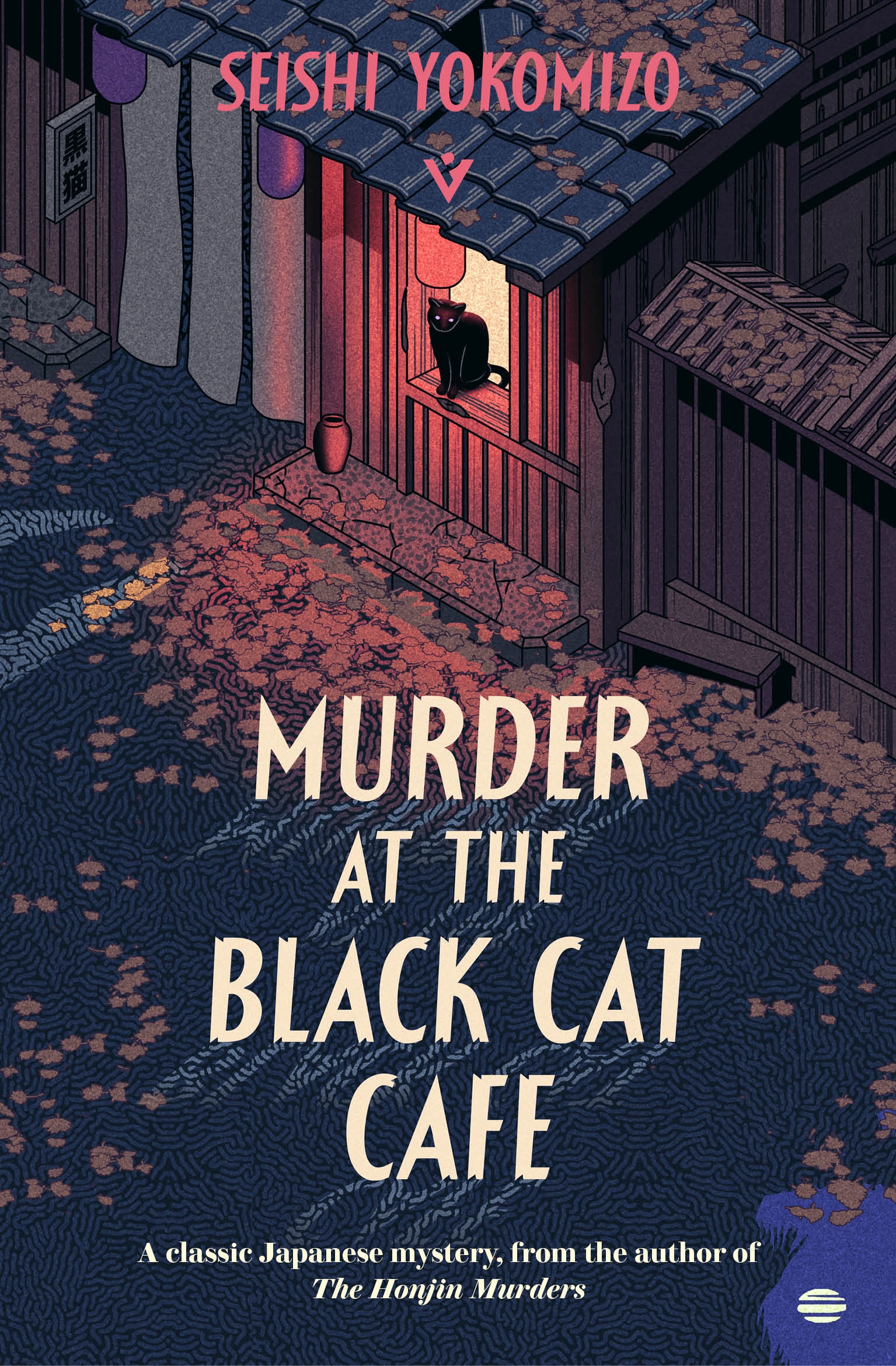
Murder at the Black Cat Cafe by Seishi Yokomizo

Translated by Bryan Karetnyk

Over the last few years, Pushkin Press have been publishing Seishi Yokomizo’s Kosuke Kindaichi mysteries in new English translations. This is the latest, but I found it different from the previous ones in several ways.

First, where the other books are full-length novels, Murder at the Black Cat Cafe is a novella (this edition also includes another short story, Why Did the Well Wheel Creak?, to make the book more substantial). Yokomizo’s detective, Kosuke Kindaichi, plays a prominent role in the first story, but a very small one in the second – in fact, I wouldn’t really call that one a Kindaichi mystery at all as he only appears right at the end. Both stories belong to the type Yokomizo refers to in the prologue as ‘faceless corpse’ mysteries – in other words, where the murder victim has had their face destroyed so they can’t be identified.

The other main difference is in the setting. Usually the Kindaichi mysteries are set in rural Japan – a small village, a country house, a remote island – but Murder at the Black Cat Cafe has a city setting: Tokyo’s red-light district, an area known as the Pink Labyrinth. First published in 1947, the story takes place just after the war and begins with a policeman on patrol discovering the faceless body of a woman in the garden of the Black Cat Cafe, an establishment owned until very recently by the Itojimas, who have just sold it and moved away. Beside the corpse is the body of a black cat, which has also been killed. It’s assumed that the cat is the famous mascot of the Cafe – until the Cafe’s black cat emerges alive and well. Where did the other cat come from and who is the dead woman?

I enjoyed the post-war urban setting, but with the second story, Why Did the Well Wheel Creak?, we are back on more familiar ground with a family living in a remote village. The patriarch, Daizaburo, has two sons – one legitimate and one illegitimate – who are almost identical apart from their eyes. When both young men go to war and only one returns alive, having lost both eyes, questions begin to be asked. Is this man who he says he is or could he be pretending to be his brother?

Both of these stories, then, feature mistaken or stolen identities and people who may or may not be impostors and both have enough twists and turns to keep the reader guessing until the truth is revealed. The first one was probably the stronger mystery, but I did enjoy the second one as well and liked the way the story unfolded through letters sent from a sister to her brother. I’m already looking forward to the next Kindaichi book, She Walks at Night, coming next year.

Thanks to Pushkin Vertigo for providing a copy of this book for review via NetGalley.

Book 2 for RIP XX

Miss Winter in the Library with a Knife by Martin Edwards

I was drawn to this book by the title and cover and as I’d been wanting to give Martin Edwards another try – I didn’t really get on with Mortmain Hall – I decided to read it. I’m pleased to say that I really enjoyed this one!

Harry Crystal, who narrates part of the story, is the author of thirty-two mystery novels. When online influencer Carys Neville describes his books as ‘dozy crime’ and accuses him of being an Agatha Christie copycat, Harry finds himself dropped by his publisher. Receiving an invitation from the Midwinter Trust inviting him to spend Christmas in the village of Midwinter and participate in a murder mystery game with a cash prize for the winner, Harry decides to accept. After all, he doesn’t have much else to do and winning something would help him to feel less of a failure.

Midwinter, considered one of the most remote settlements in England, is a tiny former mining village in the North Pennines. Privately owned by the Midwinter Trust, it’s advertised as a place to retreat from the outside world. Harry arrives during a period of heavy snow to find that the village really has been completely cut off from the rest of the world, with no phone or internet access. To his dismay, Carys Neville is one of the other contestants, along with four other people, all of whom are involved in some way with publishing or crime writing. Winning the prize isn’t going to be as easy as he’d hoped!

Miss Winter in the Library with a Knife is the title of the mystery put together by Trust director Bernadette for the six guests to solve. Clues and evidence relating to this fictional mystery are given in separate chapters titled Bonus Puzzle Content. The reader can try to solve this mystery for themselves, as well as a ‘real’ mystery which begins to unfold involving the guests, staff and Trust members. However, this structure didn’t work quite as well as I expected; the mystery-within-a-mystery feels undeveloped and is referred to less and less often as the book goes on so that when the solution was eventually revealed, I didn’t really care – and it seemed that the players didn’t either.

The Midwinter storyline was much more compelling than the Miss Winter one. I loved the setting and Edwards does a great job of conveying how remote and isolated the village is, beginning with the atmospheric drive from the station across deserted snowy moorland. Although I felt that some of the characters could have been stronger, I enjoyed the sections written from the perspectives of Harry Crystal and another of the guests, the publicist Poppy de Lisle. It’s not clear who can and can’t be believed, what the true motives of the Trust are or why these particular six guests have been invited to Midwinter, so there’s a lot to unravel.

Edwards is clearly a big fan of Golden Age mysteries (he’s the editor of the British Library Crime Classics series) and the influence of Christie and other authors is obvious here. He also includes a Cluefinder – a device sometimes used in GA mysteries – at the end of the book, listing all the clues that appeared throughout the story with references to the chapter they are found in. Unfortunately, I hadn’t spotted many of those!

I didn’t love everything about this book, then, but I did find it very entertaining and was surprised by some of the plot twists towards the end. It would be a perfect book to read during a winter snowstorm.

Thanks to Aria & Aries for providing a copy of this book for review via NetGalley.
Book 1 for RIP XX

The Game is Murder by Hazell Ward

Described by the publisher as a murder mystery in which the reader ‘plays the role of the Great Detective’, The Game is Murder sounded fun. I expected an interactive Choose Your Own Adventure style book like Max Nightingale’s Murder in Tinseltown (although hopefully better executed than that book, which didn’t quite work). It turned out to be nothing like that, but something very different.

The novel is written in the second person with an unnamed narrator – presumably the author – directly addressing you, the reader, and positioning you as a character in the story. It begins with you arriving for a murder mystery party at the London home of David Verreman and his brother Daniel:

The lights are on at 8 Broad Way. The steps have been swept and the brass door-knocker has been polished. For this is an occasion. Walk up the steps and tap lightly open the door. They are expecting you.

Before you take your seat at the dinner table, David addresses you and the other guests, explaining the purpose of the party. You’re gathered here tonight to attempt to solve an historic crime involving the Verreman family – one evening in 1974, a servant was found murdered in the basement of 8 Broad Way. Everything points to the killer being Lord Verreman, David and Daniel’s father, who was believed to have mistaken the woman for his wife. Lord Verreman fled before he could be arrested and the crime has remained unsolved ever since. Your fellow guests include suspects, witnesses and medical experts; your task as the Great Detective is to listen to their evidence and try to solve the mystery.

This may sound straightforward enough so far, but you quickly discover that the author is playing games with you and nothing is really as it seems. Without wanting to spoil too much, the direction of the story changes several times and so does your role in it. This is not the sort of book you can really become immersed in as it’s impossible to forget that you are, in fact, reading a book and are being manipulated by the author/narrator into believing or not believing certain things. It’s something people will either enjoy or they won’t and I’m sure it’s a book that’s going to massively divide opinion!

There are lots of nice little touches, such as quotes from classic mystery novels at the start of each chapter, a ‘contract’ between author and reader laying out the rules of the investigation and some games and quizzes (which I suppose form the interactive element of the book). However, there were other things I just found irritating, such as naming characters after real crime authors: Wilkie Collins, Gaston Leroux etc. And there’s no real opportunity for the reader to actually direct the course of the investigation or solve the crime for themselves, which is the impression I’d been given by the blurb (and why I was hoping for more of a choose-your-own-adventure structure).

The mystery itself is interesting, with several suspects and lots of clues, alibis and red herrings. Because it’s a crime that has already taken place, though, we only see it unfold through the statements and testimonies of the people involved, which means things become quite repetitive in the middle as we hear the same incidents described by several different characters. Overall, I found the book entertaining in places, but too ambitious and not really what I’d expected or wanted. I think other readers will love it!

Thanks to Michael Joseph for providing a copy of this book for review via NetGalley.

The Six Murders of Daphne St Clair by MacKenzie Common

Daphne St Clair is a ninety-year-old grandmother in poor health who lives at Coconut Grove Senior Home in Florida. Probably not anyone’s idea of a typical serial killer, but when another elderly resident is found dead in the home, Daphne calls the police and confesses to not only this murder but several more, spanning four states, two countries and seven decades. The police, Daphne’s family and the public are both shocked and intrigued – what could have made Daphne want to kill so many people? And why has she chosen to confess now, at this late stage of her life?

When the news of Daphne’s confession begins to spread, she is contacted by journalists and reporters wanting to be first to tell her story, but she turns them all down – except one. Ruth Robinson hopes to start a podcast about Daphne’s life and even has a title ready for it – The Murders of Daphne St Clair. Something draws Daphne to the younger woman and she agrees to be interviewed for the podcast, but as her story unfolds she begins to discover that there’s more to Ruth than meets the eye. Who is Ruth Robinson and what’s the real reason for the podcast?

I had never heard of MacKenzie Common (it seems she has previously written a YA mystery novel, although this is her first book for adults), but I was attracted by the elegant, eye-catching cover and the premise of a ninety-year-old serial killer who had spent her whole life literally getting away with murder! I did enjoy the book, with a few reservations which I’ll mention later in this review, but overall it was quite an entertaining read.

Daphne’s tale begins in Canada in the 1930s, where she grew up on a farm near a small town in Saskatchewan. After a difficult childhood, Daphne runs away from home at the age of sixteen and makes her way to Winnipeg, where she meets the man who will become her first victim. He’s an unpleasant, violent man and his death is more of an accident than a murder, so at this stage of the book, Daphne seems a sympathetic character. This quickly changes as Daphne’s actions become more senseless and inexcusable and she shows no repentance for what she has done. I disliked her more and more as the novel progressed, but at the same time, she’s a clever, witty narrator and her story is engaging.

The structure of the book was a problem for me. Daphne’s narrative is broken into short sections, some of which are written in her own first person perspective and some in the form of dialogue for the podcast. These are then interspersed with chapters from Ruth’s perspective as she carries out some investigations of her own into Daphne’s background and one particular murder that is of special interest to her. I felt that the switches from one character to the other happened too quickly and too often, which stopped the story from flowing as well as it could have done. On top of this, there are also frequent interruptions from true crime fans discussing the show on Reddit and speculating on who Daphne is going to kill next, and a fashion blogger on TikTok who imagines outfits Daphne may have worn at key moments in her life. I could have done without these as well, but they do illustrate the moral issues of treating criminals like celebrities.

The ending of the novel leaves an important question unanswered; we can decide for ourselves what happened (or what we would have liked to have happened) but I would have preferred to know for certain! This wasn’t a perfect book, then, but not many are and there were definitely more things I liked than disliked.

Thanks to Headline/Mountain Leopard Press for providing a copy of this book for review via NetGalley.