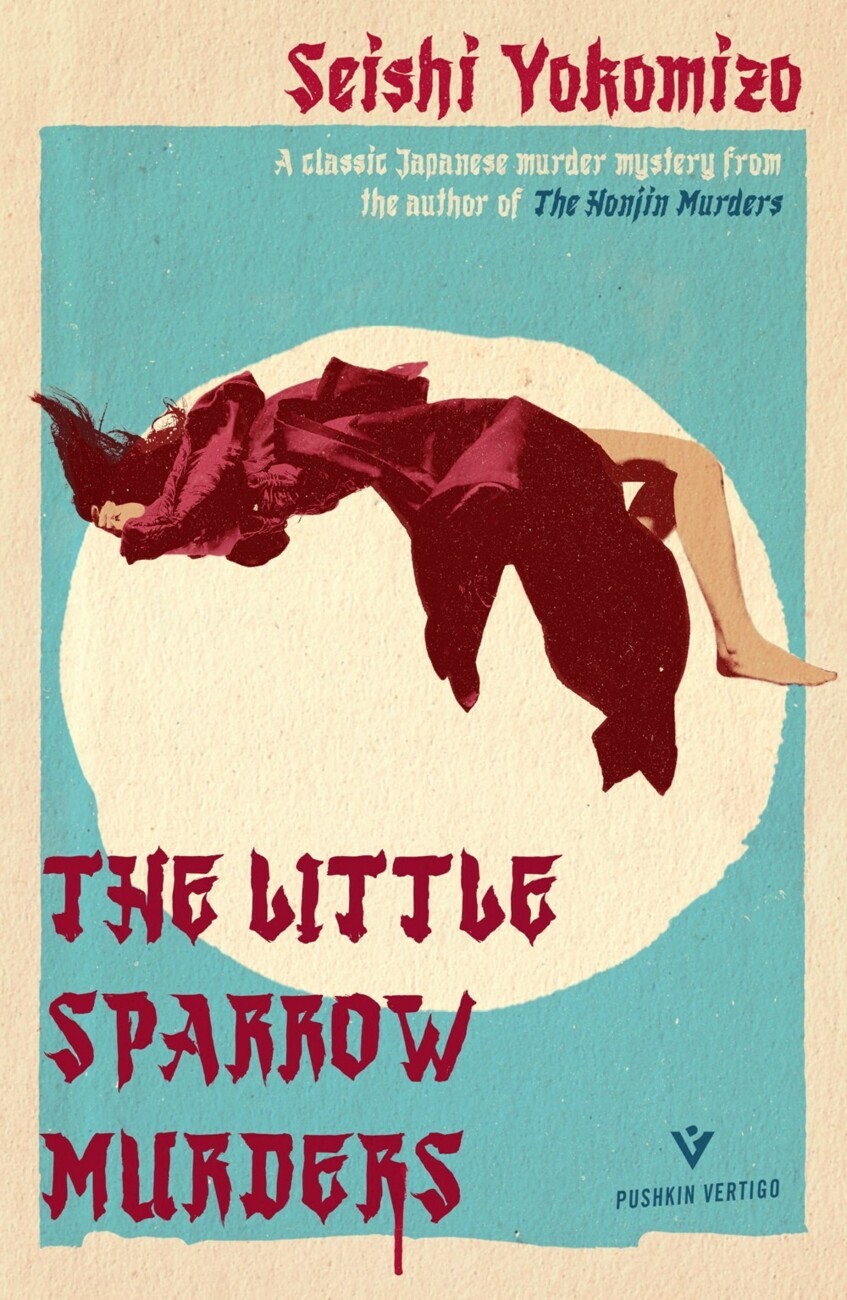
The Little Sparrow Murders by Seishi Yokomizo

Translated by Bryan Karetnyk

I’ve read all five of Seishi Yokomizo’s Kosuke Kindaichi mysteries that have previously been published by Pushkin Press in new English translations. This is the sixth, with another due later this year, and I decided to read it for the Japanese Literature Challenge being hosted this month and next by Dolce Bellezza.

The Little Sparrow Murders was originally published in Japanese in 1959 and is set a few years earlier in the village of Onikobe in Okayama Prefecture. Private detective Kosuke Kindaichi is taking a break from crime-solving and has decided to travel to Okayama to visit his old friend, Inspector Isokawa, at the prefectural police headquarters. Isokawa gives him the address of a nearby inn to stay at, run by Rika Aoike, a widowed friend. Although Kindaichi had been hoping to relax and avoid any mysteries for a while, he finds himself drawn into one when he learns that Rika’s husband, Genjiro, was murdered twenty years earlier – and the killer was never found.

As Kindaichi hears more about the events before and after Genjiro’s death and gets to know some of the people involved, another murder takes place, coinciding with the disappearance of the village chieftain and a sighting of a mysterious old woman on a mountain path. It seems that Kindaichi’s relaxing break is over before it even started. He and Isokawa begin to investigate, convinced that the key to the present day mystery lies in determining what really happened to Rika’s husband all those years ago.

Having read a lot of older Japanese crime novels over the last few years, thanks mainly to Pushkin who are doing a wonderful job with their new translations, I’ve found that many of them – most notably the ones I’ve read by Yukito Ayatsuji and Soji Shimada – are more concerned with solving seemingly impossible crimes and complex puzzles than with characters and motives. Yokomizo, I think, usually finds a better balance between the two; although his books still have intricate plots, the focus is often not so much on working out how the murders were committed, but rather on why they were committed and who could have had a reason for doing so. The impossible crime books can sometimes be fun as well, but I personally prefer the more character-driven ones. In this particular novel, the murders take place out in the open, not in locked rooms, and there’s almost no discussion of alibis, timings or similar things that can sometimes bog down a plot.

One thing I loved about The Little Sparrow Murders is that Yokomizo builds the story around a children’s rhyme – a device that Agatha Christie also often used. The killer in this novel is inspired by a temari song (a song sung by children in Japan while bouncing colourful embroidered temari balls). It begins “In the trees in the garden behind our house, Three little sparrows came to stay” and goes on to describe three young women from different families, who were “all of them sent away” – in other words, murdered. The deaths in the book correspond to the rhyme, which adds some extra interest to the mystery. I hadn’t heard of temari songs or balls before so, as always, a Yokomizo novel has contributed to my knowledge of Japanese culture.

This is one of my favourite Yokomizo novels so far, along with The Honjin Murders and The Inugami Curse, but I did have one problem with it – trying to keep track of the huge number of characters! There are five families in the book and it’s not easy to remember which family each character belongs to and how they’re connected to people in the other families. If you’re reading the ebook version (or maybe even if you’re not), I recommend taking the time to draw some family trees using the character list at the front of the book before you start, then you can easily refer to them as you read. I would have been lost otherwise, I think.

I’m now looking forward to the next Yokomizo book, Murder at the Black Cat Café, coming in September. Pushkin Vertigo also have another Ayatsuji novel, The Clock House Murders, on the way, as well as others by authors I haven’t tried yet, so 2025 should be a good year if you’re a fan of Japanese mysteries!

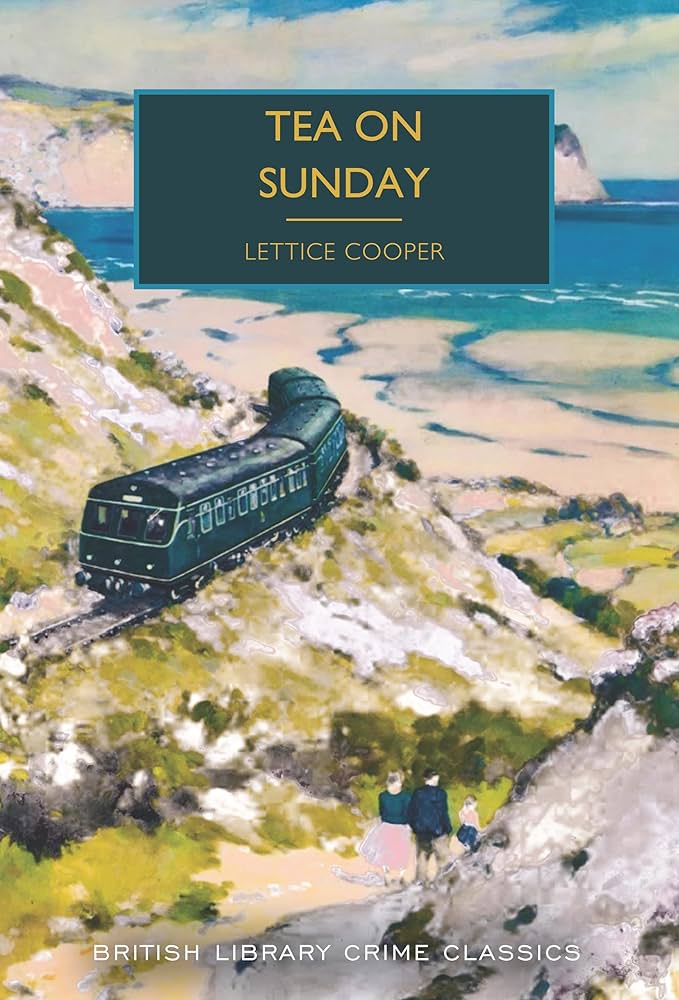
Tea on Sunday by Lettice Cooper

Lettice Cooper is a new author for me. I’m aware that two of her books from the 1930s, National Provincial and The New House, have been published by Persephone, but I haven’t read either of them yet. Tea on Sunday, her only detective novel, sounded appealing, though; it was published in 1973, very late in her life, but has the feel of a Golden Age mystery and has recently been reissued as a British Library Crime Classic.

The plot is quite a simple one. On a snowy winter’s day, Alberta Mansbridge invites eight guests to a tea party at her home in London. The guests include her family doctor, her ‘man of business’, an old friend, the manager of her late father’s engineering company, her nephew Anthony and his wife, and two young men she has taken under her wing – an Italian and an ex-prisoner. As the group gather outside her door that Sunday afternoon, they become concerned when their knocking goes unanswered. Eventually the police are called and force open the door to find that Alberta has been strangled while sitting at her desk.

There’s no real mystery regarding how the murder took place. The doors and windows had been locked and there’s no sign of a burglary, so the police are satisfied that the killer must have been someone Alberta knew and let into the house – probably one of the eight guests who arrived early, committed the murder, then left again to return a few minutes later with the others. But which of the eight was it and why did they want Alberta dead?

Tea on Sunday is a slow paced novel where, once the murder is discovered, not much else actually happens. Most of the focus is on Detective Chief Inspector Corby interviewing the various suspects one by one and delving into Alberta’s personal history to see if the answer lies in her past in Yorkshire. Despite the lack of action, I still found the book surprisingly absorbing and that’s because of Cooper’s strong characterisation. Any of the eight could be the culprit as none of them have alibis and this means Corby has to learn as much as he can about each person and whether or not they have a motive.

Corby is a likeable detective and it’s a shame he only appears in this one book by Lettice Cooper as she could probably have built a whole series around him. Although a few of his comments about women are questionable, I could make allowances for the period in which the novel was written and in general he’s respectful towards the people he interviews and doesn’t judge until he’s heard all the facts. It would be easy, for example, for him to pin the blame on Barry Slater, the former prisoner Alberta met through her charitable work and who runs away as soon as the police are called to the scene, but he doesn’t do this and waits to form his own opinion.

Of the eight suspects, the characters who stand out the most, in my opinion, are Anthony Seldon and his wife, Lisa. As the dead woman’s nephew and the only direct family member invited to the tea party, Anthony naturally comes under suspicion, so a lot of time is spent on his background, painting a picture of a young man who disappointed his aunt by refusing to go into the family business and by marrying a woman she dislikes quite intensely. Another interesting character is Myra Heseltine, Alberta’s close friend who lodged with her until discovering that Alberta’s latest protégé, Marcello Bartolozzi, whom Myra distrusts, may be moving in as well.

It’s Alberta Mansbridge herself, however, whose character comes across most strongly. Despite being murdered so early in the book, she is brought to life through the words and memories of those who knew her: a woman proud of her family’s legacy, stubbornly resistant to change and progress, who interferes in other people’s business but at the same time is generous and giving. At first it’s difficult to see why so many people may have wanted her dead, but gradually motives emerge for almost all of the suspects.

The actual solution to the mystery is disappointingly simple and there are no clever twists along the way, like we would expect from Agatha Christie, for example. I felt let down by the ending, but it was still an enjoyable read up to that point and as the first book I’ve completed in 2025 it means my reading for the year is off to a good start.

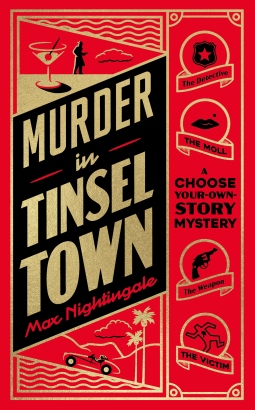
Murder in Tinseltown by Max Nightingale

I used to love Choose Your Own Adventure books as a child – who else remembers them? – so when I saw this new adult version of the same concept, I couldn’t wait to read it. Murder in Tinseltown is set in Los Angeles in the 1950s and the reader takes on the role of a detective investigating the murder of an actress. At various points in the story you’ll have the opportunity to choose your own actions and decide what happens next, either by turning to different numbered pages or, in the Kindle edition I read, simply clicking on a link.

You start your adventure at LAPD headquarters on the weekend of the Golden Star Awards when some of Hollywood’s biggest stars have descended on the city. It’s a busy day in the squad room, but when a disturbing call comes through from the Royal Premiere Hotel – “Trouble…hurt…not my fault…help…it’s them…I’m sorry…” – you head straight to the hotel to investigate. You arrive just in time to learn that one of the waiters has discovered Blanche Aikerman, probably the world’s most famous actress, stabbed to death in her room. After witnessing the dead body for yourself, you accompany the hotel manager to the suite of Peter von Hiltz, Blanche’s director, to give him the news. However, he doesn’t answer the door. What will you do next?

This is where the interactive part of the novel begins. Will you ask the manager to let you into von Hiltz’s room? Will you return to the crime scene to look for more clues? Or would you prefer to interview the waiter who found the body? Each option takes you to a different location in the book and the story continues from there until you reach another turning point and are presented with a new set of choices. It could and should have been a lot of fun working through the book and trying to solve the mystery – unfortunately, there were some problems with the structure which made the whole experience less satisfying than I’d hoped.

Maybe there was one route I could have followed through the novel where the story would have flowed perfectly, but surely somebody should have checked that all of the other possible routes also made sense. Early on, I saw a character die right in front of my eyes at an airport – then I returned to the hotel, where that same character was still walking around alive and well as if nothing had happened. Similarly, I found the murder weapon and then someone else found it again later in the book. Looking at other reviews, it seems that most of us noticed those same two things so I’m not sure how they weren’t picked up on by the author or an editor. Also, there are several outcomes where you die, but instead of the book ending as you would expect, you just come straight back to life and are directed to the ‘correct’ option so the story can continue.

From a nostalgia perspective, it was nice to have the opportunity to read a book like this, but I’m disappointed that it didn’t work as well as it could have done.

Thanks to HarperNorth for providing a copy of this book for review via NetGalley.

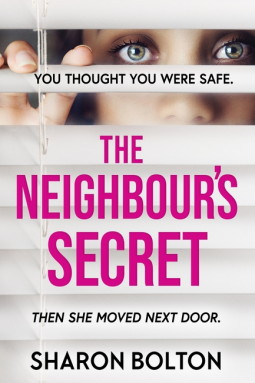
The Neighbour’s Secret by Sharon Bolton

The narrator of Sharon Bolton’s new novel is the very definition of a nosy neighbour. Living in the middle of three adjoining cottages with very thin walls makes it easy to hear the people on either side: the narrator knows what music they listen to and what they watch on television, who they speak to on the telephone and what time they get out of bed in the morning. In the evening, as it gets dark and people turn on their lights, it’s time to take a walk through the streets of the small Cumbrian village specifically to pry through illuminated windows to see the residents going about their daily lives. This is why the narrator becomes frustrated when Anna Brown moves in next door and stubbornly remains a woman of mystery, giving away very few clues to her past.

Yet the narrator is also a mystery, reluctant to share personal information with either the reader or the other characters. For a long time we don’t even know their name, which is why I’m being equally secretive in this review! Let’s focus on the plot instead. There are two separate storylines that alternate throughout the book, starting to come together towards the end. In the first, the narrator and Anna, who have formed a tense friendship, investigate the disappearances of several teenage girls at the InGathering, a yearly event held by the local church. The details of this event are – like everything else in this book – shrouded in mystery, but the church seems to resemble a cult with rituals and traditions that they prefer to keep hidden.

The other narrative is set a year earlier and describes the meetings between a psychiatrist and her patient, seventeen-year-old Jago Moore. Jago stabbed one of his teachers at school and the authorities want an assessment of his mental condition before deciding what action to take. This storyline seems quite unrelated to the other, until we start to suspect who the psychiatrist is. Again, though, not everything is as it seems and there are multiple twists and turns as we head towards the conclusion of the book!

I was able to guess some of the plot twists before they happened, but not all of them and not always very far in advance. It’s easy to make certain assumptions about some of the characters and situations in the book, but these assumptions aren’t necessarily correct and Bolton very cleverly creates confusion and misdirection from beginning to end.

The central mystery surrounding the disappearing girls at the InGathering was actually the part of the novel that interested me the least and I found the revelations about what was really going on at the church quite far-fetched. The Jago Moore sections, however, were chilling – Jago is clever and manipulative and I found his behaviour terrifyingly believable. The whole book has a dark, creepy atmosphere; the village of St Abel’s Chapel in the Lake District should have been an idyllic setting, but with so much secrecy and with most of the action taking place in the middle of the night, it feels like a sinister place rather than a picturesque one.

Although this isn’t one of my absolute favourite books by Sharon Bolton, I did enjoy it and liked it better than last year’s The Fake Wife. It seems that her next book, coming in 2025, will be another standalone; I’m looking forward to it but would also like a return to the Lacey Flint series, which I love!

Thanks to Orion for providing a copy of this book for review via NetGalley.

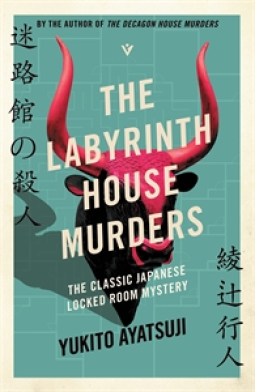
The Labyrinth House Murders by Yukito Ayatsuji

Translated by Ho-Ling Wong

This is a good example of why it’s often worth giving an author a second chance. I was disappointed with Ayatsuji’s The Decagon House Murders, finding the characters very wooden and the plot a poor imitation of And Then There Were None, so I had decided to stick with Japanese crime authors more to my taste, such as Seishi Yokomizo. Then I read lots of glowing reviews of The Mill House Murders, the second in Ayatsuji’s series to be released in a new English translation, so when I saw the third one, The Labyrinth House Murders, on NetGalley I decided to give him another try.

The Labyrinth House, we are told, is the work of the same architect who designed the Decagon House and the Mill House. As its name suggests, the house contains a labyrinth of passageways with the rooms arranged around the edges, so that to get from one room to another it’s necessary to enter the maze. The design is inspired by the Minotaur myth and all of the rooms are named after characters associated with the myth. This very unusual house is the home of the mystery writer Miyagaki Yōtarō.

Miyagaki is in poor health but, as the novel opens, he is preparing for his sixtieth birthday and has invited a group of friends and colleagues to celebrate with him at the Labyrinth House. These include four younger crime authors whom Miyagaki has mentored, a literary critic, his editor Utayama and his wife – and a friend, Shimada Kiyoshi, who is the series detective. As the guests assemble at the house, they are greeted by Miyagaki’s secretary, who gives them the shocking news that their host has committed suicide, leaving them a recorded message to listen to. The recording instructs them not to leave the house or call the police for five days and in the meantime the four authors must each use the time to write a detective story. The four stories will be judged by the other guests and the winner will inherit part of Miyagaki’s fortune.

This book was much more fun than The Decagon House Murders. Although the plot is obviously very contrived, that didn’t bother me and I found it easy enough to just suspend disbelief and accept the premise. Once the story writing competition begins, murders start to take place (in very imaginative ways) and I was completely gripped until the end. My only real criticism is that one of the clues to the solution is something that only a man would think was plausible; Ayatsuji should maybe have discussed it with a woman first before basing a key plot point around it. Sorry to be vague!

I loved the setting of the Labyrinth House and the way so many aspects of the Minotaur myth are worked into the plot. A map of the house is included to help the reader appreciate the layout of the rooms and the labyrinth (and this is where I wished I had a physical copy of the book instead of the ebook). The house has an eerie, unsettling atmosphere and I worried for the characters every time one of them went wandering off on their own! Being originally published in 1988, there are also lots of little details that set the book in that period: the way everyone smokes indoors; the word processors the authors use with floppy disks to save their work; the landline telephones that can so easily (in crime novels, anyway) become cut off from the outside world.

The characters have a bit more depth than the ones in The Decagon House, although I’m finding that characterisation doesn’t seem to be a strong point in any of the older Japanese crime novels I’ve read. Most of the book is written from Utayama’s perspective, although Shimada is the one who does the detective work – and, thankfully, explains some of his deductions to Utayama as he goes along so that the reader can follow what’s happening. And did I manage to solve the mystery? Well, no, I didn’t, but Ayatsuji conceals an important piece of information from us until the end of the book, so I don’t really consider this a fair play mystery anyway. There are also multiple plot twists and a story-within-a-story structure, just to make things even more difficult!

I’m pleased to see that the next book in the series, The Clock House Murders, is being published by Pushkin next year and also pleased that they’re sticking with Ho-Ling Wong as translator, as he’s done such a great job with this one. Meanwhile, I’ll go back and read The Mill House Murders, in the hope that for some reason it was only The Decagon House I didn’t connect with.

Thanks to Pushkin Vertigo for providing a copy of this book for review via NetGalley.
This is my sixth and final book for this year’s RIP XIX challenge.

The Examiner by Janice Hallett

It’s September 2023 and six students are preparing to start Royal Hastings University’s new Multimedia Art course. The course is led by Gela Nathaniel who has personally selected her students from different backgrounds to ensure a range of skills and artistic knowledge. There’s Jem Badhuri, an ambitious and enthusiastic young woman who works mainly in sculpture and sound; Alyson Lang, already an experienced and talented artist; Jonathan Danners, whose family own an art gallery; Cameron Wesley, a marketing executive trying to juggle the course with his job; Ludya Parak, a graphic designer and single mother; and finally, Patrick Bright, a man in his fifties who runs an art supplies shop.

Almost as soon as the course gets under way there are hints that something is wrong. Some of the students seem to be hiding secrets and tensions quickly develop between them. Then, five of the group go on an overnight trip to Somerset to visit a museum and it’s not clear whether all five have returned again. Is the missing student still alive or have they been murdered and the others are covering it up? As the course comes to an end, Ben Sketcher, an external examiner responsible for giving an independent assessment of the course and the students’ grades, is given access to all the communications between Gela and her class and must decide whether a crime has been committed.

The Examiner is written entirely in the form of emails, WhatsApp messages and transcripts of chats from the Royal Hastings University messaging app, Doodle. This makes it easy for Hallett to conceal the truth from the reader because each character only reveals what they want the others to know and they aren’t necessarily always being honest. Clues do eventually begin to emerge but the full picture doesn’t become clear until Ben has read every message and every email. Readers of Hallett’s The Appeal or The Mysterious Case of the Alperton Angels will already be familiar with the epistolary format she uses and to be honest I think it’s something you either love and connect with immediately or you don’t. If you didn’t enjoy her other books this one probably won’t change your mind. Personally, I find them unusual and imaginative – and very gripping, as the short length of the emails and chats makes it difficult to stop reading!

The Multimedia Art course is a year long and during that time the students are given various assignments and projects to complete. Their responses to these are provided in the book and although I know very little about multimedia art I enjoyed reading them as they give a deeper insight into each character. I was particularly intrigued by Jem’s work with soundscapes and binaural audio and Patrick’s experiments with resin. Gela’s notes as she examines and grades each project are also interesting as they give us clues about how she views each student and her relationship with them. Why does she show such favouritism to the overqualified Alyson, for example? Why does she make so many allowances for Cameron, who barely attends the course and makes very little effort when he does?

When I eventually discovered what was going on behind the scenes of Gela’s Multimedia Art course I felt slightly let down because it seemed so far-fetched and not what I had expected. Still, the fun was in getting there and watching the dynamics play out between the six students along the way. Although The Twyford Code and The Alperton Angels are still my favourite Hallett novels, I did love this one as well; it’s maybe not the best place to start with her books, but I think existing Hallett fans will enjoy it as much as I did.

I’m counting this as my third book for this year’s RIP challenge.

The Meiji Guillotine Murders by Futaro Yamada

Translated by Bryan Karetnyk

It’s 1869 and Japan has entered the Meiji era. The Tokugawa shogunate has fallen and the Emperor Meiji has been restored to the throne. After centuries of isolation, Japan is finally opening up to foreign trade and undergoing social, industrial and military reform. In Tokyo, a group of corrupt rasotsu (policemen) have found ways to exploit this period of change and upheaval for their own gain. With the arrival of two Chief Inspectors from the Imperial Prosecuting Office, Kawaji and Kazuki, it seems that the rasotsu will be forced to mend their ways – although the two men have other things to occupy their time as well as dealing with corruption.

With a number of bizarre murders taking place around Tokyo, Kazuki and Kawaji (based on a real person who is considered the founder of Japan’s modern police system) engage in a friendly competition to see who can solve the crimes first. A separate chapter is devoted to each case, which at first seem to be unrelated, making the book feel almost like a collection of short stories. There are five cases for the two detectives to solve, with the help of Esmeralda, a young Frenchwoman from a family of executioners whom Kazuki has brought to Japan along with that most deadly of French weapons: the guillotine. Despite the title, the guillotine is not necessarily used to carry out all of the murders in the book, but it represents the changes that Japan is experiencing as the country becomes exposed to modern, western influence. It also provides a reason for Esmeralda’s presence in Tokyo, which is important as she has a significant role to play in the solving of the mysteries.

The Meiji Guillotine Murders was first published in 1979 and is one of several Japanese crime novels that have recently been made available in English by Pushkin Press. However, although I’ve loved some of the others, I didn’t enjoy this one quite as much. Bryan Karetnyk’s translation is clear and readable (I’m already familiar with his work through some of his other translated novels), but I had problems with other aspects of the book. I struggled with the number of characters, particularly as so few of them have clearly defined personalities and with more and more of them being introduced with each new case the detectives investigate. My lack of engagement with the characters made it difficult for me to concentrate on following the plot, which is important as all of the separate cases are quite complex and you do need to be paying attention! I persevered and was rewarded with the final section of the book where, after some surprising twists and turns, everything is tied together perfectly.

I did like the historical setting of the book and felt I was learning a lot about Japan during the Meiji era. At times it seemed more like historical fiction than a murder mystery, which was fine with me, but I think someone picking the book up expecting a more traditional crime novel may be surprised by the amount of historical detail. It’s an interesting, unusual book, and although I’m not sure whether I would read any more by Yamada, I do hope more of them are translated into English for those readers who loved this one. I’m enjoying discovering Japanese crime authors through Pushkin and so far my favourites have been Seishi Yokomizo and Akimitsu Takagi.

Thanks to Pushkin Vertigo for providing a copy of this book for review via NetGalley.

This is book 7/20 of my 20 Books of Summer 2024.

Book 24/50 for the Historical Fiction Reading Challenge 2024