The Golem and the Djinni by Helene Wecker

The Golem and the Djinni Meet Chava. She’s a golem, a woman made of clay, created by a Rabbi in Poland and brought to life on a ship sailing to America. When her master dies during the voyage, the Golem, only a few days old, finds herself alone in a strange and unfamiliar land.

Ahmad is a djinni, a magical being made of flame, born in the Syrian desert in the seventh century and trapped inside a copper flask by a wizard. Now, many centuries later, the Djinni is released from the flask by a New York tinsmith, but discovers that he is bound to human form by an iron band around his wrist.

As the Golem and the Djinni try to adapt to their new surroundings and struggle to find a place for themselves in New York society, the two are eventually drawn together and their separate storylines begin to merge together in some unexpected ways.

The Golem and the Djinni have many things in common, the most obvious being that they are two non-human creatures trying to survive in the human world. They share a vulnerability and a childlike wonder at the people and things around them, which is what makes them both such endearing characters. But coming from such different cultures, they soon discover that they also have very different natures. Chava, as a golem, is designed to serve a master and satisfy the desires of others, while Ahmad has been imprisoned against his wishes and is desperate to regain his independence. The question of free will is something that comes up in their conversations often. Are the Golem and the Djinni responsible for their own actions or do their natures make them behave in a certain way? How much free will does either of them actually have? And what are the things that make a person human?

I found the relationship between the Golem and the Djinni very moving to read about and I think the reason for that was because it was not written as a typical ‘love at first sight’ romance. At first their relationship is based on curiosity and a longing to be able to discuss things with another outsider. A friendship gradually starts to form but it’s not until they find themselves threatened by a mutual enemy that the Golem and the Djinni realise how much they care about each other. I really liked the fact that the author took her time to introduce us to the characters and allowed their story to develop slowly so that the pace never felt too rushed.

Another thing I loved was the choice of setting – New York in 1899. As the Golem and the Djinni are mythical creatures they could probably have been placed into any setting and their story would still have been interesting, but choosing this specific time and place was particularly fascinating because of the insights we are given into the various immigrant communities of turn of the century New York. Through the Golem we get to know some of the city’s Jewish population and through the Djinni we meet the inhabitants of ‘Little Syria’, as well as learning about the Djinni’s previous life among the Bedouin desert tribes. There are lots of great characters in each of these communities: the old Rabbi who befriends Chava and the tinsmith who befriends Ahmad, the ice cream seller who suffers from a strange affliction that prevents him from looking people in the eye, and the beautiful young girl who receives some late night visits from the Djinni.

As a first novel, The Golem and the Djinni was a very ambitious one but everything worked perfectly. There were so many things about this book that impressed me – the beautiful writing, the clever plot, the blending of fantasy with historical fiction, and most of all, the wonderful characterisation of both Chava and Ahmad. In four months’ time when I make my list of favourite books of the year The Golem and the Djinni is one title that I’m sure will be on that list!

(Now, can anyone tell me why the spelling Djinni is used in the UK edition and Jinni in the American one?)

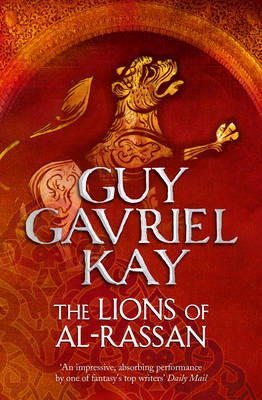
The Lions of Al-Rassan by Guy Gavriel Kay

The Lions of Al-Rassan Guy Gavriel Kay is only a recent discovery for me, but after reading Tigana in June I knew I wanted to read more of his work. Leander of The Idle Woman mentioned that she had been wanting to re-read The Lions of Al-Rassan, one of her favourite books, so we decided it would be interesting to read it at the same time and exchange our thoughts on it.

I should start by saying that although Kay is known as a fantasy author, this book has few, if any, elements that I would describe as ‘fantasy’ and is much closer to historical fiction. The story is set in a fictitious world very similar to medieval Spain. In the north, we have the sun-worshipping Jaddites – brave warriors and horsemen. The Jaddite lands have become divided and weakened over the years due to rivalries between their three kings but they still hope to one day ride south and reconquer the rest of the peninsula. In the south is Al-Rassan, the land of the Asharites, who worship the stars and who value poetry, music and beauty. After the death of their last Khalif, Al-Rassan has also become divided and is not as strong as it once was. Caught between the two are the wandering Kindath people, who pray to the two moons that shine in the sky, one blue and one white. Even with my very limited (almost non-existent) knowledge of Spanish history I could immediately see that the Jaddites represented Christians, the Asharites Muslims and the Kindath Jews.

As tension builds between the Jaddites and the Asharites and war begins to look inevitable, there are big consequences for the novel’s three central characters. One of these is Rodrigo Belmonte, Captain to a Jaddite king and one of the Jaddites’ greatest soldiers. When Rodrigo is exiled by his king he and his company find themselves in the Asharite city of Ragosa. Here he meets another great man, Ammar ibn Khairan, an Asharite who is also in exile, and the two form an instant connection. Our third protagonist is a woman, Jehane bet Ishak, a Kindath physician who joins Rodrigo’s company and becomes close to both men. With the peninsula heading rapidly towards conflict, will the bonds between Rodrigo, Ammar and Jehane be able to survive?

Now that I’ve read two of Guy Gavriel Kay’s novels, it’s hard to say which I liked best because both were such great books. I think I found Tigana more fun to read (simply because I read fantasy so rarely these days and it was something a bit different for me to read a book with magic and wizards) but I found the writing in The Lions of Al-Rassan more powerful and the characters more fully developed. Ammar, Rodrigo and Jehane are all characters that I could love and admire, and considering their very different backgrounds and cultures, it’s quite an achievement that Kay could make it possible to identify with and care about all three of them.

Although this novel is set in a fictional land, the parallels with a real period of history made me feel that I was gaining a better understanding of medieval Spain. But as well as the history, there’s also a lot of drama and excitement throughout the novel: among other things, there are battles, assassination attempts (both successful and unsuccessful), and a masked Carnival. What I really loved about this book, though, was the portrayal of the three main characters and the relationships between them. It’s not as simple as Jehane being in love with both men (or them being in love with her) and having to choose between them; although there is a romantic aspect, the relationships are much deeper and more complex than that and encompass not just love but also friendship, loyalty and trust.

There’s a growing sense of sadness too as you start to approach the end of the book and wonder whether all three of Ammar, Jehane and Rodrigo will survive the coming conflict and how they will cope if they find themselves on opposite sides. The final chapter was one of the most tense and emotional I’ve read for some time, though I thought it would have been even more effective without the epilogue that followed (I was pleased to see that Leander felt the same as I was wondering whether I was the only person who would rather not have had the loose ends tied up).

I’m excited about the prospect of working my way through the rest of Kay’s books, but I’m sure I’ll want to re-read this one at some point too – preferably after I’ve had a chance to read up on Spanish history! If you would like to see what Leander thought of The Lions of Al-Rassan, you can read her post here.

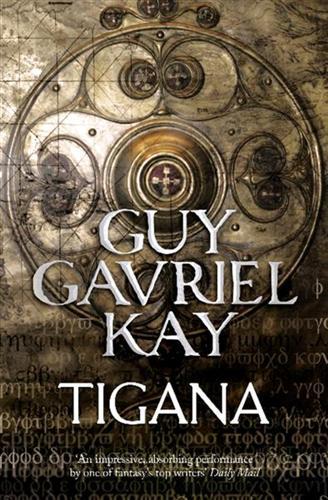
Tigana by Guy Gavriel Kay

Tigana by Guy Gavriel Kay Tigana is a fantasy novel set in the Peninsular of the Palm, a world loosely based on Renaissance Italy. Divided into nine rival provinces, the Palm is an easy target for two invading tyrants, one from the east and one from the west. Four of the Palm’s nine provinces have fallen to Alberico of Barbadior and four to Brandin of Ygrath, both powerful sorcerers, with only one province still to be conquered.

During the battle for one of these provinces, Prince Valentin of Tigana killed Brandin’s son, Stevan, which brought down Brandin’s wrath upon the entire province and its people. Brandin destroyed Tigana’s cities, its culture and its identity, then to complete his revenge he wiped all memory of Tigana and even its name from the minds of everyone in the peninsular, with the exception of those who were born in the province before the invasion. Eighteen years later, at the time when our story is set, a group of Tiganese exiles (including Prince Valentin’s only surviving son) set out to free the Palm of the two tyrants and restore Tigana’s name to the world.

This is the first book by Guy Gavriel Kay I’ve read, although I’ve been aware of his books for years and am now annoyed with myself for waiting so long to actually read one! I loved Tigana – not unreservedly, but enough to make it one of my books of the year so far.

I’ll admit to being very confused at first, as Kay doesn’t make things easy for the reader and throws us straight into a strange, unfamiliar world. Making a few notes of names and places helped, but really all that was needed was some patience. By the time I was halfway through the book, a world with one blue moon and one white, where people worship a Triad of Gods called Eanna, Adaon and Morian, and where wizards can be recognised by their two missing fingers, seemed almost as real as our own! I very rarely read fantasy anymore (not for any particular reason; I did used to enjoy it and am not sure why or when I stopped) but I actually thought that the overall feel of the book and the effort needed to understand the history, folklore and politics of the Palm were not a lot different from reading historical fiction. I could soon see the parallels with Renaissance Italy and the way its feuding city states left it vulnerable to threats from outside.

One of the things I liked about this book is that, with the possible exception of Alberico, none of the characters are portrayed as entirely good or entirely bad. The best example of this is probably Brandin of Ygrath, who at first appears to be one of the villains of the book because of what he has done to Tigana. It’s only later in the novel that we start to get closer to Brandin and see him from the point of view of the woman who loves him. This is Dianora, who is herself from Tigana and has spent several years in Brandin’s saishan (harem) on the island of Chiara, intending to kill him and lift his curse from Tigana. However, when she finds herself falling in love with him, she begins to wonder whether she’ll be able to carry her plan through to its end. I didn’t particularly like Dianora or agree with all of her choices, but I thought the scenes describing her internal conflict were very well written.

I don’t think the problem I had with Dianora was necessarily with the character herself, by the way, but more with the fact that her introduction into the novel came at a point where I had just begun to really understand the plot and to get to know Devin, Alessan, Catriana and the other characters; at that stage I didn’t want to be taken away from them and have to spend two chapters meeting a new character with a long backstory. I did become more interested in Dianora later in the book, but her sections were never my favourites and I was always glad to get back to the other characters’ storylines.

Another example of the boundaries between right and wrong becoming blurred involves the binding of a wizard. I don’t want to go into too many details as part of the fun of reading this book, being someone who doesn’t read much fantasy, was in learning about the various types of magic used in the Palm. However, the wizard binding episode raised some interesting questions. Can it ever be right to enslave a man against his will? Is the freedom of one person as important as the freedom of an entire nation?

As for the ending of the book, I both liked it and disliked it. I couldn’t quite believe in one of the romantic pairings at the end, as there had been so little hint of it throughout the book. There were other things that were left unresolved (or rather, they weren’t resolved in the way I wanted them to be) but I could accept that not everybody could have a happy ending. The revelation about one of the characters (again, I don’t want to say too much here and spoil the story for future readers) was heartbreaking! And the very last line of the epilogue is one of those final sentences that leaves you with something to continuing thinking about and trying to interpret even after you close the book and put it back on the shelf. I’ve got The Lions of Al-Rassan to read next and am excited to think that I might potentially have a new name to add to my list of favourite authors!

The River of No Return by Bee Ridgway

The River of No Return If you met Nick Davenant you would probably think he was a normal, unremarkable young man, enjoying life in 2013 as the owner of a dairy farm in Vermont, whose biggest worry is a visit from the cheese inspector. But once, Nick Davenant was Lord Nicholas Falcott, Marquess of Blackdown, an English aristocrat who fought in the Napoleonic Wars.

With an enemy soldier about to kill him on a Spanish battlefield one fateful day in 1812, Nick jumps forward almost two hundred years into the future and finds himself waking up in the twenty-first century. Here he learns that he is now a member of ‘the Guild’, a secret society of time travellers like himself. With the help of the Guild, Nick is able to adapt to modern life and accepts that there can be “no return”. Then one day Nick receives a letter from the Guild summoning him to London, where he is informed that they are going to break their own rules and send him back to his own time on a very special mission…

Back in the nineteenth century again, Nick meets his old friend, Julia Percy, who lives at nearby Dar Castle. In Nick’s absence Julia’s grandfather, the fifth Earl of Darchester, has died and her greedy, brutal cousin Eamon has become the new Earl. Grandfather had a very unusual ability: he could manipulate time, and Julia appears to have inherited this special gift. And when she discovers that Eamon is searching for the Talisman, an object he believes will give him the power to control time, Julia decides not to tell anybody about her secret talent.

I’ve always enjoyed books with a time travel element and The River of No Return is one of the most original and imaginative I’ve read for a long time. This is a time travel novel where the manipulation of time forms a big part of the plot – jumping forwards in time, jumping backwards in time, freezing time, speeding time up and slowing time down. However, after Nick’s initial jump into the future and then back again, which all takes place during the first third of the novel, we don’t actually see much movement between the centuries. The majority of the story is set in Regency England, a world where people travel by horse and carriage, where girls look forward to going to London for the Season, and where the Corn Bill is being debated in Parliament. As a fan of historical fiction who enjoys reading about the Regency period, I was very happy about this and in fact, it wasn’t until Nick left the modern day behind and returned to the past that I really found myself being pulled into the story.

The book did feel a bit too long and I thought there were too many lengthy conversations about the mechanisms of time travel, but overall, after a slow start, I thought this was a great debut novel – not purely science fiction, fantasy, romance or historical fiction, but a mixture of all four. The ending felt very abrupt and left me wanting to know more, so I hope Bee Ridgway is planning a sequel. I would happily read more of Nick and Julia’s adventures.

I received a copy of this book from the publisher via Netgalley for review.