Tomorrow by Damian Dibben

There are two things which make the narrator of Tomorrow one of the most unusual I have ever encountered. One is that he is over two hundred years old. The other is that he is a dog. We all know how loyal dogs can be, but this dog takes his loyalty to exceptional levels. Having been separated from his master, the chemist Valentyne, in 1688, our narrator has spent two centuries sitting patiently outside the church in Venice where they parted.

“If we lose one another,” Valentyne had told him, “wait for me on the steps. Just here, by the door.” The dog has no doubt that he and Valentyne will be reunited one day and so he sits obediently by the door and waits. Then, one day in 1815, he catches a glimpse of Vilder, a man whose path has crossed many times with Valentyne’s…and he sets off in pursuit, sure that this is the clue which will lead him to his master.

Tomorrow is a book that raises questions immediately. What has happened to Valentyne? How have he and his dog lived for so many years? Who is Vilder and what is his connection with Valentyne? All of these questions are answered eventually, as the story moves backwards and forwards in time, alternating between the dog’s search for his master in 19th century Venice and his memories of their early days travelling Europe together.

Their adventures take them from 17th century London to the court of Versailles and the battlefield of Waterloo and along the way they meet kings and queens, famous poets and musicians and great military leaders. Valentyne falls in love and the dog forms some special relationships too – with Sporco, a puppy he finds abandoned in Venice, and with a female dog called Blaise. However, this is where they discover that living forever is not much fun when it means having to watch your loved ones grow old and die.

I do like the idea of writing from the point of view of a canine narrator and I can appreciate both the opportunities this must give an author and also the restrictions. The dog in Tomorrow is a real dog, despite his apparent immortality – he is not a magical, talking dog and although he listens and reports on the human conversations around him he cannot take part himself. On the other hand, he is so intelligent and his internal thought processes and logic feel so human that there were times when I could almost forget that he was a dog. I’m not sure that I found all of this entirely successful, but it was certainly imaginative and different.

Finally, in case you’re wondering, the dog does have a name but I haven’t mentioned it here as it is only revealed near the end of the book and I thought it was a nice surprise!

Thanks to Michael Joseph for providing a copy of this book for review via NetGalley.

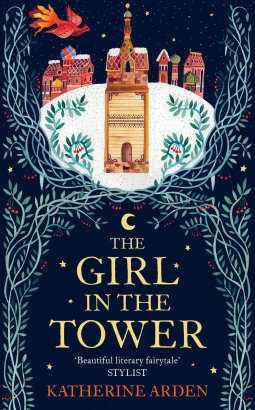
The Girl in the Tower by Katherine Arden

I enjoyed The Bear and the Nightingale when I read it almost exactly a year ago and I remember my excitement on discovering that it was actually the first in a planned trilogy. We haven’t had to wait too long for the second book, The Girl in the Tower, and I’m pleased to say that I loved it even more than the first.

Katherine Arden’s books are a wonderful mixture of history, folklore and fairytales with an atmospheric and wintry Russian setting. If you haven’t read The Bear and the Nightingale yet, I would highly recommend starting with that one – and I should warn you that there may be spoilers for the first book in the rest of this post.

At the beginning of The Girl in the Tower, our heroine Vasilisa Petrovna (Vasya) is fleeing her childhood village of Lesnaya Zemlya. Despite her efforts to rescue the villagers from a great evil, the way in which her father and stepmother died has caused Vasya to be branded a witch, regarded with suspicion and distrust. Accompanied by her magnificent stallion Solovey, Vasya sets off on a journey across northern Rus’ to Moscow, home of her sister Olga – a journey which will be filled with danger as Vasya encounters a group of bandits sweeping across the countryside burning villages and kidnapping children. First, though, she must pay a visit to Morozko, the frost-demon, in his fir-grove deep in the forest…

This novel has a much wider geographical scope than the previous one, in which the action takes place almost entirely in and around Lesnaya Zemlya. I liked this aspect of the book; medieval Moscow is an interesting setting and, with Olga’s family close to the Grand Prince, Dmitrii Ivanovich, we are given some insights into the political situation during this period of Russian history. At the time of the story, the Rus’, as it was known then, is still part of the domain of the Great Khan and the Golden Horde, but with their influence weakening as the Grand Prince grows in power, it seems that things could be about to change.

I was also pleased to see Vasya reunited with her siblings, not just Olga but also their brother Sasha, who is now a priest. Sadly, her relationships with both Olga and Sasha are very strained, partly because of what happened in Lesnaya Zemlya, for which Vasya is unable to give an adequate explanation, and also because of her behaviour on arriving in Moscow, which they consider unladylike and inappropriate. To the modern reader, Vasya is a wonderful character – brave, independent and rebellious – but her refusal to conform to the 14th century ideal of what a woman should be leads her into a great deal of trouble. In contrast, Olga has accepted her place in society and expects her young daughter, Marya, to follow the same course in life. Marya, though, appears to have other ideas!

I’ve said very little so far about the fantasy elements of the novel. We don’t see very much of the household spirits who played such an important part in The Bear and the Nightingale, but there are some appearances by intriguing new figures from Russian myth including the Firebird – and another, more sinister, character whose name I won’t give here so as not to spoil anything! I also enjoyed Vasya’s interactions with her magical horse, Solovey, who has begun to form a personality of his own. Last, but certainly not least, there’s Morozko, frost-demon and god of the dead.

There were hints in the previous book of a possible romance between Vasya and Morozko, and in this book their relationship is developed further. It’s definitely not a conventional love story and because of who Morozko is and the role he has to play in Russian folklore, he has a tendency to come and go throughout the novel. It’s frustrating but it worked for me and I found myself looking forward to the scenes they shared. I loved The Girl in the Tower – and the good news is that the third book in the trilogy, The Winter of the Witch, is expected this August!

Thanks to Ebury Publishing for providing a copy of this book for review via NetGalley.

This book counts towards this year’s What’s in a Name? Challenge: A title containing the word ‘the’ used twice.

Witch Week: The Wicked Day by Mary Stewart

This week Lory of The Emerald City Book Review is hosting her annual Witch Week event, a celebration of fantasy books and authors. This year’s theme is Dreams of Arthur – books which draw on the Arthurian legends. Having read and loved Mary Stewart’s Merlin trilogy a few years ago, I thought this would be the perfect opportunity to read The Wicked Day, another of her Arthurian novels.

There is some overlap between The Wicked Day and the events of the final Merlin novel, The Last Enchantment, but in this book the focus switches to Mordred, the son of King Arthur and his half-sister, the witch Morgause. At the beginning of the novel, Mordred is being raised by peasants in the Orkney Islands and is unaware of his true parentage. It is only by chance that he is brought back into contact with his real mother, Morgause, by now the widow of King Lot of Lothian and Orkney, with whom she has had four more sons. Aware of Merlin’s prophecy suggesting that Mordred will be the cause of Arthur’s death, Morgause takes the boy into her household, sensing that he could be a useful weapon against Arthur.

Eventually, Morgause and her sons are summoned south to Camelot and Mordred will have to decide where his loyalties lie. But even if he chooses Arthur, will he be able to defy the prophecy or will he prove to be his father’s downfall after all?

I enjoyed this book, though maybe not quite as much as the three Merlin novels, which is probably because I found Merlin himself a more appealing character than Mordred. Having said that, Mary Stewart’s portrayal of Mordred is much more sympathetic than I had expected. Although my knowledge of Arthurian legend is very limited, I had gained the impression from other sources that Mordred was a villain, a traitor who betrayed Arthur. Stewart’s Mordred is not like that at all. He’s by no means perfect – he does have flaws and makes mistakes – but he always has the best of intentions and although he is ambitious any trouble he does cause for Arthur is largely due to circumstances outside his control.

As well as Mordred’s relationship with Arthur, his interactions with his four half-brothers – Gawain, Agravain, Gaheris and Gareth – are also explored. Their attitudes towards Mordred range from suspicion and rivalry to reluctant acceptance and respect. As I’ve said, I don’t know a lot about the Arthurian legends, so although I had heard of King Lot’s four sons and had a basic idea of how their stories would play out, it really was only a basic idea! The advantage of going into a book knowing very little about a subject is that you can be kept in suspense wondering what is going to happen and enjoy the story for its own sake, without any preconceived opinions; on the other hand, it would have been nice to have had other versions of the story and characters in mind so that I could have made comparisons and looked for similarities and differences.

At the end of the book we are given brief retellings of the sections of Sir Thomas Malory’s Le Morte d’Arthur and Geoffrey of Monmouth’s The History of the Kings of Britain which deal with the Mordred legend. Stewart then goes on to explain why she chose to interpret Mordred’s character the way she did; I found it interesting to read that while she was writing the earlier Merlin novels she had accepted the traditional view of Mordred as a villain and only changed her mind when she came to research his story in detail.

As with Mary Stewart’s other Arthurian novels, the elements of fantasy in The Wicked Day are very subtle and understated, amounting to not much more than a few prophecies and visions. The 6th century Britain that she recreates is a real, believable place and her books feel much more like historical fiction than fantasy, which is possibly why I like them so much. I am planning to read her final Arthurian novel, The Prince and the Pilgrim, and will then see how other authors have approached the legends. When I reviewed The Last Enchantment I received lots of ideas for future reading in the comments, so I have plenty of books and authors to explore. Chris of Calmgrove has also put together a very informative guest post for Witch Week with more suggestions and recommendations.

The Bedlam Stacks by Natasha Pulley

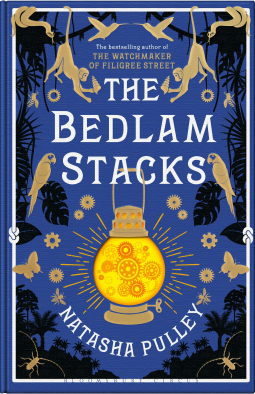
This is Natasha Pulley’s second novel. I remember seeing lots of very positive reviews of her first, The Watchmaker of Filigree Street, a year or two ago and thinking it sounded interesting. I never got round to reading that book, but when I heard about her new one, The Bedlam Stacks – which sounded just as intriguing – I decided to give it a try.

Set mainly in Peru in 1860, The Bedlam Stacks is narrated by Merrick Tremayne, a former opium smuggler and an expert in botany. Confined to his family estate in Cornwall due to a leg injury, Merrick is trying to come to terms with the fact that he will now have to put his adventuring days behind him and find something else to do with his life. Just as he is beginning to lose hope, his old friend Clem Markham arrives with a request from Merrick’s former employers, the East India Company. To tackle the problem of treating malaria in India, a supply of quinine is urgently needed – and Merrick’s expertise with plants makes him the ideal person to travel with Clem to Peru to take cuttings of the quinine-rich cinchona tree.

At first Merrick is reluctant to agree, knowing that his disability will make it difficult for him to travel through dangerous terrain – not to mention the fact that the Peruvians have a monopoly on the trees and are not about to let anyone else steal them. The alternative, though, is to stay at home and follow his brother’s suggestion of becoming a parson, so it doesn’t take him long to reach a decision! Venturing into the uncharted depths of Peru, Merrick and Clem finally arrive in the holy town of Bedlam, a place where the boundaries between magic and reality begin to merge.

The magical realism elements in The Bedlam Stacks are much more dominant than I had expected. There are moving statues, exploding trees and several other surprises which I will leave you to discover for yourself! This wasn’t really to my taste – I think I would have found it just as enjoyable to read a novel about an expedition to Peru that was based entirely on fact, without the touches of fantasy – but it was certainly imaginative and original. I did love the concept of the Markayuq statues, which apparently really exist and are still found in the countryside in Peru, originally thought to be guarding the villages. Natasha Pulley finds a clever and fascinating way to incorporate these into the story, but again I don’t want to say too much.

The sense of place is very strong – there are some wonderful descriptions of the Peruvian landscape as well as vivid accounts of more practical considerations such as the altitude sickness experienced during the journey – but I was slightly disappointed that there wasn’t a stronger sense of the time period. Neither Merrick’s narrative voice nor the dialogue between the characters felt convincingly Victorian to me; the choice of words and phrases, the grammar and the structure of sentences just weren’t right for the 19th century. I’m aware, though, that I can be a bit pedantic about anachronistic language used in historical novels and I know it’s not something that bothers everyone!

I did find a lot to enjoy in The Bedlam Stacks, although I’m sorry that I couldn’t quite manage to love it. Maybe I’m just not the right reader for Natasha Pulley’s books, but I’m still glad I’ve tried this one – even if not everything worked for me, I can understand the appeal!

Thanks to Bloomsbury Publishing for providing a copy of this book for review via NetGalley.

Ship of Destiny by Robin Hobb

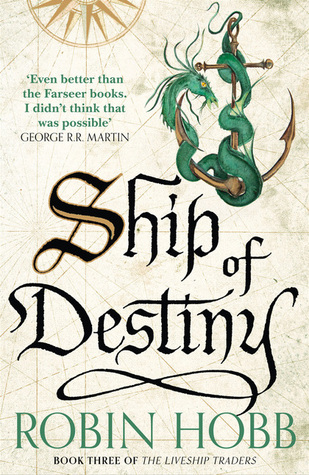
This, the third of Robin Hobb’s Liveship Traders novels, brings the trilogy to an exciting and satisfying conclusion. Having become quite attached to the characters and swept away by the story over the course of the three novels, I’m sorry to have come to the end – but I have to admit, I’m also happy that I’ve finished and can now move on to the Tawny Man books and rejoin old friends from Hobb’s Farseer trilogy. First, though, I need to post my thoughts on Ship of Destiny – and as this is a trilogy which really needs to be read in order, I can’t avoid spoiling elements of the previous two books here; if you think you might want to read them I would recommend going no further with this review until you’ve read both Ship of Magic and The Mad Ship.

Ship of Destiny picks up each of the trilogy’s many storylines from where they left off at the end of The Mad Ship. For much of the novel, our main characters are divided into small groups, each having separate adventures of their own, until fate eventually brings them together in a dramatic sequence of events which brings The Liveship Traders to a close.

First of all, there’s Malta, who has escaped from the aftermath of the earthquake in Trehaug and has found herself sailing down the hazardous Rain Wild River in the company of the childish and petulant Satrap of Jamaillia. Malta’s betrothed, Reyn Khuprus, is desperately searching for her, with the reluctant help of Tintaglia the dragon. Newly released from her cocoon, Tintaglia would prefer to be getting down to more important business, such as saving her species from extinction.

On board the liveship Paragon, Althea Vestrit, Brashen Trell and Amber the wood-carver are getting closer and closer to the Vivacia, the Vestrit family liveship which Althea has her heart set on reclaiming. But Vivacia has already bonded with her new captain, the pirate Kennit, and with Althea’s nephew Wintrow; Althea could be facing disappointment when she finally catches up with her beloved ship. Meanwhile, Ronica and Keffria are trying to rebuild and reform Bingtown following the Chalcedean invasion – but for this they will need the cooperation of Serilla, the Satrap’s Companion, whose priority seems to be to obtain power for herself.

When I wrote about The Mad Ship a few weeks ago, I mentioned that I was particularly intrigued by Amber, as she made me think of another character from the Farseer trilogy. That character, of course, is the Fool, and I was pleased to find that my suspicions were confirmed in this book. Amber recarves Paragon’s figurehead to resemble Fitz, there are discussions of destiny, and there are exchanges like this:

“You’d have to be a fool to think you could change the course of the whole world.”

She was silent until she broke out in a shaky laugh. “Oh, Paragon, in that you are more right than you know, my friend.”

Other characters continued to interest me too, particularly Malta. Who would have thought the annoying, selfish girl we met in the first book would mature so quickly and turn out to be such a shrewd negotiator? Kennit, on the other hand, goes from being a complex and strangely sympathetic character to a villain whose treatment of Althea and Paragon made me lose all respect for him – although I did find his final scenes in the book quite moving.

On reaching the end of The Liveship Traders, I didn’t feel as bereft as at the end of The Farseer trilogy, which I think is partly because, while there were plenty of characters I liked and cared about, I never felt as close to any of them as I did to Fitz. I was less emotionally involved with this trilogy, but I did still thoroughly enjoy it; I loved the world Robin Hobb created here and I was impressed by her ability to handle multiple storylines and keep track of who knows what! Also, as someone who doesn’t read a lot of fantasy, I found the dragon element fascinating, which is probably fortunate as if I’m going to continue working through Hobb’s novels I will eventually need to read The Rain Wild Chronicles which, judging by the titles, sound very dragon-heavy! First, though, I’m looking forward to the Tawny Man trilogy – I have my copy of the first book, Fool’s Errand, ready and waiting…

The Mad Ship by Robin Hobb

This is the second volume of Robin Hobb’s The Liveship Traders trilogy. I read the first one, Ship of Magic, earlier this summer and enjoyed it so much I couldn’t wait to move on to this one. As it’s a trilogy that really needs to be read in order, I have found it impossible to write about this book without spoiling the previous one, so be warned!

The Mad Ship continues to develop storylines begun in the first novel. When we last saw the Vestrit family’s liveship, the Vivacia, she had been captured by pirates far from her home port of Bingtown and her captain, Kyle Haven, had been defeated and injured. Captain Kennit, the pirate leader, is delighted to have taken possession of such a valuable ship, particularly as he is already beginning to bond with Vivacia, the liveship’s sentient figurehead. Also on board is Kyle’s son, Wintrow, who has Vestrit blood and finds himself competing with Kennit for the ship’s affections.

When news of Vivacia’s capture reaches the rest of the family, they must find a way to work together to rescue her and to bring home Kyle and Wintrow. This is easier said than done given the divisions and tensions within the Vestrit household! Althea Vestrit still believes that the Vivacia should rightfully belong to her rather than to her sister (and Kyle’s wife) Keffria, while spoiled, selfish Malta continues to cause trouble for her mother and grandmother. However, Malta is forced to grow up very quickly and through her relationship with Reyn Khuprus of the Rain Wilds, she has a chance to redeem herself in the eyes of her family.

Meanwhile, Brashen Trell and Amber the bead merchant have come up with a plan of their own to help Vivacia – one which involves relaunching Paragon, the old, abandoned liveship who is believed to be mad, having killed his crew many years earlier. Will their plan succeed or is the Vivacia lost to them forever?

Despite loving the first book, it took me a while to really get into this one, but I think it was simply suffering from being the second in a trilogy – there wasn’t the novelty of discovering a new world or the excitement of following the story to its conclusion. Halfway through, though, several of the storylines took a more dramatic turn and I found that I was absolutely riveted! So much happens in this book that I can’t possibly mention everything here; instead, I have just picked out a few of the things I found most notable.

* Dragons and serpents – What I loved most about this book was that we learn much, much more about the dragons and sea serpents and how they are connected with the wizardwood used in the construction of the liveships. In Ship of Magic, all the talk of ‘tangles’, ‘silver providers’ and ‘She Who Remembers’ had me completely mystified, but now the pieces of the puzzle are falling into place. Some links with the dragons from Robin Hobb’s Farseer Trilogy are also emerging and bearing in mind how much I loved those books it’s great to come across anything that ties the two together.

* Amber – There continues to be an aura of mystery surrounding Amber; so far we know almost nothing about her origins or how she came to be in Bingtown. Remembering a certain character in The Farseer Trilogy, I’m starting to have my suspicions about her, but I will wait and see if anything else is revealed in the next book.

* Magic – The magical elements in this book are particularly strong. Not only do we have dragons, sea serpents and talking figureheads, but with the dream sequences and the abilities of certain beings to enter the thoughts of others, I was reminded of the Skill and the Wit from The Farseer books. I also loved the descriptions of Trehaug, the Trader city on the Rain Wild River where the Khuprus family live.

* Malta – I didn’t like her at all in the previous novel and in the first half of this one she continued to annoy me, but later in the book there are signs that she is growing and developing as a person. She is just one of several strong female characters in the trilogy; I have already mentioned Amber, but Althea, Keffria, Ronica and Etta all interest me too.

There is so much more I could say about this book but, to be honest, I just wanted to get this post written quickly so that I could move straight on to the final volume, Ship of Destiny, in which I hope some more of my questions will be answered!

This is book 13/20 for my 20 Books of Summer challenge.

Ship of Magic by Robin Hobb

After finishing Robin Hobb’s wonderful Farseer trilogy in November 2014 I knew I wanted to read more of her books. I was desperate to find out what would happen next to the Farseer characters so it was tempting to go straight to her Tawny Man trilogy, but after looking at some recommended reading orders, I decided it would be better to read her other series, The Liveship Traders, first. If none of this means anything to you because you’re unfamiliar with Robin Hobb, rest assured that reading Ship of Magic does not require any knowledge of previous Hobb novels and I’ve avoided spoiling them in the rest of this post!

Ship of Magic is set in the same world as the Farseer books, but the action this time centres around Bingtown, a coastal community of traders and merchants governed by the highly respected Bingtown Trader families, descendants of the original settlers of those shores who came from the mysterious Rain Wilds. The Bingtown Traders have maintained their connections with those who remained in the Rain Wilds and as part of this alliance the Rain Wild Traders provide the Bingtown Traders with the means to build a liveship – a debt so large that it can take generations to be paid off. Why is a liveship so important? Well, it is built from wizardwood – a magical wood with a mind of its own – and is the only type of vessel which can travel safely up the hazardous Rain Wild River to trade in the magnificent, enchanted goods that are available there.

At the beginning of the novel, the Vestrit family’s liveship, the Vivacia, is about to ‘quicken’ – the term given to the process by which a wizardwood ship comes to life after three generations of the family have died on board. Althea Vestrit is devastated by her father’s death, but excited at the thought of taking over the captaincy of the ship. After all, she has spent her childhood accompanying her father on his voyages and, as a blood-member of the family, she is the one who could be expected to share a close bond with the newly quickened Vivacia. She is bitterly disappointed, then, when it emerges that her father has actually left the ship to Kyle Haven, her elder sister’s husband, a man who has no understanding of what is involved in commanding a liveship. Furious and heartbroken, Althea decides to leave home and go out into the world where she can prove herself as a sailor and one day regain control of the Vivacia.

The edition of Ship of Magic I read is over 800 pages long, so you won’t be surprised to hear that there is a lot more to the plot than I have talked about so far. I don’t want to go into too much detail here, but I would like to briefly mention some of the other storylines and characters. First there’s Wintrow, Kyle’s son, who is taken from the monastery where he was studying to be a priest and not at all happy about being forced to serve with his father on board the Vivacia. Then there’s Wintrow’s sister Malta, left at home with her mother and grandmother. Malta longs for excitement in her life – to be allowed to go to balls, to wear grown-up dresses and be courted by young men – and she can’t understand why her family are so determined to stop her. Finally, there’s Kennit, a pirate captain who dreams of becoming a pirate king and is sailing up and down the coast waiting for the chance to capture a liveship of his own.

I really enjoyed this book; although I certainly hadn’t intended to wait three years before reading it, I’m glad I didn’t pick it up immediately after finishing the last Farseer book when I would undoubtedly have just wanted more of the same story. There were times when I felt there was a little bit too much going on in this novel and too many characters to get to know – but for the most part, I thought they were worth knowing! The only characters I actively disliked were Kyle, Malta and one of Kyle’s crew members, Torg. The rest were interesting, nuanced and well written. I was particularly intrigued by Kennit, who in many ways is one of the villains of the book, but who does seem to have a conscience in the form of a wizardwood charm worn on his wrist. I’m also hoping to learn more about the wood-carver Amber and the abandoned liveship Paragon in the next book.

The title of that next novel is The Mad Ship and I have included it on my 20 Books of Summer list, so expect to hear all about it soon!